

The question of how the political values and attitudes of young people are formed has come up frequently in recent posts. This question is especially interesting in the case of the rise of far-right parties in Germany, including especially the AfD. What is of particular interest is that there seem to be several divisions at work in Germany when it comes to support for far-right politics and ideologies: region (east-west), gender, sector (urban-rural), and cohort (Gen Z versus millennials and boomers). Answering the question of the mechanisms and cultural/social circumstances that led to the growth of far-right attitudes among young people is urgent if we are to address the threat to democracy that this poses.
Rolf Frankenberger is a research expert at the Institute for Research on Right-Wing Extremism at the University of Tübingen, and his recent report in the Conversation (link) is very interesting. Most striking is the map he reproduces recording support for AfD by municipality in the 2024 European elections in Germany.
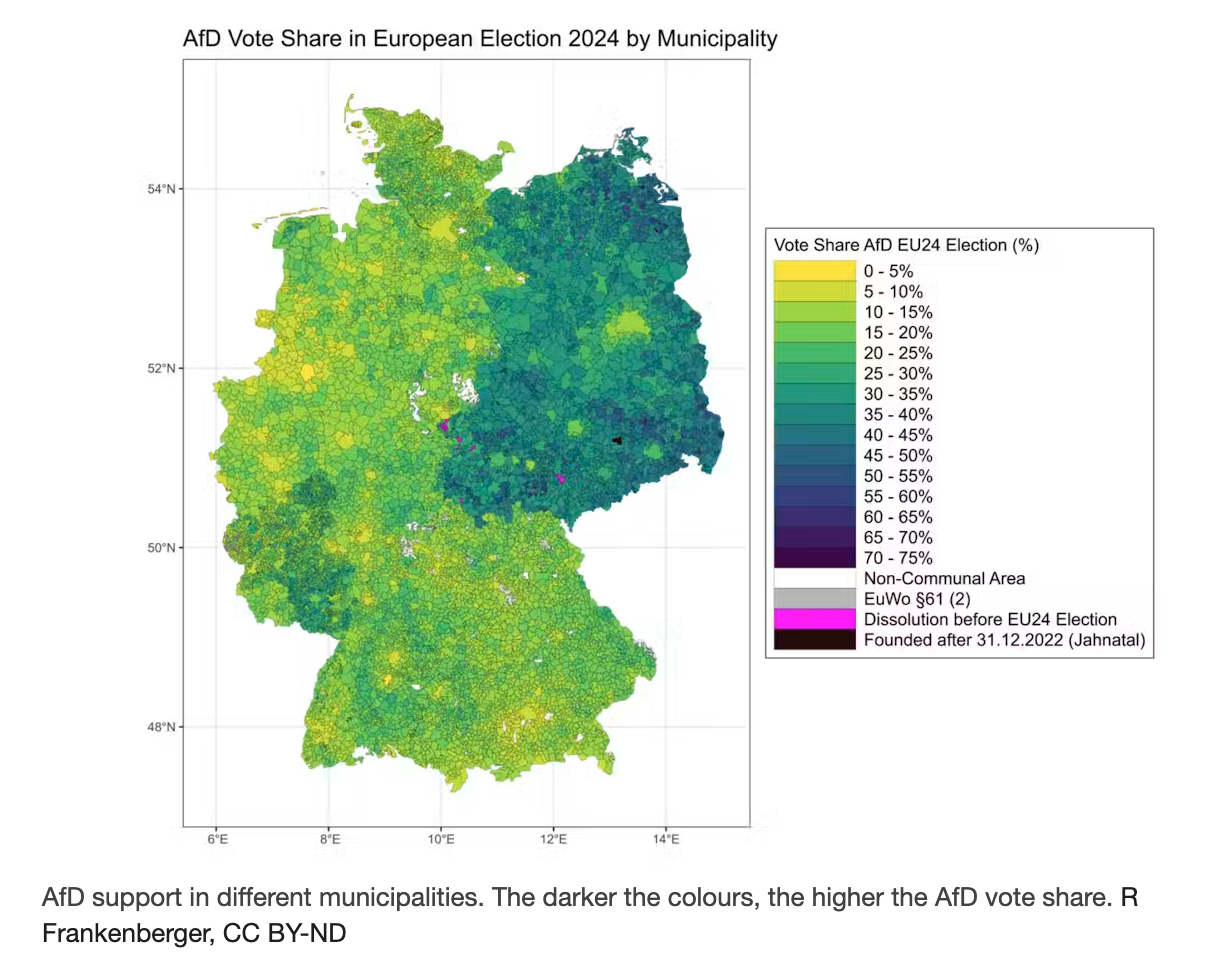
The geographical distribution of support for AfD is striking. It is concentrated in precisely the pre-unification states of the German Democratic Republic (GDR). Here is a map of East and West Germany from 1980.
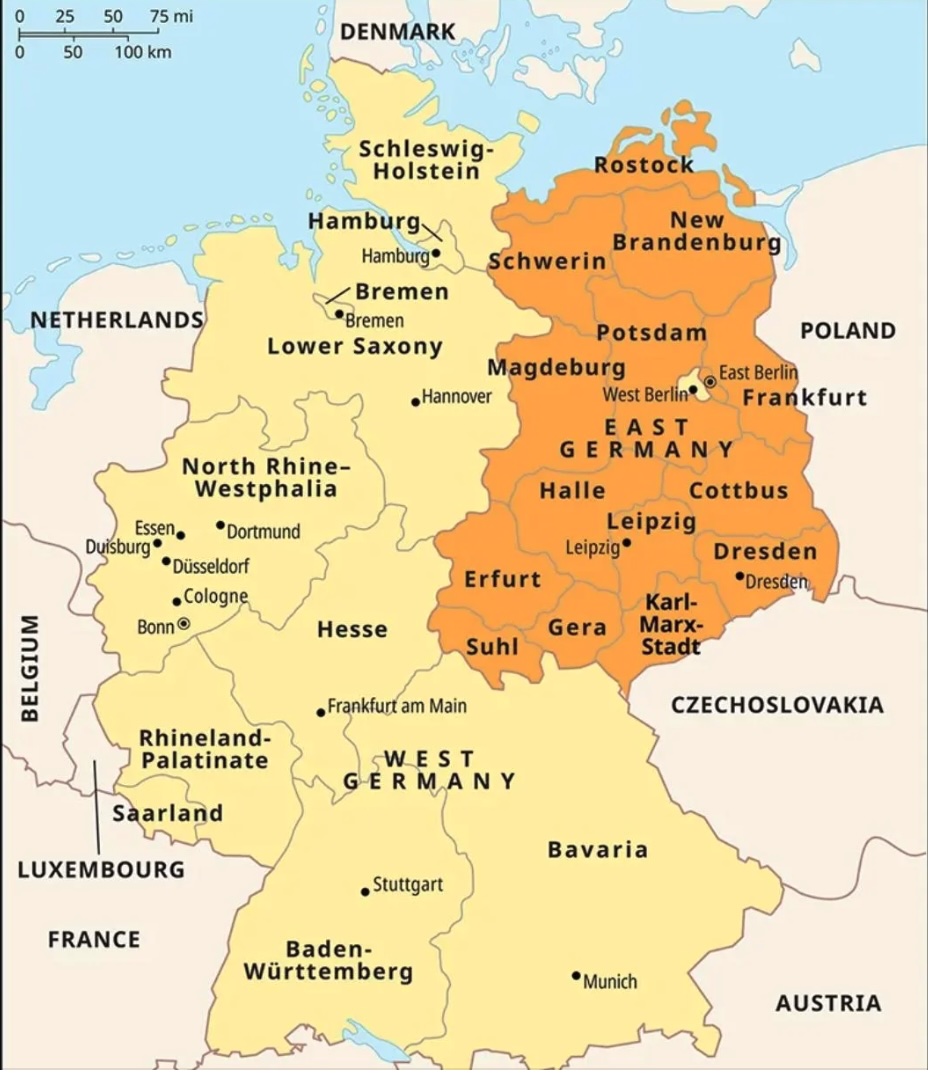
To many observers, the most significant change in life for German people in the past fifty years is the reunification of Germany that occurred in 1990. And the lives of young people in the east changed much more dramatically than their counterparts in the west.
Frankenberger wants to understand the mechanisms leading to risinig support for the far right. However, he emphasizes a different factor than the reunification issues: the divide between urban and rural social life.
A new division has emerged as a result between the urban and the rural. The two are more than just forms of settlements – they reflect ideals, values and lifestyles. Those who live in towns and cities lead almost entirely different lives to those who live in the countryside.
Frankenberger pinpoints a clash of cultures as a key to the rise of support for the far right. On his view, rural people are increasingly likely to be mobilized around what has been portrayed as “threats” to their traditional ways of life. Even solar-power windmills are hated, according to Frankenberger, because they disrupt the countryside for the benefit of “modern” urban dwellers. And on the other side of the coin, urban dwellers are better educated, more economically mobile, and less attracted to the ideologies of the far right.
Here is Frankenberger’s presentation of the variation in support for AfD in Baden-Württemberg. In general the region produces a lower level of support for AfD; but Frankenberger emphasizes the variation across the state. Rural areas have produced significantly higher levels of support for AfD than urban areas, even in this state that was part of West Germany in 1980.
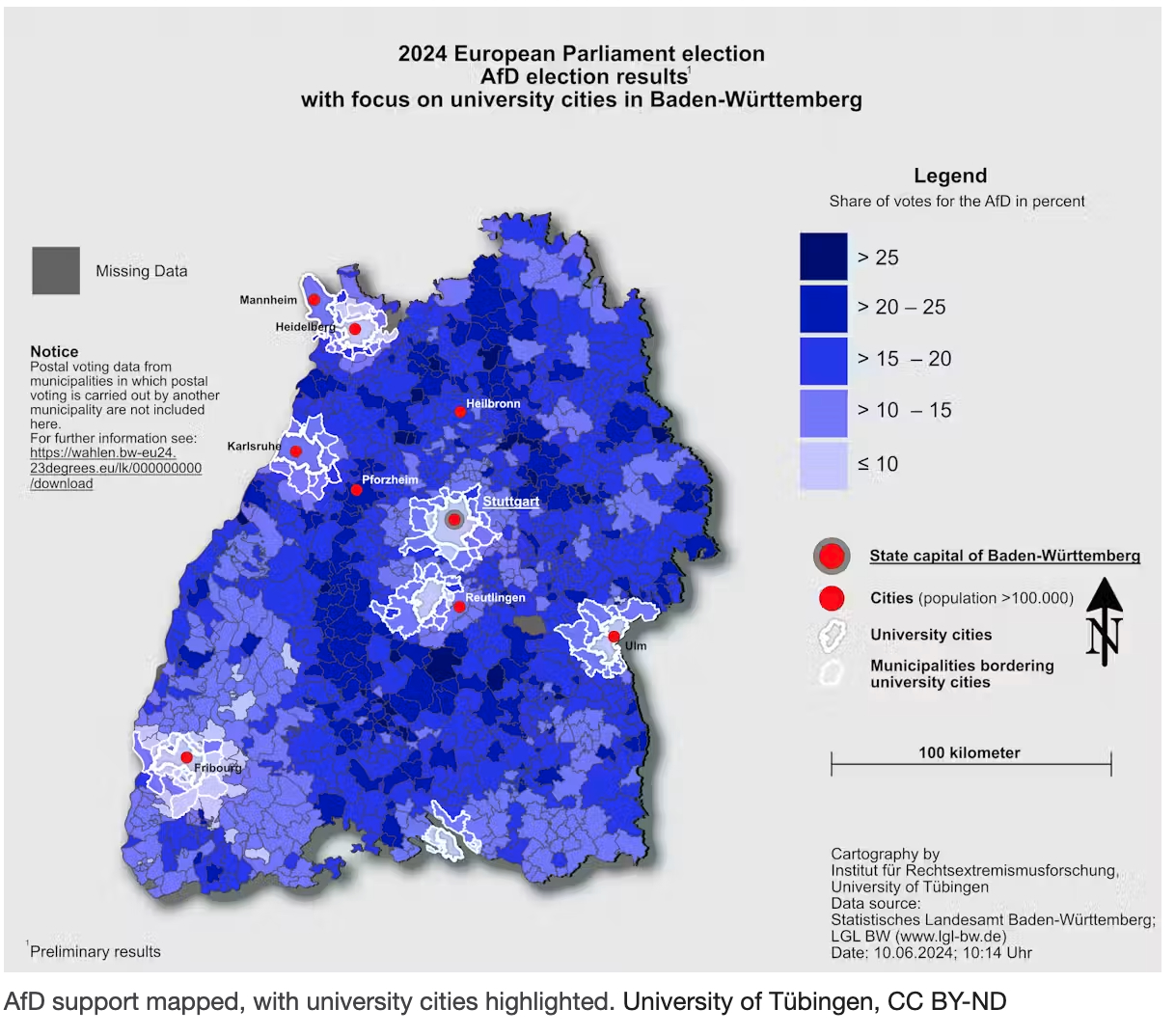
And he emphasizes the cultural conservatism of the rural areas in this region.
The Black Forest, the Swabian Forest, and Hohenlohe also have quite strong protestant and evangelical communities, which are strongholds of traditional family life, customs and traditions.
The impact of the university cities in the distribution of political attitudes across this map is visible and extensive. Each university city demonstrates less than 10% support for AfD, with the highest levels of support occurring in rural and forest areas exceeding 25%.
Frankenberger does not address the smoking gun in the first map above, however. This is the stark difference in patterns of support across the earlier political divide between the Federal Republic and the GDR. This divide seems to overshadow the urban-rural differences singled out here and to demand explanation. What accounts for the much higher level of support for far-right parties, including especially the AfD, by citizens from the former GDR? This question demands close attention. Was it deindustrialization? Was it abrupt “modernization” and erosion of traditional village and rural life? Was it an emerging trend in which women had different and better opportunities than men?
Another issue not addressed here is the gender gap in support for AfD in Germany. In recent elections a substantially higher percent of German men support AfD than women (26% against 11% in one recent poll). What explains this gap? Sabine Volk, another researcher at the Tübingen Institute, has addressed the role of antifeminism in the rise of the AfD and its particular intensity in the east in “The AfD and Antifeminism in Germany, 2014–2025: Family First, Trans Panic Second” (link). Again, this disparity between young men and young women in their political attitudes demands explanation.
Underlying all of these disparities is the urgent need to provide an account of the connection between events in the 1990s and the formation of political attitudes and values in German men and women who became adolescents and young adults after reunification.
And there is a second hanging question as well: why have other European countries (for example, Poland, Sweden, Russia, France, the Netherlands, or Italy) developed a cohort of young people in the same generation who seem to embrace very similar far-right political attitudes, even though their formative circumstances were quite different from those experienced in the former GDR region?
Here is a DW profile of one young far-right recruit (link). The video highlights a need for belonging experienced by young men, and offers a discussion of the roots of misogyny and the impact of social media and YouTube right-wing influencers.
No comments:
Post a Comment