

There is a view in the United States that impactful racial discrimination has declined significantly over time. This view flies in the face of an afternoon’s walk through Detroit, the south side of Chicago, or the Bronx, where racial segregation in housing and the disadvantages that flow from that system are evident. But what is the social-scientific evidence concerning the current situation of race-based discrimination?
This is a question that rigorous quantitative sociologists have studied in the past several decades, and the results are dismal. Consider the research agenda of Lincoln Quillian and his collaborators over that period of time (link). Researchers have studied race-based discrimination in employment using field experiments to test the relative success of equally qualified applicants in thousands of job applications. The experiments take two forms: correspondence tests (where fictitious resumés are paired with equivalent credentials but differing in signals indicating the race of the candidate) and audit tests (where pairs of job applicants played by trained actors are presented for in-person applications or interviews). Here is how Lincoln Quillian describes the procedure for in-person audits:
For in-person audits, researchers send teams of trained actors to apply for the same job vacancies (e.g., Attström 2007; Pager et al. 2009). Each team includes at least one actor belonging to the native or dominant racial group and another from a racial minority group. Teams are assigned equivalent fictitious employment credentials like education, training and previous experience. The majority and minority actors undergo a period of training that involves practice calls to employers, mock interviews and standardizing candidate responses to interview questions (Bendick et al. 2010). Actors are matched based on physical appearance, age and demeanor. In-person audit studies usually rely on at least two signals about the applicant’s race: the applicant’s name in the resume and the applicant’s in-person and physical appearance. (Quillian et al 2020 link : 734)
The experimenter then records the number of candidates by race who are “called back” for a subsequent interview. In an entirely race-blind world we would expect the callback rate to be approximately the same for “white” and “black” candidates; but almost all field experiments with this design show the opposite result.
Quillian and his colleagues conducted a major meta-study of virtually all existing field experiments on employment discrimination. In addition, he and his colleagues assessed the level of discrimination that occurs at the next stage of employment, the step from callback to job offer. In “Evidence from Field Experiments in Hiring Shows Substantial Additional Racial Discrimination after the Callback” Quillian, Lee, and Oliver (link) find that the level of discrimination from callback to job offer is even greater than that between application and callback. “Our results indicate that substantial, additional racial discrimination occurs even after minority candidates make it to the interview stage. Because of this, studies that only use callbacks seriously underestimate the complete extent of discrimination in the hiring process” (734). Here is a summary of their findings:
We begin with a basic meta-analysis of the level of discrimination at different stages. Results of the meta-analysis for each stage are shown in Figure 2 and Table 2 Panels A and B. For our sample of twelve studies, the results indicate that majority applicants receive 53% more callbacks than equally qualified minority applicants on average (discrimination ratio of 1.534; 95% confidence interval of 1.33–1.78).
What happens after the callback? The discrimination ratio for job offers conditional on receiving a callback (i.e., only for applicants who made it to the interview stage) is 1.53418; this indicates that even when both candidates receive an interview, majority applicants still receive about 50% more job offers than comparable minority applicants. Looking at the overall level of discrimination in job offers, majority applicants receive about 145% more job offers than comparable minority applicants (discrimination ratio of 2.450, 95% confidence interval of 1.68–3.57). The difference between the callback discrimination ratio and the unconditional (or overall) job offer discrimination ratio is statistically significant at p < 0.05 (shown in Panel B of Table 2). These results indicate that there is a considerable degree of additional discrimination against racial minorities as they move from callback to job offer. The point estimates suggest that minority candidates experience an average more than twice as much discrimination overall in the job offer outcome as in the callback outcome. (747-748)
Here is a graph summarizing the findings of their meta-analysis of all studies that include callback-job offer data.
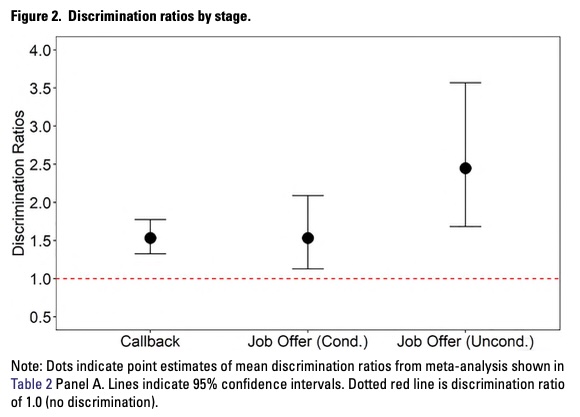
These are striking and apartheid-like conclusions. Here is the most salient point: “Looking at the overall level of discrimination in job offers, majority applicants receive about 145% more job offers than comparable minority applicants”. Out of 1000 white applicants and 1000 equally well-qualified black applicants, close to 2.5 times as many white applicants will receive job offers as black applicants. Assume there are 350 positions to be offered; this implies that 100 black applicants will receive an offer, compared to 250 white applicants — all equally qualified. By any measure, this is an enormous level of discrimination in employment.
What are the mechanisms that underlie these highly discriminatory results? Two observations in the article are suggestive:
Discrimination by employers does not appear to function in a categorical way, in which employers who know the race or ethnicity of an applicant pre-callback automatically rule out minority applicants in favor of equally qualified majority applicants. Instead, racial discrimination in hiring has a probabilistic character across stages of hiring, in which minority applicants are less likely to advance at each stage. (753)
So — no evidence of widespread “categorical” discrimination in these studies. But second, Quillian et al suggest that implicit bias is an important mechanism of discrimination by race, and they note that this factor may be even more important in face-to-face interactions:
The preferences underpinning taste-based discrimination can encompass many specific forms of racism and prejudice. For instance, employers may hold prejudices against racial and ethnic minorities rooted in suspicions of or hostility toward foreign cultural norms, values or attitudes (Pager and Shepherd 2008). On the other hand, biases that affect hiring may be unconscious, as demonstrated by studies of “implicit” racial attitudes. (735)
Many tests for implicit attitudes such as the Implicit Attitudes Test (IAT) use images of individuals from different racial and ethnic groups, which suggests that the general salience of race might be heightened in the context of face-to-face interactions. (736)
This is enormously important research in a time when the pressure on efforts to reduce and eliminate racism is even greater than the Jim Crow years, if that is possible. The field studies reported here, and the meta-analysis offered by Lincoln Quillian and his colleagues, are a wake-up call. The work is highly rigorous, and the results are unambiguous: racial discrimination in employment is substantial today, and it has not decreased over the past twenty-five years.
And what does this say to the young black man or woman leaving high school, community college, or university about their future? It provides a very bleak picture. The idea that the US economy embodies a “meritocracy” in which each individual reaches a level of achievement determined by experience, education, training, and discipline and nothing else is a self-pleasing fantasy for the majority, and a cruel and obvious lie for the minority.
(Here is a very good summary of the recent research methods and findings involved in Quillian’s research in the Harvard Business Review; link.)

No comments:
Post a Comment