

Milan Obaidi is a prolific Danish social psychologist who has worked extensively on right-wing extremism. His scientific publications provide greater detail on his emerging views of the psychology of extremism. A useful document for the ongoing discussion of the mechanisms of right-wing extremism here is a well-documented 2020 summary of findings in the field of the social psychology of right-wing extremism here. The title is descriptive: “What are the psychological characteristics of people holding far-right beliefs?”. In this summary research report Obaidi singles out a handful of psychological characteristics that are associated with receptiveness to extremist beliefs and actions.
- Avoidance of uncertainty or ambiguity
- Rigid mindset
- “Significance quest theory” (SQT)
- Psychological distress and perceived deprivation
- Need for cognitive closure
There is a substantial amount of overlap between these characteristics and the BUC(k)ET theory offered by Susan Fiske and Shelley Taylor (link), and it connects to Arie Kruglanski’s 3N theory of the psychology of hate-based extremism as well (Needs, Narratives, Networks). The quest for meaning, the desire for certainty (cognitive closure), and the emotional discomfort with uncertainty and ambiguity all align with Fiske and Taylor’s framework. And like the researchers who have developed the theory of Social Dominance Orientation (link), Obaidi’s account emphasizes a desire for maintaining an “in-group, out-group” division of society in which the extremist individual is in the dominant group. This corresponds to a perverse quest for “belonging” in the sense described by Fiske and Taylor.
Obaidi and his research collaborators have offered an ambitious attempt to unify several lines of thought in social psychology about right-wing extremism.
[Obaidi, Milan; Robin Bergh; Simon Ozer; and Cornelia Sindermann, 2025, “Toward an Integrated Psychological Model of Violent Extremism,” European Review of Social Psychology: 1-50. ]
Here is the abstract of their paper:
ABSTRACT The global threat of violent extremism (VE) has intensified in recent years, evidenced by a significant increase in violent incidents. Despite numerous theoretical and empirical explanations across disciplines, a lack of cross-fertilisation between these research domains has hindered the development of a comprehensive understanding of VE. To bridge this gap, this review integrates diverse lines of research into a comprehensive psychological model of VE, synthesising objective situations, subjective appraisals, and key individual psychological factors contributing to VE inclinations. We aim to develop a framework that more precisely demonstrates how these variables fit together, highlighting the added value of integration over piecemeal investigations. We specifically advocate for a multilevel approach that incorporates predictors from various levels of analysis to provide detailed mechanisms for how these variables relate to and complement one another. We further illuminate a multitude of mediation and moderation effects, some already tested empirically, while others await future research.
As the abstract emphasizes, their goal is to integrate “objective situations, subjective appraisals, and key individual psychological factors contributing to VE inclinations”, which they believe have been largely distinct research topics in past studies of violent extremism. They emphasize that they offer a multi-level analysis of the emergence of violent extremism, which includes information about surrounding social and economic conditions, prevalent ideologies, and individual psychological differences.
The focus on violent extremism requires some comment, since it is likely enough that the large majority of right-wing extremist young people in the US and other democracies draw the line at violence against others. The violent extremists in the United States (like the Michigan Wolverine militia group accused of planning to kidnap Michigan’s governor, or members of the Base, a clandestine terrorist group) are a minority of the right-wing movement (or so one would hope). So how much of the research described here can be applied to the broader group of young people who are “all in” for racist language, discrimination, taunting, and other harmful acts, without crossing the threshold of attacking a church, synagogue, or supermarket? Are non-violent right-wing extremists pretty much the same as violent right-wing extremists, except the latter group has a lower threshold for committing acts of violence? At various points Obaidi and his co-authors make it clear that their ultimate interest is in explaining the factors leading to the violent incidents, not the routine hate-based activism contributing to episodes like the “Young Republican chat channel” scandal of 2025, and this suggests the possibility that there may be important differences between the actively violent members of the far right and the ideological adherents.
Another valuable contribution made by Obaidi and his collaborators is a major empirical research project on the effects of Great Replacement Theory.
[Milan Obaidi, Jonas Kunst, Simon Ozer, and Sasha Y. Kimel, “The ‘Great Replacement’ conspiracy: How the perceived ousting of Whites can evoke violent extremism and Islamophobia” (Group Processes & Intergroup Relations 2022, 25(7) 1675 –1695).]
This research treats the “Great Replacement” conspiracy theory as an incendiary issue currently being used to bring adherents and violent activists into antagonism and violence against other racial groups in the US and Europe, and these investigators attempt to provide empirical evidence concerning the population effects of this conspiracy theory. Here is the abstract for the article:
ABSTRACT Increased immigration and demographic changes have not only resulted in political pushback, but also in violent attacks against immigrants. Several recent terrorist attacks committed by White supremacists invoke rhetoric around a deliberate attempt to make Whites extinct and replace them with non-Western immigrants. Yet, while it is widely acknowledged among extremism researchers that this perception of orchestrated extinction or replacement has tremendous potential to lead to violent extremism, its consequences have not yet been directly examined. Using the Scandinavian context (e.g., Denmark and Norway), in two correlational studies and one experiment, we provide evidence that this perception is associated with the persecution of Muslims, violent intentions, and Islamophobia. Further, we demonstrate that these associations are mediated by symbolic threats. Conspiracy beliefs that one’s group is being replaced seem to drive hostile intergroup attitudes. We discuss the societal implications of this finding (i.e., generating fear, polarization, and hostile public opinion towards immigrants).
An important part of their analysis is their view that this conspiracy theory of “White extinction” is a deliberate strategic effort to show that some “enemy” intends to harm the white Christian population of the United States, and to use the spreading myth as a call to action by far-right leaders and activists. In particular, they call out Stephen Miller’s use of “Great Replacement Theory” to create support for his extremist strategies of expulsion for large numbers of the US immigrant community:
For example, recently leaked emails show the former White House senior advisor Stephen Miller promoting far-right extremist, White nationalist ideas, and anti-immigrant rhetoric through the conservative website Breitbart. Importantly too, he appeared fixated on the prospect of a “White genocide” (i.e., a conspiracy theory associated with White supremacists propagating the idea that the White race is dying due to growing non-White populations; Bellware, 2019). (1676)
Key to their interpretation of this conspiracy theory is the idea that the demographic shifts the US is experiencing are the result of deliberate efforts and actions by nefarious agents to bring about the decline of the white Christian population. The authors note that the same themes are being used in populist and right-wing extremist organizations and networks to stimulate fear and antagonism between “native” Europeans and immigrant people, often Muslim.
In recent years, the “Great Replacement” conspiracy has not only gained prominence among right-wing extremists but has also found a foothold among right-wing populist political parties in Europe. For example, while evoking anti-Muslim and anti-immigrant sentiment, such ideas have been espoused by the former leader of the Danish People’s Party Pia Kjærsgaard, the Prime Minister of Hungary Viktor Orbán, the Italian Interior Minister Matteo Salvini, and the leader of the far-right movement Rassemblement National Marine Le Pen (Alduy, 2017; Kingsley, 2019; Kjærsgaard, 2020). Various conservative intellectuals and far-right organizations have also utilized language that stokes fear about the decline of the “White race” and “White identity.” (1677)
Obaidi et al connect this use of the Great Replacement myth to the 3N theory of radicalization offered by David Webber and Arie Kruglanski. This is a theory of social mobilization based on three large factors — Needs, Narratives, and Networks, with a strong emphasis on the “quest for significance” on the part of potential followers.
[Webber, David and Arie W. Kruglanski. 2017. “Psychological Factors in Radicalization: A ‘3N’ Approach,” Handbook of the Criminology of Terrorism, eds. Gary LaFree and Joshua Freilich, Wiley Blackwell, 33-46.]
Here again it is worth noticing the convergence of this line of thought with that of Susan Fiske and Shelley Taylor in developing their BUC(k)ET model of cognitive and moral development discussed in an earlier post (link). The Great Replacement myth contributes to all of the core needs discussed by Fiske and Taylor: belonging, understanding, controlling, enhancing self, and trusting in-group.
What about the methodology used in these studies? Like Lior Zmigrod and her co-authors discussed in a previous post (link), Obaidi’s research methods are largely quantitative and statistical based on interview and survey data for about 100 subjects. The research goal is to provide a strong empirical basis for making claims about the causal relationships among variables. Here is a summary of some of the findings offered in the Great Replacement paper:
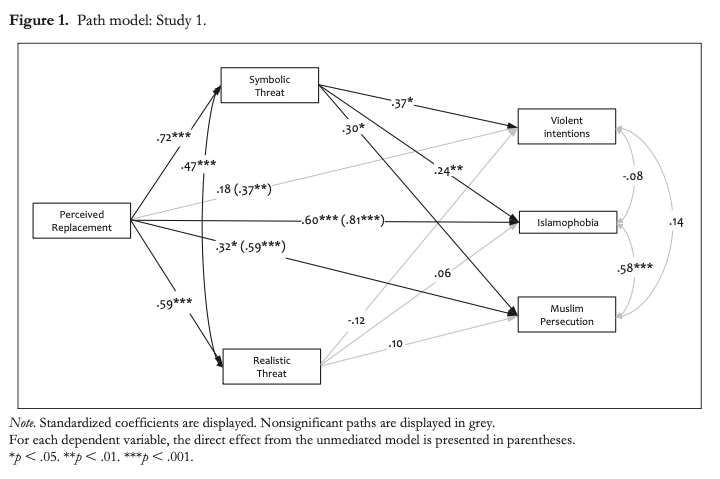
Do these findings have important implications for the future of inter-group violence in liberal democracies? Obaidi and his co-authors believe they do:
It has been suggested that immigration-related conspiracy theories trafficked by right-wing groups may nurture hate and violence against immigrants and asylum seekers in the West. Moreover, recent FBI documents predict that right-wing, conspiracy-driven extremism will increase in the next few years (Steinbuch, 2019). Indeed, new reports indicate that far-right terrorism has significantly outpaced other forms of terrorism (Jones et al., 2020). More specifically, right-wing terrorist incidents in the West have increased by 320% over the past 5 years (Institute for Economics & Peace, 2019). One of the most potent conspiracy theories evoked by right-wing extremists, politicians, and commentators is the “Great Replacement”—the conspiracy arguing that there is an attempt to replace the White autochthonous population with non-Western immigrants. (1687)
These are highly suggestive conclusions, and the research is very interesting. However, it would be useful to have a more extensive theoretical basis for linking the empirical results to a theory of the underlying psychological processes that generate them. Obaidi’s reference in the earlier paper to “objective situations, subjective appraisals, and key individual psychological factors contributing to VE inclinations” remains fairly vague. (This is perhaps predictable in a research program that is focused almost exclusively on identifying discrete operationalized variables that can be separately measured.) So once again, we are faced with the question: what processes and internal factors create attitudes of racist extremism among young people?
(The Southern Poverty Law Center 2024 report on White Nationalist organizations and activism in the US is detailed and alarming, and is very relevant to the findings discussed here; link.)


