Showing posts with label fascism. Show all posts

Friday, June 26, 2026

Far-right support in Germany


The question of how the political values and attitudes of young people are formed has come up frequently in recent posts. This question is especially interesting in the case of the rise of far-right parties in Germany, including especially the AfD. What is of particular interest is that there seem to be several divisions at work in Germany when it comes to support for far-right politics and ideologies: region (east-west), gender, sector (urban-rural), and cohort (Gen Z versus millennials and boomers). Answering the question of the mechanisms and cultural/social circumstances that led to the growth of far-right attitudes among young people is urgent if we are to address the threat to democracy that this poses.

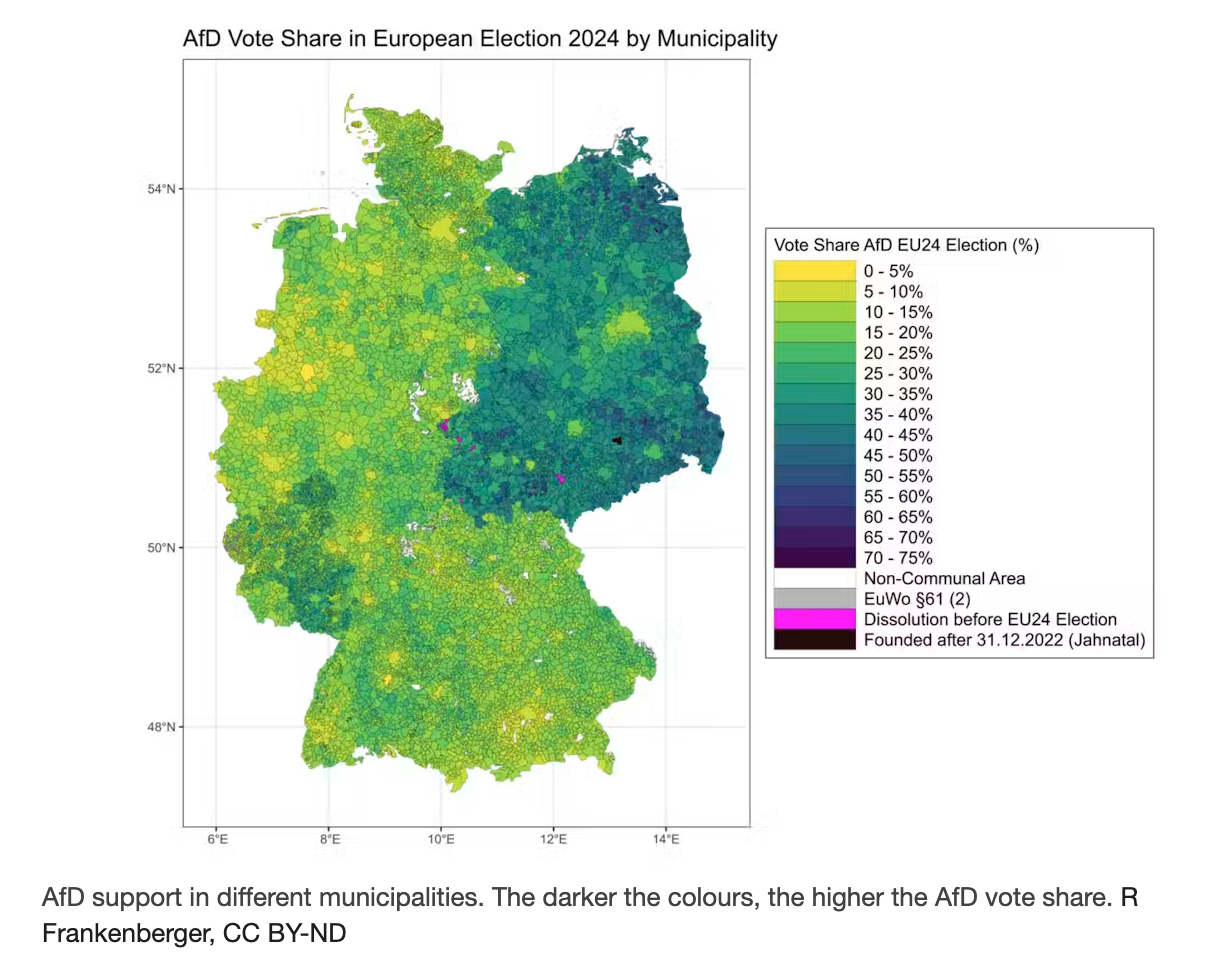
Rolf Frankenberger is a research expert at the Institute for Research on Right-Wing Extremism at the University of Tübingen, and his recent report in the Conversation (link) is very interesting. Most striking is the map he reproduces recording support for AfD by municipality in the 2024 European elections in Germany.

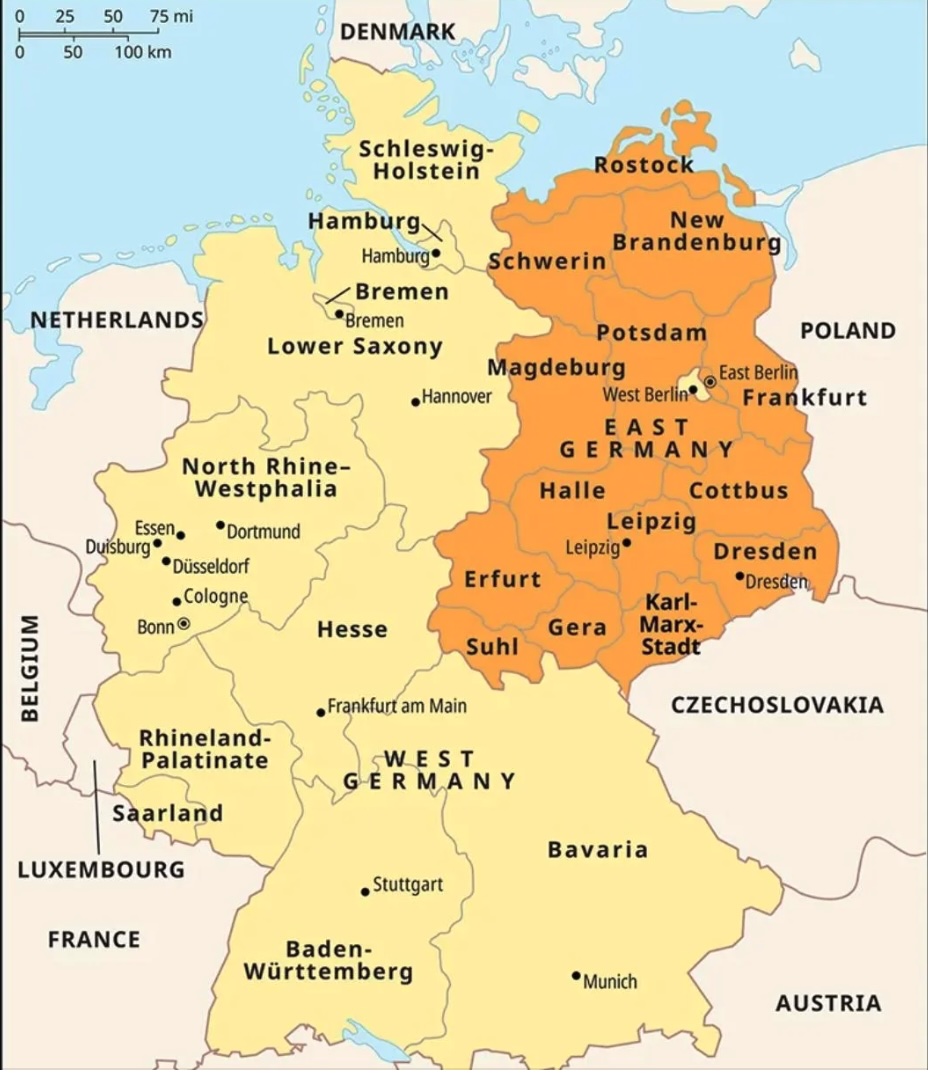
The geographical distribution of support for AfD is striking. It is concentrated in precisely the pre-unification states of the German Democratic Republic (GDR). Here is a map of East and West Germany from 1980.

To many observers, the most significant change in life for German people in the past fifty years is the reunification of Germany that occurred in 1990. And the lives of young people in the east changed much more dramatically than their counterparts in the west.

Frankenberger wants to understand the mechanisms leading to risinig support for the far right. However, he emphasizes a different factor than the reunification issues: the divide between urban and rural social life.

A new division has emerged as a result between the urban and the rural. The two are more than just forms of settlements – they reflect ideals, values and lifestyles. Those who live in towns and cities lead almost entirely different lives to those who live in the countryside.

Frankenberger pinpoints a clash of cultures as a key to the rise of support for the far right. On his view, rural people are increasingly likely to be mobilized around what has been portrayed as “threats” to their traditional ways of life. Even solar-power windmills are hated, according to Frankenberger, because they disrupt the countryside for the benefit of “modern” urban dwellers. And on the other side of the coin, urban dwellers are better educated, more economically mobile, and less attracted to the ideologies of the far right.

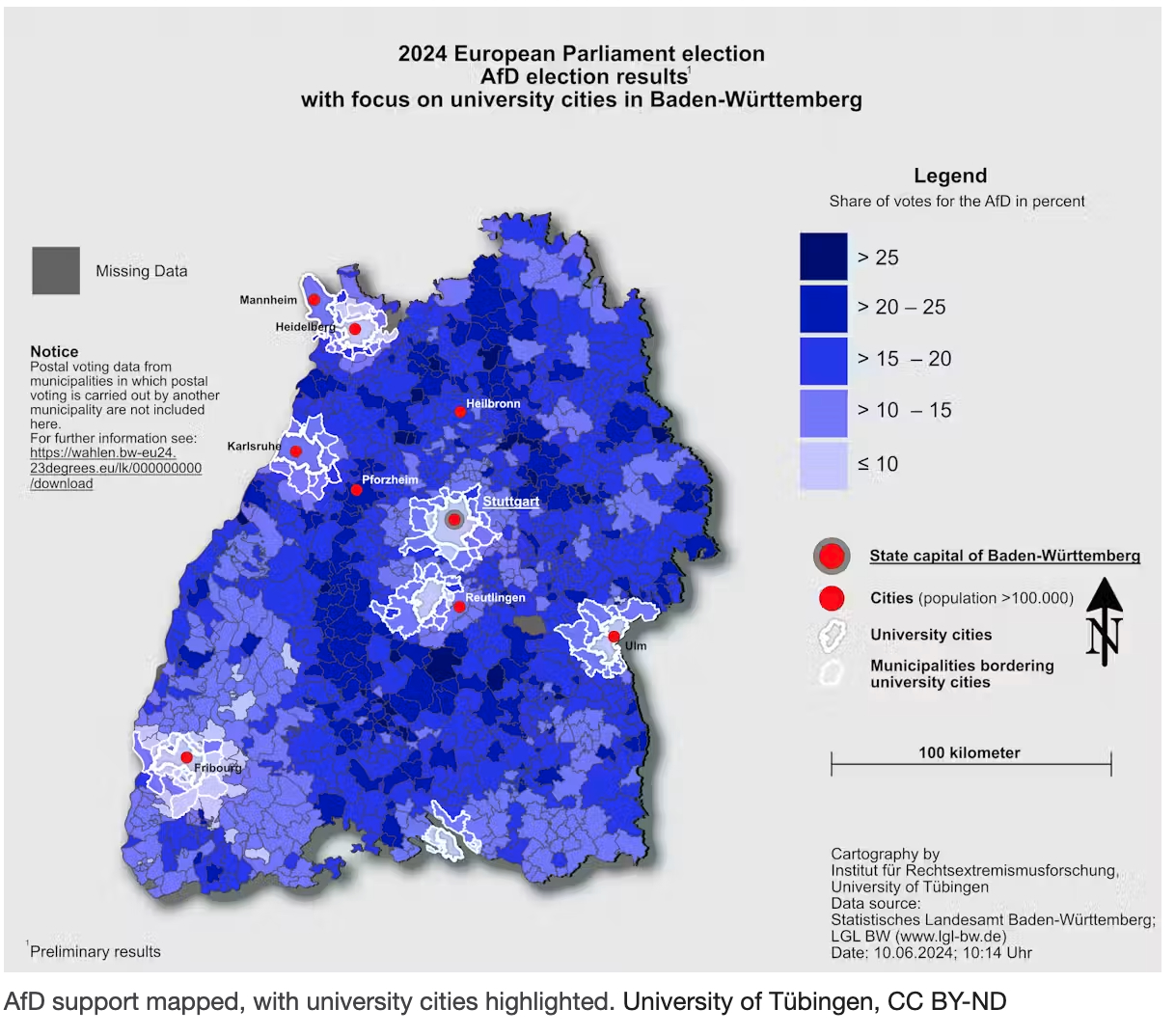
Here is Frankenberger’s presentation of the variation in support for AfD in Baden-Württemberg. In general the region produces a lower level of support for AfD; but Frankenberger emphasizes the variation across the state. Rural areas have produced significantly higher levels of support for AfD than urban areas, even in this state that was part of West Germany in 1980.

And he emphasizes the cultural conservatism of the rural areas in this region.

The Black Forest, the Swabian Forest, and Hohenlohe also have quite strong protestant and evangelical communities, which are strongholds of traditional family life, customs and traditions.

The impact of the university cities in the distribution of political attitudes across this map is visible and extensive. Each university city demonstrates less than 10% support for AfD, with the highest levels of support occurring in rural and forest areas exceeding 25%.

Frankenberger does not address the smoking gun in the first map above, however. This is the stark difference in patterns of support across the earlier political divide between the Federal Republic and the GDR. This divide seems to overshadow the urban-rural differences singled out here and to demand explanation. What accounts for the much higher level of support for far-right parties, including especially the AfD, by citizens from the former GDR? This question demands close attention. Was it deindustrialization? Was it abrupt “modernization” and erosion of traditional village and rural life? Was it an emerging trend in which women had different and better opportunities than men?

Another issue not addressed here is the gender gap in support for AfD in Germany. In recent elections a substantially higher percent of German men support AfD than women (26% against 11% in one recent poll). What explains this gap? Sabine Volk, another researcher at the Tübingen Institute, has addressed the role of antifeminism in the rise of the AfD and its particular intensity in the east in “The AfD and Antifeminism in Germany, 2014–2025: Family First, Trans Panic Second” (link). Again, this disparity between young men and young women in their political attitudes demands explanation.

Underlying all of these disparities is the urgent need to provide an account of the connection between events in the 1990s and the formation of political attitudes and values in German men and women who became adolescents and young adults after reunification.

And there is a second hanging question as well: why have other European countries (for example, Poland, Sweden, Russia, France, the Netherlands, or Italy) developed a cohort of young people in the same generation who seem to embrace very similar far-right political attitudes, even though their formative circumstances were quite different from those experienced in the former GDR region?

Here is a DW profile of one young far-right recruit (link). The video highlights a need for belonging experienced by young men, and offers a discussion of the roots of misogyny and the impact of social media and YouTube right-wing influencers.


Sunday, May 10, 2026

A more pluralistic analytical sociology


A central theme in
 Rethinking Analytical Sociology is my concern that the founders of analytical sociology presented the field as a general and universally applicable approach to sociological research. Associated with this claim is what I called “ABM fundamentalism” — the view that computational models could and should be applied to all sociological research problems. Against these views, I argued in Rethinking Analytical Sociology that analytical sociologists should take a more pluralistic and collaborative approach to other research methods in sociology, including institutional and organizational sociology and comparative historical sociology.

In March I presented some of these ideas online at the Institute for Analytic Sociology in Sweden, and in April I had the chance to make several specific arguments on this subject to small groups of students and faculty in Como and Torino, with lively discussions following. In Como I focused on the need for a much more nuanced and “thick” theory of the actor, using the example of the US civil rights movement and the current surge of right-wing extremism in many liberal democracies. In Torino I focused on organizations as “meso-level” social entities with dynamic and relatively autonomous causal properties. This is a view rejected by the founders of analytic sociology, who champion a generativist view of the social world that leaves no place for relatively autonomous meso-level social entities. Attributions of apparent causal properties to meso-level structure should ideally be replaced with the individual-level mechanisms that constitute these properties. I argued that this position makes it impossible to explain the sociology of episodes like the Montgomery bus boycott, where dynamic organizations played a crucial role in bringing about the course of events. Doug McAdam’s detailed historical sociology of the period does a great job of uncovering the multi-level dynamics involved over the thirteen months of the ultimately successful boycott, whereas no “generativist” account leading from grievances to a sustained social movement has come close.

The comments I received from analytical sociologists at the Torino talk suggested that I’ve overstated both the commitment to methodological individualism and the rejection of social structures at the heart of analytical sociology. The commentators suggested that practitioners are more open-minded about research methods than I suggest, less committed to generativism, and very open to collaboration with sociologists who proceed from different premises. And agent-based modeling is just a tool, not a way of treating every sociological puzzle.

I don’t think I’ve overstated the core ideas of the “manifesto” of analytical sociology, as put forward by Hedström, Demeulenaere, and Manzo. And Joshua Epstein’s dogmatism about generativist social science stands unparalleled. But I’m very glad to hear that the discussants from the Gen Z generation of sociologists in this tradition are more open to pluralism in methods and approaches. I suggested to them that the time is right for a new manifesto, one which is explicitly open to a range of research approaches. This would mean at least three things: recognizing the need for thicker descriptions of actors, recognizing the causal importance of mid-level social entities like organizations, and abandoning the commitment to generativism as the sole legitimate model of explanation. And most importantly, it would emphasize the synergy that results from collaboration with other research approaches within sociology when treating a complex and extended social process.

As for computational tools like agent-based modeling — perhaps the most an updated manifesto should say about the relevance of agent-based simulation techniques is that they are valuable but limited tools for exploring some of the dynamics of the assumptions we make about inter-agent influence in the setting of mobilization and activization around a set of grievances and demands.

What does this leave from the original premises of AS? It leaves a commitment to empirical rigor, a preference for “theories of the middle range”, an insistence on the importance of discovering causal mechanisms, and a special interest in computational models of simple agent-based processes. This no longer looks like a declaration of a new and general approach to all sociological research — a claim invoked in the earlier manifestos for analytical sociology — but it looks like a much less constraining set of prescriptions than the guiding precepts of the earlier formulations. It is more receptive to a pluralistic approach to sociological research. And it therefore serves better as a guiding framework within which talented researchers can pursue productive research agendas.

Another point was made during the discussion in Torino that deserves comment. A listener suggested that this kind of discussion of “methodology and ontology” has taken up way too much space in the social sciences, and that we would be better off if sociologists just went ahead with their empirical work without worrying too much about the meta-issues. But this seems incorrect to me. Scientific research requires some antecedent ideas about how the world works and how to fruitfully investigate its properties. These ideas are of course provisional. But the history of science shows us that bad “framework” assumptions often lead to bad science. I think here of the harmful effects that radical behaviorism had on psychology in the first half of the twentieth century. So it is important to be as insightful as we can manage as we design research programs in the sciences. And this means that debating the assumptions involved in the analytical sociology research tradition is not wasted effort.

A focus for discussion and comment in the Como presentation was the need for a much deeper understanding of the development of the attitudes and values of young people. How can we explain the rapid rise of extremist right-wing ideologies and values among young people in the United States and many European countries, including Italy? One or two of the people in the Como lecture room were faculty with their own early-teenage children, and they expressed bewilderment about what was driving the surge of support for neo-fascist groups like CasaPound in Italy among young people. Students of contentious politics have not paid enough attention to the mechanisms and pathways through which political attitudes and values gain traction with young people; and yet answering this question is crucial for understanding the success of recruitment and mobilization of followers for organizations and parties like CasaPound. Here is a brief description and history of the neo-fascist CasaPound movement (link).

Friday, January 16, 2026

The dual state (1938)


Ernst Fraenkel’s book The Dual State: A Contribution to the Theory of Dictatorship offers instructive and ominous reading today. Written during the rise of Hitler’s National-Socialist state by a German Jewish lawyer, it serves as a piece of “ethnographic study of the transformation of the authoritarian state” by a covert participant-observer. Fraenkel published The Dual State in 1941 after he left Germany and joined the faculty at the University of Chicago. Fraenkel (1896-1975) was Jewish, but he was also a veteran of World War I and was therefore exempt for a time from the expulsion of Jews from the legal profession. He wrote a detailed analysis of the creation by the Nazi regime of a dual state. His fundamental insight, explored in detail in the book, is that Hitler’s totalitarian state was in fact a “dual” state. It consisted of a fairly traditional system of laws and rules governing business, contracts, property, and other issues of ordinary life in civil society (the Normative State) and simultaneously it embodied a dictatorial state consisting of edicts and executive orders from the Hitler regime (the Prerogative State).

By the Prerogative State we mean that governmental system which exercises unlimited arbitrariness and violence unchecked by any legal guarantees, and by the Normative State an administrative body endowed with elaborate powers for safeguarding the legal order as expressed in statutes, decisions of the courts, and activities of the administrative agencies. (ix)

Fraenkel’s key insight was that this duality was not transitional; it was not simply a moment in time during the process of creating a totalitarian state that governed every aspect of life in Germany. Instead, it was an ongoing necessity created by the fact that Germany required a reasonably predictable legal and business environment in which companies could do the work of preparing for a war economy. The Normative State could not overrule the dictates of the Prerogative State; but the great bulk of transactions in a modern political and economic system do not need special “one-of-a-kind” dictates to function. And at moments of conflict between the apparatus of the two states, the Prerogative State invariably prevailed.

The National-Socialist state is remarkable not only for its supreme arbitrary powers but also for the way in which it has succeeded in combining arbitrary powers with a capitalistic economic organization. One of the basic propositions of Max Weber’s works is that a rational legal system is indispensable for the operation of a capitalistic economic order. (xiv)

Reading The Dual State in 2026 creates a harrowing sense of familiarity: so many of the steps towards dictatorial rule and the Prerogative State in 1933-36 seem to have close parallels with developments in the United States today. Rule by presidential decree, empowerment of legions of unregulated “Homeland Security police”, and methodical dismissal of existing constitutional limitations on the power of the president — these developments are familiar in the US since January 2025, and Fraenkel documents highly similar steps in the creation of the National-Socialist state in 1933-36.

How did the dictatorial state get established in Germany at the end of the Weimar Republic? The answer is prophetic when we consider the strategy pursued since January 2025. Trump promised to be a “dictator for a day”, and has largely attempted to rule by Executive Order rather than by legislation through Congress. He has expressed contempt for the Federal judiciary and the Congress and has made it plain through his actions and decrees that he intends to rule by fiat. This is precisely how Hitler’s regime began, according to Fraenkel:

Martial Law provides the constitution of the Third Reich. The constitutional charter of the Third Reich is the Emergency Decree of February 28, 1933. On the basis of this decree the political sphere of German public life has been removed from the jurisdiction of the general law. Administrative and general courts aided in the achievement of this condition. The guiding basic principle of political administration is not justice; law is applied in the light of ‘the circumstances of the individual case,’ the purpose being achievement of a political aim. (1)

The legal framework of the Prerogative State was established by conferring “absolute dictatorial power [upon] the Leader and Chancellor either personally or through his subordinate authorities…. The sovereign power of the Leader and Chancellor to act unhampered by restrictions is now thoroughly legalized.” (4)

And what about the forces of repression at the command of the state? Fraenkel shows how this function devolved onto the Secret State Police (Gestapo):

Outstanding among the executive branches of the absolute dictatorship is the Secret State Police (Gestapo). This body has always been and still is organized in accordance with state law. In Prussia, the functions of the Gestapo are regulated by three statutes. The Office of the Secret Police was established in April 1933. The Secret State Police was transformed into a special police force in November 1933. The general powers of the Gestapo were finally defined by the Prussian statute of February 10, 1936, which revoked the earlier statutes. (7)

Again, there is a terrible parallel between this development in 1933 and the sudden and reckless expansion and unleashing of Homeland Security and ICE agents against the citizens of numerous US cities. Has Homeland Security become the Trump administration’s Gestapo?

The next step in the formation of the National-Socialist state in 1933 was to formally establish that the security and police organs of the state were no longer subject to legal limitation or review:

In their enforcement of the Decree of February 28, 1933, the police are neither bound by the provisions of the Constitution nor by any other law. The Prussian Supreme Court (Kammergericht) in a decision of May 31, 1935, held that ‘the Prussian Executive Decree (Durchfuhrimgsverordnung) of March 3, 1933, leaves no doubt that Par. 1 of the Decree of February 28, 1933, . . . removes all federal and state restraints on the power of the police to whatever extent is required for the execution of the aims promulgated in the decree. The question of appropriateness and necessity is not subject to appeal.’ (14)

And in fact, the Gestapo simply disregarded the rulings of high courts concerning its actions:

Although the Reichsgericht [court] supported the Supreme Administrative Court, the Gestapo disregarded its decisions. A leading official of the Gestapo, Ministerialrat Eickhoff, characterized theGestapo as a ‘general staff, responsible for the defense measures as well as the equally necessary offensive measures against all the enemies of the state.’ (18)

So any action taken by Gestapo forces was formally and legally unchallengeable. Fraenkel goes into more detail about the “abolition of judicial review” of police actions later in this same chapter, quoting a legal adviser to the Gestapo.

‘The task of combatting all movements dangerous to the state implies the power of using all necessary means, provided they are not in conflict with the law. Such conflicts with the law, however, are no longer possible since all restrictions have been removed following the Decree of February 28, 1933, and the triumph of National-Socialist legal and political theory.’ (23)

This sounds very close to the claims of “absolute immunity” that leaders within the Trump administration have asserted on behalf of Homeland Security and ICE agents in the conduct of their duties. The murder of Renée Nicole Good, it appears, will go entirely unpunished.

Essentially Fraenkel demonstrates that the Prerogative State of National Socialism depends upon the idea that the Supreme Leader and his associates have complete authority in deciding what is to be done for the nation. No courts, no legal framework, no constitution can limit that authority. Fraenkel notes that an earlier advocate for unlimited monarchical power made very similar arguments for the unlimited and unconstrained authority of the “monarch” three centuries earlier:

More than 300 years ago a similar demand was made in England. King James I, in his famous message to the Star Chamber (June 20, 1616), declared that in political questions the decision rested with the Crown and not with the Courts. ‘Encroach not upon the prerogative of the Crown. If there fall out a question that concerns my prerogative or mystery of State, deal not with it till you consult with the King or his Council or both; for they are transcendent matters … As for the absolute prerogative of the Crown, that is no subject for the tongue of a lawyer, nor is it lawful to be disputed. It is atheism and blasphemy to dispute what God can do . . . so it is presumption and high contempt in a subject to dispute what a King can do, or say that a King cannot do this or that. (36)

No wonder the demonstrations around the United States expressing citizen resistance to the authoritarianism of the Trump regime are organized around the slogan, “No Kings!”. We live in a constitutional republic, and no individual or party is unconstrained by constitution and law.


Tuesday, November 25, 2025

Making a far-right activist


Far-right supporters of CasaPound

How can we understand some of the factors that lead to the development of far-right beliefs and worldview in young people? Why do a certain number of people in their teens and twenties develop a political fascination with neofascism, anti-immigrant extremism, and a range of racist ideas? Is this an expression of psychopathology just waiting for a trigger? Is it the “politics of cultural despair” re-emerging in the democratic west? Is it economic hopelessness and anger?

Polish-born ethnographer Agnieszka Pasieka has spent the first years of her research career doing in-person ethnography to try to get a better understanding of this issue. Her recent Living Right: Far-Right Youth Activists in Contemporary Europe presents some of her findings. Here are a few short descriptions that she offers concerning the challenges presented to ethnographers who undertake to study far-right organizations and activists.

Transnational ethnography is not easy either. And neither is a (transnational) ethnography of the far right. This book is an attempt to come closer to an understanding of the ideas and practices driving the varied forms of far-right activism that have been unfolding in recent years, both locally and transnationally. It strives to problematize the very ideas of the “local” and the “transnational,” demonstrating, on the one hand, how ethnographic knowledge can help to unpack these notions and, on the other, how research of this sort is a lesson in humility, prompting us to recognize the limits of our ability to define and capture the nature of “here” and “there.” It similarly strives to unpack the notions of the “far-right activist” and the “far-right movement” by juxtaposing common assumptions about who they are and what they represent with the activists’ own understandings. For me, anthropology is the language that mediates this process. (22)

One point that she emphasizes throughout her work is the heterogeneity of paths, beliefs, and worldviews that the activists she studies have experienced. She does not suppose that there is a single pathway or set of causes that lead a young person from adolescent daily life to a political affinity with the far right.

It took time to see through the label “far-right activism” and begin to discover a complex landscape made up of individuals and community, coercion and choice, violence and friendliness, conformism and revolt. It was a journey during which I learned how to get close to and yet keep a distance from people I had previously not even considered talking to, and how to create a respectful research relationship (at times close to friendship) despite the fact that I could not, to say the least, respect some of their claims and actions. It is important to emphasize that although I was accepted as a travel companion, I remained a stranger, sometimes even a suspect one. (22)

Here she articulates two problems that almost any ethnographer must confront: to avoid easy generalizations, and to negotiate the relationship between one’s role as an investigator and the personal rapport that is required in order to gain understanding of the other person’s journey.

Pasieka’s 2022 article, “‘Tomorrow belongs to us’: Pathways to Activism in Italian Far-Right Youth Communities” (link), provides a compact exposure to her style of research and some of her central findings about far-right youth activism. She offers a short historical context of fascist ideology in Italy, and her account focuses on the orientation towards the future that she finds in the language and “grammar” of the fascist and neo-fascist movement. The ethnographic content of the article involves her profiles of three young Italian activists, each with a very different story about their route to what amounts to a neo-fascist set of political commitments. Here is the future-orientation of the fascist/neo-fascist ideology that she describes:

When analyzing their agenda, it appears clear that activists like to present themselves as drawing first and foremost on the “fascism-movement” period as opposed to the “fascism-regime” one (de Felice 1997[1975]). In providing this distinction, Renzo de Felice highlighted the vitality and the revolutionary character of the“fascism-movement,” its emphasis on rebirth and orientation toward the future (ibid.: 28–29). Present-day activists eagerly embrace this vocabulary, particularly the need to adhere to revolution and build a New Man, a new society, and a new civilization. Further, as the“fascism-movement” era was also the one in which the socialist component was accentuated, it corresponds with the view of far-right movements that they are the “true” defenders of the interests of their working-class compatriots. (158)

She describes Leo’s earliest interest in neo-fascist politics in these terms:

Leo explained that he had been an active member of Forza Nuova since late high school, when he joined a meeting after a short encounter with an FN member. Prior to that, he neither held views close to those of FN nor knew much about the group. The first thing he appreciated about it, and at the same time found to be most crucial, was the community’s desire to “break the mold” (uscire dagli schemi): to believe in and create a political alternative. (160)

In spite of her desire not to reach premature generalizations, she closes “Tomorrow belongs to us” by identifying “three key factors” in the appeal of neo-fascist organizations to Italian young people:

My analysis suggests three key factors. The first is the kind of community the far-right promises: this community is presented, and experienced, as having an educational and ethical mission, as focused on“doing,” as providing members with an unconditional support and, fundamentally, as a community that transcends here and now. It is a community grounded in some ideas from the past and simultaneously constituting a model for the future. This aspect best explains people’s fascination with fascism as a movement, such as Codreanu’s grassroots activism. The second factor is that the actions of this community address “injustice”—taking care of neglected co-nationals or forgotten Christians—and speak to the injustice militants claim they too experience. As I indicated, this relates to their experiences of and with ethno-religious diversity and migration which lead them to reevaluate the importance of being rooted in and valuing “national culture.” The community is thus a vehicle which recasts social solidarity in terms of cultural particularism (Feischmidt 2020). The third factor is a lofty vocabulary marking the community discourse: the weight given to altruism and sacrifice, and on their heroic mission and arduous path. Such a rhetoric further reinforces the value of belonging to the community and, by extension, helps to “identify” political opponents (as individualistic, disregarding hierarchies, and lacking any broader vision). (175)

And in Living Right she offers a similar diagnosis:

During a conversation with an Italian activist in which we discussed what made their project special, my interlocutor affirmed: “It is simple. We want people to fall in love with our view of the world. We want to reenchant the world.” Reenchantment—which is necessarily related to the experience of disenchantment and the experience of liberal modernity—opens up numerous interpretative possibilities. It encourages us to discuss the radical nationalist project against the background of a long tradition of antimodernist and anti-Enlightenment critique; to consider it as a kind of Occidentalist narrative; and finally—and perhaps unsurprisingly—to ask whether the process of disenchantment and reenchantment is what radical nationalist activists find most inspiring about the fascist project. (41)

The movements I have been researching are often dubbed fascist or neofascist. These terms are used in political speech meant to cast them as intransigent opponents as well as in scholarly work that tries to make sense of ongoing developments. I acknowledge the importance of the historical dimension both as a source of comparisons for scholars and also, perhaps more critically, as a source on which far-right activists flexibly draw in their interpretations of history, as well as in their activism, to bring about desired futures. While their use of “fascist” grammar and vocabulary is obvious, the ways they are deployed are less so. Rather than assuming activists’ relationship to the past, I ask: What do they do with the past, broadly conceived, to make it speak to the future? (41)

This seems to present a rather idealistic and forward-looking view of the appeal of the ideology of neofascism. And while Pasieka does not ignore the explicit racism, anti-Semitism, and anti-Muslim language that is also associated with the Italian neofascist groups she studies, the issue of racism and xenophobia does not enter this closing diagnosis in an explicit way. She refers to “cultural particularism” in this summary, but the motivation of background religious and racial hatred and prejudice does not enter into her summary of the attraction of these parties to young people. We are left here with an impression of “idealistic young people” who are dissatisfied with “politics as usual” and want a new start. But this doesn’t seem to capture the core of neofascist politics and the appeal of these parties and activists.

Pasieka’s somewhat benign view of the motivations of young far-right activists seems to contrast fairly sharply with the findings of other ethnographic researchers of the far right, including Kathleen Blee and Cynthia Miller-Idriss. See in particular the virulent racism that Blee describes in her ethnography of the KKK and the emphasis on racism and violence offered by Blee and Creasap in their review article, “Conservative and Right-Wing Movements” (link). 

Right-wing movements in the United States openly and virulently embrace racism, anti-Semitism, and/or xenophobia and promote violence. They include long-standing racist movements such as the KKK; white supremacist, neo-Nazi, and white power skinhead groups; and racialist and violent groups of nationalists and patriots (Gallaher 2004, McVeigh 2009, Zeskind 2009). Their historical orientations vary, with the KKK focused on the Confederacy of the Civil War era, neo-Nazis focused on World War II–era Nazi Germany, and nationalists/patriots focused on the 1776 American Revolution (Durham 2007). Their locations also vary, as the KKK is generally in the South and Midwest, neo-Nazis across the country, and nationalists/patriots in the West and Southwest (Flint 2004a). Most right-wing groups are viciously white supremacist and anti-Semitic, regarding non-whites and Jews as inferior, destructive, and fearsome and seeking to preserve the power and privileges of white Aryans (Blee 2007b, Fredrickson 2002). (Blee and Creasap, 275)

Likewise, Miller-Idriss emphasizes the central part played by racism in mobilization of the far right in the US in Hate in the Homeland. (I should note that Miller-Idriss offers a favorable review of Living Right in Comparative Politics.)

Consider this description offered by Tobias Jones in the Guardian (2/22/2017; link) of the CasaPound movement in Italy. As a piece of documentary journalism it complements Pasieka’s ethnographic research. After describing a covert takeover of an abandoned government office building in Rome, Jones writes:

That building became the headquarters of a new movement called CasaPound. Over the next 15 years, it would open another 106 centres across Italy. Iannone, who had been in the Italian army for three years, described each new centre as a “territorial reconquest”. Because every centre was self-financing, and because they claimed to “serve the people”, those new centres in turn opened gyms, pubs, bookshops, parachute clubs, diving clubs, motorbike clubs, football teams, restaurants, nightclubs, tattoo parlours and barbershops. CasaPound suddenly seemed everywhere. But it presented itself as something beyond politics: this was “metapolitics” , echoing the influential fascist philosopher Giovanni Gentile, who wrote in 1925 that fascism was “before all else a total conception of life”. Until then, fascist revivals had usually been seen, by the Italian mainstream, as nostalgic, uncultured and thuggish. CasaPound was different. It presented itself as forward-looking, cultured, even inclusive. Iannone had been drawn to fascism in his youth because of a “fascination with the symbols”, and now he creatively mixed and matched code words, slogans and symbols from Mussolini’s ventennio” (as his 20-year rule is known), and turned them into 21st-century song lyrics, logos and political positions. In a country in which style and pose are paramount, CasaPound was fascism for hipsters. There were reports of violence, but that – for young men who felt aimless, sidelined, even emasculated – only added to the attraction. Many flocked to pay their €15 to become members.

By the early 2000s, it was no longer taboo for mainstream politicians to speak warmly of Mussolini: admirers of Il Duce had become government ministers, and many fringe, fascist parties were growing in strength – Forza Nuova, Fronte Sociale Nazionale, and various skinhead groups. But where the other fascists seemed like throwbacks to the 1930s, CasaPound focused on contemporary causes and staged creative campaigns: in 2006 they hung 400 mannequins all over Rome, with signs protesting about the city’s housing crisis. In 2012, CasaPound militants occupied the European Union’s office in Rome and dumped sacks of coal outside to protest on behalf of Italian miners. Many of their policies looked surprising: they were against immigration, of course, but on the supposedly “progressive” grounds that the exploitation of immigrant labourers represented a return to slavery.

Like Pasieka, Jones seems to be providing a kind of “progressive populist” interpretation of this resurgence of fascism — something more hip than the old-fashioned dress, language, and symbols of the crude racism of the 1950s that young people can find an affinity with. Ironically, Jones himself seems to share some of the generational cultural discontent that Pasieka’s ethnographic subjects experience as well. Here is the publisher’s description of his book about Italy, Utopian Dreams:

This is a travel book, an account of the year Tobias Jones spent living in communes and amongst unusual dreamers. It is his attempt to retreat from the ‘real world’ – which is making him emptier and angrier by the day – and seek out the alternatives to modern manners and morality. Instead of cynicism, loneliness and depression is it possible to be idealistic, find belonging and companionship? Are there really groups that transcend the opposites of individualism and community, where you can be truly yourself but also part of something else? With his wife and baby daughter in tow, Jones visits unusual orphanages, retirement villages, detox co-operatives and old-fashioned farmyards, and spends time with spiritualists, time travellers, reformed drug addicts and Quakers. He encounters wildly different communities, some more harmonious than others, which lead him to ask the deeply unfashionable question: do groups that place faith at their centre work better than those that don’t?


Saturday, April 2, 2022

Philosophies of the far right

image: Joseph de Maistre

The ideologies of the far right have a particularly strong grip on a segment of democratic society in the current epoch. This is evident in the extremism of the current leadership of the GOP, and it is evident as well in the growth of hate-based groups in the United States (link). What are the ideas, values, and emotions that possess these anti-liberal, anti-democratic persons and parties?

There is a fairly simple set of answers that resonate with journalistic coverage of the far right in the US and other countries: nativism, anti-immigrant activism, white supremacy, anti-government activism, class resentment, and willingness to appeal to violence against one’s political or cultural “enemies”. These are the items mentioned in the hypothetical “far-right index” proposed in a recent post (link). Many of these attitudes and values can be bundled together into “right-wing populism” (link).

Do these attitudes amount to a political philosophy? Or are they more akin to a smorgasbord of separate attitudes of intolerance, mostly unified by hatred and mistrust of other groups, resentment of one’s own governing classes, and a crass willfulness that refuses any sense of collective democratic obligation? 

One way of thinking about this question is provided by Mark Sedgwick’s very interesting 2019 volume, Key Thinkers of the Radical Right: Behind the New Threat to Liberal Democracy. The contributors are drawn from a range of European and North American research institutes, and their essays reflect some of the diversity that exists across right-wing extremist thought in western democracies today.

In his informative introduction Sedgwick highlights a number of political ideas in these waves of far-right thinkers: from Spengler, a theme of “apocalypticism”; from Schmitt, a “suspicion of the global universal elite”, emphasis on “friend and enemy” in politics, and legitimation of authoritarian rule; from Evola, the elevation of tradition, hierarchy, and the transcendent; from de Benoist, a rejection of egalitarianism in favor of “ethnopluralism”; from Buchanan the “white European” roots of US history and heritage, as well as a deep suspicion of “global liberal elites” and antagonism towards Mexican immigration into the United States; from Taylor and Dugin a race-specific ideal of US culture; and from Bat Ye’or a fundamental antagonism towards Muslim states and immigration. There is a broad family resemblance across these conservative visions of civilization, but they by no means add up to a coherent philosophical system.

The volume also treats “emerging” thinkers on the far right: Mencius Moldbug, Greg Johnson, Richard Spencer, Jack Donovan, and Daniel Friberg. The political and cultural radicalism of this most recent group are the most extreme and alarming -- and the most influential on current hate-based organizations:

Moldbug and Johnson are both former libertarians. Moldbug draws on Gramsci’s analysis of hegemonic intellectual elites, and Johnson draws directly on the French New Right and on the idea of metapolitics (as well as on Heidegger and Traditionalism). Moldbug, like many other key thinkers, warns against progressive elites and their universalism, the egalitarian rhetoric that conceals their rule, and the “feedback loop” of which they are part, which he labels “the Cathedral.” He goes farther than most on the radical Right in directly and explicitly condemning democracy as a mask for the Cathedral, preferring hierarchy (like Evola) to democracy. Johnson, who runs the important website Counter-Currents, is perhaps the most radical of the contemporary thinkers of the radical Right, certainly in ethnic and racial terms. He is unusual in being distinctly anti-Semitic, a position held otherwise only by Schmitt, and then really only during the Third Reich. As well as subscribing to the Traditionalist narrative of inevitable decline, Johnson sees an apocalyptic risk of “demographic Armageddon,” and calls explicitly for forced population transfer and the nonlethal ethnic cleansing of both Jewish and black Americans to allow a white “ethnostate,” with blacks getting their own ethnostate in the American South, and Jews moving to Israel. It is Johnson who, alone among modern and contemporary key thinkers of the radical right, expresses sympathy for Nazism. In a typical month in 2017, his Counter-Currents website attracted two hundred thousand visitors who viewed 1.5 million pages of content. (kl 337)

Significantly, Sedgwick observes that the most politically potent of these far-right themes in the US are the themes of racial and cultural antagonism. “Race, Islam, and elites are especially important issues today because, more than the other themes common to the key thinkers of the radical Right, they have easy resonance at the street level, and in electoral politics” (introduction, kl 405).

The non-profit organization Counter Extremism Project monitors the activities of extremist and white-supremacist groups in numerous countries. Here is an extensive report on the current activities of white supremacist groups in the US; link. The report provides extensive evidence of the themes of racism, anti-semitism, anti-Muslim bigotry, and nativist political identities that are highlighted in the current wave of "Alt-Right" writers. Many of the groups documented in this report are neo-Nazi groups with explicit messages of anti-Semitism, racism, and violence.

So here is the hard question. Does the tradition of radical-right philosophy drive modern far-right extremism? Or are the philosophies expressed by this tradition just an epiphenomenon, with the real drivers of extremism coming from currents of racism, hatred, and antagonism that are present in segments of the populations of various countries of Europe and North America? Does a Patrick Buchanan or a Richard Spencer wield political influence because of his apocalyptic ideas, or rather simply because his ideas serve as a basis for potent mobilization speeches on Youtube and TikTok for individuals and groups already inclined towards hate and violence?

The answer seems evident. The extremist right as an activist movement is not driven by a coherent political philosophy. Rather, it is propelled by demagoguery, another ancient Greek invention; the use of simple tropes to win the emotions of masses of followers and energize them to action. And the tropes that have driven extremism in the US are painfully evident: white supremacy, nativism, resentment, and fear of the black helicopters.

Wednesday, March 23, 2022

An extremism index for elected officials


Senator Mike Braun (R-Indiana) made news in the past few days by questioning whether the Supreme Court was right to rule in 1967 that state bans on interracial marriage were unconstitutional. Here is the exchange (link):

"So you would be OK with the Supreme Court leaving the question of interracial marriage to the states?" a reporter asked.

"Yes," Braun answered. "I think that that’s something that if you’re not wanting the Supreme Court to weigh in on issues like that, you’re not going to be able to have your cake and eat it too. I think that’s hypocritical."

Braun now says that he misunderstood the question; but the video makes that hard to believe.

Braun's statement is just the most recent in a long series of appalling statements, screeds, and complaints by elected officials that place them in the range of what would have been called unacceptable right-wing extremism only a few decades ago. US senators and representatives have made statements with extremely ominous implications on a range of topics:

  • justifying or encouraging political violence
  • condoning racism and white supremacy
  • vilifying their political opponents
  • aligning themselves with openly insurrectionary organizations
  • expressing admiration for authoritarian leaders in other countries
  • calling for extreme voter suppression legislation in their home states
  • defending the January 6 rioters as "peaceful protesters"

Reading the newspapers everyday provides the interested reader with an impression that these kinds of statements are increasing in frequency and boldness, but that is just an impression. Would it be possible to attempt a more systematic study of the extent and depth of anti-democratic rhetoric among our elected officials based on their public speeches and comments?

This sounds like a big-data kind of project, in which the research team would collect speeches, interviews, and quotes through newspaper reports, press releases, social media items, and other sources. Then a systematic content analysis could be performed, identifying recurring themes and phrases for each politician. The work would need to be done according to clear criteria so that it would be possible to provide a profile of the themes advocated by each politician, and a measure of each politician's score with respect to a few large themes: white supremacy/racism; condoning of political violence; support for voter suppression; support for the rule of law; support for neutral and equal political institutions; affiliation with extremist groups; ....

An ongoing project like this could be conducted by a news organization like Talking Points Memo (link), the Atlantic Monthly, or the Guardian, or it could be conducted by a non-profit organization. Much as the Americans for Democratic Action (link) constructs a "liberalism index" for elected officials based on their voting records on a selected group of pieces of legislation, we might imagine a multi-dimensional index of elected officials measuring their affiliation with right-wing extremism through statements contained in their public utterances. 

It would be very interesting to see a list of current elected officials who have explicitly supported racist or white supremacist ideas; a list of officials who have endorsed or encouraged political violence; a list of officials who cast doubt on the validity of voting and electoral processes; and officials who have publicly associated themselves with hate-based groups. Presumably there would be a good degree of association among the lists, and as citizens we would be in a much better position to understand the depth and breadth of the threat to democracy that we currently face. And it is likely that many of us would be jolted and alarmed at how long those lists are.

The graphic for this kind of research project might look like a weird spike protein for each individual, with spikes for the handful of themes and values used to aggregate the content analysis of their speeches. A politician given to racist utterances, support for political violence, and support for voter suppression would show a preponderance of elongated spikes on these themes, and negligible spikes on the pro-democracy, pro-voting rights, anti-racism themes.

The research team might go further and consider constructing a "rightwing extremism" index, as a weighted combination of several of these factors.

It would be very interesting to see how many members of the Senate and the House would emerge with high scores on the "rightwing extremism" index. In the current environment it seems as though the number would be a large one. And it would also be very interesting to see how the distribution of ratings on this index changes over time. Will these politicians become even more extreme in the near future? Will they begin to moderate their words and actions? Will the impulse towards anti-democratic extremism abate in the United States, or will it continue to intensify? And most importantly, what do these trends suggest for the health and prospects for our democracy?

It is possible that there is research along these lines currently underway. If so, I'd like to hear about it.

Friday, October 29, 2021

Telling the truth about genocide and totalitarian terror


A central question in the past year or so in Understanding Society is how historians and philosophers should confront the evils of the twentieth century. It seems clear that studying these processes fully and honestly is a key part of the answer, both for scholars and for ordinary citizens. We need to confront the truth about ugly facts about our history. In his documentary article "Treblinka as Hell" Vasily Grossman tries to express why it is important to speak honestly about the facts of mass murder and genocide.

It is the duty of a writer to tell the truth however gruelling, and the duty of the reader to learn the truth. To turn aside, or to close one's eyes to the truth is to insult the memory of the dead. The person who does not learn the whole truth will never understand what kind of enemy, what sort of monster, our great Red Army is waging battle against to the death. (399)

But telling the truth about acts of genocide, atrocities, and state crimes is not easy. This is partly true for reasons of psychology and identity -- as LaCapra has argued, the horrors of the Holocaust are locations of trauma, and trauma is difficult to confront (link). But there is a more material barrier to truth-telling when it comes to genocide and state repression: the states and groups that commit or collaborate in these atrocities are very interested in preventing knowledge of their crimes to become public. And they are generally very willing to use coercion, violence, and massive deception against those who attempt to learn the truth and make it public. Truth-telling, therefore, can be career-ending or life-ending.

This situation was especially acute during the years of Soviet dictatorship in the USSR and its dependent states in Eastern Europe, and most pointedly for writers. Anyone who lived in these countries in the 1930s through the 1980s knew a great deal about the facts of dictatorship, arbitrary arrest, state lies, and the prison camps in the Gulag. But writing openly and honestly about these facts -- or even whispering about them to trusted friends -- could lead to arrest and imprisonment or death. So how could gifted and principled authors deal with this contradiction during Soviet times? 

A substantial number of writers during the Soviet era became willing accomplices in the ideology, propaganda, and crimes of Stalinism (and the Leninist regime that preceded). But some did not. And many who did not, did not survive the purges of 1938 and later years. 

There were a few noteworthy exceptions -- writers who maintained a degree of independence and honesty, but whom good fortune permitted to survive. Consider for example Mikhail Sholokhov, a highly prominent writer from the Cossack region of the Ukraine whose Don novels became among the most popular fiction throughout the period; who became a close confidant of Stalin; and yet who persisted in expressing the suffering of the peasants of the Ukraine (his neighbors) during the 1930s collectivization and the war of starvation that Stalin waged against them. Sholokhov maintained a degree of independence and integrity, even as he navigated censorship and the NKVD. (Brian Boeck's biography of Sholokhov, Stalin's Scribe: Literature, Ambition, and Survival: The Life of Mikhail Sholokhov, is an excellent source on Sholokhov's life and writing. Sholokhov won the Nobel Prize for Literature in 1965.) Sholokhov was not entirely admirable -- he is accused of sharing the anti-Semitism of the Stalinist period more generally (including sometimes his comments about Vasily Grossman). And he never wrote or spoke publicly against the genocide of the Jews during World War II, the mass exterminations that occurred across the Ukraine, or the resurgence of Soviet anti-Semitism following the end of the war. For example, his 1943 short story about Nazis at war, "The Science of Hatred," does not mention atrocities against the Jews and other innocent people; link. But he was willing to speak some of the truth of the failures and criminality of Soviet persecution of the peasants of the Ukraine -- and that was a considerable political risk. 

But consider another singular and important case in point: the life and writings of Vasily Grossman (link). (Alexandra Popoff's biography of Grossman, Vasily Grossman and the Soviet Century, is an excellent treatment of his life and work.) Grossman was born as a Jew in the Ukraine in 1905 (the same year as Sholokhov), and in early adulthood he became a writer. He gained a degree in chemistry and worked for several years in a coal mine and a factory. When Germany invaded the Soviet Union in 1941 he attempted to volunteer for military service, but was rejected for health reasons. He was accepted as a war journalist, and he traveled with the Red Army through its most desperate fighting, culminating in the siege of Stalingrad. His journalism from the front was among the most highly respected in the Soviet Union. It was honest, penetrating, and very sensitive to the conditions of life for the average Soviet soldier in combat. 

Grossman was personally aware of the program of extermination that the invading German army was waging in the western territories of the Soviet Union, Ukraine, and the Baltic countries through his active combat experience with the Red Army. Grossman's mother had remained in their home city, Berdichev, and in 1941 the Jews of Berdichev were rounded up and massacred. Here is Grossman's account from about 1944 about the massacre of Berdichev (link), included in The Complete Black Book of Russian Jewry. In a period of only two days over 20,000 Jewish children, women, and men were killed by gunfire, rifle butt, and brutal beatings -- including Grossman's mother. (Estimates range from 20,000 to 38,536 Jewish victims during the summer of 1941.) The Communist Party and the Stalinist government of the USSR were unwilling to provide an honest account of the campaign of murder and extermination against the Jews of Eastern Europe during 1941 and subsequent years, and Grossman's directness and honesty in his journalism and in Life and Fate are exceptional. As noted in the earlier post, Grossman was the first journalist to provide extensive details about the workings of any Nazi death camp, as a result of his arrival at the site of Treblinka with the Soviet 62nd Army in 1944. His essay, "Ukraine without Jews," is an enormously important contribution to the effort to understand the true significance of the extermination of Europe's Jews. 

Grossman's experience in the Ukraine before the war and with the Red Army gave him a dramatic view of the crimes committed by the Soviet state. He witnessed the forced collectivization of agriculture and campaign of starvation in the Ukraine in the early 1930s, the crushing terror of the late 1930s, and the creation of the Gulag in the 1940s. He thus witnessed the massive totalitarian atrocities committed by Stalin’s apparatus in the name of communism and the total power of the Communist Party, resulting in the deaths of millions of Soviet citizens and hundreds of thousands of writers, engineers, functionaries, and other “enemies of the people”.

During his years as a war correspondent Grossman continued to have great respect and admiration for ordinary Red Army soldiers, but the command staff and political officers soon became contemptible to him.

Grossman wrote two important novels based on his experience at Stalingrad. Both were massively long -- well over 1,000 pages. The first, Stalingrad, was published in the USSR under the title For a Just Cause in 1943 but was quickly withdrawn from the public by Soviet censors. The second, a masterpiece of world literature, was Life and Fate, and had a much more grim view of the Soviet state and of Stalinism. In 1961 the manuscript was seized ("arrested") and Grossman was told that it could not be published for 250 years. He was expelled from the Writers Union -- his primary source of income -- and his health began to decline. He wrote several other novels, but died of stomach cancer in 1964 at the age of 59.

There were several themes which drew Grossman into conflict with the Stalinist censors, and with Stalin himself. First was the fact that Grossman understood very well that Hitler's genocidal plans of extermination were directed primarily against the Jews of Europe -- not random victims of war. But the Soviet party line was to refrain completely from "separating" Jewish victims from other "Soviet citizens" who died at the hands of the Nazis. This was an ideological principle, but it also derived from resurgent anti-Semitism in the USSR as well. This accounts for the Soviet, and later Ukrainian, refusal to place a memorial at Babi Yar in honor of the tens of thousands of Jewish men, women, and children killed there in 1941.

Second, Grossman wrote honestly about ordinary workers and soldiers, including their shortcomings. He was not primarily interested in making heroes of coal miners or infantrymen, and was very explicit about alcohol and other forms of "anti-socialist behavior" among workers. The censors, in contrast, wanted to see novels and stories in which workers were portrayed heroically.

The third line of conflict had to do with the totalitarian and murderous grip of Soviet rule itself. Grossman was especially aware of the massive harms created by Stalin's decimation of the Red Army officer corps through purges before the war and his pig-headed interference with military strategy in the conduct of the war, leading to several million unnecessary casualties and prisoners of war. Grossman was revolted at the behavior and abuses of the state and its functionaries during the conduct of World War II, and he found ways of expressing these views in his writings -- most clearly in Life and Fate. Grossman was a critic of Stalinism before it was either fashionable or safe to do so. Here is a passage from Life and Fate on the Gulag and the political prisons:

In other times, before the war, Krimov often walked past the Lubyanka at night and wondered what was happening behind the windows of that sleepless building. Those arrested were locked up in prison for eight months, a year, a year and a half, while the investigation was ongoing. Then his relatives received letters from the fields, they discovered new names: Komi, Salekhard. Norilsk, Kotlas, Magadan, Vorkutá, Kolymá, Kuznetsk, Krasnoyarsk, Karaganda, Nagayevo Bay ... But thousands of people who were imprisoned in the inner Lubyanka prison disappeared forever. The prosecution informed the relatives that they had been sentenced to "ten years without the right to correspondence", but there were no such sentences in the camps. Ten years without the right to correspond almost certainly meant that they had been shot. (853)

Consider finally the case of Aleksandr Solzhenitsyn, whose One Day in the Life of Ivan Denisovich and The Gulag Archipelago exposed in great detail the horrendous crimes and scope of suffering created by Stalin's reign of terror through secret police and prison camps. Born in 1918 near Stavropol in the North Caucasus, Solzhenitsyn's experience of the Soviet Union came a decade or more later than that of Grossman and Sholokhov. He served in the Red Army as an artillery captain, and was arrested by Stalin's NKVD in 1945 for critical comments about Stalin that he had included in a private letter to a friend. Solzhenitsyn was sentenced to eight years of labor in the Gulag. He was cleared of charges in 1956. 

Solzhenitsyn's Gulag is a massive documentation of the experience of life in a labor camp in the extreme north, the tundra and the forest, of the USSR. It begins with the arrest and progresses through the many hardships and deprivations created for the prisoners by the state. The aftermath of the arrest:

For those left behind after the arrest there is the long tail end of a wrecked and devastated life. And the attempts to go and deliver food parcels. But from all the windows the answer comes in barking voices: “Nobody here by that name!” “Never heard of him!” Yes, and in the worst days in Leningrad it took five days of standing in crowded lines just to get to that window. And it may be only after half a year or a year that the arrested person responds at all. Or else the answer is tossed out: “Deprived of the right to correspond.” And that means once and for all. “No right to correspondence”—and that almost for certain means: “Has been shot.”

And the helpless desire that it might have been possible to resist:

And how we burned in the camps later, thinking: What would things have been like if every Security operative, when he went out at night to make an arrest, had been uncertain whether he would return alive and had to say good-bye to his family? Or if, during periods of mass arrests, as for example in Leningrad, when they arrested a quarter of the entire city, people had not simply sat there in their lairs, paling with terror at every bang of the downstairs door and at every step on the staircase, but had understood they had nothing left to lose and had boldly set up in the downstairs hall an ambush of half a dozen people with axes, hammers, pokers, or whatever else was at hand?... The Organs would very quickly have suffered a shortage of officers and transport and, notwithstanding all of Stalin's thirst, the cursed machine would have ground to a halt! If...if...We didn't love freedom enough. And even more – we had no awareness of the real situation.... We purely and simply deserved everything that happened afterward. (Gulag Archipelago)

Telling the truth -- as Grossman and Solzhenitsyn did remarkably well throughout their careers, and Sholokhov did in a partial way -- is enormously hard in a totalitarian society. When the state is willing to send its critics to deadly labor camps, or to shoot them out of hand, it is virtually impossible to imagine many writers striving to tell the truths that they know. And in any case, since the state controls the means of publication, the critical writer cannot publish his or her work in any case. During the Soviet period, many writers wrote "for the desk drawer" -- manuscripts that could only be published in the distant future. And, knowing the likelihood of hidden manuscripts, the NKVD was very careful in its searches of the apartments of suspected critics and its other victims; correspondence, files, and unpublished manuscripts were routinely burned. In the somewhat less repressive period of post-Stalinist USSR there was a period of Samizdat (self-publishing) -- writings that were distributed as typescripts, hand-written documents, mimeographed documents, and eventually photocopies. Pasternak's Doctor Zhivago was published as Samizdat to a limited readership. But truthful description, diagnosis, and criticism -- these forms of expression were almost entirely impossible within the Stalinist regime. And yet it is impossible for a society to repair its most dehumanizing features if it is impossible to speak openly about those crimes.