Showing posts with label extremism. Show all posts

Wednesday, April 15, 2026

Racist extremism and inter-group violence


Ethnic cleansing, Srebrenica, July 1995

Milan Obaidi is a prolific Danish social psychologist who has worked extensively on right-wing extremism. His scientific publications provide greater detail on his emerging views of the psychology of extremism. A useful document for the ongoing discussion of the mechanisms of right-wing extremism here is a well-documented 2020 summary of findings in the field of the social psychology of right-wing extremism here. The title is descriptive: “What are the psychological characteristics of people holding far-right beliefs?”. In this summary research report Obaidi singles out a handful of psychological characteristics that are associated with receptiveness to extremist beliefs and actions.

  • Avoidance of uncertainty or ambiguity
  • Rigid mindset
  • “Significance quest theory” (SQT)
  • Psychological distress and perceived deprivation
  • Need for cognitive closure

There is a substantial amount of overlap between these characteristics and the BUC(k)ET theory offered by Susan Fiske and Shelley Taylor (link), and it connects to Arie Kruglanski’s 3N theory of the psychology of hate-based extremism as well (Needs, Narratives, Networks). The quest for meaning, the desire for certainty (cognitive closure), and the emotional discomfort with uncertainty and ambiguity all align with Fiske and Taylor’s framework. And like the researchers who have developed the theory of Social Dominance Orientation (link), Obaidi’s account emphasizes a desire for maintaining an “in-group, out-group” division of society in which the extremist individual is in the dominant group. This corresponds to a perverse quest for “belonging” in the sense described by Fiske and Taylor.

Obaidi and his research collaborators have offered an ambitious attempt to unify several lines of thought in social psychology about right-wing extremism.

[Obaidi, Milan; Robin Bergh; Simon Ozer; and Cornelia Sindermann, 2025, “Toward an Integrated Psychological Model of Violent Extremism,” European Review of Social Psychology: 1-50. ]

Here is the abstract of their paper:

ABSTRACT The global threat of violent extremism (VE) has intensified in recent years, evidenced by a significant increase in violent incidents. Despite numerous theoretical and empirical explanations across disciplines, a lack of cross-fertilisation between these research domains has hindered the development of a comprehensive understanding of VE. To bridge this gap, this review integrates diverse lines of research into a comprehensive psychological model of VE, synthesising objective situations, subjective appraisals, and key individual psychological factors contributing to VE inclinations. We aim to develop a framework that more precisely demonstrates how these variables fit together, highlighting the added value of integration over piecemeal investigations. We specifically advocate for a multilevel approach that incorporates predictors from various levels of analysis to provide detailed mechanisms for how these variables relate to and complement one another. We further illuminate a multitude of mediation and moderation effects, some already tested empirically, while others await future research.

As the abstract emphasizes, their goal is to integrate “objective situations, subjective appraisals, and key individual psychological factors contributing to VE inclinations”, which they believe have been largely distinct research topics in past studies of violent extremism. They emphasize that they offer a multi-level analysis of the emergence of violent extremism, which includes information about surrounding social and economic conditions, prevalent ideologies, and individual psychological differences.

The focus on violent extremism requires some comment, since it is likely enough that the large majority of right-wing extremist young people in the US and other democracies draw the line at violence against others. The violent extremists in the United States (like the Michigan Wolverine militia group accused of planning to kidnap Michigan’s governor, or members of the Base, a clandestine terrorist group) are a minority of the right-wing movement (or so one would hope). So how much of the research described here can be applied to the broader group of young people who are “all in” for racist language, discrimination, taunting, and other harmful acts, without crossing the threshold of attacking a church, synagogue, or supermarket? Are non-violent right-wing extremists pretty much the same as violent right-wing extremists, except the latter group has a lower threshold for committing acts of violence? At various points Obaidi and his co-authors make it clear that their ultimate interest is in explaining the factors leading to the violent incidents, not the routine hate-based activism contributing to episodes like the “Young Republican chat channel” scandal of 2025, and this suggests the possibility that there may be important differences between the actively violent members of the far right and the ideological adherents.

Another valuable contribution made by Obaidi and his collaborators is a major empirical research project on the effects of Great Replacement Theory.

[Milan Obaidi, Jonas Kunst, Simon Ozer, and Sasha Y. Kimel, “The ‘Great Replacement’ conspiracy: How the perceived ousting of Whites can evoke violent extremism and Islamophobia” (Group Processes & Intergroup Relations 2022, 25(7) 1675­ –1695).]

This research treats the “Great Replacement” conspiracy theory as an incendiary issue currently being used to bring adherents and violent activists into antagonism and violence against other racial groups in the US and Europe, and these investigators attempt to provide empirical evidence concerning the population effects of this conspiracy theory. Here is the abstract for the article:

ABSTRACT Increased immigration and demographic changes have not only resulted in political pushback, but also in violent attacks against immigrants. Several recent terrorist attacks committed by White supremacists invoke rhetoric around a deliberate attempt to make Whites extinct and replace them with non-Western immigrants. Yet, while it is widely acknowledged among extremism researchers that this perception of orchestrated extinction or replacement has tremendous potential to lead to violent extremism, its consequences have not yet been directly examined. Using the Scandinavian context (e.g., Denmark and Norway), in two correlational studies and one experiment, we provide evidence that this perception is associated with the persecution of Muslims, violent intentions, and Islamophobia. Further, we demonstrate that these associations are mediated by symbolic threats. Conspiracy beliefs that one’s group is being replaced seem to drive hostile intergroup attitudes. We discuss the societal implications of this finding (i.e., generating fear, polarization, and hostile public opinion towards immigrants).

An important part of their analysis is their view that this conspiracy theory of “White extinction” is a deliberate strategic effort to show that some “enemy” intends to harm the white Christian population of the United States, and to use the spreading myth as a call to action by far-right leaders and activists. In particular, they call out Stephen Miller’s use of “Great Replacement Theory” to create support for his extremist strategies of expulsion for large numbers of the US immigrant community:

For example, recently leaked emails show the former White House senior advisor Stephen Miller promoting far-right extremist, White nationalist ideas, and anti-immigrant rhetoric through the conservative website Breitbart. Importantly too, he appeared fixated on the prospect of a “White genocide” (i.e., a conspiracy theory associated with White supremacists propagating the idea that the White race is dying due to growing non-White populations; Bellware, 2019). (1676)

Key to their interpretation of this conspiracy theory is the idea that the demographic shifts the US is experiencing are the result of deliberate efforts and actions by nefarious agents to bring about the decline of the white Christian population. The authors note that the same themes are being used in populist and right-wing extremist organizations and networks to stimulate fear and antagonism between “native” Europeans and immigrant people, often Muslim.

In recent years, the “Great Replacement” conspiracy has not only gained prominence among right-wing extremists but has also found a foothold among right-wing populist political parties in Europe. For example, while evoking anti-Muslim and anti-immigrant sentiment, such ideas have been espoused by the former leader of the Danish People’s Party Pia Kjærsgaard, the Prime Minister of Hungary Viktor Orbán, the Italian Interior Minister Matteo Salvini, and the leader of the far-right movement Rassemblement National Marine Le Pen (Alduy, 2017; Kingsley, 2019; Kjærsgaard, 2020). Various conservative intellectuals and far-right organizations have also utilized language that stokes fear about the decline of the “White race” and “White identity.” (1677)

Obaidi et al connect this use of the Great Replacement myth to the 3N theory of radicalization offered by David Webber and Arie Kruglanski. This is a theory of social mobilization based on three large factors — Needs, Narratives, and Networks, with a strong emphasis on the “quest for significance” on the part of potential followers.

[Webber, David and Arie W. Kruglanski. 2017. “Psychological Factors in Radicalization: A ‘3N’ Approach,” Handbook of the Criminology of Terrorism, eds. Gary LaFree and Joshua Freilich, Wiley Blackwell, 33-46.]

Here again it is worth noticing the convergence of this line of thought with that of Susan Fiske and Shelley Taylor in developing their BUC(k)ET model of cognitive and moral development discussed in an earlier post (link). The Great Replacement myth contributes to all of the core needs discussed by Fiske and Taylor: belonging, understanding, controlling, enhancing self, and trusting in-group.

What about the methodology used in these studies? Like Lior Zmigrod and her co-authors discussed in a previous post (link), Obaidi’s research methods are largely quantitative and statistical based on interview and survey data for about 100 subjects. The research goal is to provide a strong empirical basis for making claims about the causal relationships among variables. Here is a summary of some of the findings offered in the Great Replacement paper:
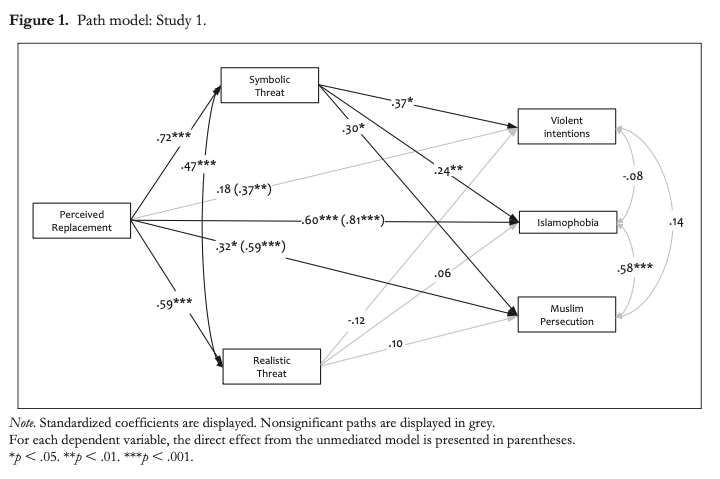
The graph represents correlations and associations among the identified variables, leading ultimately to behavioral outcomes (violent intentions, Islamophobia, Muslim persecution).

Do these findings have important implications for the future of inter-group violence in liberal democracies? Obaidi and his co-authors believe they do:

It has been suggested that immigration-related conspiracy theories trafficked by right-wing groups may nurture hate and violence against immigrants and asylum seekers in the West. Moreover, recent FBI documents predict that right-wing, conspiracy-driven extremism will increase in the next few years (Steinbuch, 2019). Indeed, new reports indicate that far-right terrorism has significantly outpaced other forms of terrorism (Jones et al., 2020). More specifically, right-wing terrorist incidents in the West have increased by 320% over the past 5 years (Institute for Economics & Peace, 2019). One of the most potent conspiracy theories evoked by right-wing extremists, politicians, and commentators is the “Great Replacement”—the conspiracy arguing that there is an attempt to replace the White autochthonous population with non-Western immigrants. (1687)

These are highly suggestive conclusions, and the research is very interesting. However, it would be useful to have a more extensive theoretical basis for linking the empirical results to a theory of the underlying psychological processes that generate them. Obaidi’s reference in the earlier paper to “objective situations, subjective appraisals, and key individual psychological factors contributing to VE inclinations” remains fairly vague. (This is perhaps predictable in a research program that is focused almost exclusively on identifying discrete operationalized variables that can be separately measured.) So once again, we are faced with the question: what processes and internal factors create attitudes of racist extremism among young people?

(The Southern Poverty Law Center 2024 report on White Nationalist organizations and activism in the US is detailed and alarming, and is very relevant to the findings discussed here; link.)

Social psychologists on the appeal of antagonism and hate


Our current political scene presents an unresolved and important question: why have the ideologies of hate, fear, nationalism, antagonism, and violence had such appeal to a segment of young men across many countries in the past thirty years? How does it happen that many fairly typical twelve-year-old boys somehow become captivated by the extremist right-wing political ideas of racism, sexism, and nationalism? Previous posts have considered major generational events and pervasive social influencers as causes of the rise of extremist attitudes among young people. But this leaves the psychological question unanswered: why do these particular divisive attitudes and ideas find such a receptive audience among some young people? And why do messages of inclusion, democracy, and tolerance not have a similar appeal?

Kathleen Blee has devoted her career to understanding the minds of racist activists in the United States, and she emphasizes the importance of the developmental process involved in becoming racist. In Inside Organized Racism: Women in the Hate Movement (2002) she writes:

Intense, activist racism typically does not arise on its own; it is learned in racist groups. These groups promote ideas radically different from the racist attitudes held by many whites. They teach a complex and contradictory mix of hatred for enemies, belief in conspiracies, and allegiance to an imaginary unified race of “Aryans.” (Blee 2002:3)

A new generation of social psychologists have attempted to theorize about the emotional and cognitive systems of children and young people that might help to answer these questions. They have focused on the underlying “needs” that children and young people have, to which various ideologies and belief systems are appealing to a greater or lesser extent. Especially influential is work by Susan Fiske and her collaborators, including especially Social Beings (Susan Fiske and Shelley Taylor, 4th edition, 2021). Fiske and Taylor offer a compact theory of social motives, which they summarize as the “BUC(k)ET” scheme:

Social cognition is animated by social motives traceable to belonging, including understanding, controlling, enhancing self, and trusting others. This framework fits the history of motivations in psychology (S. T. Fiske, 2008) as well as current work in social psychology generally (S. T. Fiske, 2010) and social cognition in particular (S. T. Fiske, 2002). Although other frameworks are possible, this highlights some motives that determine when and how people operate in more automatic or more controlled modes. (Fiske and Taylor 94)

BUC(k)ET scheme

This is a proto-theory of what an adolescent is looking for as he or she approaches adulthood as a grounding of his emotional and social landscape. Fiske’s model places a quest to gain a sense of belonging at the center of this set of needs, as well as a thought framework that helps to “make sense” of the world the young person is beginning to experience (through personal experience, media, social media, clubs, and other social associations). The young person wants to find ways of feeling that he or she is able to control some aspects of the social environment he confronts; to find a basis for developing a positive view of himself; and perhaps most importantly, find ways of forming relationships of trust with some other people. Notice how closely this corresponds to some of the themes of extremist messaging and activism.

Consider these passages from Michael Kimmel’s description of some of the young men and boys attracted to the neo-Nazi movement in Sweden. (See this previous post on Kathleen Blee’s excellent special volume on ethnographies of the far-right (link).) Here Kimmel describes a twelve-year-old boy Edward and his inner life:

Insecure and lonely at twelve years old, Edward started hanging out with skinheads because he “moved to a new town, knew nobody, and needed friends.” Equally lonely and utterly alienated from his distant father, Pelle met an older skinhead who took him under his wing and became a sort of mentor. Pelle was a “street hooligan” hanging out in street gangs, brawling and drinking with other gangs. “My group actually looked down on the neo-Nazis,” he says, because “they weren’t real fighters.” “All the guys had an insecure role as a man,” says Robert. “They were all asking ‘who am I?’” …

Already feeling marginalized and often targeted, the boys and men described themselves as “searchers” or “seekers,” kids looking for a group with which to identify and where they would feel they belonged. “When you enter puberty, it’s like you have to choose a branch,” said one ex-Nazi. “You have to choose between being a Nazi, anti-Nazi, punk or hip- hopper—in today’s society, you just can’t choose to be neutral” (cited in Wahlstrom 2001, 13-14). …

For others, it was a sense of alienation from family and especially the desire to rebel against their fathers. “Grown-ups often forget an important component of Swedish racism, the emotional conviction,” says Jonas Hallen (2000). “If you have been beaten, threatened, and stolen from, you won’t listen to facts and numbers.” (209-210)

Belonging is the recurring theme here. And experts on far-right mobilization suggest that the “influencers” who craft messages of hate, antagonism, and racism are just as aware of these underlying cravings of young people as marketers of sports shoes and cell phones: they find persuasive messages and narratives that play into the need for meaning, direction, belonging, and influence that Fiske describes. The impulses of “belonging” and “narratives of meaning” are powerful, according to Fiske, and these deep psychological needs help to explain the appeal of right-wing extremism and “us-them” antagonism. Fiske’s guiding idea here is that political ideas, attitudes, and ideologies are adopted by the young person as ways of forming a link between a group and the individual’s own course in life. Racism is one way of defining one’s primary group for “belonging”: by defining other groups as separate, threatening, and inferior, the individual simultaneously creates an identity group for himself. And this construction of one’s social identity is fertile ground for aggression, hostility, and prejudice towards other groups.

Lior Zmigrod and co-authors have attempted to discover correlations between cognitive traits and ideological propensities (Zmigrod, Leor, Ian W. Eisenberg, Patrick G. Bissett, Trevor W. Robbins, and Russell A. Poldrack. 2021, “The cognitive and perceptual correlates of ideological attitudes: a data-driven approach”, Philosophical Transactions of the Royal Society B: Biological Sciences 376 (1822)). Their research is relevant to the theories of social cognition offered by Susan Fiske (though they do not mention her work). Here is a relevant description from their abstract:

Even less is known about how cognitive dispositions—individual differences in how information is perceived and processed— sculpt individuals’ ideological worldviews, proclivities for extremist beliefs and resistance (or receptivity) to evidence…. We uncovered the specific psychological signatures of political, nationalistic, religious and dogmatic beliefs. Cognitive and personality assessments consistently outperformed demographic predictors in accounting for individual differences in ideological preferences by 4 to 15-fold. (Abstract)

The methodology pursued here is statistical, based on surveys of a moderate number of subjects. (In fact, the authors are critical of the social-psychology approach that begins with an analysis of psychic needs.) Two kinds of survey instruments are used: one to evaluate the individual’s level on several cognitive measures; and the second to evaluate the individual’s level with regard to a set of political attitudes. The two sets of variables are illustrated on the following table. As the table indicates, “Strategic Information Processing” (a cognitive trait) is strongly negatively associated with each ideological feature except “Social Dominance”. “Caution”, another cognitive feature, is positively associated with each ideological feature across the board.

What were those “psychological signatures” (bundles of psychological attributes strongly associated with features of ideological susceptibility) that Zmigrod and her colleagues discovered? Here is their description of the “religion” signature:

The psychological signature of religiosity consisted of heightened caution and reduced strategic information processing in the cognitive domain (similarly to conservatism), and enhanced agreeableness, risk perception and aversion to social risk-taking, in the personality domain (figure 4 and electronic supplementary material, figure S6). The finding that religious participants exhibited elevated caution and risk perception is particularly informative to researchers investigating the theory that threat, risk and disgust sensitivity are linked to moral and religious convictions [92–97], and that these cognitive and emotional biases may have played a role in the cultural origins of large-scale organized religions [98,99]. (11)

This empirical study is interesting and suggestive, and it has some similarity to research surrounding the Right Wing Authoritarianism scale discussed in earlier posts (link). However, it does not illuminate what seems to be a key question: how are these cognitive attitudes formed, and how does a given set of cognitive attitudes bring about a high (or low) level of receptiveness to racist ideology and extremist political attitudes? We might even ask whether the causal influence might flow in the opposite direction: the person indoctrinated into religious dogmatism is thereby led to develop a low affinity for the cognitive skill of strategic information processing. These are the questions that Fiske’s work seems to provide a basis for answering.


Tuesday, April 11, 2023

Origins of American right-wing extremism in the 1960s

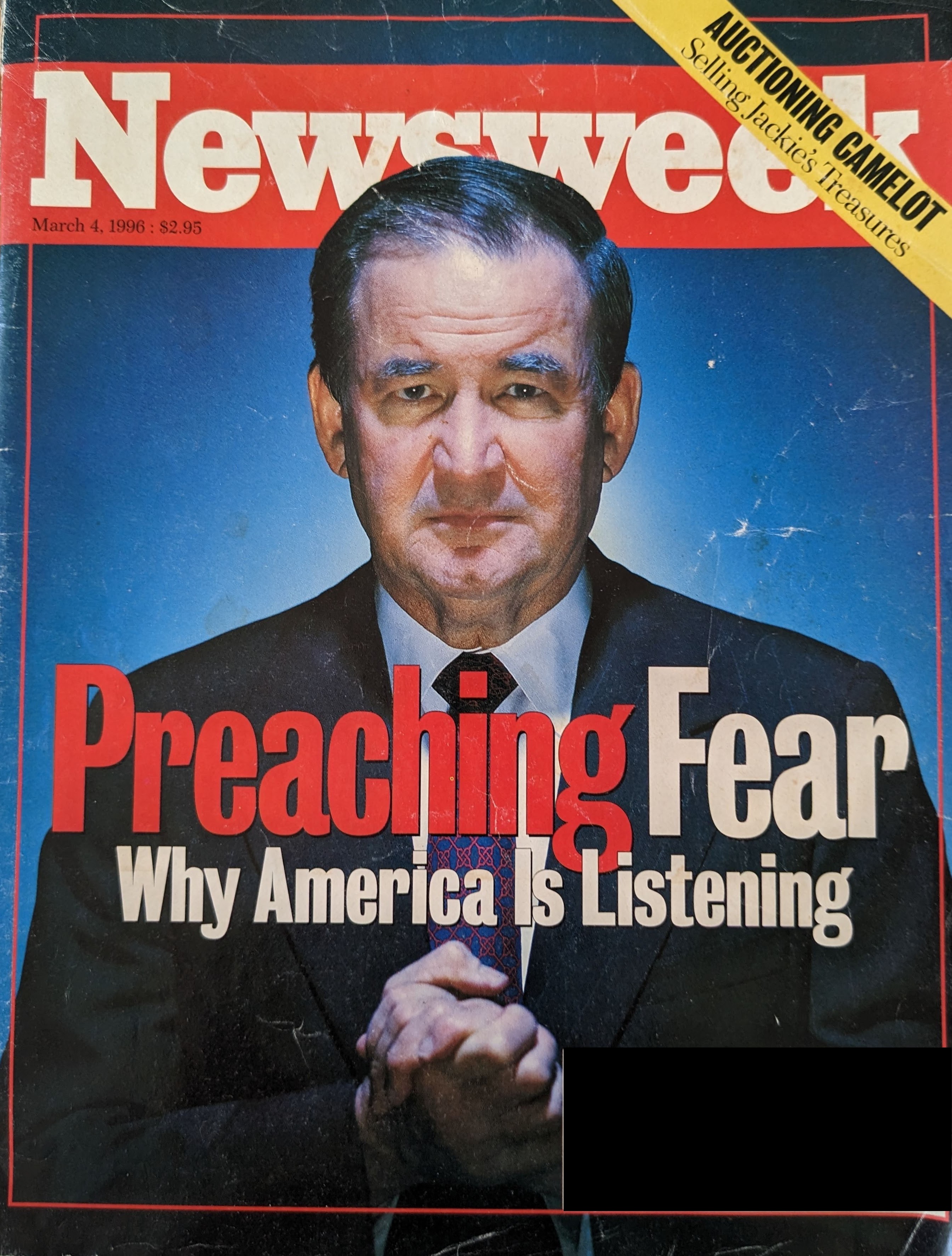
photo: Pat Buchanan, Newsweek, March 4, 1996

The election of Donald Trump in 2016 presented mainstream America with a shocking wakeup: right-wing extremism, with its dimensions of Christian nationalism, white supremacy, racism, and anti-LGBTQ bigotry, had somehow wound up on the carousel, and was now in control. This shouldn't be a complete surprise, since the Tea Party and the rantings of Pat Buchanan in the previous decades had written many of the scripts of the president with the orange hair. But we need to know more about how the extreme right came to be a mainstream political ideology.

Matthew Dallek's Birchers: How the John Birch Society Radicalized the American Right provides one important strand of that background. Dallek argues that the John Birch Society managed to deeply radicalize the Republican political movement from its founding in 1958 to the 2010s. Dallek provides a narrative of the formative years of the Birch Society in the 1950s when activists like Robert Welch marketed an extreme anticommunism among wealthy, conservative businessmen (often including leading members in the National Association of Manufacturers). A striking feature of this story is the speed and virulence with which right-wing activists established new chapters of the John Birch Society in cities throughout the country. And it was largely a white-collar and professional group of men and women who became true believers.

By the time of the assassination of President John F. Kennedy in 1963, the society had declared itself around strident themes of anticommunism, opposition to the civil rights movement, alliance with segregationist politicians (p. 99), alignment with fundamentalist Christian groups, conspiracy theories (fluoridation of public water supplies), and unhinged attacks on school teachers and libraries thought to harbor "un-American" ideas. When the struggle for civil rights intensified in the 1960s, Dallek documents the alliances that existed between the Birch Society and the segregationist governors George Wallace and Lester Maddox (191, 199). 

What is especially striking about the account Dallek offers is the "no-holds-barred" tactics used by the Birch Society in attacking its enemies. Ruining careers, threatening violence, and making unfounded accusations against their opponents were all in a day's work for this movement completely certain of its moral correctness. The recklessness and malevolence of Joe McCarthy continued in the Birch Society.

Dallek's narrative makes it apparent that there is a great deal of continuity from the early political extremism of the John Birch Society and contemporary right-wing GOP talking points -- anticommunism, conspiracy theories about public health measures, the language of white supremacy, xenophobia, and a propensity towards guns and violence. And, as Dallek demonstrates, many of these themes became talking points for Donald Trump in his first presidential campaign, and central to MAGA political speeches. But there is another similarity as well -- the behind-the-scenes alliances that existed in 1958, and continue to exist today, between highly wealthy donors and the political strategies of extremist politicians. 

Pat Buchanan was not a member of the John Birch Society, so far as I know. But his influence as a far-right advocate of conservative issues -- as an opinion writer, as a presidential assistant, as a speech writer for Nixon and Agnew, and as a serial candidate for President -- has been enormous within the US conservative movement. A scan of the quotes on his official webpage illustrates these themes: Christian nationalism, extreme anti-abortion advocacy, Great Replacement Theory, racist fear of "dependent Americans", anti-immigrant bigotry, rejection of equality of citizenship, fundamental mistrust of the Federal government, anticommunism, anti-Muslim bigotry, and an apocalyptic view of the future of America. Here is one quotation from State of Emergency that encapsulates Buchanan's worldview:

If we do not solve our civilizational crisis — a disintegrating culture, dying populations, and invasions unresisted — the children born in 2006 will witness in their lifetimes the death of the West. In our hearts we know what must be done. We must stop the invasion. But do our leaders have the vision and will to do it? (State of Emergency)

Buchanan ran for the GOP presidential nomination in 1996. And, as a contemporary Newsweek profile put it, he ran on a platform of fear, mistrust, and hatred (Newsweek, March 4, 1996). Here are the closing paragraphs of the profile, illustrating Buchanan's "ethnonationalism".

Last week on CBS Radio, Buchanan defended his columns that helped free wrongly accused Nazi war criminal John Demjanjuk as "the best journalism I ever did." The critics were "fly-specking," he said. But in his March 17, 1990, column on Demjanjuk, the mistakes were hardly trivial. In arguing that diesel-engine gas could not have killed the Jews at Treblinka, Buchanan ignored evidence of deadly Zyklon B gas at Treblinka (where more than 850,000 Jews died), accused survivors of "group fantasies of martyrdom and heroics" and essentially bought the line of those who minimize the Holocaust.

His old words on immigration may pose an even larger problem in the campaign. "The central objection to the present flood of illegals is that they are not English-speaking white people from Western Europe, they are Spanish-speaking brown and black people from Mexico, Latin America, and the Caribbean," he wrote in 1984, stressing that the issue is "not about economics." (26)

 (Here is the entry on Treblinka on the United States Holocaust Memorial Museum website. The historical evidence concerning the use of diesel-engine carbon monoxide as a lethal gas at Treblinka is unambiguous, and was documented in Vasily Grossman's initial reporting on Treblinka in 1944 in The Hell of Treblinka; link.And here is an article Dallek contributed to the Atlantic that does a good job of formulating his key findings; link.)

Friday, February 17, 2023

Mechanisms of extremist mobilization


The increase in public belief in core claims of far-right extremism in the United States is alarming. Central among those beliefs is the "Great Replacement" theory advocated by Fox News pundits, and contributing to white supremacist mobilization and violence. The Southern Poverty Law Center conducted a public opinion survey in spring 2022 (link) and found "substantial public support" for "great replacement" theory; and, not surprisingly, this support differed significantly by party affiliation, gender, and age. Here are several particularly striking tables from the report.


The first graph provides data showing a stark difference between Republicans and Democrats concerning attitudes towards rising racial diversity in the United Staes. 47% of Republic respondents were somewhat or very negative about this fact, whereas 63% of Democrats were somewhat or very positive about this fact. The second table indicates that 58% of Republicans feel strongly, somewhat, or a little that this fact is a threat to white Americans, whereas 67% of Democrats feel that this fact is not a threat to white Americans. 

The rise of extremist beliefs and violence in the US (and in other liberal democracies) raises many questions. Especially important is the topic of mechanisms: what are the pathways and strategies through which extremist ideologies and activism are conveyed? Cynthia Miller-Idriss's Hate in the Homeland: The New Global Far Right provides granular details about how right-wing extremist groups are currently mobilizing young people in support of their causes. Her account is eye-opening. Her focus is on the techniques of mobilization that extremist leaders and activists have chosen to influence potential followers to get engaged and to follow their lead. Ideology and rhetoric play important roles in these efforts; but so do music, style, sports, and food. Here is her brief description of the underlying ideologies of the far right:

Far-right ideologies are hierarchical and exclusionary. They establish clear lines of superiority and inferiority according to race, ethnicity, nationality, gender, religion, and sexuality. This includes a range of racist, anti-immigrant, nativist, nationalist, white-supremacist, anti-Islam, anti-Semitic, and anti-LGBTQ+ (lesbian, gay, bisexual, transgender, queer, and others) beliefs. At their extreme, these are ideologies that dehumanize groups of people who are deemed to be inferior, in ways that have justified generations of violence in such forms as white supremacy, patriarchy, Christian supremacy, and compulsory heterosexuality. These kinds of ideologies have imbued individuals from the dominant groups with a sense of perceived superiority over others: slaves, nonwhites, women, non-Christians, or the LGBTQ+ community. (6)

Miller-Idriss focuses on "youth" mobilization -- not because this is the only segment of population that is active in far-right activism and violence, but because success with young people lays the ground for an even greater level of activism in the future.

In this light, the efforts of organized far-right groups to engage with young people in the spaces and places described in this book—combat sports and MMA clubs, music scenes, YouTube cooking channels, college campuses, and a variety of youth-oriented online spaces like gaming chatrooms or social-media platforms—are especially important. Far-right groups have always worked to recruit young people to their movements and politicize youth spaces like concerts, festivals, youth-oriented events, and music lyrics. These are sometimes referred to as youth “scenes”—a word that reflects a less hierarchical and more disorganized structure than traditional social movements. Today there exists a broader range of spaces, places, and scenes to engage young people in the far right. Older leaders in far-right movements rely on college students for speaking invitations and campus activism. They recruit young people to join boxing gyms and compete in combat sports tournaments. Propaganda videos featuring fit, young men in training camps and shooting ranges use music and imagery clearly oriented toward younger recruits. (23-24)

And she emphasizes that the majority of these young people are men. 

It’s not only youth who drive most of the violence on the far right, of course. Mostly, it’s youth who are men. There is much to say about masculinity and toxic masculinity as drivers of far-right violence in both online and off-line contexts, through online harassment and trolling as well as physical violence against others. It’s also important to note that we have seen and are still seeing increasing participation of women in the far right, including in violent fringe and terrorist groups. Women also enable the far right in important ways, whether through YouTube cooking videos that create a softer entry or by playing more supportive roles in extremist movements as mothers, partners, and wives who help to reproduce white nations. (24-25)

Miller-Idriss describes a progression of engagement with far-right activism:

Far-right youth today might initially encounter extremist narratives through chance encounters in mainstream spaces like the MMA, a campus auditorium, a podcast, or a YouTube video. Each of those mainstream spaces, however, can act as a channel, opening the door to dedicated far-right MMA festivals, alt-tech platforms and encrypted communication platforms, and dedicated YouTube subscriptions that mix mainstream interest in cooking or music with far-right ideology. Understanding these new spaces and places—the geography of hate—is key to comprehending the far right in its modern form. (25-26)

This approach emphasizes the importance of studying the spaces within which far-right extremist narratives are conveyed and where they find the beginnings of a mass audience. And she points out that memes of "place and space" play a major role in the narratives of the far right -- in polemics and in popular culture:

Fans of one clothing brand that is well-known for its use of far-right symbols could connect with other brand fans and learn about in-person meet-ups on a now-defunct Tumblr blog. In 2016, this included an announcement of a one-week trip to the “lands of Hyperborea—a mythical pre-historic motherland of our race”—in the region of the Karelia and Kola Peninsula in northwest Russia. Hyperborea was also the name of a prior clothing product line for the German brand Ansgar Aryan, which featured website and catalog text that explained the importance of Hyperborea and described its epic battle between the people of the “light” and the “dark men.” (37)

An especially interesting feature of M-I's research focuses on clothing style within popular culture, and the symbolic importance that far-right extremists place on "costume":

For a generation of adults who grew up with images of far-right extremists as racist Nazi skinheads, far-right aesthetics had clear signals: a uniform style of shaved heads, high black combat boots, and leather bomber jackets. You would be hard-pressed to find a bomber jacket in far-right youth scenes today. The past few years have seen a dramatic shift in the aesthetics of far-right extremism, as the far right has all but abandoned the shaved heads and combat boots of the racist skinhead in favor of a hip, youth-oriented style that blends in with the mainstream. (62)

In the years since white-supremacist blogger Andrew Anglin urged his followers to dress in “hip” and “cool” ways at the Unite the Right rally in Charlottesville, far-right fashion has rapidly evolved. The clean-cut aesthetic of the white polo shirts and khakis that drew national attention in 2017 has been supplanted by new brands marketing the far right, with messages and symbols embedded in clothing to convey white-supremacist ideology. (78)

In Northwest Washington, DC, I glanced out of my office window and saw a young man with an imperial eagle emblazoned across his jacket—part of a British fashion brand’s controversial logo, which has been likened to the Nazi eagle symbol. Later that year, I shared a campus elevator with a man wearing a “patriotic” brand T-shirt whose advertising tagline is “forcing hipsters into their safe space, one shirt at a time.” Symbols and messaging on otherwise ordinary clothing help signal connections to far-right ideology and organized movements—like the torch-bearing Charlottesville marcher, for example, whose polo shirt bore a logo from the white-supremacist group Identity Evropa. (78-79)

And what is the function of extremist branding of clothing? It is to establish "signaling" among a group of people, and to "mainstream" the messages of the hate-based extremist right.

Hate clothing celebrates violence in the name of a cause—often using patriotic images and phrases and calls to act like an American, along with Islamophobic, anti-Semitic, and white-supremacist messages. In this way, far-right clothing links patriotism with violence and xenophobia. On one T-shirt, a saluting, grimacing emoji wielding a semiautomatic gun replaces the stars in the American flag, overlaid with the words “locked-n-loaded;” on the back of the T-shirt, the text reads “White American/Hated by Many/Zero F#cks Given.” In the “about” section of the website, the company explains it was “not founded on prejudice, seperatism (sic) or racism, but simply out of pride.” (80)

M-I also notes the importance of extremist music in the mobilization of young people: 

New genres of racist music—such as “fashwave” (fascism wave, a variant of electronic music) and white-power country and pop—have broadened far-right music scenes far beyond the hard rock style typically associated with white-power music. Across the globe, the commercial and cultural spaces the far right uses to reach new audiences and communicate its ideologies have expanded rapidly—aided in no small part by social media and “brand fan” image-sharing sites that help promote and circulate new products. (69-70)

And these fashions in extremist music have effect in the broader population:

Decades of research on far-right youth culture has shown how particular facets of subcultures and youth scenes—like hate music—can spread intolerance and prejudice against minorities, not only in expected genres like right-wing hard rock and black metal, but also in more mainstream genres like country and pop music. (82)

The most surprising part of M-I's book is her treatment of fight clubs and mixed martial arts. She regards these as important vectors of extremist mobilization in many countries. 

By the mid-2000s, MMA gyms across the European continent had developed a reputation as places where far-right youth were recruited and radicalized. This was a significant shift for violent far-right youth scenes, which had previously been oriented around soccer hooliganism and stadium brawls, but were now gravitating toward the MMA world. Journalists, nongovernmental organizations (NGOs), think tanks, and watchdog groups have documented connections between the MMA world and white supremacists across Europe and North America. (97)

In retrospect, it isn’t surprising that the far right homed in on MMA and other combat sports like jujitsu and boxing as a perfect way to channel ideologies and narratives about national defense, military-style discipline, masculinity, and physical fitness to mainstream markets. Hitler himself had advocated for the importance of combat sports for training Nazi soldiers. The National Socialist Sturmabteilung (storm division, or storm troopers) incorporated not only calisthenics but also boxing and jujitsu as a core part of training for street fights. (95)

She notes that this phenomenon is under-studied in North America, but equally present.

MMA is a perfect incubator for the far right. It helps recruit new youth to the movement from adjacent subcultures, introducing key far-right messages about discipline, resistance to the mainstream, and apocalyptic battles. The combat-sports scene helps the far right motivate youth around ideals related to physical fitness, strength, combat, and violence. This mobilization calls on youth to train physically to defend the nation and white European civilization against the dual threats posed by immigrants and the degenerate left. At the same time, MMA and combat sports reinforce dominant ideals about masculinity and being a man—related not only to violence, risk, and danger but also to solidarity, brotherhood, and bonding.47 The MMA world also helps radicalize and mobilize youth by intensifying far-right ideals about masculinity and violence and the range of exclusionary and dehumanizing ideologies that relate to the supposed incursion of immigrants, the coming of “Eurabia,” “white genocide,” or the “great replacement.” (100-101)

MMA also has the advantage of a built-in structure to reach out to groups of young men through local gyms’ efforts to increase profitability and broaden their client base. Local MMA gyms in the United States, for example, regularly host live sparring demonstrations for broader communities—at open houses, martial-arts facilities, fraternity houses, and university and community centers—to promote their gyms. (104)

In addition to these aspects of cultural mobilization on the far right, M-I also sheds light on the increase that has occurred on university campuses in the open promulgation of extremist speech and mobilization and the sustained attack on the supposed "cultural Marxism" endemic in university faculties. 

Propaganda, white-supremacist fliers, racist graffiti, and provocative speaking tours have brought hate to campuses across the country in new ways, exposing hundreds of thousands of students to far-right ideologies. This kind of hate intimidates and threatens members of vulnerable groups, unsettles campus climates, and creates significant anxiety around student safety and well-being. Students at Syracuse University who staged a sit-in in November 2019 following more than a dozen hate incidents at the university told journalists that they didn’t feel safe on campus. (120)

There is much more of interest in Hate in the Homeland. The book should be priority reading for anyone interested in stemming the rise of extremism in western liberal democracies. 

Saturday, May 2, 2020

Right-wing extremism and the Covid-19 crisis


No one needs to be brought up to date on the devastation already wrought by Covid-19, in the United States, in Europe, and in other parts of the world, and more is almost certain to come in the next two years. The virus is highly contagious in social settings -- not as contagious as measles, but more so than other viral diseases. It has a high mortality rate for older individuals, but it kills patients of every age. It can be spread by persons who do not yet show symptoms -- perhaps even by people who will never develop symptoms. The disease has the great potential of overwhelming health systems in regions where it strikes hardest -- northern Italy, New York City, Britain, Detroit. There is no effective treatment for severe cases of the disease, and there is no vaccine currently available. This is the pandemic that sane governments have feared and prepared for, for many years. Ali Khan, an experienced and long-serving leader on infectious disease at the Centers for Disease Control and Prevention, provides vivid descriptions of the background scientific and public health infrastructure needed to contain viral outbreaks like ebola, monkeypox, MERS, and SARS (The Next Pandemic: On the Front Lines Against Humankind's Gravest Dangers). (Here is a list of possible global virus threats by the World Health Organization (link).

It is therefore plain to any sensible person that government-enforced public health measures are required in order to slow the spread of this disease. Countries that were slow to take the pandemic seriously and establish strong measures designed to slow the infection rate -- like the United States and Great Britain -- have reaped the whirlwind; the United States now has the highest number of Covid-19 cases in the world (link). And the stakes are incredibly high. The 1918 Spanish flu, for example, hit the city of Philadelphia with savage effect because the mayor decided not to cancel the Liberty Loan parade on September 28, 1918 (link); whereas cities like St. Louis made different decisions about public gatherings and had much lower levels of influenza.

The governors of most states in the United States have enacted physical distancing orders mandating "stay-at-home" requirements, business closures, closures of public places, and restrictions on public gatherings. And these measures have worked, on the whole. The governor of Michigan, my home state, for example, has assembled a world-class team of scientific and health advisers concerning the details of the shut-down orders, and a highly respected committee of business and health system leaders to work on developing a strategy for reopening the state in a way that does the best job possible of protecting the health of our ten million citizens. And the curve has flattened.

But now we come to the right-wing protests that have occurred in Lansing and other state capitals around the country (link, link). Guns, extremist placards, threatening behavior, and an armed invasion of the floor of the Michigan state house -- what in the world is going on here? Protest of government policy is one of the fundamental rights of citizenship -- of course. But why heavily armed protesters? Why racist, white-supremacist groups in the crowd? Why the hateful, vitriolic language towards elected officials? What are the underlying political motivations -- and organizational resources -- of these protests?

Cas Mudde has a perceptive analysis in the Guardian (link). His recent book The Far Right Today provides the broader context. Mudde sees the anti-lockdown demonstrations as being largely about Donald Trump's increasingly desperate efforts to win reelection. Mudde calls out the financial ties that exist between these demonstrations and well-funded not-for-profit Republican organizations linked to Betsy DeVos (link).

And indeed, these protests look a lot like Trump campaign rallies, calling the faithful in "battleground" states. The hats, slogans, and behavior make it clear that these protesters are making a political statement in favor of their president. And the president has returned the compliment, describing these protests as reasonable, and encouraging more. The president's behavior is, as usual, horrible. The idea that the president of the United States is actively seeking to interfere with the performance of the governors of many states in their duties of preserving the health and safety of their citizens, after himself failing abysmally to prepare or respond to the pandemic, is something out of a dystopian novel. Here is how Mudde describes the political strategy underlying this approach:
For Trump, the anti-lockdown protests provide him with visible popular support for his Covid-19 strategy. For the sake of his re-election, he is keen to move discussion from public health to the economy. Given that a clear majority of Americans support the stay-at-home policies, Trump needs the momentum to shift. The protests can help him, by taking his struggle from the White House to the streets, and thereby to the media. (link)
Where does the gun-toting extremism come into this political activism? One obvious strand of this "movement" is the extremist anti-government ideology that brought world attention to the Malheur National Wildlife Refuge takeover in 2016. These are radical militia adherents, rejecting the authority of the Federal government in all of its actions, and willing to overtly threaten the lives of others in their activism. Brandishing semi-automatic weapons is not political theatre; it is not “simply an assertion of second amendment rights”; it is a deliberate effort to intimidate and frighten the rest of society. And it is hard to avoid the question — what if these were anarchist protesters in black masks carrying semi-automatic weapons? Or Black Panthers? And what if the venue were the entrance to the White House, or the entrance to the Capitol Building in Washington? How would conservative Republicans react to these scenarios?

Another stream, not entirely distinct from the first, is the persistent and growing white supremacist movement in the right wing of conservative politics. Their involvement in these protests is opportunistic, but their potentially violent opposition to democratically elected government is in common. Here is a report by the Southern Poverty Law Center about involvement by extremist nationalist group the Proud Boys in the anti-lockdown demonstrations; link. Here is a snippet from the SPLC report:
Even though the Proud Boys weren’t behind efforts to get the protests off the ground, they quickly realized their value. They are the perfect platform for the proto-fascist group to make the case that the will of a small minority of Americans – the hyper-individualistic “patriots” who attend these rallies – should supersede democratic processes, and that individual desires should trump the collective public good. The protests also provide other benefits: the chance to launch their ideas into wider right-wing circles, further cement their status as core members of the Trump coalition, build relationships with local politicians and gain attention from outlets like Fox News.
(Neil MacFarquhar and Adam Goldman's coverage in the New York Times of the white-supremacist terrorist organization, the Base, is sobering reading; link.)

It is certainly true that the pandemic is creating huge economic suffering for millions of Americans (and Europeans, Indians, Brazilians, ...). People are suffering, and some much more than others. Poor people, hourly workers, small farmers, gig workers, and people of color are disproportionately victims to the economic recession, and people of color are vastly over-represented among the infected population and the death rolls of the disease. Closures of businesses have led to vast numbers of unemployed men and women. But notably, these demonstrations in Lansing and elsewhere don't seem to be supported by the constituencies most at risk in the economic shutdown; the participants who show up to flaunt their guns and their reckless disregard for social distancing seem to be mostly angry activists pursuing their own agendas.

So an answer to the fundamental question here -- why are we seeing this surge of right-wing extremist protests to pandemic policies? -- seems to involve three related factors: political supporters of Donald Trump (President Trump's efforts to normalize the pandemic and attack Democratic governors who are doing something about it); anti-government extremists who object to any exercise of the appropriate powers of the state; and opportunistic efforts by white supremacist organizations to capture the moment. Add to that the understandable concerns that citizens have about their immediate economic futures, and you have a combustible mixture. And the issue of trust in the institutions of government, raised in a recent post, is plainly relevant here as well; these extremist organizations are working very hard to undermine the trust that ordinary citizens have in the intentions, competence, and legitimacy of their elected officials.

Yes, the economic consequences of the pandemic are enormous. But the alternative is undoubtedly worse. Do nothing about physical distancing and the virus will sweep every state, every county, and every town. Experts believe that the unchecked virus would infect 20-60% of the globe's population. And a conservative estimate of the mortality rate associated with the disease is on the order of 1%. Thomas Tsai, Benjamin Jacobson, and Ashish Jha do the math in Health Affairs (link), assuming a 40% infection rate. For the United States that implies an infected population within about eighteen months of about 98.9 million victims, 20.6 million hospitalizations, and 4.4 million patients needing treatment in ICUs. Both hospitalization rates and ICU demand greatly exceed the total stock available in the United States. Tsai et al do not provide a mortality estimate, but at a 1% mortality rate, this would amount to about a million deaths. It goes without saying that the health system, the food supply system, and virtually every aspect of our "normal" economy would collapse. So the only choice we have is rigorous physical distancing, a sound public health plan for cautiously restarting economic activity, massive increase in testing capacity, aggressive search for treatments and vaccine, and generous programs of Federal assistance to help our whole population make it through the hard times that are coming. And generosity needs to come from all of us -- contributions to local funds for food and social assistance can make a big difference.