Thursday, May 28, 2026

Discrimination in employment today


There is a view in the United States that impactful racial discrimination has declined significantly over time. This view flies in the face of an afternoon’s walk through Detroit, the south side of Chicago, or the Bronx, where racial segregation in housing and the disadvantages that flow from that system are evident. But what is the social-scientific evidence concerning the current situation of race-based discrimination?

This is a question that rigorous quantitative sociologists have studied in the past several decades, and the results are dismal. Consider the research agenda of Lincoln Quillian and his collaborators over that period of time (link). Researchers have studied race-based discrimination in employment using field experiments to test the relative success of equally qualified applicants in thousands of job applications. The experiments take two forms: correspondence tests (where fictitious resumés are paired with equivalent credentials but differing in signals indicating the race of the candidate) and audit tests (where pairs of job applicants played by trained actors are presented for in-person applications or interviews). Here is how Lincoln Quillian describes the procedure for in-person audits:

For in-person audits, researchers send teams of trained actors to apply for the same job vacancies (e.g., Attström 2007; Pager et al. 2009). Each team includes at least one actor belonging to the native or dominant racial group and another from a racial minority group. Teams are assigned equivalent fictitious employment credentials like education, training and previous experience. The majority and minority actors undergo a period of training that involves practice calls to employers, mock interviews and standardizing candidate responses to interview questions (Bendick et al. 2010). Actors are matched based on physical appearance, age and demeanor. In-person audit studies usually rely on at least two signals about the applicant’s race: the applicant’s name in the resume and the applicant’s in-person and physical appearance. (Quillian et al 2020 link : 734)

The experimenter then records the number of candidates by race who are “called back” for a subsequent interview. In an entirely race-blind world we would expect the callback rate to be approximately the same for “white” and “black” candidates; but almost all field experiments with this design show the opposite result.

Quillian and his colleagues conducted a major meta-study of virtually all existing field experiments on employment discrimination. In addition, he and his colleagues assessed the level of discrimination that occurs at the next stage of employment, the step from callback to job offer. In “Evidence from Field Experiments in Hiring Shows Substantial Additional Racial Discrimination after the Callback” Quillian, Lee, and Oliver (link) find that the level of discrimination from callback to job offer is even greater than that between application and callback. “Our results indicate that substantial, additional racial discrimination occurs even after minority candidates make it to the interview stage. Because of this, studies that only use callbacks seriously underestimate the complete extent of discrimination in the hiring process” (734). Here is a summary of their findings:

We begin with a basic meta-analysis of the level of discrimination at different stages. Results of the meta-analysis for each stage are shown in Figure 2 and Table 2 Panels A and B. For our sample of twelve studies, the results indicate that majority applicants receive 53% more callbacks than equally qualified minority applicants on average (discrimination ratio of 1.534; 95% confidence interval of 1.33–1.78).

What happens after the callback? The discrimination ratio for job offers conditional on receiving a callback (i.e., only for applicants who made it to the interview stage) is 1.53418; this indicates that even when both candidates receive an interview, majority applicants still receive about 50% more job offers than comparable minority applicants. Looking at the overall level of discrimination in job offers, majority applicants receive about 145% more job offers than comparable minority applicants (discrimination ratio of 2.450, 95% confidence interval of 1.68–3.57). The difference between the callback discrimination ratio and the unconditional (or overall) job offer discrimination ratio is statistically significant at p < 0.05 (shown in Panel B of Table 2). These results indicate that there is a considerable degree of additional discrimination against racial minorities as they move from callback to job offer. The point estimates suggest that minority candidates experience an average more than twice as much discrimination overall in the job offer outcome as in the callback outcome. (747-748)

Here is a graph summarizing the findings of their meta-analysis of all studies that include callback-job offer data.
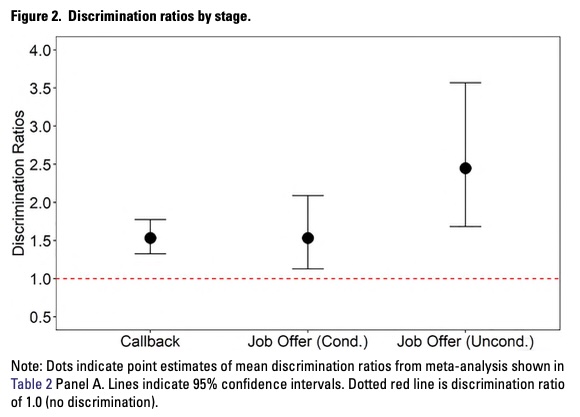
Meta-study estimates of employment discrimination

These are striking and apartheid-like conclusions. Here is the most salient point: “Looking at the overall level of discrimination in job offers, majority applicants receive about 145% more job offers than comparable minority applicants”. Out of 1000 white applicants and 1000 equally well-qualified black applicants, close to 2.5 times as many white applicants will receive job offers as black applicants. Assume there are 350 positions to be offered; this implies that 100 black applicants will receive an offer, compared to 250 white applicants — all equally qualified. By any measure, this is an enormous level of discrimination in employment.

What are the mechanisms that underlie these highly discriminatory results? Two observations in the article are suggestive:

Discrimination by employers does not appear to function in a categorical way, in which employers who know the race or ethnicity of an applicant pre-callback automatically rule out minority applicants in favor of equally qualified majority applicants. Instead, racial discrimination in hiring has a probabilistic character across stages of hiring, in which minority applicants are less likely to advance at each stage. (753)

So — no evidence of widespread “categorical” discrimination in these studies. But second, Quillian et al suggest that implicit bias is an important mechanism of discrimination by race, and they note that this factor may be even more important in face-to-face interactions:

The preferences underpinning taste-based discrimination can encompass many specific forms of racism and prejudice. For instance, employers may hold prejudices against racial and ethnic minorities rooted in suspicions of or hostility toward foreign cultural norms, values or attitudes (Pager and Shepherd 2008). On the other hand, biases that affect hiring may be unconscious, as demonstrated by studies of “implicit” racial attitudes. (735)

Many tests for implicit attitudes such as the Implicit Attitudes Test (IAT) use images of individuals from different racial and ethnic groups, which suggests that the general salience of race might be heightened in the context of face-to-face interactions. (736)

This is enormously important research in a time when the pressure on efforts to reduce and eliminate racism is even greater than the Jim Crow years, if that is possible. The field studies reported here, and the meta-analysis offered by Lincoln Quillian and his colleagues, are a wake-up call. The work is highly rigorous, and the results are unambiguous: racial discrimination in employment is substantial today, and it has not decreased over the past twenty-five years.

And what does this say to the young black man or woman leaving high school, community college, or university about their future? It provides a very bleak picture. The idea that the US economy embodies a “meritocracy” in which each individual reaches a level of achievement determined by experience, education, training, and discipline and nothing else is a self-pleasing fantasy for the majority, and a cruel and obvious lie for the minority.

(Here is a very good summary of the recent research methods and findings involved in Quillian’s research in the Harvard Business Review; link.)

Sunday, May 10, 2026

A more pluralistic analytical sociology


A central theme in
 Rethinking Analytical Sociology is my concern that the founders of analytical sociology presented the field as a general and universally applicable approach to sociological research. Associated with this claim is what I called “ABM fundamentalism” — the view that computational models could and should be applied to all sociological research problems. Against these views, I argued in Rethinking Analytical Sociology that analytical sociologists should take a more pluralistic and collaborative approach to other research methods in sociology, including institutional and organizational sociology and comparative historical sociology.

In March I presented some of these ideas online at the Institute for Analytic Sociology in Sweden, and in April I had the chance to make several specific arguments on this subject to small groups of students and faculty in Como and Torino, with lively discussions following. In Como I focused on the need for a much more nuanced and “thick” theory of the actor, using the example of the US civil rights movement and the current surge of right-wing extremism in many liberal democracies. In Torino I focused on organizations as “meso-level” social entities with dynamic and relatively autonomous causal properties. This is a view rejected by the founders of analytic sociology, who champion a generativist view of the social world that leaves no place for relatively autonomous meso-level social entities. Attributions of apparent causal properties to meso-level structure should ideally be replaced with the individual-level mechanisms that constitute these properties. I argued that this position makes it impossible to explain the sociology of episodes like the Montgomery bus boycott, where dynamic organizations played a crucial role in bringing about the course of events. Doug McAdam’s detailed historical sociology of the period does a great job of uncovering the multi-level dynamics involved over the thirteen months of the ultimately successful boycott, whereas no “generativist” account leading from grievances to a sustained social movement has come close.

The comments I received from analytical sociologists at the Torino talk suggested that I’ve overstated both the commitment to methodological individualism and the rejection of social structures at the heart of analytical sociology. The commentators suggested that practitioners are more open-minded about research methods than I suggest, less committed to generativism, and very open to collaboration with sociologists who proceed from different premises. And agent-based modeling is just a tool, not a way of treating every sociological puzzle.

I don’t think I’ve overstated the core ideas of the “manifesto” of analytical sociology, as put forward by Hedström, Demeulenaere, and Manzo. And Joshua Epstein’s dogmatism about generativist social science stands unparalleled. But I’m very glad to hear that the discussants from the Gen Z generation of sociologists in this tradition are more open to pluralism in methods and approaches. I suggested to them that the time is right for a new manifesto, one which is explicitly open to a range of research approaches. This would mean at least three things: recognizing the need for thicker descriptions of actors, recognizing the causal importance of mid-level social entities like organizations, and abandoning the commitment to generativism as the sole legitimate model of explanation. And most importantly, it would emphasize the synergy that results from collaboration with other research approaches within sociology when treating a complex and extended social process.

As for computational tools like agent-based modeling — perhaps the most an updated manifesto should say about the relevance of agent-based simulation techniques is that they are valuable but limited tools for exploring some of the dynamics of the assumptions we make about inter-agent influence in the setting of mobilization and activization around a set of grievances and demands.

What does this leave from the original premises of AS? It leaves a commitment to empirical rigor, a preference for “theories of the middle range”, an insistence on the importance of discovering causal mechanisms, and a special interest in computational models of simple agent-based processes. This no longer looks like a declaration of a new and general approach to all sociological research — a claim invoked in the earlier manifestos for analytical sociology — but it looks like a much less constraining set of prescriptions than the guiding precepts of the earlier formulations. It is more receptive to a pluralistic approach to sociological research. And it therefore serves better as a guiding framework within which talented researchers can pursue productive research agendas.

Another point was made during the discussion in Torino that deserves comment. A listener suggested that this kind of discussion of “methodology and ontology” has taken up way too much space in the social sciences, and that we would be better off if sociologists just went ahead with their empirical work without worrying too much about the meta-issues. But this seems incorrect to me. Scientific research requires some antecedent ideas about how the world works and how to fruitfully investigate its properties. These ideas are of course provisional. But the history of science shows us that bad “framework” assumptions often lead to bad science. I think here of the harmful effects that radical behaviorism had on psychology in the first half of the twentieth century. So it is important to be as insightful as we can manage as we design research programs in the sciences. And this means that debating the assumptions involved in the analytical sociology research tradition is not wasted effort.

A focus for discussion and comment in the Como presentation was the need for a much deeper understanding of the development of the attitudes and values of young people. How can we explain the rapid rise of extremist right-wing ideologies and values among young people in the United States and many European countries, including Italy? One or two of the people in the Como lecture room were faculty with their own early-teenage children, and they expressed bewilderment about what was driving the surge of support for neo-fascist groups like CasaPound in Italy among young people. Students of contentious politics have not paid enough attention to the mechanisms and pathways through which political attitudes and values gain traction with young people; and yet answering this question is crucial for understanding the success of recruitment and mobilization of followers for organizations and parties like CasaPound. Here is a brief description and history of the neo-fascist CasaPound movement (link).

Saturday, May 9, 2026

Organizational failure — upcoming video seminar

 Here is an interesting opportunity to do some thinking about the ways that organizational features create hazards for technology systems at many levels…

Dear problem-solving community

Please join us on Friday, May 15, 11AM Eastern time (17:00 CET), at this Zoom Link for a problem-solving coffee hour with Catino Maurizio (University of Milano-Bicocca) on “Solving the scapegoat problem in organizations.”

 Abstract: When a large cruise ship sinks after hitting rocks near the shore, public debate quickly turns to a fundamental question: who is to blame? In the aftermath of negative events—accidents, corporate scandals, crises, and bankruptcies—organizations typically adopt one of two blame management strategies. The first consists in acknowledging responsibility and implementing structural corrective measures. The second involves constructing one or more scapegoats by shifting blame onto individuals directly involved in the event. By personalizing failure, the organization can appear structurally sound and avoid costly reforms. Revisiting the Costa Concordia shipwreck, this talk analyzes the organizational processes and mechanisms through which the “organizational scapegoat” is produced. It shows how individualized accounts of guilt transform systemic problems into moral failures, thereby protecting organizational arrangements from scrutiny. From the perspective of problem-solving sociology, scapegoating represents the opposite of a genuinely problem-oriented approach. While scapegoating closes the problem by locating it in deviant individuals, problem-solving sociology seeks to reopen the analysis at the organizational level, asking how structures, routines, and decision processes made the failure possible. The talk argues that moving beyond blame-centered narratives is a necessary step toward developing a civic epistemology capable of addressing organizational responsibility in complex systems.A Virtual Coffee Hour is an informal discussion of issues that arise in problem-solving research.  For more information and the upcoming schedule, see here. To present at a virtual coffee hour, sign up here.

Please forward this to others who may be interested.  (If someone forwarded this to you, you can subscribe to our mailing list from the problem-solving sociology website.)

Problem-Solving Sociology Network
Copyright © 2026 problem solving sociology, All rights reserved.
You are receiving this email because you opted in via our website.

Our mailing address is:
problem solving sociology3400 N. Charles St.Baltimore, MD 21218