Showing posts with label justice. Show all posts

Thursday, May 28, 2026

Discrimination in employment today


There is a view in the United States that impactful racial discrimination has declined significantly over time. This view flies in the face of an afternoon’s walk through Detroit, the south side of Chicago, or the Bronx, where racial segregation in housing and the disadvantages that flow from that system are evident. But what is the social-scientific evidence concerning the current situation of race-based discrimination?

This is a question that rigorous quantitative sociologists have studied in the past several decades, and the results are dismal. Consider the research agenda of Lincoln Quillian and his collaborators over that period of time (link). Researchers have studied race-based discrimination in employment using field experiments to test the relative success of equally qualified applicants in thousands of job applications. The experiments take two forms: correspondence tests (where fictitious resumés are paired with equivalent credentials but differing in signals indicating the race of the candidate) and audit tests (where pairs of job applicants played by trained actors are presented for in-person applications or interviews). Here is how Lincoln Quillian describes the procedure for in-person audits:

For in-person audits, researchers send teams of trained actors to apply for the same job vacancies (e.g., Attström 2007; Pager et al. 2009). Each team includes at least one actor belonging to the native or dominant racial group and another from a racial minority group. Teams are assigned equivalent fictitious employment credentials like education, training and previous experience. The majority and minority actors undergo a period of training that involves practice calls to employers, mock interviews and standardizing candidate responses to interview questions (Bendick et al. 2010). Actors are matched based on physical appearance, age and demeanor. In-person audit studies usually rely on at least two signals about the applicant’s race: the applicant’s name in the resume and the applicant’s in-person and physical appearance. (Quillian et al 2020 link : 734)

The experimenter then records the number of candidates by race who are “called back” for a subsequent interview. In an entirely race-blind world we would expect the callback rate to be approximately the same for “white” and “black” candidates; but almost all field experiments with this design show the opposite result.

Quillian and his colleagues conducted a major meta-study of virtually all existing field experiments on employment discrimination. In addition, he and his colleagues assessed the level of discrimination that occurs at the next stage of employment, the step from callback to job offer. In “Evidence from Field Experiments in Hiring Shows Substantial Additional Racial Discrimination after the Callback” Quillian, Lee, and Oliver (link) find that the level of discrimination from callback to job offer is even greater than that between application and callback. “Our results indicate that substantial, additional racial discrimination occurs even after minority candidates make it to the interview stage. Because of this, studies that only use callbacks seriously underestimate the complete extent of discrimination in the hiring process” (734). Here is a summary of their findings:

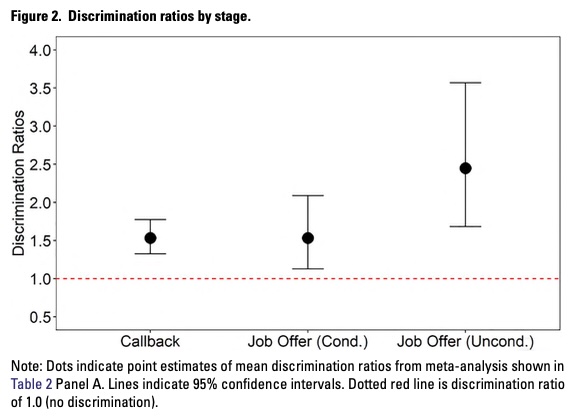
We begin with a basic meta-analysis of the level of discrimination at different stages. Results of the meta-analysis for each stage are shown in Figure 2 and Table 2 Panels A and B. For our sample of twelve studies, the results indicate that majority applicants receive 53% more callbacks than equally qualified minority applicants on average (discrimination ratio of 1.534; 95% confidence interval of 1.33–1.78).

What happens after the callback? The discrimination ratio for job offers conditional on receiving a callback (i.e., only for applicants who made it to the interview stage) is 1.53418; this indicates that even when both candidates receive an interview, majority applicants still receive about 50% more job offers than comparable minority applicants. Looking at the overall level of discrimination in job offers, majority applicants receive about 145% more job offers than comparable minority applicants (discrimination ratio of 2.450, 95% confidence interval of 1.68–3.57). The difference between the callback discrimination ratio and the unconditional (or overall) job offer discrimination ratio is statistically significant at p < 0.05 (shown in Panel B of Table 2). These results indicate that there is a considerable degree of additional discrimination against racial minorities as they move from callback to job offer. The point estimates suggest that minority candidates experience an average more than twice as much discrimination overall in the job offer outcome as in the callback outcome. (747-748)

Here is a graph summarizing the findings of their meta-analysis of all studies that include callback-job offer data.

Meta-study estimates of employment discrimination

These are striking and apartheid-like conclusions. Here is the most salient point: “Looking at the overall level of discrimination in job offers, majority applicants receive about 145% more job offers than comparable minority applicants”. Out of 1000 white applicants and 1000 equally well-qualified black applicants, close to 2.5 times as many white applicants will receive job offers as black applicants. Assume there are 350 positions to be offered; this implies that 100 black applicants will receive an offer, compared to 250 white applicants — all equally qualified. By any measure, this is an enormous level of discrimination in employment.

What are the mechanisms that underlie these highly discriminatory results? Two observations in the article are suggestive:

Discrimination by employers does not appear to function in a categorical way, in which employers who know the race or ethnicity of an applicant pre-callback automatically rule out minority applicants in favor of equally qualified majority applicants. Instead, racial discrimination in hiring has a probabilistic character across stages of hiring, in which minority applicants are less likely to advance at each stage. (753)

So — no evidence of widespread “categorical” discrimination in these studies. But second, Quillian et al suggest that implicit bias is an important mechanism of discrimination by race, and they note that this factor may be even more important in face-to-face interactions:

The preferences underpinning taste-based discrimination can encompass many specific forms of racism and prejudice. For instance, employers may hold prejudices against racial and ethnic minorities rooted in suspicions of or hostility toward foreign cultural norms, values or attitudes (Pager and Shepherd 2008). On the other hand, biases that affect hiring may be unconscious, as demonstrated by studies of “implicit” racial attitudes. (735)

Many tests for implicit attitudes such as the Implicit Attitudes Test (IAT) use images of individuals from different racial and ethnic groups, which suggests that the general salience of race might be heightened in the context of face-to-face interactions. (736)

This is enormously important research in a time when the pressure on efforts to reduce and eliminate racism is even greater than the Jim Crow years, if that is possible. The field studies reported here, and the meta-analysis offered by Lincoln Quillian and his colleagues, are a wake-up call. The work is highly rigorous, and the results are unambiguous: racial discrimination in employment is substantial today, and it has not decreased over the past twenty-five years.

And what does this say to the young black man or woman leaving high school, community college, or university about their future? It provides a very bleak picture. The idea that the US economy embodies a “meritocracy” in which each individual reaches a level of achievement determined by experience, education, training, and discipline and nothing else is a self-pleasing fantasy for the majority, and a cruel and obvious lie for the minority.

(Here is a very good summary of the recent research methods and findings involved in Quillian’s research in the Harvard Business Review; link.)

Thursday, February 26, 2026

New thinking about generational change about race


The United States has a long history of racism against African-Americans, at multiple levels. At the level of individuals, we have a history of negative attitudes, stereotypes, fears, and antagonisms that are built into the social consciousness of white men and women about African-Americans. Racist attitudes about “genetic inferiority”, crime, and other negative stereotypes have persisted since the slave period. At the level of behavior, institutions and individuals in “majority society” discriminate against African-American men, women, and children. The code of inter-racial behavior embodied in the Jim Crow epoch has continuing relevance to contemporary society, and discrimination in employment and other socially important opportunities persists. And then there is “structural racism” or “institutional racism” — the persistence of patterns of disparity and disadvantage for African-American individuals and families that seem to result from the workings of the institutions themselves. Residential segregation and its consequences provide a clear illustration of structural racism, and the persistence of health and longevity disparities by race illustrates the deadly seriousness of these patterns of unequal treatment. (Here is an earlier post on racial disparities.)

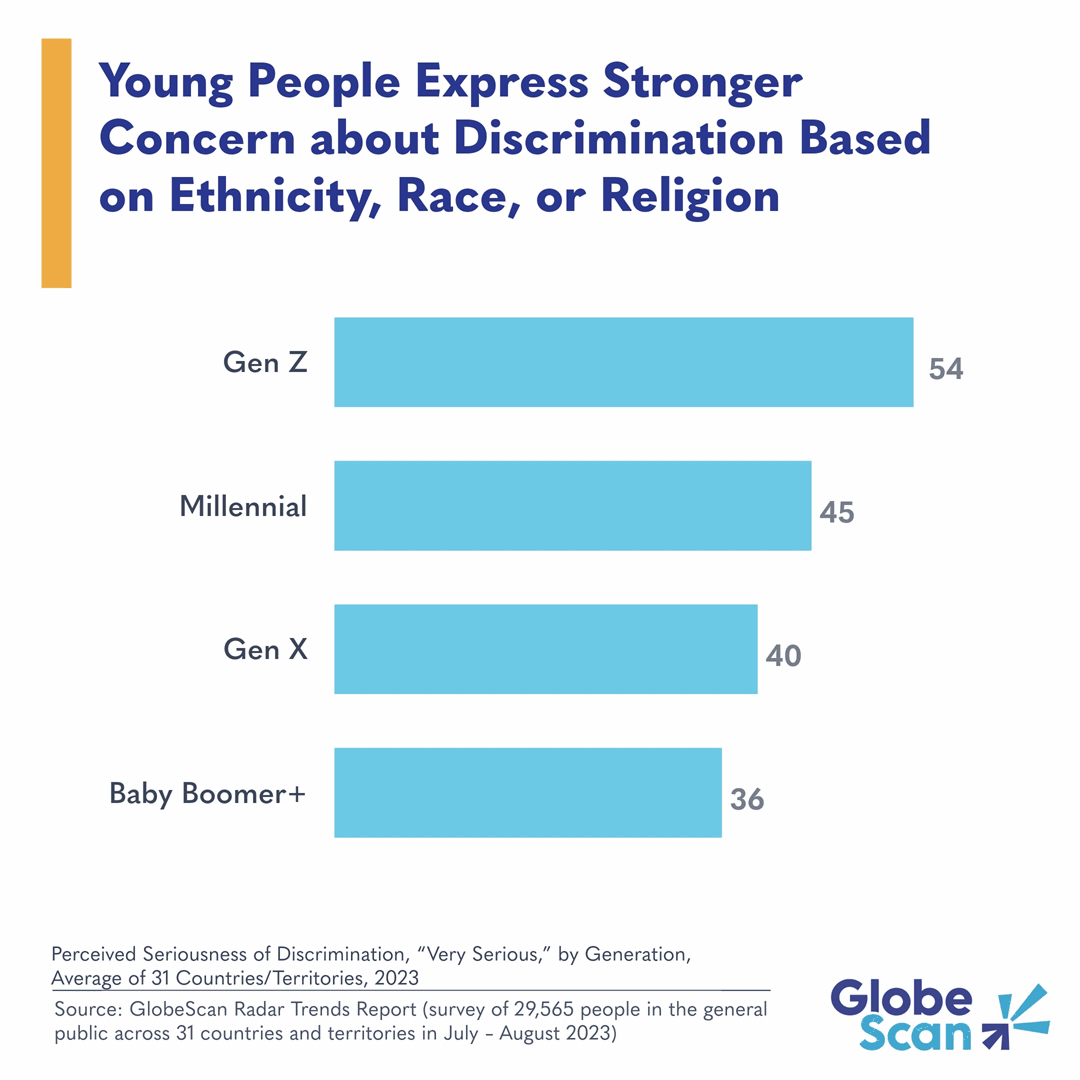
Observers have recognized for decades that American society needs to change in order to eliminate these facts of racism and substantive disparity of outcomes. But what kinds of change are called for? There is a comforting theory of change that seems to have some empirical basis. It is the idea that each cohort of Americans has become less racist and more tolerant of diversity than its predecessor cohort. On this account, the “silent generation” (1928-1945) had more explicitly racist attitudes than the baby boomers (1946-1964), Gen X (1965-1980), and Gen Z (1996-?). Each successive cohort was more accepting of racial diversity than its predecessor. This narrative suggests that racism and its legacy will die out as the more tolerant generations replace their less tolerant predecessors. GlobeScan, a global public opinion research organization, published the results of a brief survey on this topic in 2023 (link):

This report offers an empirical snapshot of the change across generations that is evident in some public opinion surveys: that concern about racial discrimination has steadily increased across recent generations of people. This is a comforting storyline for anyone who cares about an inclusive multicultural democracy. But Christopher DeSante and Candis Watts Smith argue in Racial Stasis: The Millennial Generation and the Stagnation of Racial Attitudes in American Politics (2020) that the storyline is fundamentally incorrect.

DeSante and Smith do not dispute that the generations since the 1940s have indeed experienced a shift in racial attitudes away from overt and explicit “biological racism”. Generations since the baby boom of the 1950s have internalized more “race-neutral” ways of describing current realities. And they have expressed rising discomfort with the fact of continuing racial discrimination. But these generations — GenX, Millennials, and GenZ in particular — appear not to have moved forward to the logical conclusion — the need for supporting the policy changes that would be effective in addressing the continuing realities of racial discrimination. This is the “stagnation and stasis” to which DeSante and Smith refer in the title of the book: progress on ending racism appears to have stalled.

The heart of their argument involves the question of how to measure “racist attitudes” among individuals. For several decades the primary tool of social-psychological measurement of racial attitudes has been based on the concept of “racial resentment” or symbolic racism. Survey questions were designed to elicit the subject’s level of resentment, fear, or antagonism towards members of another race. DeSante and Smith argue that this approach is no longer satisfactory as a measurement tool. They maintain that racism is inherently multidimensional, involving emotions and cognitive assumptions and frameworks, and a satisfactory measure needs to permit observation of several of these dimensions in the subjects of a survey. Instead they offer a four-dimensional framework that they call FIRE (Fear, Institutionalist Racism, and Empathy), and they use a set of survey questions that allow measurement of each dimension. These questions are designed to capture the emotional and cognitive components of “attitudes about race” among individuals in a racially mixed society.

Their measurement tool elaborates on these four questions:

-- I am fearful of people of other races.
-- White people in the US have certain advantages because of the color of their skin.
-- Racial problems in the US are rare, isolated situations.
-- I am angry that racism exists. (DeSantes and Smith 2020: 227)

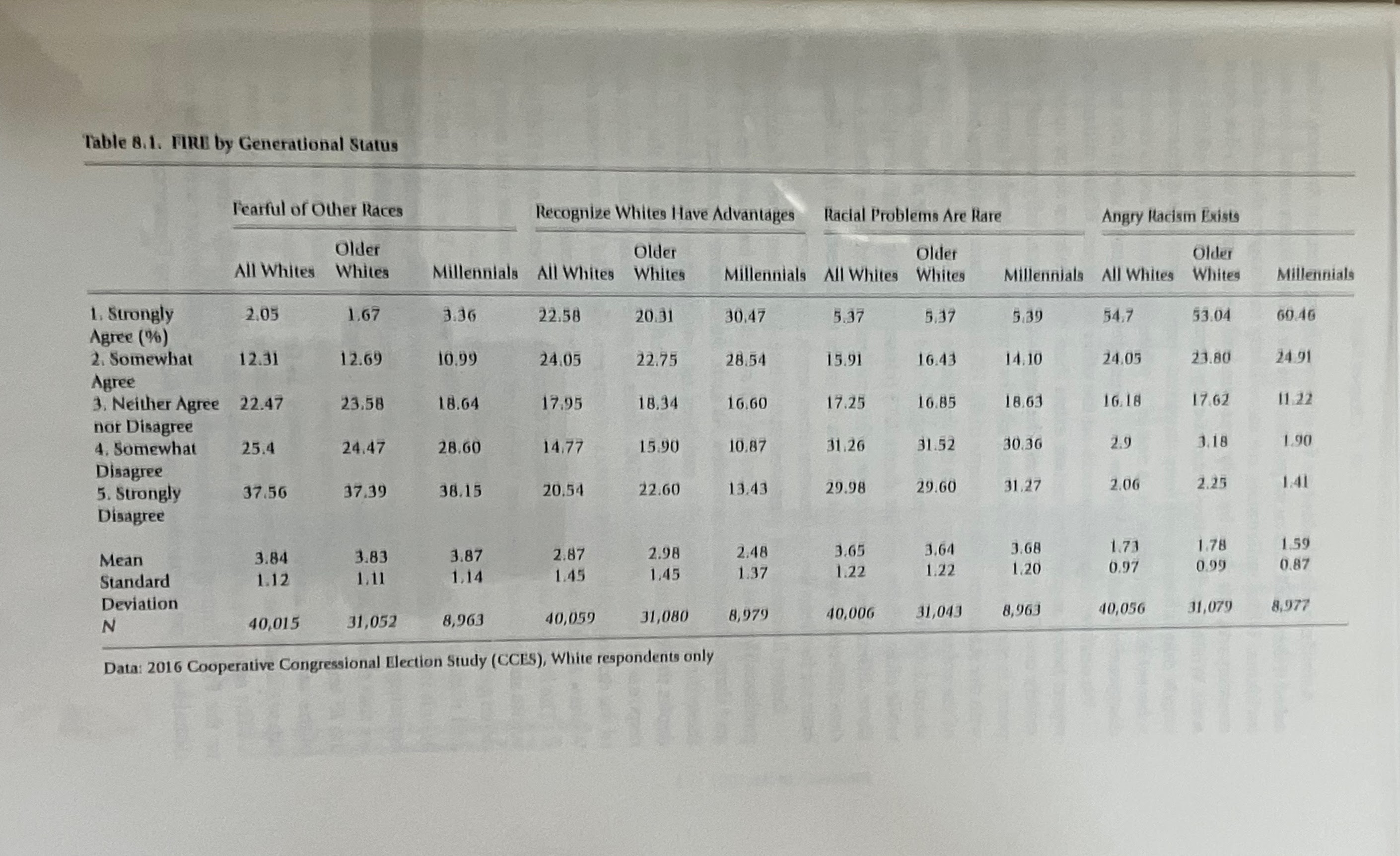
The questions are borrowed from several other survey instruments and are validated using statistical tools of consistency and predictive value. Here are the results of using these questions on the 2016 Cooperative Congressional Election Study (White respondents only).

The results are striking. Millennials are no less “racist” on average than the population of older whites on each of these measures. Here are the mean values for each question:

  • -- “Fearful of other races” 3.83 vs. 3.87
  • -- “Recognize whites have advantages” 2.98 vs. 2.48
  • -- “Racial problems are rare” 3.64 vs. 3.68
  • -- “Angry racism exists” 1.78 vs. 1.59

On average, Millennials demonstrate the same level of racist attitudes as older whites. The pattern is somewhat different when we compare “strongly agree” and “somewhat agree” responses to the four questions.

  • -- “Fearful of other races” 14.36 vs. 14.35
  • --  “Recognize whites have advantages” 43.06 vs. 59.01
  • -- “Racial problems are rare” 21.28 vs. 19.59
  • -- “Angry racism exists” 76.84 vs. 85.37

There are two significant differences in these “agree” responses. Millennials are more likely to agree that “whites have advantages” and agree more frequently that they are “angry racism exists”. Millennials are more likely to disagree or strongly disagree that they are “fearful of other races”. But overall, DeSantes and Smith argue that these differences are small, indicating that little change has occurred between the generations born before 1981 and the Millennials. Millennials have abandoned “old-fashioned racism” but have not advanced much further. Here is their summary statement:

Generally speaking, our results in this chapter also highlight the issue of racial stasis, as signs of the countervailing forces remain visible. For instance, White millennials do present more progressive attitudes. Compared to their predecessors, they are more likely to express anger about racism and more likely to acknowledge their privilege. But we also found that nearly one in five White millennials (20 percent) simultaneously feels angry that racism exists and does not believe Whites have advantages because of the color of their skin…. Ultimately we have a large number of walking contradictions in American society that are helping to produce and perpetuate ongoing racial inequities through their political stances and policy preferences. (244)

So if DeSantes and Smith are correct, then the hope that America’s conflicts over race and racism will disappear as a result of generational replacement is not likely to materialize. Instead, positive and purposeful steps will be needed in the realm of public and semi-public policy in order to address the effects of discrimination and prejudice. And since the burdens of discrimination are cumulative, it is not enough to ensure that opportunities are available on the basis of merit and achievement to solve the problem. If residential segregation makes it less likely that black children will receive equal educational opportunities, then all of their opportunities in later life will be stunted as well. If elementary schools or high schools are racially oriented so that black children on average receive lower quality educations, then “equal opportunity” at the university level is insufficient.

DeSante and Smith do not have much to say about what a “non-racist” mentality and culture would look like, but we can extend their thinking by emphasizing the importance of “education for an inclusive multicultural democracy”. This is a view of “civic education” for all of us based on respect across our various lines of division. A major part of such an education is a clear and honest knowledge of some of the sources of racist oppression and violence that have burdened our society in the past. Another is a deliberate and creative effort by educators, leaders, and students themselves to find our way to some of the ideals articulated by MLK and the beloved community. Without some idea of how young people can be genuinely transformed in their underlying attitudes about race, it is hard to see how the “stagnation of racial attitudes” called out by DeSante and Smith can be disrupted and reimagined. (Here is a more extensive discussion of what is needed for an inclusive multicultural democracy to become a reality; link.)


Thursday, October 2, 2025

Confronting race through Rawls's political philosophy

 Rawls believes that a just society must be a pluralistic society, and that means that it must be neutral across (reasonable) comprehensive conceptions of the good. Citizens must be enabled to pursue their own comprehensive conceptions without interference from the state. Does this imply that a comprehensive conception based on the idea of ethnic or racial superiority over another must be condoned? It does not, because Rawls is not in fact neutral across all comprehensive conceptions. He believes there is a background condition that is both morally and sociologically necessary for the maintenance of a just society — the requirement that recognizes equal freedoms, dignity, and opportunity for all groups of citizens and that cultivates citizens who share these commitments. This has a very powerful implication: Rawls’s theory implies the urgent need for finding means of developing citizens who embody respect, tolerance, and compassion for others. This means finding effective means of reducing and eliminating racism in our society.

Consider this short text from section 7 of Political Liberalism:

Think, then, of the principles of justice as designed to form the social world in which our character and our conception of ourselves as persons, as well as our comprehensive views and their conceptions of the good, are first acquired, and in which our moral powers must be realized, if they are to be realized at all. These principles must give priority to those basic freedoms and opportunities in background institutions of civil society that enable us to become free and equal citizens in the first place, and to understand our role as persons with that status. (Political Liberalism, 41)

This paragraph merits close attention. Let’s start with the idea of “forming the social world in which our character … as well as our comprehensive views … are first acquired”. This is an acknowledgement of the plasticity of character, conception of the good, and moral powers in real human beings. These features of the person must be acquired, and they are shaped and influenced by the circumstances in which the individual develops. This introduces a fundamental aspect of historicity into the question of justice: a society both shapes the individuals who constitute it and is the result of the moral identities of past generations of individuals. Moral development is a crucial part of the creation and maintenance of a just society.

This idea has an important implication: a society founded on “bad” institutions, practices, and principles will result in the creation of individual persons — the constituents of the next phase of the social order — who are morally flawed. And this implies that the society that they play a role in creating will itself be morally flawed.

As an example, imagine a society in which sons and daughters are treated very differently within the family, with sons having a privileged role and daughters being expected to behave in subordinate ways and to accept different kinds of opportunities (schooling, employment, sports). How will the institutions and social arrangements of adult society be affected by this feature of family behavior? The answer seems clear: privilege and subordination between boys and girls in the family will seem “natural” and this inequality will carry over into civil society. The institutions of a society consisting of individuals shaped within these family norms and practices will themselves reflect the domination and subordination associated with familial roles for boys and girls.

So what kind of principles and practices must a healthy just society embody? The final two sentences of the paragraph bring the point home. The background principles of a just society “must give priority to those basic freedoms and opportunities … that enable us to become free and equal citizens in the first place, and to understand our role as persons with that status.” Conversely, a society that does not give priority to equality and basic freedoms will result in generations of citizens who are unable to become “free and equal citizens”. Such a society requires reform before it can become a just and equal democracy.

So a just society over time needs to ensure the legal, normative, and institutional principles that establish basic (and equal) freedoms and opportunities. This means that social, familial, or cultural practices that are inconsistent with equal freedoms and opportunities must be altered. The practice of treating daughters as subordinate is toxic to the creation of a just society because it fails to embody the conditions required for creating men and women who understand themselves as free and equal citizens, and who respect each other accordingly.

This line of thought has direct relevance to the history of racism and racial discrimination in the United States and other countries. It is part of what Charles Mills is getting at in his critique of “the racial contract”. If racial subordination and discrimination are woven into the experience of childhood and young adulthood, then the ambient social institutions and practices fail the test Rawls is proposing. They fail to give priority “to basic freedoms and opportunities … that enable us to become free and equal citizens in the first place”. It is therefore a first priority that such a society, and the state that governs such a society, must make strenuous and sustained efforts at reforming the social environment in which citizens form their “moral powers” and develop their comprehensive conceptions of the good. That means finding effective ways of removing racial subordination and racist ways of thinking from society.

It is a fact that creating a just society is a process of “boot-strapping”, in which one series of improvements lays the basis for new improvements at the next level. Establishing legal and political equality for all groups — a basic tenet of progressive liberalism in the 1950s — was a pressing goal. It is not yet achieved. The next pressing goal is to find ways of changing the experiences that children and young adults have of inter-group relations. Forms of behavior and ideas of prejudice are formed through lived experience; so teachers, family members, members of civic associations and places of worship, and political leaders can provide powerful and transformative examples that cultivate mutual respect, tolerance, and compassion across groups.

But the point to emphasize here is that both activities — establishing equal constitutional rights and liberties, and changing the developmental environment so as to cultivate attitudes of respect, tolerance, and compassion for others — both these activities are mandatory for a “becoming-just” society, according to Rawls’s prescriptions here. The goal of both kinds of reforms is the same: to “enable us to become free and equal citizens” and to participate fully in a just and multicultural society.

Wednesday, September 24, 2025

Racial assumptions in western political philosophy


A prior post asked whether liberal political philosophy can be “anti-racist”. Charles Mills addresses a related question in much more radical terms. He offers a fundamental critique of European/American liberal philosophy grounded in his view that the “social contract” tradition embodies a comprehensive “racial contract” that embodies racial hierarchy and white supremacy. Here is Mills’s critical overview of the social contract tradition from Hobbes to Rawls:

The social contract is, by definition, classically voluntaristic, modeling the polity on a basis of individualized consent. What justifies the authority of the state over us is that “we the people” agreed to give it that authority. (On the older, “feudal” patriarchal model, by contrast—the model of Sir Robert Filmer, Locke’s target in the Second Treatise—people were represented as being born into subordination.) The legitimacy of the state derives from the freely given consent of the signatories to transfer or delegate their rights to it, and its role in the mainstream moralized/constitutionalist version of the contract (Lockean/Kantian) is, correspondingly, to protect those rights and safeguard the welfare of its citizens. The liberal-democratic state is then an ethical state, whether in the minimalist, night-watchman Lockean version of enforcing noninterference with citizens’ rights or in the more expansive redistributivist version of actively promoting citizens’ welfare. In both cases the liberal state is neutral in the sense of not privileging some citizens over others. Correspondingly, the laws that are passed have as their rationale this juridical regulation of the polity for generally acceptable moral ends.

This idealized model of the liberal-democratic state has, of course, been challenged from various political directions over the past century or so: the recently revived Hegelian moral critique from the perspective of a competing, allegedly superior ideal, a communitarian state seeking actively to promote a common conception of the good; the degraded version of this in the fascist corporatist state; the anarchist challenge to all states as usurping bodies of legitimized violence; and what has been the most influential radical critique up till recently, the Marxist analysis of the state as an instrument of class power, so that the liberal-democratic state is supposedly unmasked as the bourgeois state, the state of the ruling class.

My claim is that the model of the Racial Contract shows us that we need another alternative, another way of theorizing about and critiquing the state: the racial, or white-supremacist, state, whose function inter alia is to safeguard the polity as a white or white-dominated polity, enforcing the terms of the Racial Contract by the appropriate means and, when necessary, facilitating its rewriting from one form to another. (Racial Contract, 111-112)

Mills is especially critical of the choice made by modern liberal social contract theorists like John Rawls to restrict their attention to “ideal theory of justice” without paying attention to the actual systemic injustices that US society embodied. In particular, he is highly critical of the fact that these liberal political philosophers have completely ignored the history and current realities of racial domination and oppression in the United States. He argues, along the lines of the main argument in Racial Contract, that this reflects the continued hegemony of the assumptions of White / European supremacy that he maintains were present within social contract theory from its beginnings.

The retreat of mainstream normative moral and political theory into an “ideal” theory that ignores race merely rescripts the Racial Contract as the invisible writing between the lines. So John Rawls, an American working in the late twentieth century, writes a book on justice widely credited with reviving postwar political philosophy in which not a single reference to American slavery and its legacy can be found, and Robert Nozick creates a theory of justice in holdings predicated on legitimate acquisition and transfer without more than two or three sentences acknowledging the utter divergence of U.S. history from this ideal. (Mills 1997, Racial Contract, 106)

And in Black Rights / White Wrongs (2017) he argues: 

Rawls and Nozick may be in conflict over left-wing versus right-wing liberalism, but both offer us idealized views of the polity that ignore the racial subordination rationalized by racial liberalism. Rawls and Sandel may be in conflict over contractarian liberalism versus neo-Hegelian communitarianism, but neither confronts how the whiteness of the actual American contract and its conception of the right and of the actual American community and its conception of the good affects their views of justice and the self. Late Rawls may be in conflict with early Rawls about political versus comprehensive liberalism, but neither addresses the question of the ways in which both versions have been shaped by race , whether through an ” overlapping consensus ” (among whites) or a “reflective equilibrium” (of whites). (Mills 2017 : 32)

An important manifestation of the importance of features of “imperfect justice” is the fact that a current generation of society may embody ways of thinking, stereotypes, and prejudices that serve to reproduce racist, sexist, or religious discrimination in the next generation. Is there any doubt that cultures of discrimination, disparagement, and bias continue to exist in American society? Of course not; the persistence of these attitudes and behaviors are all too evident, even when expressed in indirect and “socially acceptable” ways. And these attitudes and emotions have consequences for the freedoms of the men and women who are the object of these prejudices. Mills writes in The Racial Contract:

Similarly, a study of how “American apart-heid” is maintained points out that whereas in the past realtors would have simply refused to sell to blacks, now blacks “are met by a realtor with a smiling face who, through a series of ruses, lies, and deceptions, makes it hard for them to learn about, inspect, rent, or purchase homes in white neighborhoods. . . . Because the discrimination is latent, however, it is usually unobservable, even to the person experiencing it. One never knows for sure.” (Mills 1997 [quoting Massey and Denton, American Apartheid, 84, 97-98]

This is one concrete mechanism of cross-generational racial domination. A few minutes of reflection can allow us to identify numerous other mechanisms through which current racialized thinking leads to future racial domination and disparity. For example, health disparities often derive from assumptions made by caregivers based on racial or gender stereotypes — sometimes entirely unconsciously. Employment decisions are influenced by stereotyped assumptions about a person based on gender, race, or ethnicity. The racial assumptions and attitudes of police officers often lead to differential treatment of members of the public, including increased likelihood of excessive force and firearms against one group as compared to another. And there are many other examples as well.

Failing to consider “non-ideal justice” is crippling for political philosophy, because it leaves completely unspoken the moral fact that discrimination, oppression, and violence are morally and socially unacceptable and that these evils are pervasive in contemporary society; and it leaves no place for focused thinking about how to move from a non-ideal society to a more just society.

So far Mills offers a damning view of the social contract tradition. However, in Black Rights / White Wrongs he suggests that Rousseau does a better job of bringing “domination” into the discussion of justice and the state. Here he draws extensively from Rousseau’s discussion in the First and Second Discourses:

Rousseau can be seen as initiating an alternative, radical democratic strain in contract theory, one that seeks to expose the realities of domination behind the façade and ideology of liberal consensuality. He retains the two key insights captured by the contract metaphor, the constructed nature of the polity and the recognition of human moral equality, but he incorporates them into a more realistic narrative that shows how they are perverted. Some human beings come to dominate others, denying them the equality they enjoyed in the state of nature. (Mills 2017: 36)

Rousseau, then, is at least open to the idea that “non-ideal” features of social life demand philosophical attention. This view creates an entrance for a more fully anti-racist political philosophy within the social contract tradition. It aligns with the political philosophy of republicanism and Philip Pettit’s views in  Republicanism : a theory of freedom and government (link), in that Mills’s remarks here emphasize “freedom as non-domination”. If freedom means a set of social arrangements in which no individual or group has the power to dominate others, then a constitution guaranteeing freedom is one that authorizes appropriate steps for recognizing and ending past and present forms of domination.

Mills’s criticisms of the social contract tradition are highly negative. Mills seems to suggest that the tradition is entirely useless as a basis for thinking about justice. However, a more nuanced view would allow that this tradition has largely ignored racial domination, a gaping blindspot that demands correction; but that the abstract philosophical principles through which Rawls, Locke, or Rousseau reasoned about freedom, equality, and consent are indeed appropriate principles for thinking about the just society. Suitably embedded in a philosophy that acknowledges categorical inequality and racism, these principles can in fact be quite radical in their implications for needed reform. And it is worth noting that Rawls does not ignore racial discrimination completely; rather, he looks at its injustice as being obvious and beyond debate. His restatement of this point in Justice as Fairness emphasizes the topic of domination and subservience in language that converges with that of Pettit:

Significant political and economic inequalities are often associated with inequalities of social status that encourage those of lower status to be viewed both by themselves and by others as inferior. This may arouse widespread attitudes of deference and servility, on one side, and a will to dominate and arrogance on the other. These effects of social and economic inequalities can be serious evils and the attitudes they engender great vices… Fixed status ascribed by birth, or by gender or race, is particularly odious (Justice as Fairness, 131).

Particularly odious … that doesn’t sound like a silent endorsement of racial discrimination and domination.

Rawls also addresses the religious arguments used by the abolitionists and by Martin Luther King, Jr., in the context of the issue of public reason versus “comprehensive reason” (arguments based on a particular comprehensive conception of the good). From the point of view of justice, only public reasons have force, since there is no politically relevant comprehensive conception of the good.

On this account the abolitionists and the leaders of the civil rights movement did not go against the ideal of public reason; or rather, they did not provided they thought, or on reflection would have thought (as they certainly could have thought), that the comprehensive reasons they appealed to were required to give sufficient strength to the political conception to be subsequently realized. To be sure, people do not normally distinguish between comprehensive and public reasons; nor do they normally affirm the ideal of public reason, as we have expressed it. Yet people can be brought to recognize these distinctions in particular cases. The abolitionists could say, for example, that they supported political values of freedom and equality for all, but that given the comprehensive doctrines they held and the doctrines current in their day, it was necessary to invoke the comprehensive grounds on which those values were widely seen to rest.289 Given those historical conditions, it was not unreasonable of them to act as they did for the sake of the ideal of public reason itself. In this case, the ideal of public reason allows the inclusive view. (Political Liberalism, 251)

His view is that both the 19th-century abolitionists and civil rights activists like MLK made compelling arguments because their “comprehensive” (religious) arguments are entirely supported by public arguments based on equality and equal freedom. Here again, it seems clear that Rawls’s underlying view is one that regards racial inequalities as fundamentally unjust, within the terms of justice as fairness. Though Rawls did not explicitly put this point forward, it is a strong endorsement of the justice of the demands for equality being advanced by the civil rights movement in the 1960s.

Tommie Shelby has done substantial work in attempting to help thread the way between the ideal theory offered by Rawls and the concrete, sociological and historical realities of racial oppression that Mills believes must be incorporated into theories of the just society. Shelby’s 2017 book Dark Ghettos: Injustice, Dissent, and Reform offers an extensive and nuanced reformulation of “justice as fairness” in terms that do take racial oppression into account. Here is a key paragraph:

Rawls has suggested that if we were to conceive of society as a system of social cooperation over time and took an impartial view of what the distribution of benefi ts and burdens of participating in this scheme ought to be, we could arrive at conclusions about what social justice requires that warrant our rational assent. The idea of society as a fair system of cooperation is a moral notion to be used in the evaluation of institutional arrangements. Social justice is constituted by the legitimate claims and responsibilities individuals have within a fair overall social arrangement. Thought about in this way, justice is a matter of reciprocity between persons who regard each other as equals. Taking this approach to questions of social justice is particularly apt when considering criticisms often made against the ghetto poor. It provides a framework for settling whether the urban poor are doing their fair share in upholding the system of cooperation and whether they are receiving the fair share due them as equal participants in this system. Reciprocity, as a central value in liberal political morality, is the primary normative standpoint from which I reflect on family structure, joblessness, and crime in ghetto neighborhoods. (Dark Ghettos, 20)

Mills in turn expresses his own disagreement with Shelby’s approach to Rawls in “Dark Mores: Some Comments on Tommie Shelby’s Dark Ghettos: Injustice, Dissent, and Reform“. Shelby offers a concise summary of his own position in “Racial realities and corrective justice: A reply to Charles Mills” (Critical Philosophy of Race 1:2 (2013)):

In all these interventions, the main thrust of Mills’s critique is to emphasize the need to attend carefully to the realities of racial domination and to deny the value of a normative theory that abstracts away from the actual history of racial injustice. However, this critique has been mainly negative, telling us how not to derive principles of racial justice. Apart from vague suggestions that reparations are due for past racial injustices (e.g., for slavery and land expropriation), the positive normative analysis remains undeveloped. What we get instead is an emphasis on the necessity of getting the historical facts right about white supremacy. Mills does not offer his own positive normative principles for condemning or responding to the history of racial domination that he so forcefully describes. By contrast, Rawls does offer a specific set of normative principles of justice that, I argue, can be usefully applied to racial subordination. Mills, so far as I am aware, does not argue that if we were to follow his methodological approach we would arrive at principles that conflict with the ones that Rawls defends. Nor does he specifically attack or attempt to reformulate Rawls’s principles. So our dispute does not turn on the content of those two principles. (link)

Both Mills and Shelby offer deep and valuable new lines of thought to political philosophy, and their debate is a sign of healthy engagement within a field of philosophy that has sometimes come down to disagreements about the third decimal point. Bringing structures of race and domination into the dialogue within political philosophy is profoundly important.


Friday, September 5, 2025

A political philosophy for an inclusive multicultural democracy

 We might say that a political philosophy is a formulation of the normative ideals that the philosopher holds to be primary in implementing the moral and social facts of “assemblages of free individuals in society, with conflicts of interest and belief”. How should such a society be organized? What values should it aspire to realize through its laws and practices? What forms of constitution, law, and state are best for the realization of the individuals who live within the society?

Here I want to lay out the skeleton of a political philosophy incorporating the ideals of an inclusive multicultural democracy. I maintain that a stable and inclusive multicultural democracy is a positive value for the whole of society: all citizens are benefited by a varied and harmonious population of peoples with distinct traditions, values, and practices. This is a society in which there are many groups and identities in society (racial, ethnic, sexual, class, nationality), and in which members of these groups have the moral emotions of compassion and respect towards members of other groups. Difference exists without discrimination and prejudice; more fundamentally, difference exists within the context of a cohesive sense of shared community. Rather than antagonism there is friendship across groups.

This political philosophy corresponds closely to many of the ideas about racial justice formulated by Dr. Martin Luther King, Jr. during his efforts to find a way towards greater racial justice in the United States. Several ideas in King’s political philosophy stand out in particular. First, his idea of the “Beloved Community” emphasizes that the transformations needed to achieve a good multiracial society go beyond establishing formal legal equality for all, to enhancing the moral emotions of compassion and mutual caring as human beings [“Birth of a New Nation” (1957), “Facing the Challenge of a New Age” (1957), “Stride Toward Freedom” (1958)]. The multiracial society that King envisioned involves a cohesive community of mutual respect, understanding, and compassion. Second, King’s discussions of a future for racial justice in America and other countries always invokes the need for moral transformation — for a change in the way that people think about their fellow human beings with compassion and respect. Third, King’s conception of a just future invokes a deep recognition of shared humanity across race, ethnicity, and other group identities. This advances the idea that citizens in a just multicultural democracy will experience the moral emotions of compassion and respect for each other. King described this as a kind of “civic friendship” in which people from different groups succeed in living together harmoniously and leads them to experience a sense of goodwill and shared identity with their fellow citizens.

All of this requires moral transformation of generations of citizens. Freedom from discrimination, violence, and prejudice is only the beginning of a good multiracial society. Rather, real, concrete human beings need to come to think and feel differently about their humanity and the humanity of others around them.

For King these ideas are placed within a religious or spiritual interpretation, but the theological point is not essential; the values King articulates can be equally endorsed from a purely secular and humanist point of view.

What are those good effects thought to follow from achieving a “harmonious, tolerant, and mutually respectful multicultural society”? Several lines of thought are relevant here. Take Martha Nussbaum’s argument that “compassion is the fundamental moral emotion” and her view that compassion must be learned (link). Exposure to the lived experience and traditions of people different from oneself is a powerful way of developing greater compassion for others — and this presumably makes for better neighbors, citizens, and human beings. Or take the idea that “ethnic conflict is a constant threat in divided societies” (link). It can be argued that a multicultural society that has extensive experience in engaging across communities (racial groups, religious groups, ethnic groups, sexual identities) will be more resilient when crises and conflicts arise (link). I’m thinking here of events like disagreements between neighbors that escalate along racial or ethnic lines; occasions when opportunistic political leaders actively cultivate inter-group suspicion and antagonism; or when economic events occur that seem to divide groups along racial, religious, or ethnic lines. A final benefit that we can imagine is the rewarding experience of learning from another person’s experience or traditions about the norms and events that shaped them, and the reflective benefit that such learning can have for one’s understanding of him or herself (link). For reasons like these we might say that we are all better off if we live in a tolerant and respectful community, and the community itself will be healthier and perhaps even more productive as a result.

So achieving a just, stable, and cohesive multicultural democracy is a worthwhile goal. But will a well-ordered liberal democratic state have the authority — and perhaps the duty — to take measures that enhance the workings of a multicultural democracy? These ideas about inclusive democracy make up a feature of a specific political philosophy, a theory of the values that a good and just society ought to strive to realize. But how can these features be realized within a liberal constitution defining “a good and just society”? Would we do better to recognize that these are ideas open to democratic debate for consideration by the population itself?

In order to bring about a “stable and inclusive multicultural democracy”, it seems evident that citizens themselves need to embrace these values. And this means education. This may mean taking steps to change the ways that children, young people, and adults think about the different groups in their society through education, celebrations, and “inclusive practices” in private and public institutions like corporations, places of work, and universities. This may take the form of promoting forms of education for children that emphasize the values of mutual tolerance and acceptance across lines of race, culture, or ethnicity; it may take the form of universities celebrating Juneteenth or the birthday of Martin Luther King, Jr.; or it may take the form of hosting a reading of the poetry of Audre Lorde or the fiction of James Baldwin. The goal of such activities is to actively encourage the psychology of acceptance and mutual understanding across social, racial, and cultural divisions in our society.

There are obvious ways of connecting “institutional encouragement of inter-group tolerance and respect” to the agreed-upon mandate of achieving “equal rights of liberty, participation, and opportunity” for all groups. It can be argued that persistent prejudice in a segment of a population is itself a mechanism through which out-group disadvantage is maintained (Mills, The Racial Contract). Residential segregation leads to other social ills for the segregated group (health disparities, for example) and so the mechanisms that lead to the persistent residential segregation, which surely include latent prejudice and negative affect towards the out-group, can legitimately be targeted by state programs aiming at reducing prejudice and antagonism. So “anti-prejudice” and “tolerance-enhancing” programs and educational initiatives are a legitimate mechanism for achieving progress towards civil and social equality, to the extent that we can demonstrate that these efforts are efficacious. This is an instrumental justification for public and private programs aimed at reducing prejudice, stereotype, disrespect for others, and outright antagonism.

However, MLK wanted to argue for a stronger view: that achieving a harmonious, tolerant, and mutually respectful multicultural society is good in itself as an important and beneficial goal for the whole of society — not merely instrumentally valuable for achieving civil equality. In fact, it is a fundamental value for a modern democracy. Can this position be supported within liberal political philosophy? And can achieving a tolerant and respectful citizenry be considered a legitimate duty of the state?

There is a strong basis for arguing that a political philosophy articulating the values of a respectful, compassionate, and free community of equals across all groups in society is an excellent basis for thinking about the challenges of twenty-first century social life. We can offer both intrinsic and instrumental reasons for thinking that progress towards this ideal — a version of Martin Luther King Jr.’s Beloved Community — would lead to a better social world. What is less clear is whether a state organized around the principles of traditional liberalism can effectively adopt — or even tolerate — the steps needed to transform society in a more tolerant and compassionate direction. Seen in this light, the struggle over DEI raises profound questions about the possibility of progress towards real racial justice in our democracy.

(Tommie Shelby and Brandon M. Terry’s edited collection, To Shape a New World: Essays on the Political Philosophy of Martin Luther King, Jr., provides an excellent and detailed new beginning for understanding MLK’s political philosophy.)

Sunday, August 24, 2025

The consequences of a trillion dollars


Many thoughtful people in the US are concerned about the effects that the 2025 federal budget reconciliation law will have on poor people in many states who are currently enrolled in Medicaid health coverage. KFF has put together a comprehensive analysis of the implications of this omnibus act for Medicaid patients here. I asked Gemini for a summary of the impact this massive change in Medicaid will have, with over $1 trillion reductions in Medicaid spending over the coming ten years(!). Here is the analysis Gemini provided:

________

QUERY:  what are the main effects of the 2025 budget bill on Medicaid recipients?

GEMINI RESPONSE 8/21/25

The 2025 budget bill, also known as the One Big Beautiful Bill Act (OBBBA), includes significant changes to the Medicaid program, which is expected to have a considerable impact on recipients. 

Here are the main effects of the 2025 budget bill on Medicaid recipients:

  • Significant funding cuts: The bill implements an estimated $1.035 trillion reduction in federal Medicaid spending over ten years. These cuts will necessitate states either increasing their own funding or reducing services, potentially affecting various benefits, according to the Center on Budget and Policy Priorities.
  • Work requirements: The bill introduces work reporting requirements, referred to as “community engagement” activities, for most Medicaid expansion enrollees aged 19 to 64. These recipients will need to work, volunteer, or participate in educational activities for at least 80 hours per month to maintain their eligibility.
  • Increased paperwork and administrative burdens: The new requirements will place a greater administrative burden on recipients to verify their eligibility and for states to manage the process, potentially leading to some eligible individuals losing coverage due to difficulties navigating the system.
  • More frequent eligibility redeterminations: States will be required to conduct eligibility redeterminations for Medicaid expansion adults every six months, rather than annually, starting January 1, 2027. This increased frequency could lead to coverage losses for those unable to complete the renewal process on time or with changes in circumstances.
  • Cost-sharing requirements: States are now mandated to impose cost-sharing requirements of up to $35 per service for Medicaid expansion enrollees with incomes above 100% of the federal poverty level, says the Center for American Progress. Out-of-pocket costs will remain capped at 5% of family income.
  • Restrictions on immigrant eligibility: Some categories of lawfully present immigrants will lose eligibility for Medicaid and Medicare under the bill, notes the Center for Medicare Advocacy.
  • Potential impacts on specific services: Reductions in federal funding might lead states to cut optional benefits, including home- and community-based services (HCBS) that are crucial for individuals with disabilities and older adults.
  • Increased risk for certain groups: Older adults, people with disabilities, and individuals in rural areas are particularly vulnerable to losing coverage or facing increased costs due to these changes. 

It’s important to remember that some provisions of the bill may have delayed effective dates, and future policy changes could still occur. 

________

So why is this a big deal for lower- and lower-middle income people in the United States? Because it seems likely that millions of people will lose affordable health coverage, and many thousands of them will sicken and die from preventable illnesses. The Center on Budget and Policy Priorities (link) estimates that as many as 36 million people are at risk of losing Medicaid eligibility as a result of new work requirements. The Modern Medicaid Alliance is collecting stories of individual people whose Medicaid benefits have been (or will soon be) cancelled (link). These are short items drawn from various news outlets, and they paint a tragic picture from all over the country of the situations that will confront struggling low-income people, young and old, when these new Medicaid reductions begin to hit.

Let’s recall as well that health disparities in the US are severe by almost any measure. Here are disparities of infant mortality in NE Florida noted by Northeast Florida Healthy Start (link).

Health Disparities by Race

And here is a comparison of urban and rural mortality statistics offered by the Rural Health Information Hub (link).

Does anyone seriously doubt that reductions in Medicaid eligibility to millions of individuals will worsen these disparities? And for what? To reduce taxes on the top 1% of income earners in the US.

Thursday, June 26, 2025

Stock ownership as system-wide exploitation?


A prior post made an effort to gain greater analytical clarity concerning the unfairness involved in the separation between the “one percent” economy and the rest of us. In what ways is the wealth owned by the super-billionaires an “unfair” extraction from the rest of US society? How can we account for the very rapid accumulation of wealth in the hands of the richest 1 percent of US wealth holders since 1980? The answer seems to largely turn on the rapid expansion in wealth represented by the US stock market over that period, and the fact that a very small number of wealth holders captured the lion’s share of these gains. The following graph shows a five-fold increase in the value of the US equity market in part of that time, from about $12 trillion in 1998 to $52 trillion in 2024. The wealth owned by the top 1% of households increased at about the same rate, which implies that this class rode the wave to wealth right along with the stock market in those years. “Corporate equities and mutual fund shares” are the largest component by far of the wealth portfolios of the top .1% and 1%, as reflected in the second chart below, produced by the Federal Reserve.

Screenshot

It was shown in the earlier post that the growth of the super-billionaires’ share of the nation’s wealth cannot be explained in normal “business profit” terms. (For reference, the top twenty billionaires in the US own 2.8 trillion dollars of wealth; link.) Rather, the bulk of the wealth now held by individuals like Mark Zuckerberg, Elon Musk, and Jeff Bezos represents the rapid appreciation of value in capital markets of the companies in which they have large ownership stakes. The companies themselves do not generate billions of dollars in dividends; rather, their total stock value has witnessed billions of dollars in gains over very short periods of time.

So why should we think this is in any way unfair? How is it exploitative? Is it not more like the fortunate visitor to “Antiques Road Show” who finds that the forgotten painting in the closet is in fact an early Picasso and is worth millions on the art market? This is good fortune for the owners of the canvas, but surely these facts don’t suggest “exploitation” of anyone else. Perhaps not in the case of the Antiques Road Show guest; but the majority owner of Amazon, Tesla, or Meta is in a different set of circumstances. Rather, the existence and continuing success of these companies depends on background conditions to which all sectors and components of the US economy contribute: a stable system of law and regulation, a robust education and research sector, a skilled workforce, an infrastructure of roads, ports, rail lines, fiber optic cables, and electricity providers. The value of US companies is at least in part a system effect: it is facilitated and constituted by a vast network of private and public stakeholders, all of whom contribute ultimately to the success of the company and the value it finds within the equity market. So the value of the US company is inseparable from the large and heterogeneous economic and political system in which it operates, and the increase in value over time of the US company reflects the continuing contribution expected by the investing public from the functioning of that system.

It will be said, of course, that the companies and their executives themselves contribute to the value that investors attribute to them: innovative products, good management systems, efficient decision-making, appropriate personnel practices, “entrepreneurship” and risk-taking. This is true. But it is also true that these contributions represent only a portion of the increase in value that the company experiences over time. The system effects described here represent an independent and important component of that substantial increase in value. So we might say that “system-created increase in value” is the uncompensated part of wealth creation in today’s economy. Companies pay little or nothing to cover the cost of these system-level inputs on which they depend; these are the inverse of “externalities”, in that they are benefits taken without compensation from the public (rather than harms imposed without compensation on the public). And these system-created increments in value constitute a very important part of the increase in value that they experience over time.

We might therefore look at “system-created increase in value” as the counterpart to “unpaid labor time” in the classic theory of exploitation. It is the source of wealth (profit) that the owners of wealth derive simply in virtue of their position in the property system and in their opportunity to benefit from the economic system upon which they depend. But now it does not derive from the “surplus value” contributed to profits by each worker, but rather from the synergies created by the socio-economic system as a whole.

It should also be noted that the ability of private companies to “extract” value from system-level inputs without compensation depends on their ability collectively to influence government policy. Therefore owners of private companies and stock wealth have strong incentives to shape the decision-making of elected officials, government policy makers, the fiscal system, and the regulatory process. This reinforces the arguments made by Thomas Volscho and Nathan Kelly in “The Rise of the Super-Rich: Power Resources, Taxes, Financial Markets, and the Dynamics of the Top 1 Percent, 1949 to 2008” (link). It follows, then, that achieving powerful influence on public policy and economic rule-making is not just a hobby for the oligarchy; it is an existential necessity.

This analysis of “system-input exploitation” has important consequences for distributive justice. If the whole of society contributes to the creation of the system-level properties that generate a significant fraction of the new wealth created in the past forty years, then surely fairness requires that all participants should receive some part of the gains. It would seem logical for the non-wealth-holding stakeholders — workers, farmers, and uncompensated contributors to social reproduction — to demand economic reforms that direct a fair share of that new wealth to the benefit of the whole population.

The previous post suggested one possible mechanism that would do this. The post discusses a hypothetical “public investment fund” that “would be automatically vested with ownership shares of businesses and corporations as they are created and grow, and that would function as a ‘wealth reserve’ for all citizens”. This would constitute a large and growing asset to be used for the benefit of the whole of society. In that discussion a distribution of gains resulting in public ownership of 1/3 of all capital was considered. Such a division would reduce (though not eliminate) the most extreme inequalities of wealth that currently exist, and would provide a financial basis for a more genuine “free community of equals” through the secure establishment of a high level of the resources most needed — healthcare, education and training, environmental protection, and provisioning of basic human needs for children, the disabled, the elderly, and the unemployed.

This idea of a public investment fund corresponding to the “systemic value creation” of the economy might go a long way towards the securing political values embodied in John Rawls’s concept of a “property-owning democracy” (link). Rawls argues that “the equal worth of liberty” is incompatible with a society in which political influence is proportional to wealth and where wealth is extremely unequally distributed. Wealth inequality of this magnitude means that the oligarch’s liberty and worth are magnified many times relative to the ordinary citizen’s situation. The creation of a substantial public investment fund representing the value created by our social, economic, and political system of cooperation would reduce the total proportion of the total value of the economy that the multi-billionaire class is able to expropriate. It would create real property entitlements for the great majority of society, and it would redress the current horrendous inequality of political influence that exists between the super-rich and the ordinary citizen.