Saturday, June 27, 2026

Poland’s self-limiting revolution in 1980


Military coup, Poland, December 1981

Poland is an important example of the paths taken by the citizens of satellite states within the former Soviet Union. Soviet domination of the governments of Poland, Hungary, East Germany (GDR), Czechoslovakia, and other satellite states led to uprisings in several states, resulting in violent military interventions by the Soviet Union in East Germany (1953), Hungary (1956), and Czechoslovakia (1968), as well as threats of intervention and other forms of political pressure against others (Poland in 1956 and 1980-81).

The Polish pathway from Communist authoritarian rule to democracy included the rise of a large mass-based social movement, Solidarity. One telling of the story of the rise of the Solidarity movement is the pragmatic tactics and goals pursued by its leaders, including Lech Wałęsa. By carefully crafting goals and plans around labor union goals rather than an overtly “anti-communist” uprising, the Solidarity movement avoided a violent clash with the Polish military and General Jaruzelski. This is the line of interpretation offered by the Center for Nonviolent Conflict Research in its 2009 report on the movement (Maciej Bartkowski, link). According to Bartkowski, the movement illustrated an intelligent mobilization and marshaling of support from over ten million union members, and it avoided a violent showdown with the armed forces of the state. It was, in other words, a striking success for “people power” in the face of a vastly more powerful military and state apparatus. And it was an outcome worth celebrating by activists and organizations (like the CNCR) who advocate for the power of mass nonviolent action. Bartkowski writes:

With its self-limiting philosophy of nonviolent struggle and the support of the Catholic Church, Solidarity was in a position to consider the offer of negotiations and accept a pacted transition, even though that meant a preservation of the economic and social status of the ruling elites.

But this description uses a phrase that points to the limitations of the Solidarity movement as well, the idea of a “self-limiting” strategy of struggle. This phrase originated in the writings of the outstanding Polish sociologist Jadwiga Staniszkis, who was both an observer and a participant in the Solidarity movement and the political struggles it brought about. She was one of Poland’s leading academic sociologists in the 1970s and 1980s, and she was also asked to serve as a member of the Inter-Factory Strike Committee, a small group of advisers to the Solidarity union in Gdańsk about strategies for negotiations with the government. Her book, Poland’s Self-Limiting Revolution, was written during and immediately following the rise of the workers’ movement and the imposition of martial law in 1981. It is notable for her objective and clear-eyed account of the movement. She does not romanticize the movement. She had brought an early draft of the book to the United States during an academic visit in 1980, and in 1981 it found a receptive reading at Princeton University Press. Jan Gross, another exceptional Polish sociologist who had emigrated to the U.S. in 1969, agreed to edit the manuscript and to add an historical section providing an account of the background events leading to the emergence of Solidarity, and the book was published by Princeton in 1984. In the editor’s preface to the book Jan Gross describes his reaction to the book as one of the initial readers for the press:

Staniszkis’s book is the best, most original, thought-provoking analysis of an East-Central European society and its politics that I have read in a long time. It goes beyond analyses derived from the totalitarian model approach and it is also more sophisticated than analyses using the interest group approach to study ‘socialist’ societies. The book is an attempt to describe and understand the authoritarian regime in Poland as a sort of corporatist society. As a sociologist of organizations the author succeeds in analyzing an intricate system of mechanisms that have been generated by a social system in order to compensate for irrationalities due to ideological restrictions placed upon it. She has been sensitive to the manifestations of symbolic manipulation in the process of social control and able to analyze such phenomena as simulation of interest group representation or ritualization of periodic crises of the regime. In these analyses she has demonstrated how the system succeeded in incorporating and, as it were, domesticating what would be seen by a less astute observer (or a traditionally thinking social scientist) as developments disrupting and threatening the system’s stability. (x)

Staniszkis describes the core concept of a “self-limiting revolution” in these terms:

Self-limiting revolution. The most striking characteristic of the initial period of the movement’s history was the painful process of cramming that radical wave of protest and class war into a ‘trade union” formula. Nearly all other features of the movement stemmed from this self-limitation of the Polish revolution. For instance, its symbolic politics (which took the form of attacks on local PUWP bosses and did not try to undermine the political institutions as such) provided a peculiar alibi for regional Solidarity leaders who had to pay with their own authority for the policy of moderating the movement, persuaded by its top authorities and experts from the intelligentsia. (17)

Staniszkis’s account differs substantially from that of Alain Touraine, discussed in earlier posts (link, link). Touraine emphasized (or perhaps over-emphasized) the substantial agency and purposiveness of the Solidarity movement, whereas Staniszkis emphasized the structural limitations to which its “pragmatic strategies” subjected it. There were clear limits to the scope of what could be demanded and achieved through the Solidarity social and political mobilization, according to Staniszkis, and this left the authoritarian capacity of the Polish state substantially unchanged. And Staniszkis’s view of the rank-and-file workers who made up the constituency of Solidarity is markedly different from Touraine’s. Touraine regarded Polish workers as having a high level of political consciousness and agency; whereas Staniszkis’s view is that workers were not especially ideological or militant in their support for the union. In her view, the interests motivating a substantial portion of the union members were primarily economic; and in fact, the union had very little concrete economic power (19 ff.). She writes: “Also almost all the victories won by Solidarity during this stage of the conflict were superficial, the ruling group made promises that it did not intend to keep, and hence Solidarity victories were pointless. The deadlock of the self-limiting revolution was also due to the narrow trade-union formula used to label the movement’s activity” (21).

Analysis of a social movement requires providing an account of the motivations and mental frameworks of the potential followers of the movement. Staniszkis considers the content and determinants of “working-class consciousness” in some detail:

Three thresholds must be mentioned when talking about the development of the consciousness of working class in Poland. The first is the barrier created by the limited semantic competence of the workers, which in the past has led to articulation of interests only in restricted, situation-specific, terms. In the first part of this chapter I will try to show how this limited semantic competence made the workers’ protest less efficient. This is a good example of a situation in which the structure of speech (rather than its content) plays an ideological role because it reinforces and stablizes the political system. However, this same limited competence sometimes served as an advantage by reducing the areas of possible communication during negotiations, as a result making the working class less vulnerable to manipulation and in a sense more radical. In this context, I will discuss radicalism as a problem of imagination as well as of attitude and the events of August 1980 as a type of cultural revolution. (113)

She refers also to the barrier of “reification” — the mental attitude according to which “power relations are perceived as painful but natural and without alternative” (113), and what she calls the “peculiar self-image of Solidarity activists” (113).

As suggested by the first barrier, Staniszkis takes a fairly negative view of the role of intellectuals and experts in the Solidarity struggle. She writes of the disconnect between the language and “semantic power” wielded by the intellectuals which rarely resonated with the political consciousness or goals of the rank-and-file union leaders and members. And she suggests that this semantic advantage sometimes worked to derail the more radical demands made by some activists and union leaders.

Most interesting in this chapter is her articulation of how she understands “ideological functions” in a social situation:

By ideological functions of forms of consciousness I mean:

  • 1) their participation in measures to stabilize present social relations;
  • 2) their influence on the opportunities of individuals, social groups, and classes in conflict situations;  
  • 3) their impact on the ability to defend against the tensions generated by the system;
  • 4) their role in the techniques of domination and manipulation applied by the ruling group. (115-116)

This is not a theory of the content of an ideology (as Marx attempts to do); rather, it is an effort at diagnosing the “functions” or “social effects” of a social ideology. So the book doesn’t give much attention to what Polish workers thought about the political structures within which they lived, and how they made sense of them. Instead, she places most of her attention on what she calls “semantic competence” — the concepts and vocabulary through which workers, leaders, unionists, farmers, and other members of Polish society expressed their thoughts about the political forces around them.

In fact, she seems to find the concept of “ideology” somewhat vacuous. Instead, she suggests the term “mentality” as a way of framing the “sense-making” thought processes of various segments of Polish society. (She cites Juan Linz’s use of these concepts in his analysis of authoritarianism.)

I use the term “mentality” as a synonym for a framework of cognitive forms actually operative in political life that is action-oriented and loaded with emotions. This term seems more useful in our case than the concept of ideology. (135)

In the end, Staniszkis’s assessment of the impact of the Solidarity movement in Polish political and social transformation is somewhat negative:

It may sound like heresy, but Polish political life and especially the flow of ideas after August 1980 and the creation of Solidarity has been impoverished as a result of the impact of the populist and solidarist perspective pressed upon society by Solidarity. This view contrasts with the segmented, often morally ambiguous but nevertheless less uniform and less aggregated course of society in the 1970s. (145)

And indeed, the military coup and martial law regime of December 1981 provided a striking parenthesis to the idea that Solidarity was a powerful social movement capable of transforming Polish society. She describes the final weeks in November and December leading up to the coup in these terms:

1) Solidarity leaders believed that the power vacuum (the ruling group’s inability to control the real processes in society and the economy) was synonymous with the ruling group’s inability to use repression. Interestingly, this assumption closely paralleled the position of the ruling group itself. Ironically, the latter has also mistaken the ability to repress for an ability to govern.
2) Leaders of Solidarity also assumed that, even if confrontation were to come, the ruling group would begin with mild and legal methods and that its options would be limited by the present form of the institutional regime, with its characteristic situation of stalemate. At worst a “state of emergency” would exist with the delegation of extraordinary powers to the government by Sejm, not a “state of war,” preceded by a military coup. (326)

These were grave mistakes. The Solidarity organization was outlawed and forced underground, its leaders were arrested and imprisoned, and the strategies of mass demonstration and protest were no longer feasible. So the repressive power of the state succeeded in blocking Solidarity as a political force for at least a few years. But Staniszkis argues that internal contradictions within the union itself presented another large obstacle to continued resistance:

Another mistake of Solidarity leaders was rooted in their underestimation of the problems within Solidarity itself. Recent surveys made by the sociological research center of Mazowsze Region” show among members of Solidarity not only a low willingness to strike (even if the right to strike were in danger), but also deep differences within the union, the ambiguous relationship between the rank-and-file members and their national leaders, and, above all, the increasing passivity of Solidarity members. The ruling group appears to have read this evidence much more carefully; especially the data showing the relatively high prestige of the army among Solidarity members as well as their ambivalence toward at least some proposals popular among Solidarity activists. (326-327).

The third mistake of the national leaders of Solidarity was in accelerating a “paper war’’ (an exchange of statements and resolutions) without any real preparation for the eventual consequences of such an escalation of claims. A feeling of strength based on its membership of nearly 10 million was one of the basic reasons for the ‘‘safe game” attitude of most of Solidarity’s leaders. They did not take into account how easily the union could be paralyzed by cutting off communications and arresting activists. (328)

For some reason Staniszkis’s account of this fairly short period of social conflict makes me think of Marx and Tocqueville in their treatment of the events leading up to the June Days in Paris, 1848. Here are Alexander Herzen’s recollections of the class warfare that occurred in the streets of Paris on those days:

I listened to the thunder and the tocsin and gazed avidly at this panorama of Paris; it was as though I was taking my leave of it. At that moment I loved Paris passionately. It was my last tribute to the great town; after the June days it grew hateful to me. On the other side of the river barricades were being raised in all the streets and alleys. I can still see the gloomy faces of the men dragging stones; women and children were helping them. A young student from the Polytechnic climbed up on to an apparently completed barricade, planted the banner and started singing the Marseillaise in a soft, sad, solemn voice; all the workers joined in and the chorus of this great song, resounding from behind the stones of the barricades, gripped one’s soul. . . . The tocsin was still tolling. Meanwhile, the artillery clattered across the bridge and General Bedeau standing there raised his field-glasses to inspect the enemy positions. . . . (From the Other Shore, After the Storm, 46)


Friday, June 26, 2026

Far-right support in Germany


The question of how the political values and attitudes of young people are formed has come up frequently in recent posts. This question is especially interesting in the case of the rise of far-right parties in Germany, including especially the AfD. What is of particular interest is that there seem to be several divisions at work in Germany when it comes to support for far-right politics and ideologies: region (east-west), gender, sector (urban-rural), and cohort (Gen Z versus millennials and boomers). Answering the question of the mechanisms and cultural/social circumstances that led to the growth of far-right attitudes among young people is urgent if we are to address the threat to democracy that this poses.

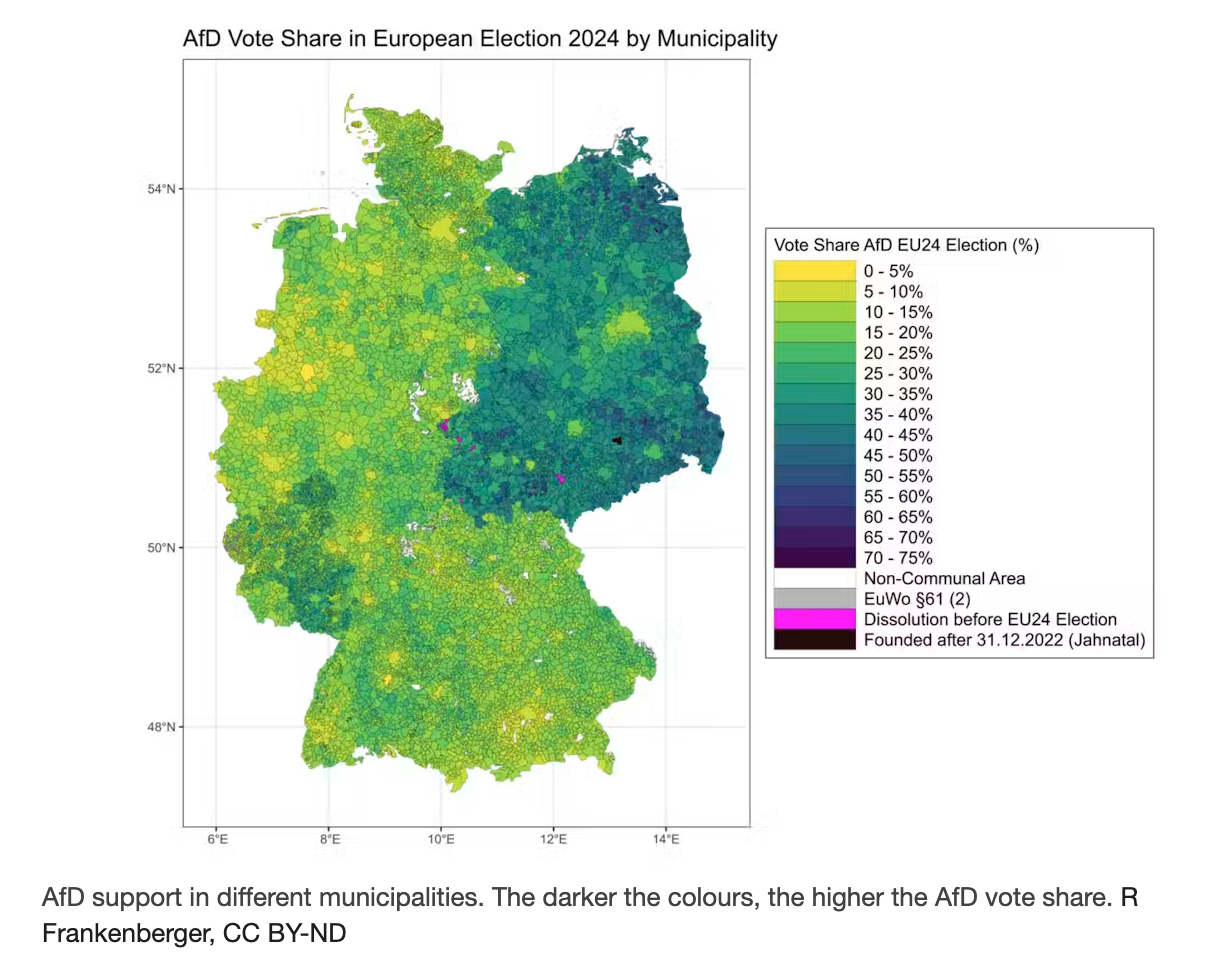
Rolf Frankenberger is a research expert at the Institute for Research on Right-Wing Extremism at the University of Tübingen, and his recent report in the Conversation (link) is very interesting. Most striking is the map he reproduces recording support for AfD by municipality in the 2024 European elections in Germany.

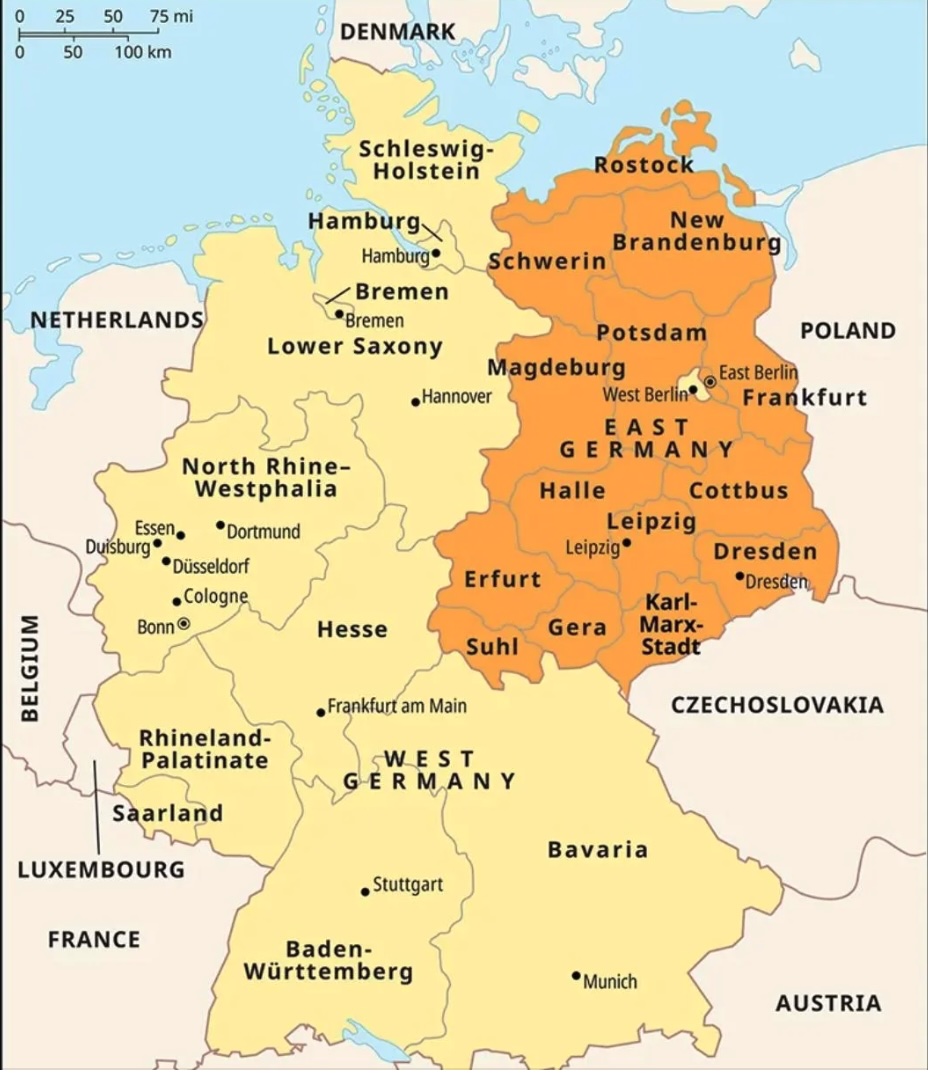
The geographical distribution of support for AfD is striking. It is concentrated in precisely the pre-unification states of the German Democratic Republic (GDR). Here is a map of East and West Germany from 1980.

To many observers, the most significant change in life for German people in the past fifty years is the reunification of Germany that occurred in 1990. And the lives of young people in the east changed much more dramatically than their counterparts in the west.

Frankenberger wants to understand the mechanisms leading to risinig support for the far right. However, he emphasizes a different factor than the reunification issues: the divide between urban and rural social life.

A new division has emerged as a result between the urban and the rural. The two are more than just forms of settlements – they reflect ideals, values and lifestyles. Those who live in towns and cities lead almost entirely different lives to those who live in the countryside.

Frankenberger pinpoints a clash of cultures as a key to the rise of support for the far right. On his view, rural people are increasingly likely to be mobilized around what has been portrayed as “threats” to their traditional ways of life. Even solar-power windmills are hated, according to Frankenberger, because they disrupt the countryside for the benefit of “modern” urban dwellers. And on the other side of the coin, urban dwellers are better educated, more economically mobile, and less attracted to the ideologies of the far right.

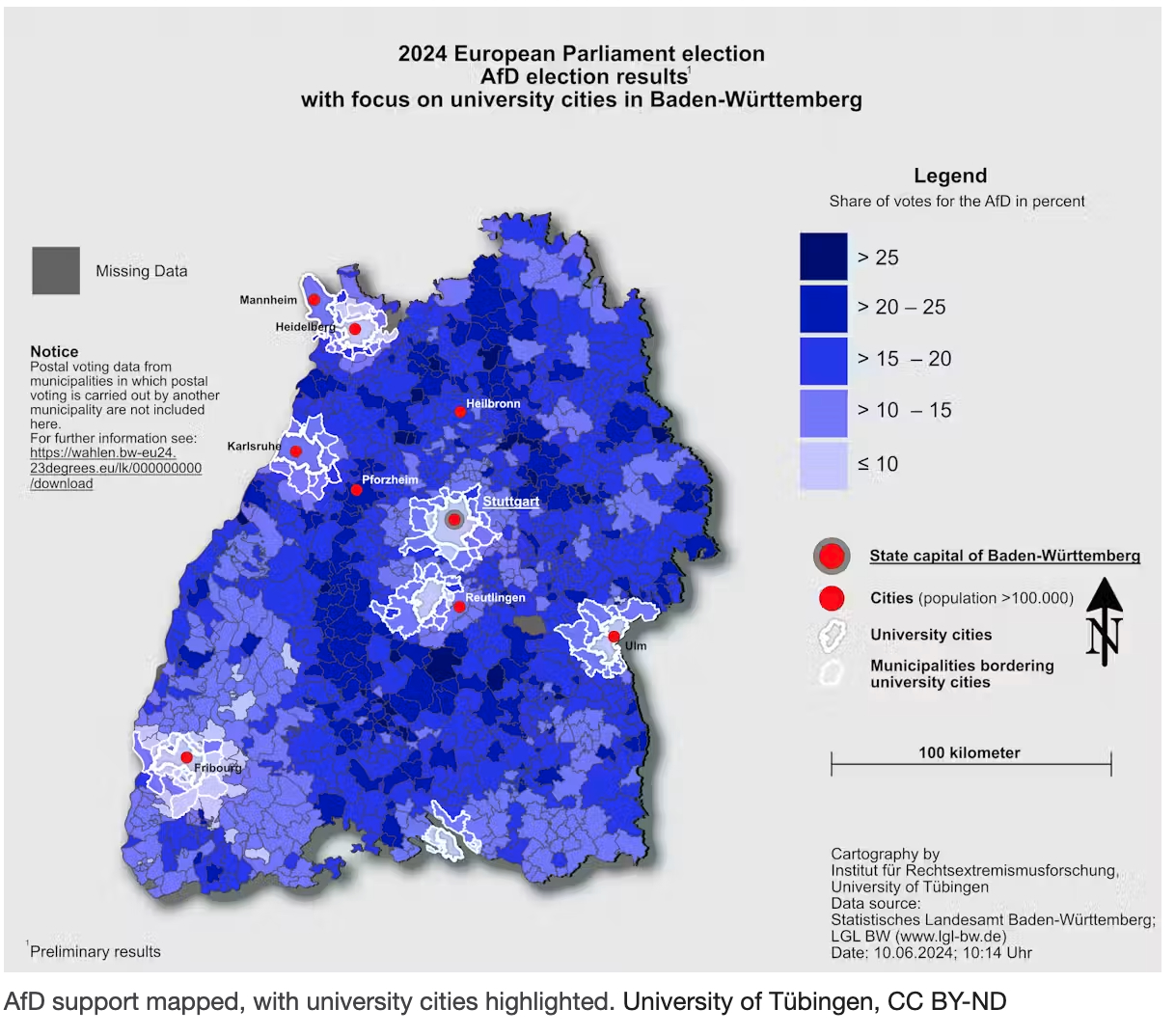
Here is Frankenberger’s presentation of the variation in support for AfD in Baden-Württemberg. In general the region produces a lower level of support for AfD; but Frankenberger emphasizes the variation across the state. Rural areas have produced significantly higher levels of support for AfD than urban areas, even in this state that was part of West Germany in 1980.

And he emphasizes the cultural conservatism of the rural areas in this region.

The Black Forest, the Swabian Forest, and Hohenlohe also have quite strong protestant and evangelical communities, which are strongholds of traditional family life, customs and traditions.

The impact of the university cities in the distribution of political attitudes across this map is visible and extensive. Each university city demonstrates less than 10% support for AfD, with the highest levels of support occurring in rural and forest areas exceeding 25%.

Frankenberger does not address the smoking gun in the first map above, however. This is the stark difference in patterns of support across the earlier political divide between the Federal Republic and the GDR. This divide seems to overshadow the urban-rural differences singled out here and to demand explanation. What accounts for the much higher level of support for far-right parties, including especially the AfD, by citizens from the former GDR? This question demands close attention. Was it deindustrialization? Was it abrupt “modernization” and erosion of traditional village and rural life? Was it an emerging trend in which women had different and better opportunities than men?

Another issue not addressed here is the gender gap in support for AfD in Germany. In recent elections a substantially higher percent of German men support AfD than women (26% against 11% in one recent poll). What explains this gap? Sabine Volk, another researcher at the Tübingen Institute, has addressed the role of antifeminism in the rise of the AfD and its particular intensity in the east in “The AfD and Antifeminism in Germany, 2014–2025: Family First, Trans Panic Second” (link). Again, this disparity between young men and young women in their political attitudes demands explanation.

Underlying all of these disparities is the urgent need to provide an account of the connection between events in the 1990s and the formation of political attitudes and values in German men and women who became adolescents and young adults after reunification.

And there is a second hanging question as well: why have other European countries (for example, Poland, Sweden, Russia, France, the Netherlands, or Italy) developed a cohort of young people in the same generation who seem to embrace very similar far-right political attitudes, even though their formative circumstances were quite different from those experienced in the former GDR region?

Here is a DW profile of one young far-right recruit (link). The video highlights a need for belonging experienced by young men, and offers a discussion of the roots of misogyny and the impact of social media and YouTube right-wing influencers.


Thursday, May 28, 2026

Discrimination in employment today


There is a view in the United States that impactful racial discrimination has declined significantly over time. This view flies in the face of an afternoon’s walk through Detroit, the south side of Chicago, or the Bronx, where racial segregation in housing and the disadvantages that flow from that system are evident. But what is the social-scientific evidence concerning the current situation of race-based discrimination?

This is a question that rigorous quantitative sociologists have studied in the past several decades, and the results are dismal. Consider the research agenda of Lincoln Quillian and his collaborators over that period of time (link). Researchers have studied race-based discrimination in employment using field experiments to test the relative success of equally qualified applicants in thousands of job applications. The experiments take two forms: correspondence tests (where fictitious resumés are paired with equivalent credentials but differing in signals indicating the race of the candidate) and audit tests (where pairs of job applicants played by trained actors are presented for in-person applications or interviews). Here is how Lincoln Quillian describes the procedure for in-person audits:

For in-person audits, researchers send teams of trained actors to apply for the same job vacancies (e.g., Attström 2007; Pager et al. 2009). Each team includes at least one actor belonging to the native or dominant racial group and another from a racial minority group. Teams are assigned equivalent fictitious employment credentials like education, training and previous experience. The majority and minority actors undergo a period of training that involves practice calls to employers, mock interviews and standardizing candidate responses to interview questions (Bendick et al. 2010). Actors are matched based on physical appearance, age and demeanor. In-person audit studies usually rely on at least two signals about the applicant’s race: the applicant’s name in the resume and the applicant’s in-person and physical appearance. (Quillian et al 2020 link : 734)

The experimenter then records the number of candidates by race who are “called back” for a subsequent interview. In an entirely race-blind world we would expect the callback rate to be approximately the same for “white” and “black” candidates; but almost all field experiments with this design show the opposite result.

Quillian and his colleagues conducted a major meta-study of virtually all existing field experiments on employment discrimination. In addition, he and his colleagues assessed the level of discrimination that occurs at the next stage of employment, the step from callback to job offer. In “Evidence from Field Experiments in Hiring Shows Substantial Additional Racial Discrimination after the Callback” Quillian, Lee, and Oliver (link) find that the level of discrimination from callback to job offer is even greater than that between application and callback. “Our results indicate that substantial, additional racial discrimination occurs even after minority candidates make it to the interview stage. Because of this, studies that only use callbacks seriously underestimate the complete extent of discrimination in the hiring process” (734). Here is a summary of their findings:

We begin with a basic meta-analysis of the level of discrimination at different stages. Results of the meta-analysis for each stage are shown in Figure 2 and Table 2 Panels A and B. For our sample of twelve studies, the results indicate that majority applicants receive 53% more callbacks than equally qualified minority applicants on average (discrimination ratio of 1.534; 95% confidence interval of 1.33–1.78).

What happens after the callback? The discrimination ratio for job offers conditional on receiving a callback (i.e., only for applicants who made it to the interview stage) is 1.53418; this indicates that even when both candidates receive an interview, majority applicants still receive about 50% more job offers than comparable minority applicants. Looking at the overall level of discrimination in job offers, majority applicants receive about 145% more job offers than comparable minority applicants (discrimination ratio of 2.450, 95% confidence interval of 1.68–3.57). The difference between the callback discrimination ratio and the unconditional (or overall) job offer discrimination ratio is statistically significant at p < 0.05 (shown in Panel B of Table 2). These results indicate that there is a considerable degree of additional discrimination against racial minorities as they move from callback to job offer. The point estimates suggest that minority candidates experience an average more than twice as much discrimination overall in the job offer outcome as in the callback outcome. (747-748)

Here is a graph summarizing the findings of their meta-analysis of all studies that include callback-job offer data.

Meta-study estimates of employment discrimination

These are striking and apartheid-like conclusions. Here is the most salient point: “Looking at the overall level of discrimination in job offers, majority applicants receive about 145% more job offers than comparable minority applicants”. Out of 1000 white applicants and 1000 equally well-qualified black applicants, close to 2.5 times as many white applicants will receive job offers as black applicants. Assume there are 350 positions to be offered; this implies that 100 black applicants will receive an offer, compared to 250 white applicants — all equally qualified. By any measure, this is an enormous level of discrimination in employment.

What are the mechanisms that underlie these highly discriminatory results? Two observations in the article are suggestive:

Discrimination by employers does not appear to function in a categorical way, in which employers who know the race or ethnicity of an applicant pre-callback automatically rule out minority applicants in favor of equally qualified majority applicants. Instead, racial discrimination in hiring has a probabilistic character across stages of hiring, in which minority applicants are less likely to advance at each stage. (753)

So — no evidence of widespread “categorical” discrimination in these studies. But second, Quillian et al suggest that implicit bias is an important mechanism of discrimination by race, and they note that this factor may be even more important in face-to-face interactions:

The preferences underpinning taste-based discrimination can encompass many specific forms of racism and prejudice. For instance, employers may hold prejudices against racial and ethnic minorities rooted in suspicions of or hostility toward foreign cultural norms, values or attitudes (Pager and Shepherd 2008). On the other hand, biases that affect hiring may be unconscious, as demonstrated by studies of “implicit” racial attitudes. (735)

Many tests for implicit attitudes such as the Implicit Attitudes Test (IAT) use images of individuals from different racial and ethnic groups, which suggests that the general salience of race might be heightened in the context of face-to-face interactions. (736)

This is enormously important research in a time when the pressure on efforts to reduce and eliminate racism is even greater than the Jim Crow years, if that is possible. The field studies reported here, and the meta-analysis offered by Lincoln Quillian and his colleagues, are a wake-up call. The work is highly rigorous, and the results are unambiguous: racial discrimination in employment is substantial today, and it has not decreased over the past twenty-five years.

And what does this say to the young black man or woman leaving high school, community college, or university about their future? It provides a very bleak picture. The idea that the US economy embodies a “meritocracy” in which each individual reaches a level of achievement determined by experience, education, training, and discipline and nothing else is a self-pleasing fantasy for the majority, and a cruel and obvious lie for the minority.

(Here is a very good summary of the recent research methods and findings involved in Quillian’s research in the Harvard Business Review; link.)

Sunday, May 10, 2026

A more pluralistic analytical sociology


A central theme in
 Rethinking Analytical Sociology is my concern that the founders of analytical sociology presented the field as a general and universally applicable approach to sociological research. Associated with this claim is what I called “ABM fundamentalism” — the view that computational models could and should be applied to all sociological research problems. Against these views, I argued in Rethinking Analytical Sociology that analytical sociologists should take a more pluralistic and collaborative approach to other research methods in sociology, including institutional and organizational sociology and comparative historical sociology.

In March I presented some of these ideas online at the Institute for Analytic Sociology in Sweden, and in April I had the chance to make several specific arguments on this subject to small groups of students and faculty in Como and Torino, with lively discussions following. In Como I focused on the need for a much more nuanced and “thick” theory of the actor, using the example of the US civil rights movement and the current surge of right-wing extremism in many liberal democracies. In Torino I focused on organizations as “meso-level” social entities with dynamic and relatively autonomous causal properties. This is a view rejected by the founders of analytic sociology, who champion a generativist view of the social world that leaves no place for relatively autonomous meso-level social entities. Attributions of apparent causal properties to meso-level structure should ideally be replaced with the individual-level mechanisms that constitute these properties. I argued that this position makes it impossible to explain the sociology of episodes like the Montgomery bus boycott, where dynamic organizations played a crucial role in bringing about the course of events. Doug McAdam’s detailed historical sociology of the period does a great job of uncovering the multi-level dynamics involved over the thirteen months of the ultimately successful boycott, whereas no “generativist” account leading from grievances to a sustained social movement has come close.

The comments I received from analytical sociologists at the Torino talk suggested that I’ve overstated both the commitment to methodological individualism and the rejection of social structures at the heart of analytical sociology. The commentators suggested that practitioners are more open-minded about research methods than I suggest, less committed to generativism, and very open to collaboration with sociologists who proceed from different premises. And agent-based modeling is just a tool, not a way of treating every sociological puzzle.

I don’t think I’ve overstated the core ideas of the “manifesto” of analytical sociology, as put forward by Hedström, Demeulenaere, and Manzo. And Joshua Epstein’s dogmatism about generativist social science stands unparalleled. But I’m very glad to hear that the discussants from the Gen Z generation of sociologists in this tradition are more open to pluralism in methods and approaches. I suggested to them that the time is right for a new manifesto, one which is explicitly open to a range of research approaches. This would mean at least three things: recognizing the need for thicker descriptions of actors, recognizing the causal importance of mid-level social entities like organizations, and abandoning the commitment to generativism as the sole legitimate model of explanation. And most importantly, it would emphasize the synergy that results from collaboration with other research approaches within sociology when treating a complex and extended social process.

As for computational tools like agent-based modeling — perhaps the most an updated manifesto should say about the relevance of agent-based simulation techniques is that they are valuable but limited tools for exploring some of the dynamics of the assumptions we make about inter-agent influence in the setting of mobilization and activization around a set of grievances and demands.

What does this leave from the original premises of AS? It leaves a commitment to empirical rigor, a preference for “theories of the middle range”, an insistence on the importance of discovering causal mechanisms, and a special interest in computational models of simple agent-based processes. This no longer looks like a declaration of a new and general approach to all sociological research — a claim invoked in the earlier manifestos for analytical sociology — but it looks like a much less constraining set of prescriptions than the guiding precepts of the earlier formulations. It is more receptive to a pluralistic approach to sociological research. And it therefore serves better as a guiding framework within which talented researchers can pursue productive research agendas.

Another point was made during the discussion in Torino that deserves comment. A listener suggested that this kind of discussion of “methodology and ontology” has taken up way too much space in the social sciences, and that we would be better off if sociologists just went ahead with their empirical work without worrying too much about the meta-issues. But this seems incorrect to me. Scientific research requires some antecedent ideas about how the world works and how to fruitfully investigate its properties. These ideas are of course provisional. But the history of science shows us that bad “framework” assumptions often lead to bad science. I think here of the harmful effects that radical behaviorism had on psychology in the first half of the twentieth century. So it is important to be as insightful as we can manage as we design research programs in the sciences. And this means that debating the assumptions involved in the analytical sociology research tradition is not wasted effort.

A focus for discussion and comment in the Como presentation was the need for a much deeper understanding of the development of the attitudes and values of young people. How can we explain the rapid rise of extremist right-wing ideologies and values among young people in the United States and many European countries, including Italy? One or two of the people in the Como lecture room were faculty with their own early-teenage children, and they expressed bewilderment about what was driving the surge of support for neo-fascist groups like CasaPound in Italy among young people. Students of contentious politics have not paid enough attention to the mechanisms and pathways through which political attitudes and values gain traction with young people; and yet answering this question is crucial for understanding the success of recruitment and mobilization of followers for organizations and parties like CasaPound. Here is a brief description and history of the neo-fascist CasaPound movement (link).

Saturday, May 9, 2026

Organizational failure — upcoming video seminar

 Here is an interesting opportunity to do some thinking about the ways that organizational features create hazards for technology systems at many levels…

Dear problem-solving community

Please join us on Friday, May 15, 11AM Eastern time (17:00 CET), at this Zoom Link for a problem-solving coffee hour with Catino Maurizio (University of Milano-Bicocca) on “Solving the scapegoat problem in organizations.”

 Abstract: When a large cruise ship sinks after hitting rocks near the shore, public debate quickly turns to a fundamental question: who is to blame? In the aftermath of negative events—accidents, corporate scandals, crises, and bankruptcies—organizations typically adopt one of two blame management strategies. The first consists in acknowledging responsibility and implementing structural corrective measures. The second involves constructing one or more scapegoats by shifting blame onto individuals directly involved in the event. By personalizing failure, the organization can appear structurally sound and avoid costly reforms. Revisiting the Costa Concordia shipwreck, this talk analyzes the organizational processes and mechanisms through which the “organizational scapegoat” is produced. It shows how individualized accounts of guilt transform systemic problems into moral failures, thereby protecting organizational arrangements from scrutiny. From the perspective of problem-solving sociology, scapegoating represents the opposite of a genuinely problem-oriented approach. While scapegoating closes the problem by locating it in deviant individuals, problem-solving sociology seeks to reopen the analysis at the organizational level, asking how structures, routines, and decision processes made the failure possible. The talk argues that moving beyond blame-centered narratives is a necessary step toward developing a civic epistemology capable of addressing organizational responsibility in complex systems.A Virtual Coffee Hour is an informal discussion of issues that arise in problem-solving research.  For more information and the upcoming schedule, see here. To present at a virtual coffee hour, sign up here.

Please forward this to others who may be interested.  (If someone forwarded this to you, you can subscribe to our mailing list from the problem-solving sociology website.)

Problem-Solving Sociology Network
Copyright © 2026 problem solving sociology, All rights reserved.
You are receiving this email because you opted in via our website.

Our mailing address is:
problem solving sociology3400 N. Charles St.Baltimore, MD 21218

Wednesday, April 15, 2026

Racist extremism and inter-group violence


Ethnic cleansing, Srebrenica, July 1995

Milan Obaidi is a prolific Danish social psychologist who has worked extensively on right-wing extremism. His scientific publications provide greater detail on his emerging views of the psychology of extremism. A useful document for the ongoing discussion of the mechanisms of right-wing extremism here is a well-documented 2020 summary of findings in the field of the social psychology of right-wing extremism here. The title is descriptive: “What are the psychological characteristics of people holding far-right beliefs?”. In this summary research report Obaidi singles out a handful of psychological characteristics that are associated with receptiveness to extremist beliefs and actions.

  • Avoidance of uncertainty or ambiguity
  • Rigid mindset
  • “Significance quest theory” (SQT)
  • Psychological distress and perceived deprivation
  • Need for cognitive closure

There is a substantial amount of overlap between these characteristics and the BUC(k)ET theory offered by Susan Fiske and Shelley Taylor (link), and it connects to Arie Kruglanski’s 3N theory of the psychology of hate-based extremism as well (Needs, Narratives, Networks). The quest for meaning, the desire for certainty (cognitive closure), and the emotional discomfort with uncertainty and ambiguity all align with Fiske and Taylor’s framework. And like the researchers who have developed the theory of Social Dominance Orientation (link), Obaidi’s account emphasizes a desire for maintaining an “in-group, out-group” division of society in which the extremist individual is in the dominant group. This corresponds to a perverse quest for “belonging” in the sense described by Fiske and Taylor.

Obaidi and his research collaborators have offered an ambitious attempt to unify several lines of thought in social psychology about right-wing extremism.

[Obaidi, Milan; Robin Bergh; Simon Ozer; and Cornelia Sindermann, 2025, “Toward an Integrated Psychological Model of Violent Extremism,” European Review of Social Psychology: 1-50. ]

Here is the abstract of their paper:

ABSTRACT The global threat of violent extremism (VE) has intensified in recent years, evidenced by a significant increase in violent incidents. Despite numerous theoretical and empirical explanations across disciplines, a lack of cross-fertilisation between these research domains has hindered the development of a comprehensive understanding of VE. To bridge this gap, this review integrates diverse lines of research into a comprehensive psychological model of VE, synthesising objective situations, subjective appraisals, and key individual psychological factors contributing to VE inclinations. We aim to develop a framework that more precisely demonstrates how these variables fit together, highlighting the added value of integration over piecemeal investigations. We specifically advocate for a multilevel approach that incorporates predictors from various levels of analysis to provide detailed mechanisms for how these variables relate to and complement one another. We further illuminate a multitude of mediation and moderation effects, some already tested empirically, while others await future research.

As the abstract emphasizes, their goal is to integrate “objective situations, subjective appraisals, and key individual psychological factors contributing to VE inclinations”, which they believe have been largely distinct research topics in past studies of violent extremism. They emphasize that they offer a multi-level analysis of the emergence of violent extremism, which includes information about surrounding social and economic conditions, prevalent ideologies, and individual psychological differences.

The focus on violent extremism requires some comment, since it is likely enough that the large majority of right-wing extremist young people in the US and other democracies draw the line at violence against others. The violent extremists in the United States (like the Michigan Wolverine militia group accused of planning to kidnap Michigan’s governor, or members of the Base, a clandestine terrorist group) are a minority of the right-wing movement (or so one would hope). So how much of the research described here can be applied to the broader group of young people who are “all in” for racist language, discrimination, taunting, and other harmful acts, without crossing the threshold of attacking a church, synagogue, or supermarket? Are non-violent right-wing extremists pretty much the same as violent right-wing extremists, except the latter group has a lower threshold for committing acts of violence? At various points Obaidi and his co-authors make it clear that their ultimate interest is in explaining the factors leading to the violent incidents, not the routine hate-based activism contributing to episodes like the “Young Republican chat channel” scandal of 2025, and this suggests the possibility that there may be important differences between the actively violent members of the far right and the ideological adherents.

Another valuable contribution made by Obaidi and his collaborators is a major empirical research project on the effects of Great Replacement Theory.

[Milan Obaidi, Jonas Kunst, Simon Ozer, and Sasha Y. Kimel, “The ‘Great Replacement’ conspiracy: How the perceived ousting of Whites can evoke violent extremism and Islamophobia” (Group Processes & Intergroup Relations 2022, 25(7) 1675­ –1695).]

This research treats the “Great Replacement” conspiracy theory as an incendiary issue currently being used to bring adherents and violent activists into antagonism and violence against other racial groups in the US and Europe, and these investigators attempt to provide empirical evidence concerning the population effects of this conspiracy theory. Here is the abstract for the article:

ABSTRACT Increased immigration and demographic changes have not only resulted in political pushback, but also in violent attacks against immigrants. Several recent terrorist attacks committed by White supremacists invoke rhetoric around a deliberate attempt to make Whites extinct and replace them with non-Western immigrants. Yet, while it is widely acknowledged among extremism researchers that this perception of orchestrated extinction or replacement has tremendous potential to lead to violent extremism, its consequences have not yet been directly examined. Using the Scandinavian context (e.g., Denmark and Norway), in two correlational studies and one experiment, we provide evidence that this perception is associated with the persecution of Muslims, violent intentions, and Islamophobia. Further, we demonstrate that these associations are mediated by symbolic threats. Conspiracy beliefs that one’s group is being replaced seem to drive hostile intergroup attitudes. We discuss the societal implications of this finding (i.e., generating fear, polarization, and hostile public opinion towards immigrants).

An important part of their analysis is their view that this conspiracy theory of “White extinction” is a deliberate strategic effort to show that some “enemy” intends to harm the white Christian population of the United States, and to use the spreading myth as a call to action by far-right leaders and activists. In particular, they call out Stephen Miller’s use of “Great Replacement Theory” to create support for his extremist strategies of expulsion for large numbers of the US immigrant community:

For example, recently leaked emails show the former White House senior advisor Stephen Miller promoting far-right extremist, White nationalist ideas, and anti-immigrant rhetoric through the conservative website Breitbart. Importantly too, he appeared fixated on the prospect of a “White genocide” (i.e., a conspiracy theory associated with White supremacists propagating the idea that the White race is dying due to growing non-White populations; Bellware, 2019). (1676)

Key to their interpretation of this conspiracy theory is the idea that the demographic shifts the US is experiencing are the result of deliberate efforts and actions by nefarious agents to bring about the decline of the white Christian population. The authors note that the same themes are being used in populist and right-wing extremist organizations and networks to stimulate fear and antagonism between “native” Europeans and immigrant people, often Muslim.

In recent years, the “Great Replacement” conspiracy has not only gained prominence among right-wing extremists but has also found a foothold among right-wing populist political parties in Europe. For example, while evoking anti-Muslim and anti-immigrant sentiment, such ideas have been espoused by the former leader of the Danish People’s Party Pia Kjærsgaard, the Prime Minister of Hungary Viktor Orbán, the Italian Interior Minister Matteo Salvini, and the leader of the far-right movement Rassemblement National Marine Le Pen (Alduy, 2017; Kingsley, 2019; Kjærsgaard, 2020). Various conservative intellectuals and far-right organizations have also utilized language that stokes fear about the decline of the “White race” and “White identity.” (1677)

Obaidi et al connect this use of the Great Replacement myth to the 3N theory of radicalization offered by David Webber and Arie Kruglanski. This is a theory of social mobilization based on three large factors — Needs, Narratives, and Networks, with a strong emphasis on the “quest for significance” on the part of potential followers.

[Webber, David and Arie W. Kruglanski. 2017. “Psychological Factors in Radicalization: A ‘3N’ Approach,” Handbook of the Criminology of Terrorism, eds. Gary LaFree and Joshua Freilich, Wiley Blackwell, 33-46.]

Here again it is worth noticing the convergence of this line of thought with that of Susan Fiske and Shelley Taylor in developing their BUC(k)ET model of cognitive and moral development discussed in an earlier post (link). The Great Replacement myth contributes to all of the core needs discussed by Fiske and Taylor: belonging, understanding, controlling, enhancing self, and trusting in-group.

What about the methodology used in these studies? Like Lior Zmigrod and her co-authors discussed in a previous post (link), Obaidi’s research methods are largely quantitative and statistical based on interview and survey data for about 100 subjects. The research goal is to provide a strong empirical basis for making claims about the causal relationships among variables. Here is a summary of some of the findings offered in the Great Replacement paper:

The graph represents correlations and associations among the identified variables, leading ultimately to behavioral outcomes (violent intentions, Islamophobia, Muslim persecution).

Do these findings have important implications for the future of inter-group violence in liberal democracies? Obaidi and his co-authors believe they do:

It has been suggested that immigration-related conspiracy theories trafficked by right-wing groups may nurture hate and violence against immigrants and asylum seekers in the West. Moreover, recent FBI documents predict that right-wing, conspiracy-driven extremism will increase in the next few years (Steinbuch, 2019). Indeed, new reports indicate that far-right terrorism has significantly outpaced other forms of terrorism (Jones et al., 2020). More specifically, right-wing terrorist incidents in the West have increased by 320% over the past 5 years (Institute for Economics & Peace, 2019). One of the most potent conspiracy theories evoked by right-wing extremists, politicians, and commentators is the “Great Replacement”—the conspiracy arguing that there is an attempt to replace the White autochthonous population with non-Western immigrants. (1687)

These are highly suggestive conclusions, and the research is very interesting. However, it would be useful to have a more extensive theoretical basis for linking the empirical results to a theory of the underlying psychological processes that generate them. Obaidi’s reference in the earlier paper to “objective situations, subjective appraisals, and key individual psychological factors contributing to VE inclinations” remains fairly vague. (This is perhaps predictable in a research program that is focused almost exclusively on identifying discrete operationalized variables that can be separately measured.) So once again, we are faced with the question: what processes and internal factors create attitudes of racist extremism among young people?

(The Southern Poverty Law Center 2024 report on White Nationalist organizations and activism in the US is detailed and alarming, and is very relevant to the findings discussed here; link.)