This is a superb and emotionally powerful evocation of what a multicultural and harmonious America can be. It is inspiring.
And here is the key point: it stands as a marvelous, transformative alternative to the hateful “Great Replacement” myth promulgated by Tucker Carlson and the world of white supremacy influencers for the past twenty years. Rather than division, mistrust, and hate, it speaks to living together in community and harmony. And it speaks to a political movement for a kind of democracy that embodies the ideals of freedom and equality for everyone.
An earlier post discussed the question of how a generation acquired its framing ideas and values, and it expresses deep concern about the segment of young Gen Z men who adopted a framework of superiority and antagonism — towards black and brown people, towards immigrants, towards women, and towards gays and lesbians. The Great Replacement myth played an important part in the formation of those framing values, and many observers suggest that the racist backlash that followed Obama’s nomination and election fueled the flames.
Susan Fiske’s theories of social cognition shed a lot of light on the question of how children and young adults adopt political ideas and values. Fiske emphasizes the young person’s quest for meaning and identity and for a set of narratives that “make sense”. The politics of division and hate played into this quest.
If we are to overcome the politics of hate, we must find ways of creating an equally accessible and engaging narrative of how to live together as free and equal citizens. It is deeply important for our democracy for us to create and discover new narratives and new identities that can be the basis for a harmonious multicultural and multiracial America.
It will take songwriters, artists, poets, filmmakers, novelists, and teachers, but it can be done. Musicians like Bruce Springsteen can help — so can Taylor Swift. We need to inspire each other and inspire the young people who come later that justice, equality, and democracy are worth struggling for, and they are within reach.
“yes we can!” offers a superb example of a positive and hopeful creation that can work to inspire young people in a political framework of freedom and equality.
We need to think very clearly about the policies and actions our government is carrying out with respect to “illegal immigration”. The Trump administration has waged a war of hate-based language and accusation against non-citizens in the United States, and has set the goal of achieving one million arrests and deportations annually. It has characterized the undocumented peoples currently living and working in the United States in the most dehumanizing and racist terms, specifically aiming to whip up fear, distrust, and hate against non-US-born people, mostly black and brown. Think of Trump’s language about the Somali communities of the midwest (“Garbage!”), Trump and Vance’s lies about Haitian refugees in Ohio (“they’re eating the pets!”), and blanket racism about people from Mexico and Central America (“criminals and rapists”).
The language and lies expressed here are entirely reminiscent of the anti-Semitism of the Nazi rise to power. They serve the purpose of dehumanizing this whole population of people, turning them into something “subhuman” and dangerous. It is racism, it is white supremacy, and it is fundamentally shameful and wrong. It is the language used by Nazi leaders like Eichmann in their efforts to rid Europe of non-Aryan peoples.
The language and lies are accompanied by practices, actions, and policies that are both extra-legal and fundamentally brutal and evil. The use of deadly force by ICE agents is too wide to be the work of the occasional “bad apple”; it is the systemic result of an armed government secret police force that does not recognize normal procedural protections for human life and welfare. Only in fascist states, Stalin’s regime, (and often enough, the Jim Crow South) were armed security services so unhampered by law and training from the exercise of brutality and violent death against “suspects”.
The goal of removing one million peaceful men, women, and children per year because of their national origin is nothing short of ethnic cleansing — the use of violent means to force masses of a population to leave a region or country. It was familiar in the Nazi era, it was common in the period of the breakup of Yugoslavia, and it is happening in the United States. It is fundamentally shameful for every one of us — whether we supported Donald Trump in 2024 or we did not. The actions now being taken by the US against millions of human beings is a mark of inhumanity that all of us are responsible for.
And what of the children? Since we all met five-year-old Liam Conejo Ramos some months ago, we’ve known that the children of non-US-born parents are at grave risk. CNN posted a report today about unaccompanied children being forced to appear in immigration courts to plead against deportation (link).
In a Texas courtroom Monday, 25 migrant children lined the pews — a 6-year-old pretended to fly an airplane, a 3-year-old played with the mic, and a teen girl tried to make eye contact with a friend. The judge reminded everyone of what was at stake.
“I see you’re smiling and think these proceedings are funny, but I need you to pay attention,” the judge told the teen girl. “They could determine whether you remain in the country or are removed.”
Migrant children as young as 2 are showing up at immigration courts nationwide, many without attorneys, to make their case to stay in the US and avoid deportation.
It is heartbreaking to think of these children, alone, facing deportation to a country they often do not even remember, and to think of the inexpressible cruelty of a government that inflicts this pain and lifetime loss on children. Like the “family separation policy” of the first Trump administration (link), its purpose seems literally to impose pain on these children and their parents, as a deterrence to other people thinking of passing into the United States.
In 1940 Adolph Eichmann was tasked to develop a plan for deporting Europe’s Jews to Madagascar. Here is a description of Eichmann’s plan from Wikipedia:
Adolf Eichmann, the head of the RSHA Sub-Department IV-B4, which dealt with Jewish affairs and evacuation, soon became involved. On 15 August, he released a memorandum titled Reichssicherheitshauptamt: Madagaskar Projekt (Reich Security Main Office: Madagascar Project), calling for the resettlement of a million Jews per year for four years and abandoning the idea of retaining any Jews in Europe. The RSHA, he emphasised, would control all aspects of the program.[27] While Rademacher called for the colony to be under German control but self-governing under Jewish administration, Eichmann made it plain that he intended for the SS to control and oversee every aspect of life on the island, which they would govern as a police state.
Notice the brutality, scope, and SS control that are specified by Eichmann. Each of these is a feature of today’s campaign of arrest, detention, and deportation.
Here is an excerpt from Eichmann’s trial in Jerusalem concerning the Madagascar plan (link).
Stephen Miller, as longstanding designer and advocate for the administration’s current plan for deporting one million men, women, and children per year, you will be remembered as sitting among the most appalling criminals against the innocent of our century.
Every day that passes brings more bad news from Donald Trump’s unhinged behavior. His actions and dictatorial executive orders have caused immeasurable harm to our country, our citizens and residents, our friends and allies in the world community, and the standing of our country as a leader and a moral example.
Trump’s unprovoked war against Iran has caused thousands of deaths, erosion of the US military capability, and vast economic disruption to the world economy. His tariffs have increased the cost of living for Americans, and his government’s assault on Medicaid and government-assisted health insurance has forced millions of Americans into deep health insecurity. His completely unwarranted hostility and war of words and tariffs against Canada are examples of his reckless and impulsive behavior. His administration’s foolish and unscientific rejection of vaccinations, including measles vaccinations for children, has led to the largest measles outbreak the United States has seen in decades. Trump’s personal and brazen financial corruption and conflicts of interest have led to growth of his personal wealth of over $2 billion — perhaps as high as $4 billion — since his inauguration in 2025, and his family’s exploitation of their relationship to the White House is well-known as well. And Trump’s narcissistic insistence on remaking the face of our nation’s capital, his mismanagement and threats against the Kennedy Center, and his determination to proceed with a 250-foot-tall arch show a narcissistic and fundamental disregard for the traditions and values of our citizens.
Trump has failed to perform the duties of the presidency. He has sought to avoid or ignore legal orders by Federal courts. He has created a private army of violent thugs who have committed violence against innocent people in multiple cities. He has engaged in racist rants against Africans and people of African descent like the Somalis of Minneapolis and the Haitian refugees in Springfield, Ohio. He is morally unfit to be the leader of our country.
The Republican Congress has shown zero willingness to exercise its authority and to restrain the president’s actions. Fear of losing office in primary challenges appears to be more important to most incumbent Republicans than making a sober appraisal of this president’s usurpations of power, recklessness, and contempt for the institutions and norms of our democracy. And yet their most basic moral duty is to preserve our constitutional order.
Imagine an alternative political world in which we the people have taken the lead. Imagine a movement that begins with “letters of impeachment” signed by 50 million Americans, demanding impeachment and trial of Donald Trump. Imagine 50,000 people assembling every week in front of the Kennedy Center or the proposed site for Trump’s arch, peacefully resisting demolition and construction. Imagine pro-democracy demonstrations in our major cities, each involving 100,000 people in New York, Miami, St. Louis, Houston, Chicago, Seattle, Detroit, Boston, and occurring every week. Imagine every city standing up for its population against ICE in the way that Minneapolis did, forcing a retreat by Homeland Security.
And imagine an unprecedented turnout for the November election, leading to a majority in House and Senate for principled and courageous leaders like Jon Ossoff, Sherrod Brown, Joyce Beatty, and James Talarico. Majorities in Congress can provide some degree of braking capacity on Trump’s dictatorship in the final two years of his presidency.
Winning the midterms is crucial for our future as a democracy. But it is only a beginning. Reasserting the authority of Congress against a dictatorial president, finding new and unconventional ways of opposing Trump’s policies (like his assault on Canada or his threat to withdraw substantially from NATO or his determination to build a triumphal arch), and demanding accountability from cabinet officials (Blanche, Hegseth, Mullin, …) — these are the minimal steps that Democratic majorities must take. And facing the new crises that have arisen, and that Trump has waved aside (like the warnings about rogue AI technology) must be addressed. (Elizabeth Warren is ready to do this.)
And the rising economic disparities we have witnessed in our country since the 1970s must be addressed. Tax cuts for the super-rich that are paid for by reductions in Medicaid, food assistance, and other social programs are grotesque; the fact that our tech-oligarchs pay a tiny percentage of their income in taxes (3.4% according to ProPublica); the fact that corporations have many ways of avoiding revenue taxes altogether — all of these facts have contributed to the sudden transformation of the US distribution of wealth and income into an oligarch’s utopia.
A large majority of Americans now disapprove of Trump for his policies, and do not trust his promises or assurances about the future. The American public deserves better, and Trump has broken his Constitutional oath of office in numerous ways. Trump should be removed from office through impeachment, and successor administrations should learn the lesson: the Federal government exists to serve the interests of the American people within the strictures of the Constitution — not the private interests of the president and his loyal administration. And we are watching.
Even a short trip from Michigan to Canada refreshes the US visitor’s confidence that an inclusive multicultural democracy is not only possible, but that it is being happily experienced in North America already. That happy democratic experience is being lived in Canada — and most emphatically not in the United States. Crossing the international border between Michigan and Ontario underlines that difference.
This fact puts Donald Trump’s ungrounded and impulsive hostility and bullying of Canada into even more shameful relief. His ludicrous and childish pretence of “renaming” Lake Ontario as Lake America is roughly similar to the mad emperor Caligula’s command to his troops to attack the waves of the incoming time. It is mad, and it is deeply shameful for all of us who respect the dignity, responsibility, and institutions of the United States in the year of its 250th anniversary. For shame, Donald Trump, for shame! You bring dishonor to our country.
So why is a short visit to a Canadian city so invigorating for a lifelong US citizen and resident? For many reasons. First, the streets, businesses, and destinations give an impression of a people who are secure in their freedoms and who trust their government and their fellow citizens. There is not the sense of foreboding which is so pervasive across America, in cities and towns. The police in Canada seem to live the slogan so often expressed but often not lived in the US, “to serve and protect”. Second, there is great racial, religious, and national diversity in most Canadian cities, and it is not a source of conflict and hate-based extremism. This seems apparent in the street behavior of ordinary men and women, families and children, reflecting that diversity. There is not the sense of wariness that pervades so many intergroup interactions in the US. Rather, the many racial and national communities appear to live in way and respectful harmony.
Other countries with powerful liberal traditions of equality and inclusion have succumbed to the vile forces of extremist right-wing populism. So far Canada has not shown itself vulnerable to that horrible disease. The dictatorial actions of the current US president, the affiliation of his movement with Christian nationalism and white supremacy, and his growing threats against the friends and allies of the United States in favor of the current strongmen and tyrants of our international environment suggest that the US has gone a long way down the road to fascist extremism. Having the humility to recognize that our country has misstepped and must take new resolve to strengthen our democracy suggests there is much we can learn from Canada’s experience. We must nurture our friendship with Canada, not destroy it.
And, as the map above reminds us, Lake Ontario has been Lake Ontario much longer than the United States has been a nation.
If we accept the premise that exploitative tenancy, credit, and employment relations are fundamental to the enduring patterns of low human wellbeing in much of rural Asia, Africa, and the Americas, then changing those relations is the critical factor for improving human development in the coming 50 years. But if we also recognize the current reality that elites in these regions have shown a willingness to use ferocious violence in defense of these relations, then we are faced with a very challenging question. How can the most powerless and oppressed people in an agrarian society gain position and resources that will allow them to enact change in the face of elite and state defenders of the status quo?
Progressive advocates of international justice sometimes underestimate the critical role played in many developing countries of brutal violence and murder in maintaining existing relations of exploitation by elites. The histories of India, Thailand, Brazil, and many other middle- and low-income countries with extensive agrarian economies provide numerous examples of massacre of peasants, workers, and under-employed rural people by military or private militias. Especially egregious was the campaign of the Thai military-security apparatus against the Farmers Federation of Thailand between 1973 and 1976. The FFF was a non-communist indigenous movement of farmers in rural areas in the north and east of Thailand that had succeeded in creating a grassroots movement demanding enforcement of previously enacted tenancy reforms. Through an orchestrated campaign of terror, at least 30 leaders of the FFT were assassinated in their villages and in Chiang Mai — a campaign of murder that essentially destroyed the FFT movement. (Tyrell Haberkorn has documented this campaign in several important publications; “An unfinished past: Assassination and the 1974 Land Rent Control Act in Northern Thailand.” Critical Asian Studies 2009. 41 (1): 3-35; and “Getting Away with Murder in Thailand: State Violence and Impunity in Phatthalung.” In State violence in East Asia, 2013, edited by N. Ganesan and Sung Chull Kim.) Massacres in rural India against Dalit workers and instigated by elite landlords show the same dynamic (link).
So how can the riddle of exploitation and violence be solved?
In a reasonably democratic system one answer is through electoral mobilization supporting programs and candidates pledged to relevant reforms of credit, tenancy, and employment. Rural populations in states like India, Thailand, and Brazil constitute a majority, so if legislative processes and their implementation could be trusted, then this may be a feasible avenue. However, the states in these countries and others throughout the developing world are strongly biased towards elite interests (as the Thai FFT example in the 1970s confirms). So confidence in purely electoral mobilization and demands seems insufficient.
Another possibility— also suggested by Thailand — is mass mobilization of farmers, workers, and others demanding change that leads to large demonstrations and civil disobedience. The Red Shirt movement in Thailand is a good example of this strategy. However, as social movement sociologists have demonstrated, large mobilizations like this require resources to coordinate, motivate, and facilitate effective protest. And eventually these movements seem either to run out of steam or run up against the “violent repression” problem all over again. States have demonstrated their willingness to use deadly force to end large demonstrations in cities like Bangkok and Beijing when they persist long enough to threaten real costs for the regime.
A third possibility is that illustrated by the experience of the Indian state of Kerala. The Kerala history combines the first two strategies and adds a third—the development of a well-organized political party with strong grassroots presence that is committed to property reform and to achieving electoral success. Farmers’ unions, labor unions, and women’s organizations had established strong presence in Kerala even before statehood, and they provided a basis for a Left political movement that was able to gain office over long periods of time in the state. Governance by Left coalitions proved sufficient to enhance and enforce land reforms that constituted the spine of the Kerala transformation.
This suggests that Kerala escaped the contradiction between exploitation and elite violence by establishing a powerful “third force” in society, capable of constraining and reducing the power of traditional elites without triggering massive outbreaks of rural violence. the government of Kerala kept its promises, maintained trust with rural society, and enacted social programs that led to remarkable progress in the level of human wellbeing in all parts of Kerala society.
Other parts of Asia also pursued a “Left” strategy. One was China, whose complicated history since 1949 is well known, including the massacre at Tiananmen Square. Another was Indonesia, when the well-established Indonesian Communist Party (PKI) was thought to have attempted a military coup in 1965. Then-General Suharto initiated a campaign of repression against suspected PKI adherents leading to the killing of between 500,000 and one million Indonesians. It was the worst use of mass murder Asia witnessed in the twentieth century. US foreign policy and President Lyndon Johnson turned a blind eye to the massacres even as they were underway.
So we are back to where we started. Is there a future for the agrarian poor throughout the developing world that preserves the three “nots”: not permanent status quo of exploitation, not massacre of poor people demanding their rights, and not violent revolution?
Senator Margaret Chase Smith stands up to Senator Joe McCarthy
People make choices among alternatives, and they can’t know the future. So they can anticipate that each option they face usually presents risks, but they can’t always anticipate those risks. Certainly they can’t guarantee that by pushing this button the desired outcome will happen; rather, there are likely to be several outcomes, each with its own value and probability. Rational choice theory offers a general theory of decision-making under conditions of risk and uncertainty, and this theory of choice underlies much of microeconomics. The assumption is that decision-makers are rational in calculating the “expected value” of each of the options they face (the value of a particular outcome times the probability of that outcome), and that they then choose the option with the greatest expected utility.
Aristotle, on the other hand, had a more nuanced conception of “rational deliberation” in action, which involve consideration of multiple factors in a situation of choice. Practical reason is more than a question of estimating probabilities and utilities; it is an extensive reflection upon the circumstances, values, outcomes, and meanings of the choices that we make. (Here is an earlier post on rational deliberation about important choices in life; link.)
Here is a simple example. It’s a considered risk to go on winter vacation for two months with the heat turned off — “save a little money and count on the weather not getting down to the frozen-pipes level”. You care about the $800 you might save in heating bills, and you judge that a disastrous freeze ($12,000 damage) is too unlikely to worry about. But managing risk is something we can think about analytically. We can assign value to the possible outcomes and we can make an estimate of the likelihood of success and failure, and then we can choose the plan or action with the greatest expected value. In the winter vacation example, we’ve already specified the value of the good and bad outcomes, so we just need to make an estimate of the likelihood of each scenario. If we leave the heat turned off, we have a 100% likelihood of a saving of $800. The best winter forecast of the likelihood of a deep freeze event in my neighborhood is only 1%. This means the expected value of the frozen pipes is -$120 and the net expected gain/loss is $680. On these estimates it is prudent to leave the heat turned off. But if the likelihood of a deep freeze event is greater — say 8% — then the situation changes. Now the expected loss is -$960, and the net loss is -$160. It is no longer prudent to leave the heat off during the winter vacation. I’m better off leaving the heat on for the duration and being sure of avoiding the disastrous freeze.
So what are some of the blindspots of the theory of expected utility as a general model for decision-making? On the rational-choice approach, prudence (wisdom in handling risky situations) means a choice among options ranked by the expected gain/loss of each option. This is one common way of thinking about choice under circumstances of risk and uncertainty. This what economists mean by the advice, “maximize expected utility!”. It is the scheme that underlies cost-benefit analysis. And within its domain it is guaranteed to produce the greatest overall utility when applied consistently over time. But as a rule of choice aimed at guiding a person’s life choices, it is plainly a loser’s maxim. It is appropriate only for “rational fools”, as Amartya Sen put the point in an article of the same name (link). Here are several problems.
First, many life choices involve incommensurable outcomes. A person choosing between career options illustrates this. Alice has a choice: to become an expert on financial systems, because this choice has a 95% probability of generating lifetime wealth holdings of $10 million; or to become a climate activist, because this choice will give meaning to her life and will lead to social relationships with people she can respect and trust. There is no common denominator here, and Alice’s choice cannot be guided by the expected utility rule. Alice simply has to decide: which eventual outcome will be most important to her when all is said and done, a large stock portfolio or a lifetime of meaningful and satisfying work?
Second, many important life choices cannot be fitted out with objective or numerical probabilities. We may be able to assign subjective estimates to outcomes — “It is more likely that my home will burn down as a result of electrical shorts than because it is struck by a small private plane” — but we can’t make a pretense of assigning a specific probability to each possible event. And this is even more of an obstacle when it comes to less tangible events. Imagine if Caesar responded to the soothsayer’s warning “Beware the Ides of March” by jotting down probabilities about these possible hazards: the legions in Britain may mutiny (5%); Mt. Vesuvius may erupt (1%); my friends may murder me (10%); I may get bad news from Gaul that gives me a migraine (15%); … Pointless!
Third, many choices involve values and normative commitments in their doing as well as tangible benefits in their outcomes. This is a point that Sen emphasizes in “Rational Fools”. Another example will help here. William the Haberdasher recognizes that he can make a few extra dollars in profits by stocking Chinese knockoff “Mani” suits where his clientele is expecting Italian “Armani” suits. But William believes he has a duty of honesty to his customers, so he refrains. This is a considered and deliberative choice on William’s part that does not depend upon a cost-benefit analysis. It is not “rational”, if the only relevant consideration is the amount of profit of one business practice versus another; but for William, this is not the case.
It also seems that the expected utility rule is questionable when the unlikely negative outcome is very, very bad. (This seems particularly relevant in the case of a decision to implement highly dangerous technologies like first-generation fission reactors.) Suppose there is a choice between action A and B. A has an 80% probable benefit of $1000 and a 20% possible loss of $1,500. The expected utility is $500. B has a 99.9% likelihood of a return of $2000 and a 0.1% likelihood of a return of -$10,000, with a discounted loss of -$10. The expected return of option B is $1,990 — apparently a no-brainer from the point of view of the expected utility rule. But here the choice depends upon more than the dollars and cents (or rupees), because the unlikely outcome is also extremely bad. In the context of an agrarian society, for a poor landless tenant a debt of $10,000 means debt bondage for life. The landless tenant would surely be prudent to avoid that risk altogether and go with option A. The return on this option will be much less, but it rules out lifetime debt bondage completely. (Some development economists argue that the relatively slow adoption of Green Revolution technologies in rice farming followed from just such a risk-averse strategy. It was called the maximin strategy: choose that option with the least-bad worst outcome. This is the decision rule that John Raws recommends in arguing for the Difference Principle in his two principles of justice.)
And what if the pending choice is a one-off situation — you will never be faced with this choice again? Now the rationale for the expected utility rule disappears, because that rule depends on repeated similar choices. But for a unique choice you will never get the chance to make up for the unlikely roll of the dice. There is only the action and the outcome. The actor needs to ask: is there a best choice here and now, that I will not regret even if the dice rolls against me?
So Aristotle was right: wisdom in action within a risky world of choice cannot be reduced to simple arithmetic. Rather, reflection and deliberation about means and ends, moral and personal commitments, and the context of action and its consequences are needed in order to make genuinely wise decisions. “Self-interest” is only one part of wisdom; character and commitments are also part of the process of choice in important decisions. Phronesis rather than calculation is unavoidable in life’s more complicated and multifaceted situations of choice. (Here is a post on the topic of character that is relevant to decision-making; link.)
Selected materials removed from National Park sites at instructions from Trump administration (legal cases underway) (Gemini generated)
It is quite difficult to celebrate the 250th anniversary of our country under the current conditions. The occasion has been hijacked by a president and a political party that have no dignity, no respect for the basic values of our country, no allegiance to our Constitution and the rule of law, and no benevolence for our people, and no respect for the international system and other nations that have been loyal partners throughout times of crisis in the past and present.
Like many Americans, I am ashamed of the lies told every day by our president, the cruelty and lack of compassion he and his administration show to the people of the United States and in other countries, the crassness of his constant efforts at self-promotion in attacking the great monuments of our capital city, and the corruption and massive conflicts of interest shown by the $1.2-$1.5 billion he has gained since taking office through industries he has promoted as president. Even the day of national celebration itself has been hijacked by his party’s Freedom 250 organization, converting the July 4h celebrations into a rally on the president’s behalf.
And yet this sense of shame about our nation’s current leader and his administration does not extend to a sense of disillusionment about our nation itself. My thoughts go first to Abraham Lincoln and the words of his Gettysburg Address on November 19, 1863.
So many lines in this brief speech demonstrate a fundamental contrast to our current president. "The world will little note, nor long remember, what we say here" -- can we imagine the current occupant in the White House making such a humble remark? And just a moment later, Lincoln expresses a fundamental aspiration for the nation -- not for himself, not for his followers, not for his party, but for the nation: "That we here highly resolve that these dead shall not have died in vain; that this nation, under God, shall have a new birth of freedom, and that the government of the people, by the people, and for the people, shall not perish from the earth." Lincoln's thoughts in 1863 were for the people of the United States, for the institutions through which their freedom and equality is secured, and for our unity as a democratic people. Have we ever heard the current president make a sincere effort to speak to and on behalf of the whole of the people of the United States, not simply his "base"?
Recall as well the closing lines of Lincoln’s First Inaugural Address in 1861:
I am loath to close. We are not enemies, but friends. We must not be enemies. Though passion may have strained, it must not break our bonds of affection. The mystic chords of memory, stretching from every battlefield, and patriot grave, to every living heart and hearthstone, all over this broad land, will yet swell the chorus of the Union, when again touched, as surely they will be, by the better angels of our nature.
Or recall Dr. Martin Luther King, Jr.’s speech in the same place as the current “Great American State Fair” has been staged — to a crowd of some 250,000 men, women, and children from around the country on August 28, 1963. What a dignified and affirming set of aspirations were articulated on the steps of the Lincoln Memorial on that day, and what a stunning contrast to the scene on the same location today. Here are a few of MLK's words on that day:
I say to you today, my friends, though, even though we face the difficulties of today and tomorrow, I still have a dream. It is a dream deeply rooted in the American dream. I have a dream that one day this nation will rise up, live out the true meaning of its creed: “We hold these truths to be self-evident, that all men are created equal.”
I have a dream that one day on the red hills of Georgia sons of former slaves and the sons of former slave-owners will be able to sit down together at the table of brotherhood. I have a dream that one day even the state of Mississippi, a state sweltering with the heat of injustice, sweltering with the heat of oppression, will be transformed into an oasis of freedom and justice.
Or go back to Susan B. Anthony’s words in 1873 affirming women’s equality and demanding the right to vote for women after her own arrest for the crime of voting in the 1972 U.S. presidential election:
Friends and fellow citizens: I stand before you tonight under indictment for the alleged crime of having voted at the last presidential election, without having a lawful right to vote. It shall be my work this evening to prove to you that in thus voting, I not only committed no crime, but, instead, simply exercised my citizen's rights, guaranteed to me and all United States citizens by the National Constitution, beyond the power of any state to deny.
The preamble of the Federal Constitution says:
"We, the people of the United States, in order to form a more perfect union, establish justice, insure domestic tranquillity, provide for the common defense, promote the general welfare, and secure the blessings of liberty to ourselves and our posterity, do ordain and establish this Constitution for the United States of America."
It was we, the people; not we, the white male citizens; nor yet we, the male citizens; but we, the whole people, who formed the Union. And we formed it, not to give the blessings of liberty, but to secure them; not to the half of ourselves and the half of our posterity, but to the whole people - women as well as men. And it is a downright mockery to talk to women of their enjoyment of the blessings of liberty while they are denied the use of the only means of securing them provided by this democratic-republican government - the ballot.
Think finally of a fearless defender of freedom and the rule of law in the U.S. Senate, Senator Margaret Chase Smith of Maine. She spoke up against Senator Joseph McCarthy's unconscionable and cowardly attacks on the loyalty of other Americans in these words in June, 1950:
I speak as a Republican. I speak as a woman. I speak as a United States Senator. I speak as an American.
The United States Senate has long enjoyed worldwide respect as the greatest deliberative body in the world. But recently that deliberative character has too often been debased to the level of a forum of hate and character assassination sheltered by the shield of congressional immunity. ...
I think that it is high time that we remembered that we have sworn to uphold and defend the Constitution. I think that it is high time that we remembered that the Constitution, as amended, speaks not only of the freedom of speech but also of trial by jury instead of trial by accusation.
Whether it be a criminal prosecution in court or a character prosecution in the Senate, there is little practical distinction when the life of a person has been ruined.
Those of us who shout the loudest about Americanism in making character assassinations are all too frequently those who, by our own words and acts, ignore some of the basic principles of Americanism:
The right to criticize;
The right to hold unpopular beliefs;
The right to protest;
The right of independent thought.
The exercise of these rights should not cost one single American citizen his reputation or his right to a livelihood nor should he be in danger of losing his reputation or livelihood merely because he happens to know someone who holds unpopular beliefs. Who of us doesn’t? Otherwise none of us could call our souls our own. Otherwise thought control would have set in.
Abraham Lincoln, Susan B. Anthony, Martin Luther King, Jr., Margaret Chase Smith -- these were all Americans with a deep and enduring commitment to the values of equality, freedom, and the rule of law upon which our nation rests. And they all spoke in terms that recalled the language of the Declaration of Independence and the U.S. Constitution. They recognized very clearly the distance still to travel before those values are more adequately realized. In their various ways, they stood courageously in the face of threats, violence, and unsettled times. And they did not stand alone. Countless other leaders, citizens, officials, and ordinary citizens stood up in their own times and places to support equality, freedom, and dignity for all.
The values that we share as Americans are profound, their goals are incomplete, and they are under attack today. The rule of law, the responsibility of government to act justly and in support of the common good, and the political morality of mutual respect and dignity are all threatened by the current administration and its supporters in Congress and in the nation.
So, yes, let us celebrate the 250th anniversary of our nation on this Fourth of July, 2026. Let us embrace with renewed understanding the core values of equality and freedom, dignity and mutual respect, that are fundamental to a democracy that embraces all its citizens. And let us each take the actions that we can to help to ensure that our democracy survives these many challenges.
Poland is an important example of the paths taken by the citizens of satellite states within the former Soviet Union. Soviet domination of the governments of Poland, Hungary, East Germany (GDR), Czechoslovakia, and other satellite states led to uprisings in several states, resulting in violent military interventions by the Soviet Union in East Germany (1953), Hungary (1956), and Czechoslovakia (1968), as well as threats of intervention and other forms of political pressure against others (Poland in 1956 and 1980-81).
The Polish pathway from Communist authoritarian rule to democracy included the rise of a large mass-based social movement, Solidarity. One telling of the story of the rise of the Solidarity movement is the pragmatic tactics and goals pursued by its leaders, including Lech Wałęsa. By carefully crafting goals and plans around labor union goals rather than an overtly “anti-communist” uprising, the Solidarity movement avoided a violent clash with the Polish military and General Jaruzelski. This is the line of interpretation offered by the Center for Nonviolent Conflict Research in its 2009 report on the movement (Maciej Bartkowski, link). According to Bartkowski, the movement illustrated an intelligent mobilization and marshaling of support from over ten million union members, and it avoided a violent showdown with the armed forces of the state. It was, in other words, a striking success for “people power” in the face of a vastly more powerful military and state apparatus. And it was an outcome worth celebrating by activists and organizations (like the CNCR) who advocate for the power of mass nonviolent action. Bartkowski writes:
With its self-limiting philosophy of nonviolent struggle and the support of the Catholic Church, Solidarity was in a position to consider the offer of negotiations and accept a pacted transition, even though that meant a preservation of the economic and social status of the ruling elites.
But this description uses a phrase that points to the limitations of the Solidarity movement as well, the idea of a “self-limiting” strategy of struggle. This phrase originated in the writings of the outstanding Polish sociologist Jadwiga Staniszkis, who was both an observer and a participant in the Solidarity movement and the political struggles it brought about. She was one of Poland’s leading academic sociologists in the 1970s and 1980s, and she was also asked to serve as a member of the Inter-Factory Strike Committee, a small group of advisers to the Solidarity union in Gdańsk about strategies for negotiations with the government. Her book, Poland’s Self-Limiting Revolution, was written during and immediately following the rise of the workers’ movement and the imposition of martial law in 1981. It is notable for her objective and clear-eyed account of the movement. She does not romanticize the movement. She had brought an early draft of the book to the United States during an academic visit in 1980, and in 1981 it found a receptive reading at Princeton University Press. Jan Gross, another exceptional Polish sociologist who had emigrated to the U.S. in 1969, agreed to edit the manuscript and to add an historical section providing an account of the background events leading to the emergence of Solidarity, and the book was published by Princeton in 1984. In the editor’s preface to the book Jan Gross describes his reaction to the book as one of the initial readers for the press:
Staniszkis’s book is the best, most original, thought-provoking analysis of an East-Central European society and its politics that I have read in a long time. It goes beyond analyses derived from the totalitarian model approach and it is also more sophisticated than analyses using the interest group approach to study ‘socialist’ societies. The book is an attempt to describe and understand the authoritarian regime in Poland as a sort of corporatist society. As a sociologist of organizations the author succeeds in analyzing an intricate system of mechanisms that have been generated by a social system in order to compensate for irrationalities due to ideological restrictions placed upon it. She has been sensitive to the manifestations of symbolic manipulation in the process of social control and able to analyze such phenomena as simulation of interest group representation or ritualization of periodic crises of the regime. In these analyses she has demonstrated how the system succeeded in incorporating and, as it were, domesticating what would be seen by a less astute observer (or a traditionally thinking social scientist) as developments disrupting and threatening the system’s stability. (x)
Staniszkis describes the core concept of a “self-limiting revolution” in these terms:
Self-limiting revolution. The most striking characteristic of the initial period of the movement’s history was the painful process of cramming that radical wave of protest and class war into a ‘trade union” formula. Nearly all other features of the movement stemmed from this self-limitation of the Polish revolution. For instance, its symbolic politics (which took the form of attacks on local PUWP bosses and did not try to undermine the political institutions as such) provided a peculiar alibi for regional Solidarity leaders who had to pay with their own authority for the policy of moderating the movement, persuaded by its top authorities and experts from the intelligentsia. (17)
Staniszkis’s account differs substantially from that of Alain Touraine, discussed in earlier posts (link, link). Touraine emphasized (or perhaps over-emphasized) the substantial agency and purposiveness of the Solidarity movement, whereas Staniszkis emphasized the structural limitations to which its “pragmatic strategies” subjected it. There were clear limits to the scope of what could be demanded and achieved through the Solidarity social and political mobilization, according to Staniszkis, and this left the authoritarian capacity of the Polish state substantially unchanged. And Staniszkis’s view of the rank-and-file workers who made up the constituency of Solidarity is markedly different from Touraine’s. Touraine regarded Polish workers as having a high level of political consciousness and agency; whereas Staniszkis’s view is that workers were not especially ideological or militant in their support for the union. In her view, the interests motivating a substantial portion of the union members were primarily economic; and in fact, the union had very little concrete economic power (19 ff.). She writes: “Also almost all the victories won by Solidarity during this stage of the conflict were superficial, the ruling group made promises that it did not intend to keep, and hence Solidarity victories were pointless. The deadlock of the self-limiting revolution was also due to the narrow trade-union formula used to label the movement’s activity” (21).
Analysis of a social movement requires providing an account of the motivations and mental frameworks of the potential followers of the movement. Staniszkis considers the content and determinants of “working-class consciousness” in some detail:
Three thresholds must be mentioned when talking about the development of the consciousness of working class in Poland. The first is the barrier created by the limited semantic competence of the workers, which in the past has led to articulation of interests only in restricted, situation-specific, terms. In the first part of this chapter I will try to show how this limited semantic competence made the workers’ protest less efficient. This is a good example of a situation in which the structure of speech (rather than its content) plays an ideological role because it reinforces and stablizes the political system. However, this same limited competence sometimes served as an advantage by reducing the areas of possible communication during negotiations, as a result making the working class less vulnerable to manipulation and in a sense more radical. In this context, I will discuss radicalism as a problem of imagination as well as of attitude and the events of August 1980 as a type of cultural revolution. (113)
She refers also to the barrier of “reification” — the mental attitude according to which “power relations are perceived as painful but natural and without alternative” (113), and what she calls the “peculiar self-image of Solidarity activists” (113).
As suggested by the first barrier, Staniszkis takes a fairly negative view of the role of intellectuals and experts in the Solidarity struggle. She writes of the disconnect between the language and “semantic power” wielded by the intellectuals which rarely resonated with the political consciousness or goals of the rank-and-file union leaders and members. And she suggests that this semantic advantage sometimes worked to derail the more radical demands made by some activists and union leaders.
Most interesting in this chapter is her articulation of how she understands “ideological functions” in a social situation:
By ideological functions of forms of consciousness I mean:
1) their participation in measures to stabilize present social relations;
2) their influence on the opportunities of individuals, social groups, and classes in conflict situations;
3) their impact on the ability to defend against the tensions generated by the system;
4) their role in the techniques of domination and manipulation applied by the ruling group. (115-116)
This is not a theory of the content of an ideology (as Marx attempts to do); rather, it is an effort at diagnosing the “functions” or “social effects” of a social ideology. So the book doesn’t give much attention to what Polish workers thought about the political structures within which they lived, and how they made sense of them. Instead, she places most of her attention on what she calls “semantic competence” — the concepts and vocabulary through which workers, leaders, unionists, farmers, and other members of Polish society expressed their thoughts about the political forces around them.
In fact, she seems to find the concept of “ideology” somewhat vacuous. Instead, she suggests the term “mentality” as a way of framing the “sense-making” thought processes of various segments of Polish society. (She cites Juan Linz’s use of these concepts in his analysis of authoritarianism.)
I use the term “mentality” as a synonym for a framework of cognitive forms actually operative in political life that is action-oriented and loaded with emotions. This term seems more useful in our case than the concept of ideology. (135)
In the end, Staniszkis’s assessment of the impact of the Solidarity movement in Polish political and social transformation is somewhat negative:
It may sound like heresy, but Polish political life and especially the flow of ideas after August 1980 and the creation of Solidarity has been impoverished as a result of the impact of the populist and solidarist perspective pressed upon society by Solidarity. This view contrasts with the segmented, often morally ambiguous but nevertheless less uniform and less aggregated course of society in the 1970s. (145)
And indeed, the military coup and martial law regime of December 1981 provided a striking parenthesis to the idea that Solidarity was a powerful social movement capable of transforming Polish society. She describes the final weeks in November and December leading up to the coup in these terms:
1) Solidarity leaders believed that the power vacuum (the ruling group’s inability to control the real processes in society and the economy) was synonymous with the ruling group’s inability to use repression. Interestingly, this assumption closely paralleled the position of the ruling group itself. Ironically, the latter has also mistaken the ability to repress for an ability to govern. 2) Leaders of Solidarity also assumed that, even if confrontation were to come, the ruling group would begin with mild and legal methods and that its options would be limited by the present form of the institutional regime, with its characteristic situation of stalemate. At worst a “state of emergency” would exist with the delegation of extraordinary powers to the government by Sejm, not a “state of war,” preceded by a military coup. (326)
These were grave mistakes. The Solidarity organization was outlawed and forced underground, its leaders were arrested and imprisoned, and the strategies of mass demonstration and protest were no longer feasible. So the repressive power of the state succeeded in blocking Solidarity as a political force for at least a few years. But Staniszkis argues that internal contradictions within the union itself presented another large obstacle to continued resistance:
Another mistake of Solidarity leaders was rooted in their underestimation of the problems within Solidarity itself. Recent surveys made by the sociological research center of Mazowsze Region” show among members of Solidarity not only a low willingness to strike (even if the right to strike were in danger), but also deep differences within the union, the ambiguous relationship between the rank-and-file members and their national leaders, and, above all, the increasing passivity of Solidarity members.The ruling group appears to have read this evidence much more carefully; especially the data showing the relatively high prestige of the army among Solidarity members as well as their ambivalence toward at least some proposals popular among Solidarity activists. (326-327).
The third mistake of the national leaders of Solidarity was in accelerating a “paper war’’ (an exchange of statements and resolutions) without any real preparation for the eventual consequences of such an escalation of claims. A feeling of strength based on its membership of nearly 10 million was one of the basic reasons for the ‘‘safe game” attitude of most of Solidarity’s leaders. They did not take into account how easily the union could be paralyzed by cutting off communications and arresting activists. (328)
For some reason Staniszkis’s account of this fairly short period of social conflict makes me think of Marx and Tocqueville in their treatment of the events leading up to the June Days in Paris, 1848. Here are Alexander Herzen’s recollections of the class warfare that occurred in the streets of Paris on those days:
I listened to the thunder and the tocsin and gazed avidly at this panorama of Paris; it was as though I was taking my leave of it. At that moment I loved Paris passionately. It was my last tribute to the great town; after the June days it grew hateful to me. On the other side of the river barricades were being raised in all the streets and alleys. I can still see the gloomy faces of the men dragging stones; women and children were helping them. A young student from the Polytechnic climbed up on to an apparently completed barricade, planted the banner and started singing the Marseillaise in a soft, sad, solemn voice; all the workers joined in and the chorus of this great song, resounding from behind the stones of the barricades, gripped one’s soul. . . . The tocsin was still tolling. Meanwhile, the artillery clattered across the bridge and General Bedeau standing there raised his field-glasses to inspect the enemy positions. . . . (From the Other Shore, After the Storm, 46)
The question of how the political values and attitudes of young people are formed has come up frequently in recent posts. This question is especially interesting in the case of the rise of far-right parties in Germany, including especially the AfD. What is of particular interest is that there seem to be several divisions at work in Germany when it comes to support for far-right politics and ideologies: region (east-west), gender, sector (urban-rural), and cohort (Gen Z versus millennials and boomers). Answering the question of the mechanisms and cultural/social circumstances that led to the growth of far-right attitudes among young people is urgent if we are to address the threat to democracy that this poses.
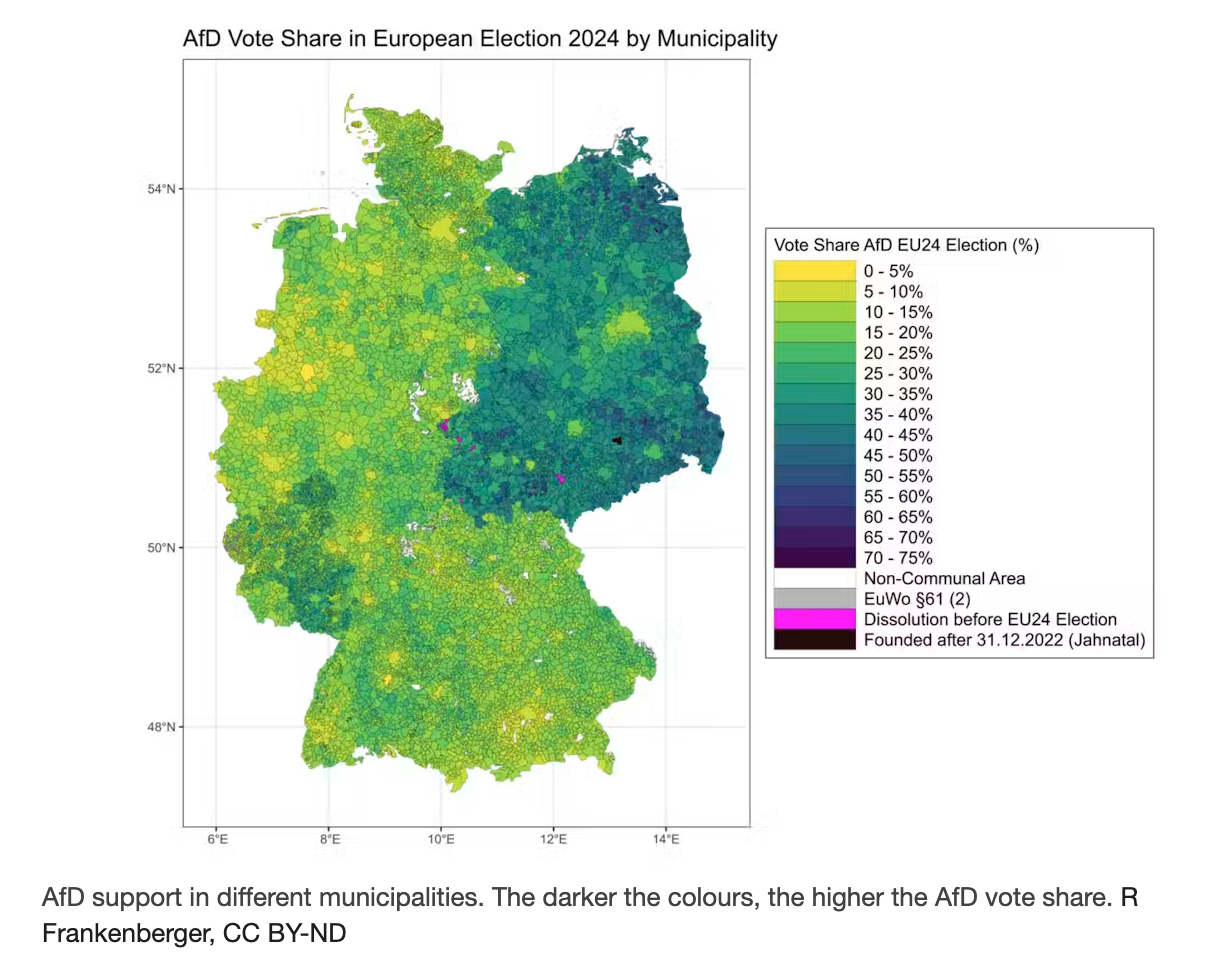
Rolf Frankenberger is a research expert at the Institute for Research on Right-Wing Extremism at the University of Tübingen, and his recent report in the Conversation (link) is very interesting. Most striking is the map he reproduces recording support for AfD by municipality in the 2024 European elections in Germany.
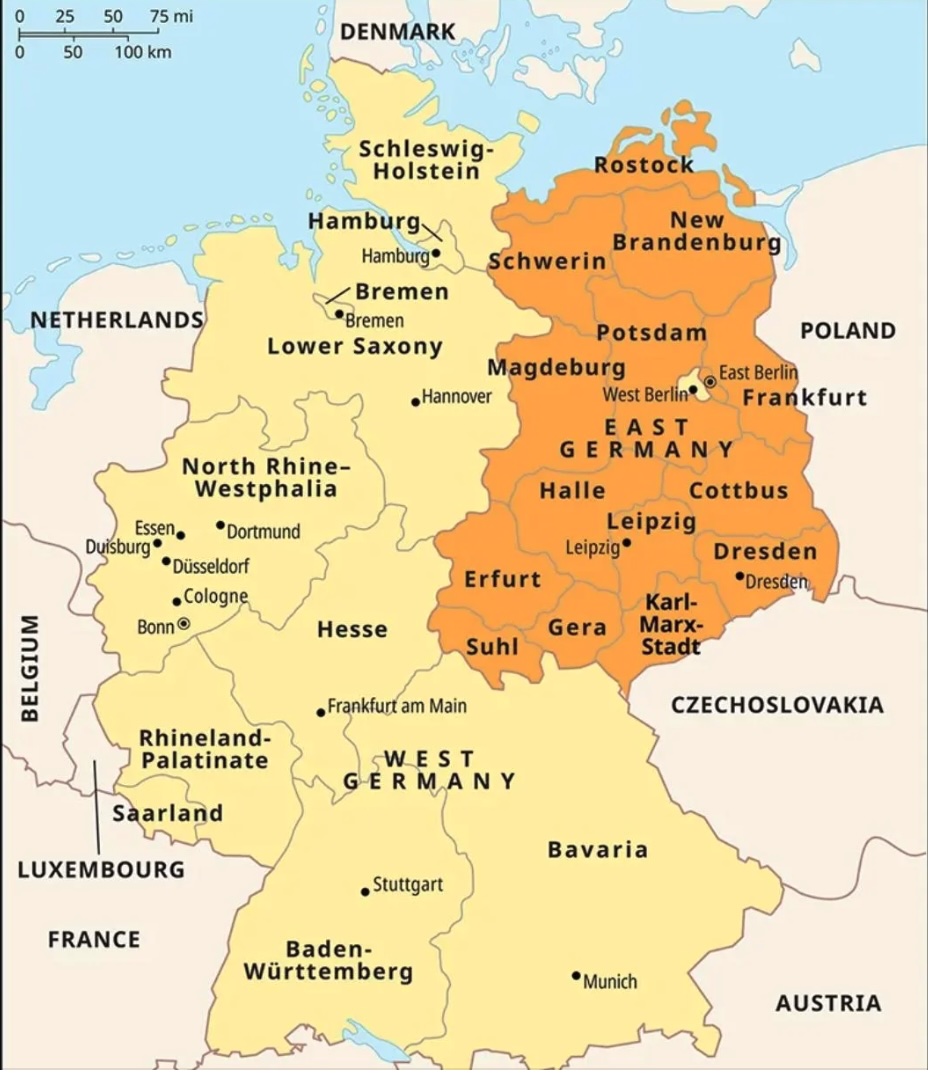
The geographical distribution of support for AfD is striking. It is concentrated in precisely the pre-unification states of the German Democratic Republic (GDR). Here is a map of East and West Germany from 1980.
To many observers, the most significant change in life for German people in the past fifty years is the reunification of Germany that occurred in 1990. And the lives of young people in the east changed much more dramatically than their counterparts in the west.
Frankenberger wants to understand the mechanisms leading to risinig support for the far right. However, he emphasizes a different factor than the reunification issues: the divide between urban and rural social life.
A new division has emerged as a result between the urban and the rural. The two are more than just forms of settlements – they reflect ideals, values and lifestyles. Those who live in towns and cities lead almost entirely different lives to those who live in the countryside.
Frankenberger pinpoints a clash of cultures as a key to the rise of support for the far right. On his view, rural people are increasingly likely to be mobilized around what has been portrayed as “threats” to their traditional ways of life. Even solar-power windmills are hated, according to Frankenberger, because they disrupt the countryside for the benefit of “modern” urban dwellers. And on the other side of the coin, urban dwellers are better educated, more economically mobile, and less attracted to the ideologies of the far right.
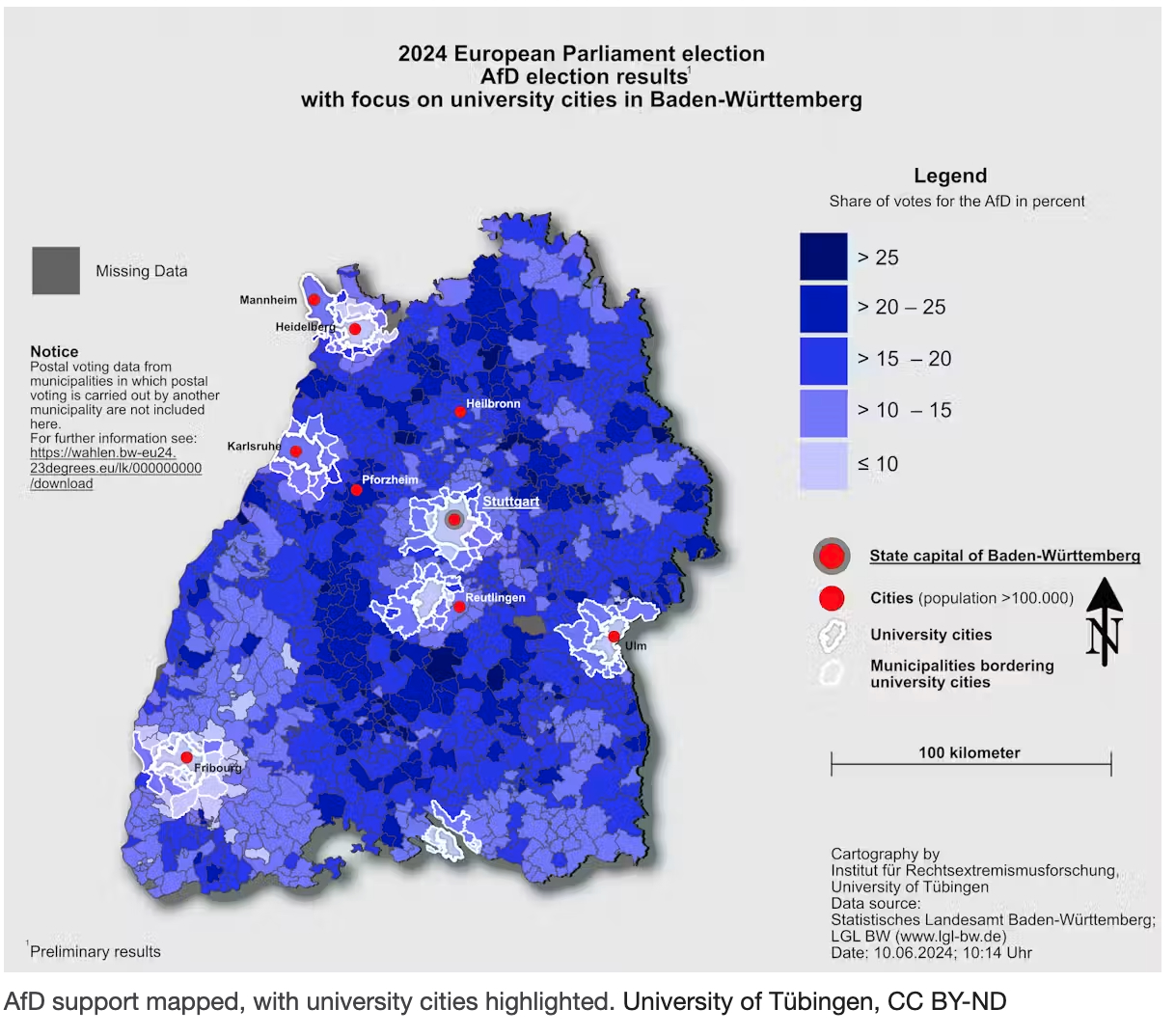
Here is Frankenberger’s presentation of the variation in support for AfD in Baden-Württemberg. In general the region produces a lower level of support for AfD; but Frankenberger emphasizes the variation across the state. Rural areas have produced significantly higher levels of support for AfD than urban areas, even in this state that was part of West Germany in 1980.
And he emphasizes the cultural conservatism of the rural areas in this region.
The Black Forest, the Swabian Forest, and Hohenlohe also have quite strong protestant and evangelical communities, which are strongholds of traditional family life, customs and traditions.
The impact of the university cities in the distribution of political attitudes across this map is visible and extensive. Each university city demonstrates less than 10% support for AfD, with the highest levels of support occurring in rural and forest areas exceeding 25%.
Frankenberger does not address the smoking gun in the first map above, however. This is the stark difference in patterns of support across the earlier political divide between the Federal Republic and the GDR. This divide seems to overshadow the urban-rural differences singled out here and to demand explanation. What accounts for the much higher level of support for far-right parties, including especially the AfD, by citizens from the former GDR? This question demands close attention. Was it deindustrialization? Was it abrupt “modernization” and erosion of traditional village and rural life? Was it an emerging trend in which women had different and better opportunities than men?
Another issue not addressed here is the gender gap in support for AfD in Germany. In recent elections a substantially higher percent of German men support AfD than women (26% against 11% in one recent poll). What explains this gap? Sabine Volk, another researcher at the Tübingen Institute, has addressed the role of antifeminism in the rise of the AfD and its particular intensity in the east in “The AfD and Antifeminism in Germany, 2014–2025: Family First, Trans Panic Second” (link). Again, this disparity between young men and young women in their political attitudes demands explanation.
Underlying all of these disparities is the urgent need to provide an account of the connection between events in the 1990s and the formation of political attitudes and values in German men and women who became adolescents and young adults after reunification.
And there is a second hanging question as well: why have other European countries (for example, Poland, Sweden, Russia, France, the Netherlands, or Italy) developed a cohort of young people in the same generation who seem to embrace very similar far-right political attitudes, even though their formative circumstances were quite different from those experienced in the former GDR region?
Here is a DW profile of one young far-right recruit (link). The video highlights a need for belonging experienced by young men, and offers a discussion of the roots of misogyny and the impact of social media and YouTube right-wing influencers.