Showing posts with label violence. Show all posts

Wednesday, April 15, 2026

Racist extremism and inter-group violence


Ethnic cleansing, Srebrenica, July 1995

Milan Obaidi is a prolific Danish social psychologist who has worked extensively on right-wing extremism. His scientific publications provide greater detail on his emerging views of the psychology of extremism. A useful document for the ongoing discussion of the mechanisms of right-wing extremism here is a well-documented 2020 summary of findings in the field of the social psychology of right-wing extremism here. The title is descriptive: “What are the psychological characteristics of people holding far-right beliefs?”. In this summary research report Obaidi singles out a handful of psychological characteristics that are associated with receptiveness to extremist beliefs and actions.

  • Avoidance of uncertainty or ambiguity
  • Rigid mindset
  • “Significance quest theory” (SQT)
  • Psychological distress and perceived deprivation
  • Need for cognitive closure

There is a substantial amount of overlap between these characteristics and the BUC(k)ET theory offered by Susan Fiske and Shelley Taylor (link), and it connects to Arie Kruglanski’s 3N theory of the psychology of hate-based extremism as well (Needs, Narratives, Networks). The quest for meaning, the desire for certainty (cognitive closure), and the emotional discomfort with uncertainty and ambiguity all align with Fiske and Taylor’s framework. And like the researchers who have developed the theory of Social Dominance Orientation (link), Obaidi’s account emphasizes a desire for maintaining an “in-group, out-group” division of society in which the extremist individual is in the dominant group. This corresponds to a perverse quest for “belonging” in the sense described by Fiske and Taylor.

Obaidi and his research collaborators have offered an ambitious attempt to unify several lines of thought in social psychology about right-wing extremism.

[Obaidi, Milan; Robin Bergh; Simon Ozer; and Cornelia Sindermann, 2025, “Toward an Integrated Psychological Model of Violent Extremism,” European Review of Social Psychology: 1-50. ]

Here is the abstract of their paper:

ABSTRACT The global threat of violent extremism (VE) has intensified in recent years, evidenced by a significant increase in violent incidents. Despite numerous theoretical and empirical explanations across disciplines, a lack of cross-fertilisation between these research domains has hindered the development of a comprehensive understanding of VE. To bridge this gap, this review integrates diverse lines of research into a comprehensive psychological model of VE, synthesising objective situations, subjective appraisals, and key individual psychological factors contributing to VE inclinations. We aim to develop a framework that more precisely demonstrates how these variables fit together, highlighting the added value of integration over piecemeal investigations. We specifically advocate for a multilevel approach that incorporates predictors from various levels of analysis to provide detailed mechanisms for how these variables relate to and complement one another. We further illuminate a multitude of mediation and moderation effects, some already tested empirically, while others await future research.

As the abstract emphasizes, their goal is to integrate “objective situations, subjective appraisals, and key individual psychological factors contributing to VE inclinations”, which they believe have been largely distinct research topics in past studies of violent extremism. They emphasize that they offer a multi-level analysis of the emergence of violent extremism, which includes information about surrounding social and economic conditions, prevalent ideologies, and individual psychological differences.

The focus on violent extremism requires some comment, since it is likely enough that the large majority of right-wing extremist young people in the US and other democracies draw the line at violence against others. The violent extremists in the United States (like the Michigan Wolverine militia group accused of planning to kidnap Michigan’s governor, or members of the Base, a clandestine terrorist group) are a minority of the right-wing movement (or so one would hope). So how much of the research described here can be applied to the broader group of young people who are “all in” for racist language, discrimination, taunting, and other harmful acts, without crossing the threshold of attacking a church, synagogue, or supermarket? Are non-violent right-wing extremists pretty much the same as violent right-wing extremists, except the latter group has a lower threshold for committing acts of violence? At various points Obaidi and his co-authors make it clear that their ultimate interest is in explaining the factors leading to the violent incidents, not the routine hate-based activism contributing to episodes like the “Young Republican chat channel” scandal of 2025, and this suggests the possibility that there may be important differences between the actively violent members of the far right and the ideological adherents.

Another valuable contribution made by Obaidi and his collaborators is a major empirical research project on the effects of Great Replacement Theory.

[Milan Obaidi, Jonas Kunst, Simon Ozer, and Sasha Y. Kimel, “The ‘Great Replacement’ conspiracy: How the perceived ousting of Whites can evoke violent extremism and Islamophobia” (Group Processes & Intergroup Relations 2022, 25(7) 1675­ –1695).]

This research treats the “Great Replacement” conspiracy theory as an incendiary issue currently being used to bring adherents and violent activists into antagonism and violence against other racial groups in the US and Europe, and these investigators attempt to provide empirical evidence concerning the population effects of this conspiracy theory. Here is the abstract for the article:

ABSTRACT Increased immigration and demographic changes have not only resulted in political pushback, but also in violent attacks against immigrants. Several recent terrorist attacks committed by White supremacists invoke rhetoric around a deliberate attempt to make Whites extinct and replace them with non-Western immigrants. Yet, while it is widely acknowledged among extremism researchers that this perception of orchestrated extinction or replacement has tremendous potential to lead to violent extremism, its consequences have not yet been directly examined. Using the Scandinavian context (e.g., Denmark and Norway), in two correlational studies and one experiment, we provide evidence that this perception is associated with the persecution of Muslims, violent intentions, and Islamophobia. Further, we demonstrate that these associations are mediated by symbolic threats. Conspiracy beliefs that one’s group is being replaced seem to drive hostile intergroup attitudes. We discuss the societal implications of this finding (i.e., generating fear, polarization, and hostile public opinion towards immigrants).

An important part of their analysis is their view that this conspiracy theory of “White extinction” is a deliberate strategic effort to show that some “enemy” intends to harm the white Christian population of the United States, and to use the spreading myth as a call to action by far-right leaders and activists. In particular, they call out Stephen Miller’s use of “Great Replacement Theory” to create support for his extremist strategies of expulsion for large numbers of the US immigrant community:

For example, recently leaked emails show the former White House senior advisor Stephen Miller promoting far-right extremist, White nationalist ideas, and anti-immigrant rhetoric through the conservative website Breitbart. Importantly too, he appeared fixated on the prospect of a “White genocide” (i.e., a conspiracy theory associated with White supremacists propagating the idea that the White race is dying due to growing non-White populations; Bellware, 2019). (1676)

Key to their interpretation of this conspiracy theory is the idea that the demographic shifts the US is experiencing are the result of deliberate efforts and actions by nefarious agents to bring about the decline of the white Christian population. The authors note that the same themes are being used in populist and right-wing extremist organizations and networks to stimulate fear and antagonism between “native” Europeans and immigrant people, often Muslim.

In recent years, the “Great Replacement” conspiracy has not only gained prominence among right-wing extremists but has also found a foothold among right-wing populist political parties in Europe. For example, while evoking anti-Muslim and anti-immigrant sentiment, such ideas have been espoused by the former leader of the Danish People’s Party Pia Kjærsgaard, the Prime Minister of Hungary Viktor Orbán, the Italian Interior Minister Matteo Salvini, and the leader of the far-right movement Rassemblement National Marine Le Pen (Alduy, 2017; Kingsley, 2019; Kjærsgaard, 2020). Various conservative intellectuals and far-right organizations have also utilized language that stokes fear about the decline of the “White race” and “White identity.” (1677)

Obaidi et al connect this use of the Great Replacement myth to the 3N theory of radicalization offered by David Webber and Arie Kruglanski. This is a theory of social mobilization based on three large factors — Needs, Narratives, and Networks, with a strong emphasis on the “quest for significance” on the part of potential followers.

[Webber, David and Arie W. Kruglanski. 2017. “Psychological Factors in Radicalization: A ‘3N’ Approach,” Handbook of the Criminology of Terrorism, eds. Gary LaFree and Joshua Freilich, Wiley Blackwell, 33-46.]

Here again it is worth noticing the convergence of this line of thought with that of Susan Fiske and Shelley Taylor in developing their BUC(k)ET model of cognitive and moral development discussed in an earlier post (link). The Great Replacement myth contributes to all of the core needs discussed by Fiske and Taylor: belonging, understanding, controlling, enhancing self, and trusting in-group.

What about the methodology used in these studies? Like Lior Zmigrod and her co-authors discussed in a previous post (link), Obaidi’s research methods are largely quantitative and statistical based on interview and survey data for about 100 subjects. The research goal is to provide a strong empirical basis for making claims about the causal relationships among variables. Here is a summary of some of the findings offered in the Great Replacement paper:
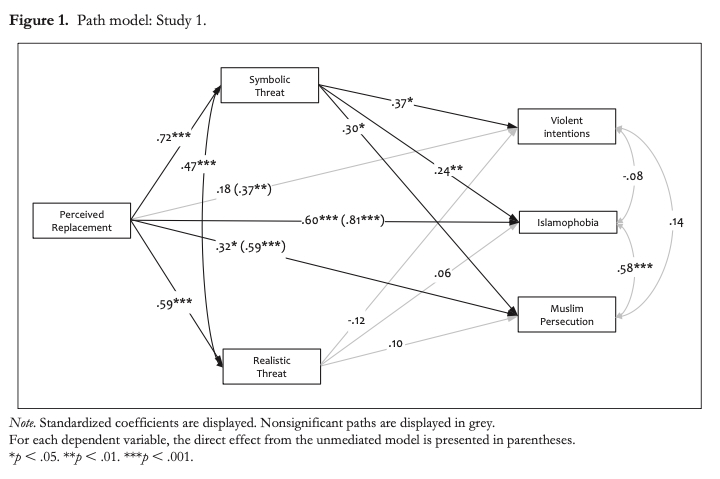
The graph represents correlations and associations among the identified variables, leading ultimately to behavioral outcomes (violent intentions, Islamophobia, Muslim persecution).

Do these findings have important implications for the future of inter-group violence in liberal democracies? Obaidi and his co-authors believe they do:

It has been suggested that immigration-related conspiracy theories trafficked by right-wing groups may nurture hate and violence against immigrants and asylum seekers in the West. Moreover, recent FBI documents predict that right-wing, conspiracy-driven extremism will increase in the next few years (Steinbuch, 2019). Indeed, new reports indicate that far-right terrorism has significantly outpaced other forms of terrorism (Jones et al., 2020). More specifically, right-wing terrorist incidents in the West have increased by 320% over the past 5 years (Institute for Economics & Peace, 2019). One of the most potent conspiracy theories evoked by right-wing extremists, politicians, and commentators is the “Great Replacement”—the conspiracy arguing that there is an attempt to replace the White autochthonous population with non-Western immigrants. (1687)

These are highly suggestive conclusions, and the research is very interesting. However, it would be useful to have a more extensive theoretical basis for linking the empirical results to a theory of the underlying psychological processes that generate them. Obaidi’s reference in the earlier paper to “objective situations, subjective appraisals, and key individual psychological factors contributing to VE inclinations” remains fairly vague. (This is perhaps predictable in a research program that is focused almost exclusively on identifying discrete operationalized variables that can be separately measured.) So once again, we are faced with the question: what processes and internal factors create attitudes of racist extremism among young people?

(The Southern Poverty Law Center 2024 report on White Nationalist organizations and activism in the US is detailed and alarming, and is very relevant to the findings discussed here; link.)

Monday, September 7, 2020

Mass murder in the borderlands


The facts of mass murder in eastern Europe in the 1930s through the 1950s are simply too horrific to fully absorb. These decades include the mass killings of millions of Jewish men, women, and children by the Nazi state and military and their collaborators in territories they conquered in eastern Europe -- the Holocaust. And they include the murder by Stalin and the deliberate policies of the Soviet state of further millions of peasants, Poles, and other ethnic minority populations in Ukraine, Belarus, and the Baltic states -- the Holodomor. Anne Applebaum's recent Red Famine: Stalin's War on Ukraine chronicles Stalin's war of starvation against the small farmers of the Ukraine and the deaths by hunger of almost four million people, the Holodomor. Applebaum's Gulag: A History provides a vivid and horrific account of the story of Stalin's prison camps and labor camps where his regime sent millions of "class enemies" to labor and often to die (link).

An earlier post discussed Tim Snyder's 2010 book Bloodlands: Europe Between Hitler and Stalin, which treats the almost unlimited mass killings of eastern Europe. Alexander Prusin's 2010 book The Lands Between: Conflict in the East European Borderlands, 1870-1992 treats roughly the same region over a longer time period (1870-1992), largely the same regimes of killing, and a somewhat different historiographic orientation.

Prusin describes his historical methodology in these terms.
The main methodology employed in this study can be dubbed 'integral' -- namely, it neither attempts to provide a detailed description of each borderland region, nor to illuminate all political and socio-economic changes that transpired in the borderlands as a whole. Rather it intends to create a larger synthetic narrative and analytical framework that encompasses all the borderlands as a specific region, giving it the appearance of a particular zone, within a specific time-frame and across whatever arbitrary and usually quite provisional international borders that had been determined by external or internal forces. (7)
Thus Prusin (like Snyder) defines his subject matter as a region rather than a nation or collection of nations. The national borders that exist within the region are of less importance in his account than the facts of ethnic, religious, and community disparities that are evident across the region. He chooses the concept of "borderlands" to capture the region he treats.
The term 'borderlands' here is applied in a geographical rather than in an ethnographic sense and implies as a spatial concept, a zone of overlapping, co-habitation, and contact between different polities, cultures, and peoples. In comparison, the more ideological term 'frontier' would denote a fluid zone within or outside of the state-organized society, even if bounded by clearly marked political boundaries. (10)
...
By the turn of the twentieth century approximately 16,352,000 people lived in the borderlands, including 10,809,000 on the Russian and 5,542,000 on the Austro-Hungarian side of the border. Situated on the fringes of the empires, the borderlands were 'incomplete societies', where modernity coexisted with the outdated socio-economic structures and socio-economic inequalities coincided with ethno-cultural categories, often defined in terms of religion. (38)
Snyder emphasizes the breakdown of state institutions in these "borderland" nations as a crucial determinant of the regimes of mass killing that ensued. Prusin too looks to the states -- Germany and the USSR -- and argues that these states, and their leaders and bureaucracies of killing, were the "main instigators of violence". The two views are complementary: when intact, state institutions in Ukraine, Poland, or Lithuania had some autonomous ability to subvert or ignore the murderous policies of the Nazi and Soviet states. Once destroyed, the local impulses of lethal anti-Semitism and the organized strategies of the German military occupiers spelt doom for millions of Jews and other victims.
The Soviet and German rule in the borderlands followed the same methods of eradicating 'class-enemies' or the racially 'inferior' ethnic groups. Both states greatly facilitated internal conflicts by encouraging latent hostilities and creating an environment in which inter-communal violence was conceived as a legitimate means and could assume a genocidal character. This study, accordingly, accentuates the role of the state as the main instigator of violence. (Prusin, 5)
Here is Prusin's map of the borderlands in 1920-1939:


Snyder's map of the bloodlands picks out essentially the same region as the "borderlands" delineated by Prusin.

Image: Snyder, Bloodlands

Prusin gives a great deal of attention to the ethnic groups and relationships (as well as antagonisms) that existed across each of the national jurisdictions of these borderland nations ("the amazing heterogeneity of the borderlands"; 15), as well as the empires (Russian and Austrian, and earlier, the Ottoman) that dominated the region for a century prior to the shattering associated with the end of the Great War into the 1930s. Prusin finds that the borderlands were exceptionally violent when it came to war and largescale conflict:
The frontier wars displayed the appalling combination of extreme violence such as pogroms, massacres, the murder of prisoners of war, and collective reprisals. Violence thrived within and without clear ideology foundations and it was committed in the name of ideology as well as base human instincts. Its most disturbing aspect, and arguably its most profound cause, was that in many instances the state structure ceased to exist. (87)
Mass killings and pogroms were familiar in the borderlands. But the German invasion of the USSR in June 1941 led to killings of many groups, including especially Jews, on a huge scale.
Since the mechanisms of the Holocaust in the different regions of the borderlands are discussed in numerous studies, this chapter focuses on the attitudes of the local population towards the situation of the Jews.... Local volunteers constituted a fraction of the populations in which they lived, but their involvement cut across social status, educational level, creed, and age, and entailed a variety of motives. While the political aspirations of the nationalist groups that were particularly active in the initial stages of the war diverged from the Nazi ideological objectives, their interests effectively converged in the elimination of the Jews as ideological enemies or socio-economic rivals. (150)
Writ large, Prusin's account of German invasion and occupation mirrors that of Jan Gross in Neighbors: The Destruction of the Jewish Community in Jedwabne, Poland (link). He notes, for example, that the mass executions of prisoners and class enemies committed by the Soviets as they retreated in face of the German armies were attributed to the Jews, and led to horrific reprisal mass killings of Jews. Prusin believes that the massive killings of Jews that occurred in the region were the result of the intersection of Nazi strategic aims (elimination of the Jews) and local antagonisms towards the Jewish population in these countries that could be triggered into a frenzy of mass killings.
It can be argued, however, that the combination of these factors was at the core of the pogroms. Since the annihilation of Jews was inseparable from the Nazi military and ideological preparations for the war, the invasion of the Soviet Union created a particularly murderous environment -- aptly named the 'Jedwabne state' by a prominent Polish historian -- whereby anti-Semitism and anti-Jewish violence were officially structured and integrated into the emerging pattern of the Holocaust. Where the Germans and Romanians did not partake directly in the pogroms, they acted as organizers and overseers, guiding and encouraging native-driven violence as long as it was directed against the specific target -- Jews. (154)
The initial period of "spontaneous" attacks on Jewish communities was followed in areas of Nazi occupation with organized systems for mass killing. These systems depended upon German leadership and organization, but also depended on large numbers of local volunteers who populated units assigned to eliminating Jews.
With the front moving eastward, the offices of the security and the Order Police commanders oversaw the reorganization of the native police forces that were to be deployed for regular duties, anti-partisan operations, and ultimately for the liquidation of Jews.... The constant shortage of German manpower was but one problem that the native auxiliaries helped resolve. As important was their ability and willingness to carry out the murder of thousands of men, women, and children, at least partially reducing the psychological stress and physical fatigue endured by the German police and security functionaries deployed in carrying out such tasks. Indeed, in any place where the 'Final Solution' was carried out, the role of the native policemen was crucial.... Some of the native police details smoothly mutated into proficient and zealous killing squads such as the notorious Arājs commando, which drove through Latvia and murdered at least 26,000 Jews." (169-170)
There is one striking topic where Prusin's book differs from Snyder's Bloodlands: the mass starvation in Ukraine in 1932-33 created by Stalin as a way of destroying "class enemies of the Soviet state" -- the Holodomor. This is a central topic in Bloodlands, but it receives no meaningful treatment in The Lands Between. Why is this? It seems as though it is a result of the way that Prusin defines his topic. Prusin's book addresses mass killing in the borderlands region; but its primary focus is on mass-killing and extermination as policies by states at war. Prusin provides detail about the wartime policies and actions of the Nazi military and the Soviet Union and Red Army in its treatment of the peoples of the Baltics, Ukraine, Poland, and the other parts of this tormented region, but the internal use of mass killing through starvation by Stalin is not part of his definition of the scope of the book -- apparently because at the time of this event, the people and territory were part of the Soviet Union. Prusin refers to a later period of famine in Ukraine caused by German military commanders (166), but he refers to the much larger Soviet famine of 1932-33 in just a single sentence: "By controlling food supplies, the state had at its disposal a powerful weapon to combat potential resistance, and in the early 1930s the Soviet government demonstrated its willingness to use this weapon to starve millions to death" (215). Here is a map of the extent of starvation in 1932-33:


The omission is perplexing. This region falls squarely within the borderlands that are the focus of Prusin's book. So why was it not part of the story that Prusin tells? Apparently simply because it was at that time a part of a powerful nation, the USSR, and not the result, directly or indirectly, of inter-state war. Ukraine was no longer a borderland but a national possession.

Prusin's book is an important contribution, and it is a good complement to Snyder's Bloodlands. In a very real sense each book sheds light that the other does not choose to discuss at all.

*    *    *

Prusin offers a quotation from Nicholai Bukharin, leading figure/victim in the Moscow show trials, that is grimly ironic eighty years later:
In the words of a prominent Soviet theoretician, Nicholai Bukharin, "however paradoxical it sounds, proletarian oppression (принуждение) in all its forms from executions to forced labour, is a method of the separating and forging the communist humankind from the capitalist epoch." (141)
So tovarishch [comrade] Bukharin, you pronounced your own death sentence under the banner of принуждение ... a term that is also translated as compulsion, coercion, constraint, duress, and forcing. In Moscow 1938 it meant a bullet in the back of the neck (link).

Saturday, September 5, 2020

The Gulag


The ruthless authoritarianism and tyranny of Stalinist rule depended on a leader, a party, and a set of institutions that worked to terrorize and repress the population of the USSR. The NKVD (the system of internal security police that enforced Stalin's repression), a justice system that was embodied in the Moscow Show Trials of 1936-38, and especially the system of forced labor and prison camps that came to be known as the Gulag were the sharp end of the stick -- the machinery of repression through which a population of several hundred million people were controlled, imprisoned, and repressed. And, like the Nazi regime, Stalin used the slave labor of the camps to contribute to the economic output of the Soviet economy.

Anne Applebaum's Gulag: A History is a detailed and honest history of the Gulag and its role in maintaining Soviet dictatorship. Here is her summary description of the Gulag:
Literally, the word GULAG is an acronym, meaning Glavnoe Upravlenie Lagerei, or Main Camp Administration. Over time, the word “Gulag” has also come to signify not only the administration of the concentration camps but also the system of Soviet slave labor itself, in all its forms and varieties: labor camps, punishment camps, criminal and political camps, women’s camps, children’s camps, transit camps. Even more broadly, “Gulag” has come to mean the Soviet repressive system itself, the set of procedures that prisoners once called the “meat-grinder”: the arrests, the interrogations, the transport in unheated cattle cars, the forced labor, the destruction of families, the years spent in exile, the early and unnecessary deaths. (13)
Here is a map of the locations of thousands of camps in the Gulag, according to the Gulag.online museum (link). (This site is worth visiting and exploring.) It is remarkable how many of the camps are in the borderlands or bloodlands of eastern Europe, Ukraine, and Baltic states as defined by Prusin and Snyder.


Applebaum estimates that roughly two million prisoners inhabited the camps at a time in the 1940s, and that as many as 18 million people had passed through the camps by 1953 (13). And the economic role of the Gulag was considerable:
By that time the camps had come to play a central role in the Soviet economy. They produced a third of the country’s gold, much of its coal and timber, and a great deal of almost everything else. In the course of the Soviet Union’s existence, at least 476 distinct camp complexes came into being, consisting of thousands of individual camps, each of which contained anywhere from a few hundred to many thousands of people. The prisoners worked in almost every industry imaginable—logging, mining, construction, factory work, farming, the designing of airplanes and artillery—and lived, in effect, in a country within a country, almost a separate civilization. (13)
Applebaum makes a crucial and important point about historical knowledge as she frames her attempt to put together the history of the Gulag: the inherent incompleteness of historical understanding and the mechanisms of overlooking and forgetting that get in the way of historical honesty. She notes that public knowledge of the camps outside the Soviet Union was available, but was de-dramatized and treated as a fairly minor part of the reality of the USSR.
Yet although they lasted as long as the Soviet Union itself, and although many millions of people passed through them, the true history of the Soviet Union’s concentration camps was, until recently, not at all well known. By some measures, it is still not known. Even the bare facts recited above, although by now familiar to most Western scholars of Soviet history, have not filtered into Western popular consciousness. “Human knowledge,” once wrote Pierre Rigoulot, the French historian of communism, “doesn’t accumulate like the bricks of a wall, which grows regularly, according to the work of the mason. Its development, but also its stagnation or retreat, depends on the social, cultural and political framework.” (16)
The reality -- that the USSR embodied and depended upon a massive set of concentrations camps where millions of people were enslaved and killed -- was never a major part of the Western conception of the USSR. She comments, "far more common, however, is a reaction of boredom or indifference to Stalinist terror" (18), and she quotes the odious Jean-Paul Sartre, apologist for Stalinism to the end:
“As we were not members of the Party,” he once wrote, “it was not our duty to write about Soviet labor camps; we were free to remain aloof from the quarrels over the nature of the system, provided no events of sociological significance occurred.” On another occasion, he told Albert Camus that “Like you, I find these camps intolerable, but I find equally intolerable the use made of them every day in the bourgeois press.” (18)
It is interesting though not surprising to know that there were a number of major rebellions in large camps in the Gulag, which Applebaum describes in a chapter called "The Zeks' Revolution". The largest of these was the Kengir uprising in Kazakhstan. This rebellion occurred in spring 1954 (after the death of Stalin) and was put down some 40 days later by overwhelming military force, including tanks. Solzhenitsyn provided an extensive description of this uprising in the third volume of Gulag Archipelago in a chapter titled "The forty days of Kengir" (link). (Here is an analysis of the Kengir uprising by Steven Barnes in Slavic Review; link.)

Wide knowledge in the West of the scope and specific human catastrophe of the Gulag was first made available by Aleksandr Isayevich Solzhenitsyn in The Gulag Archipelago, first published in Russian and English in 1973. And he wrote, not as an investigative journalist, but as a former prisoner, a zek. While serving in the Red Army in 1945 Aleksandr Isayevich was convicted of anti-Soviet propaganda under Article 58 and sentenced to eight years of forced labor. He spent the full eight years in several different camps in the Gulag, from 1945 to 1956. Following his release he lived in internal exile in Kazakhstan for several years before being pardoned by Nikita Khrushchev.

Here are the opening lines of The Gulag Archipelago:

How do people get to this clandestine Archipelago? Hour by hour planes fly there, ships steer their course there, and trains thunder off to it-but all with nary a mark on them to tell of their destination. And at ticket windows or at travel bureaus for Soviet or foreign tourists the employees would be astounded if you were to ask for a ticket to go there. They know nothing and they've never heard of the Archipelago as a whole or of anyone of its innumerable islands.

Those who go to the Archipelago to administer it get there via the training schools of the Ministry of Internal Affairs. Those who go there to be guards are conscripted via the military conscription centers.

And those who, like you and me, dear reader, go there to die, must get there solely and compulsorily via arrest.

Arrest! Need it be said that it is a breaking point in your life, a bolt of lightning which has scored a direct hit on you? That it is an unassimilable spiritual earthquake not every person can cope with, as a result of which people often slip into insanity?

The Universe has as many different centers as there are living beings in it. Each of us is a center of the Universe, and that Universe is shattered when they hiss at you: "You are under arrest."

If you are arrested, can anything else remain unshattered by this cataclysm?


In 1978 -- thirty-three years after his own arrest at the German front while serving as a decorated combat officer in the Red Army -- Solzhenitsyn gave the commencement address at Harvard University, and he offered these important words about hard truths:
Harvard's motto is "VERITAS." Many of you have already found out and others will find out in the course of their lives that truth eludes us as soon as our concentration begins to flag, all the while leaving the illusion that we are continuing to pursue it. This is the source of much discord. Also, truth seldom is sweet; it is almost invariably bitter. A measure of truth is included in my speech today, but I offer it as a friend, not as an adversary.
...
A decline in courage may be the most striking feature that an outside observer notices in the West today. The Western world has lost its civic courage, both as a whole and separately, in each country, in each government, in each political party, and, of course, in the United Nations. Such a decline in courage is particularly noticeable among the ruling and intellectual elites, causing an impression of a loss of courage by the entire society. There are many courageous individuals, but they have no determining influence on public life.
Political and intellectual functionaries exhibit this depression, passivity, and perplexity in their actions and in their statements, and even more so in their self-serving rationales as to how realistic, reasonable, and intellectually and even morally justified it is to base state policies on weakness and cowardice. And the decline in courage, at times attaining what could be termed a lack of manhood, is ironically emphasized by occasional outbursts and inflexibility on the part of those same functionaries when dealing with weak governments and with countries that lack support, or with doomed currents which clearly cannot offer resistance. But they get tongue-tied and paralyzed when they deal with powerful governments and threatening forces, with aggressors and international terrorists.
The primary truths that Solzhenitsyn addressed that afternoon in Cambridge concerned the realities of colonialism and the Cold War and the moral failures of Western intellectuals and political leaders to confront authoritarianism and injustice. These are important words for us in the United States today; both truth and courage are called for. But beyond the present, these ideas underline the importance of the honest historical writings of scholars like Snyder, Judt, Applebaum, Gross, and Prusin in describing the catastrophes of the twentieth century. Solzhenitsyn himself demonstrated that courage and that commitment to revealing the truth about a gigantic and secret system of repression.

source: Russia Beyond

Wednesday, March 25, 2020

Brass on anti-Muslim violence in India


The occurrence of anti-Muslim violence, arson, and murder in New Delhi last month is sometimes looked at a simply an unpredictable episode provoked by protest against the citizenship legislation enacted by the BJP and Prime Minister Modi. (See Jeffrey Gettleman and Maria Abi-Habib's New York Times article for a thoughtful and detailed account of the riots in New Delhi; link.) However, Paul Brass demonstrated several decades ago in The Production of Hindu-Muslim Violence in Contemporary India, that riots and violent episodes like this have a much deeper explanation in Indian politics. His view is that the political ideology of Hindutva (Hindu nationalism) is used by BJP and other extremist parties to advance its own political fortunes. This ideology (and the political program it is designed to support) is a prime cause of continuing violence by Hindu extremists against Muslims and other non-Hindu minorities in India.

Brass asks a handful of crucial and fundamental questions: Do riots serve a function in Indian politics? What are the political interests that are served by intensifying mistrust, fear, and hatred of Muslims by ordinary Hindu workers, farmers, and shopkeepers? How does a framework of divisive discourse contribute to inter-group hatred and conflict? “I intend to show also that a hegemonic discourse exists in Indian society, which I call the communal discourse, which provides a framework for explaining riotous violence.” (24). Throughout Brass keeps the actors in mind -- including leaders, organizers, and participants: “It is one of the principal arguments of this book that we cannot understand what happens in riots until we examine in detail the multiplicity of roles and persons involved in them”. (29) Here are the central themes of the book:
The whole political order in post-Independence north India and many, if not most of its leading as well as local actors—more markedly so since the death of Nehru—have become implicated in the persistence of Hindu-Muslim riots. These riots have had concrete benefits for particular political organizations as well as larger political uses. (6)
The maintenance of communal tensions, accompanied from time to time by lethal rioting at specific sites, is essential for the maintenance of militant Hindu nationalism, but also has uses for other political parties, organizations, and even the state and central governments. (9)
Brass documents his interpretation through meticulous empirical research, including a review of the demographic and political history of regions of India, a careful timeline of anti-Muslim riots and pogroms since Independence, and extensive interviews with participants, officials, and onlookers in one particularly important city, Aligarh, in Uttar Pradesh (northern India). Brass gives substantial attention to the discourse chosen by Hindu nationalist parties and leaders, and he argues that violent attacks are deliberately encouraged and planned.
Most commonly, the rhetoric is laced with words that encourage its members not to put up any longer with the attacks of the other but to retaliate against their aggression. There are also specific forms of action that are designed to provoke the other community into aggressive action, which is then met with a stronger retaliatory response. (24)
Brass asks the fundamental question:
What interests are served and what power relations are maintained as a consequence of the wide acceptance of the reality of popular communal antagonisms and the inevitability of communal violence? (11)
(We can ask the same question about the rise of nationalist and racist discourse in the United States in the past fifteen years: what interests are served by according legitimacy to the language of white supremacy and racism in our politics?)

Brass rejects the common view that riots in India are “spontaneous” or "responsive to provocation"; instead, he argues that communal Hindu-nationalist riots are systemic and strategic. Violence derives from a discourse of Hindu-Muslim hostility and the legitimization of violence. Given this view that riots and anti-Muslim violence are deliberate political acts in India, Brass offers an analysis of what goes into "making of a riot". He argues that there are three analytically separable phases: preparation / rehearsal; activation / enactment; and explanation / interpretation (15). This view amounts to an interpretation of the politics of Hindu nationalism as an "institutionalized riot system" (15).
When one examines the actual dynamics of riots, one discovers that there are active, knowing subjects and organizations at work engaged in a continuous tending of the fires of communal divisions and animosities, who exercise by a combination of subtle means and confrontational tactics a form of control over the incidence and timing of riots.” (31)
This deliberate provocation of violence was evident in the riots in Gujarat in 2002, according to Dexter Filkins in a brilliant piece of journalism on these issues in the New Yorker (link):
The most sinister aspect of the riots was that they appeared to have been largely planned and directed by the R.S.S. Teams of men, armed with clubs, guns, and swords, fanned out across the state’s Muslim enclaves, often carrying voter rolls and other official documents that led them to Muslim homes and shops.
Especially important in the question of civil strife and ethnic conflict in any country is the behavior and effectiveness of the police. Do the police work in an even-handed way to suppress violent acts and protect all parties neutrally? And does the justice system investigate and punish the perpetrators of violence? In India the track record is very poor, including in the riots in the early 1990s in Mumbai and in 2002 in Gujarat. Brass writes:
The government of India and the state governments do virtually nothing after a riot to prosecute and convict persons suspected of promoting or participating in riots. Occasionally, but less frequently in recent years, commissions of inquiry are appointed. If the final reports are not too damaging to the government of the day or to the political supporters of that government in the Hindu or Muslim communities, the report may be published More often than not, there is a significant delay before publication. Some reports are never made public. (65)
This pattern was repeated in Delhi during the most recent period of anti-Muslim pogrom. The police stand by while Hindutva thugs attack Muslims, burn homes and shops, and murder the innocent. Conversely, when the police function as representatives of the whole of civil society rather than supporters of a party, they are able to damp down inter-religious killing quickly (as Brass documents in his examination of the period of relative peace in Aligarh between 1978-80 to 1988-90).

Brass is especially rigorous in his development of the case for the deliberate and strategic nature of anti-Muslim bigotry within the politics of Hindu nationalism and its current government. But other experts agree. For example, Ashutosh Varshney described the dynamics of religious conflict in India in very similar terms to those offered by Brass (link):
Organized civic networks, when intercommunal, not only do a better job of withstanding the exogenous communal shocks—like partitions, civil wars, and desecration of holy places; they also constrain local politicians in their strategic behavior. Politicians who seek to polarize Hindu and Muslims for the sake of electoral advantage can tear at the fabric of everyday engagement through the organized might of criminals and gangs. All violent cities in the project showed evidence of a nexus of politicians and criminals. Organized gangs readily disturbed neighborhood peace, often causing migration from communally heterogeneous to communally homogenous neighborhoods, as people moved away in search of physical safety. Without the involvement of organized gangs, large-scale rioting and tens and hundreds of killings are most unlikely, and without the protection afforded by politicians, such criminals cannot escape the clutches of law. Brass has rightly called this arrangement an institutionalized riot system. (378)
Varshney treats these issues in greater detail in his 2002 book, Ethnic Conflict and Civic Life: Hindus and Muslims in India.

The greatest impetus to the political use of the politics of hate and the program of Hindu nationalism was the campaign to destroy the Babri Mosque in Ayodhya, UP, in 1992. For an informative and factual account of the Babri Mosque episode and its role within the current phase of Hindu nationalism in India, see Abdul Majid, "The Babri Mosque and Hindu Extremists Movements"; link.

Saturday, February 22, 2020

Fascist attacks on democracy


The hate-based murders of at least nine young people in Hanau, Germany this week brought the world's attention once again to right-wing extremism in Germany and elsewhere. The prevalence of right-wing extremist violence in Germany today is shocking, and it presents a deadly challenge to democratic institutions in modern Germany. Here is the German justice minister, quoted in the New York Times (link):
“Far-right terror is the biggest threat to our democracy right now,” Christine Lambrecht, the justice minister, told reporters on Friday, a day after joining the country’s president at a vigil for the victims. “This is visible in the number and intensity of attacks.”
Extremist political parties like the Alternative for Germany and the National Democratic Party (link, link) have moved from fringe extremism to powerful political organizations in Germany, and it is not clear that the German government has strategies that will work in reducing their power and influence. Most important, these parties, and many other lesser organizations, spread a message of populist hate, division, and distrust that motivates some Germans to turn to violence against immigrants and other targeted minorities. These political messages can rightly be blamed for cultivating an atmosphere of hate and resentment that provokes violence. Right-wing populist extremism is a fertile ground for political and social violence; hate-based activism leads to violence. (Here is an excellent report from the BBC on the political messages and growing political influence of AfD in Germany (link).)

Especially disturbing for the fate of democracy in Germany is the fact that there is a rising level of violence and threat against local elected officials in Germany over their support for refugee integration. (Here is a story in the New York Times (2/21/20) that documents this aspect of the crisis; link.) The story opens with an account of the near-fatal attack in 2015 on Henriette Reker, candidate for mayor of Cologne. She survived the attack and won the election, but has been subject to horrendous death threats ever since. And she is not alone; local officials in many towns and municipalities have been subjected to similar persistent threats. According to the story, there were 1,240 politically motivated attacks against politicians and elected officials (link). Of these attacks, about 33% are attributed to right-wing extremists, about double the number attributed to left-wing extremists. Here is a summary from the Times story:
The acrimony is felt in town halls and village streets, where mayors now find themselves the targets of threats and intimidation. The effect has been chilling. 
Some have stopped speaking out. Many have quit, tried to arm themselves or taken on police protection. The risks have mounted to such an extent that some German towns are unable to field candidates for leadership at all. 
“Our democracy is under attack at the grass-roots level,” Ms. Reker said in a recent interview in Cologne’s City Hall. “This is the foundation of our democracy, and it is vulnerable.” 
This is particularly toxic for the institutions of democratic governance, because the direct and obvious goal is to intimidate government officials from carrying out their duties. This is fascism.

What strategies exist that will help to reduce the appeal of right-wing extremism and the currents of hatred and resentment that these forms of populism thrive on? In practical terms, how can liberal democracies (e.g. Germany, Britain, or the United States) reduce the appeal of white supremacy, nationalism, racism, and xenophobia while enhancing citizens' commitment to the civic values of equality and rule of law?

One strategy involves strengthening the institutions of democracy and the trust and confidence that citizens have in those institutions. This is the approach developed in an important 2013 issue of Daedalus (link) devoted to civility and the common good. This approach includes efforts at improving civic education for young people. It also includes reforming political and electoral institutions in such a way as to address the obvious sources of inequality of voice that they currently involve. In the United States, for example, the prevalence of extreme and politicized practices of gerrymandering has the obvious effect of reducing citizens' confidence in their electoral institutions. Their elected officials have deliberately taken policy steps to reduce citizens' ability to affect electoral outcomes. Likewise, the erosion of voting rights in the United States through racially aimed changes to voter registration procedures, polling hours and locations, and other aspects of the institutions of voting provokes cynicism and detachment from the institutions of government. (McAdam and Kloos make these arguments in Deeply Divided: Racial Politics and Social Movements in Postwar America.)

Second, much of the appeal of right-wing extremism turns on lies about minorities (including immigrants). Mainstream and progressive parties should do a much better job of communicating the advantages to the whole of society that flow from diversity, talented immigrants, and an inclusive community. Mainstream parties need to expose and de-legitimize the lies that right-wing politicians use to stir up anger, resentment, and hatred against various other groups in society, and they need to convey a powerful and positive narrative of their own.

Another strategy to enhance civility and commitment to core democratic values is to reduce the economic inequalities that all too often provoke resentment and distrust across groups within society. Justin Gest illustrates this dynamic in The New Minority; the dis-employed workers in East London and Youngstown, Ohio have good reason to think their lives and concerns have been discarded by the economies in which they live. As John Rawls believed, a stable democracy depends upon the shared conviction that the basic institutions of society are working to the advantage of all citizens, not just the few (Justice as Fairness: A Restatement).

Finally, there is the police response. Every government has a responsibility to protect its citizens from violence. When groups actively conspire to commit violence against others -- whether it is Baader-Meinhof, radical spinoffs of AfD, or the KKK -- the state has a responsibility to uncover, punish, and disband those groups. Germany's anti-terrorist police forces are now placing higher priority on right-wing terrorism than they apparently have done in the past, and this is a clear responsibility for a government with duty for ensuring the safety of the public (link). (It is worrisome to find that members of the police and military are themselves sometimes implicated in right-wing extremist groups in Germany.) Here are a few paragraphs from a recent Times article on arrests of right-wing terrorists:
BERLIN — Twelve men — one a police employee — were arrested Friday on charges of forming and supporting a far-right terrorism network planning wide-ranging attacks on politicians, asylum seekers and Muslims, the authorities said. 
The arrests come as Germany confronts both an increase in violence and an infiltration of its security services by far-right extremists. After focusing for years on the risks from Islamic extremists and foreign groups, officials are recalibrating their counterterrorism strategy to address threats from within. 
The arrests are the latest in a series of episodes that Christine Lambrecht, the justice minister, called a “very worrying right-wing extremist and right-wing terrorist threat in our country.” 
“We need to be particularly vigilant and act decisively against this threat,” she said on Twitter. (link)
The German political system is not well prepared for the onslaught of radical right-wing populism and violence. But much the same can be said in the United States, with a president who espouses many of the same hate-based doctrines that fuel the rise of radical populism in other countries, and in a national climate where hate-based crimes have accelerated in the past several years. (Here is a recent review of hate-based groups and crimes in the United States provided by the Southern Poverty Law Center; link.) And, like Germany, the FBI has been slow to place appropriate priority on the threat of right-wing terrorism in the United States.

(This opinion piece in the New York Times by Anna Sauerbrey (link) describes one tool available to the German government that is not available in the United States -- strong legal prohibitions of neo-Nazi propaganda and incitement to hatred:
“There is the legal concept of Volksverhetzung,” the incitement to hatred: Anybody who denigrates an individual or a group based on their ethnicity or religion, or anybody who tries to rouse hatred or promotes violence against such a group or an individual, could face a sentence of up to five years in prison.
Because of virtually unlimited protection of freedom of speech and association guaranteed in the First Amendment of the Bill of Rights, these prohibitions do not exist in the United States. Here is an earlier discussion of this topic (link).)

Wednesday, September 20, 2017

Experiencing the Holocaust


When we think we know about an historical event -- the French Revolution, the Spanish Civil War, the Jim Crow years in America -- generally what we know is a limited and miscellaneous set of facts, impressions, interpretations, and summaries we have gathered through many avenues -- monographs, novels, films, poetry, historical lectures in college. No one now living has had direct experience of the French Revolution. And even if we came across a time-traveling Parisian from the relevant dates, we would probably quickly learn that this person's perspective on the events he or she lived through is highly limited and perhaps even misleading.

What do most American adults know about the Holocaust? Here are some core beliefs that most people could probably recite. It was a horrible crime. It was a deliberate program of extermination. Over six million Jewish men, women, and children were murdered. Other groups were also targeted, including Roma people, homosexuals, and Communists. It was the result of racist Nazi ideology. There were particular agents of this evil -- Hitler, Himmler, Göring, Hess, ... There were countless ordinary people across the face of Europe, in Germany and many other countries, who facilitated this evil -- the "banality of evil". There were some heroes who fought against the killing -- Wallenberg, Schindler, Bonhoeffer, Marc Bloch, the villagers of Le Chambron. There are noted tragic victims -- Anne Frank, Maximilian Kolbe. And the Allies could have done much more to disrupt the killing and to facilitate escape for the Jews of Europe.

But notice how thin this body of beliefs is. It is barely thick enough to constitute "knowledge of the Holocaust". It is encapsulated in just a few sentences. If it has emotional content it is a hazy version of the emotions of pity and sorrow. Is this knowledge adequate to the realities it represents? When we repeat the words, "Never again!", do we know what we are saying? And how can a more full and satisfactory level of knowledge of this horrifying and defining event in the twentieth century be achieved?

Here is one possible answer. There is a different way of gaining a more personal and nuanced understanding of the Holocaust -- an extended visit to Auschwitz and Birkenau (link). It is a museum, an historical site, a killing ground, a place where one and a half million people were systematically murdered.  A visit to the concentration camps is a very different avenue of knowledge -- knowledge through personal, empathic understanding of the vastness and horror of the crimes committed here.

So, for example, one can see the photographs of individual prisoners, their life stories encapsulated by the date and place of their arrest and the date of their death in the gas chambers. One can read a very personal family tragedy in these photographs.


There are mountains of human hair. There are piles of kitchen goods, shoe polish, clothing, combs, and other items of daily life, all carried through their final days of desperation and transit, all stolen from the dead. There are the drawings by child prisoners found on the walls of the barracks, depicting scenes of concentration camp life through the eyes of children. These children too mostly did not survive. 


This drawing by a child depicts something the child must have seen -- the arrival of prisoners and their separation at the platform into those who would perform slave labor and those who would die immediately.

So an intensive visit to Auschwitz is very powerful at the level of emotion and empathy. It makes the horror of the Holocaust both personal and particular. The visitor is led to imaginatively place himself or his loved ones on the platform, in the barracks, in the changing room. The Holocaust is no longer just a set of numbers and facts, but am invitation to vicarious empathic understanding -- and then a mental multiplication of that experience by a factor of millions. 


The museum and grounds of the death camps of Auschwitz-Birkenau receive over two million visitors a year, from dozens of countries. Some number of these visitors are perhaps unaffected by what they see. But surely large numbers of visitors are profoundly affected, and come to have a much more nuanced and personal understanding of what happened here. And surely this is a more important way of influencing our collective understanding of the Holocaust than any number of monographs.

There is a practical consequence of this kind of more personal experience of an historical horror. This experience strongly pushes the person to consider how the currents of hate that led to this historical crime are present in the world today. It leads one to care in a more particular way about the Rohingya people today, or about the resurgence of white supremacy and anti-Semitism in the United States at Charlottesville. And it brings one to see the danger implicit in anti-Muslim bigotry in the United States and other countries today.

In other words, we may speculate that the more particular experience of the Holocaust afforded by a meaningful visit to Auschwitz contributes to creating a different kind of twenty-first century citizen, one who has a deeper visceral appreciation of what these crimes of the Nazi period involved in human terms, and a better and deeper understanding of the enormity of this experience. Equally important, it helps to create a much more specific emotional experience of pity and sorrow that honors the humanity of these millions of human beings who were murdered during this period. 

(I offer special thanks to Teresa Wontor-Cichy, a senior researcher and educator at the museum, for the very intensive tour of Auschwitz and Birkenau that she provided.)

Monday, August 1, 2016

Ethnography of the far right


Can we understand the dynamics of far-right extremism without understanding far-right extremists? Probably not; it seems clear we need to have a much more "micro" understanding of the actors than we currently have if we are to understand these movements so antithetical to the values of liberal democracy. And yet there isn't much of a literature on this subject.

An important exception is a 2007 special issue of the Journal of Contemporary Ethnography, curated by Kathleen Blee (link). This volume brings together several ethnographic studies of extremist groups, and it makes for very interesting reading. Kathleen Blee is a pioneer in this field and is the author of Inside Organized Racism: Women in the Hate Movement (2002). She writes in Inside Organized Racism:
Intense, activist racism typically does not arise on its own; it is learned in racist groups. These groups promote ideas radically different from the racist attitudes held by many whites. They teach a complex and contradictory mix of hatred for enemies, belief in conspiracies, and allegiance to an imaginary unified race of "Aryans." (3)
One of Blee's key contributions has been to highlight the increasingly important and independent role played by women in right-wing extremist movements in the United States and Europe.

The JCE issue includes valuable studies of right-wing extremist groups in India, France, Germany, the Netherlands, and Scandinavia. And each of the essays is well worth reading, including especially Blee's good introduction. Here is the table of contents:


Key questions concerning the mechanisms of mobilization arise in almost all the essays. What are the mechanisms through which new adherents are recruited? What psychological and emotional mechanisms are in play that keep loyalists involved in the movement? Contributors to this volume find a highly heterogeneous set of circumstances leading to extremist activism. Blee argues that an internalist approach is needed to allow us to have a more nuanced understanding of the social and personal dynamics of extremist movements. What she means by externalist here is the idea that there are societal forces and "risk factors" that contribute to the emergence of hate and racism within a population, and that these factors can be studied in a general way. An internalist approach, by contrast, aims at discovering the motives and causes of extremist engagement through study of the actors themselves, within specific social circumstances.
But it is problematic to use data garnered in externalist studies to draw conclusions about micromobilization since it is not possible to infer the motivations of activists from the external conditions in which the group emerged. Because people are drawn to far-right movements for a variety of reasons that have little connection to political ideology (Blee 2002)—including a search for community, affirmation of masculinity, and personal loyalties— what motivates someone to join an anti-immigrant group, for example, might—or might not—be animus toward immigrants. (120)
Based on interviews, participant-observation, and life-history methods, contributors find a mix of factors leading to the choice of extremist involvement: adolescent hyper-masculinity, a desire to belong, a history of bullying and abuse, as well as social exposure to adult hate activists. But this work is more difficult than many other kinds of ethnographic research because of the secrecy, suspiciousness, and danger associated with these kinds of activism:
Close-up or “internalist” studies of far-right movements can provide a better understanding of the workings of far-right groups and the beliefs and motivations of their activists and supporters, but such studies are rare because data from interviews with members, observations of group activities, and internal documents are difficult to obtain.... Few scholars want to invest the considerable time or to establish the rapport necessary for close-up studies of those they regard as inexplicable and repugnant, in addition to dangerous and difficult. Yet, as the articles in this volume demonstrate, internalist studies of the far right can reveal otherwise obscured and important features of extreme rightist political mobilization. (121-122)
A few snippets will give some flavor of the volume. Here is Michael Kimmel's description of some of the young men and boys attracted to the neo-Nazi movement in Sweden:
Insecure and lonely at twelve years old, Edward started hanging out with skinheads because he “moved to a new town, knew nobody, and needed friends.” Equally lonely and utterly alienated from his distant father, Pelle met an older skinhead who took him under his wing and became a sort of mentor. Pelle was a “street hooligan” hanging out in street gangs, brawling and drinking with other gangs. “My group actually looked down on the neo-Nazis,” he says, because “they weren’t real fighters.” “All the guys had an insecure role as a man,” says Robert. “They were all asking ‘who am I?’” ...
Already feeling marginalized and often targeted, the boys and men described themselves as “searchers” or “seekers,” kids looking for a group with which to identify and where they would feel they belonged. “When you enter puberty, it’s like you have to choose a branch,” said one ex-Nazi. “You have to choose between being a Nazi, anti-Nazi, punk or hip- hopper—in today’s society, you just can’t choose to be neutral” (cited in Wahlstrom 2001, 13-14). ...
For others, it was a sense of alienation from family and especially the desire to rebel against their fathers. “Grown-ups often forget an important component of Swedish racism, the emotional conviction,” says Jonas Hallen (2000). “If you have been beaten, threatened, and stolen from, you won’t listen to facts and numbers.”(209-210)
Here is Meera Sehgal's description of far-right Hindu nationalist training camps for young girls in India:
The overall atmosphere of this camp and the Samiti’s camps in general was rigid and authoritarian, with a strong emphasis on discipline. ... A number of girls fell ill with diarrhea, exhaustion, and heat stroke. Every day at least five to ten girls could be seen crying, wanting to go home. They pleaded with their city’s local Samiti leaders, camp instructors, and organizers to be allowed to call their parents, but were not allowed to do so. ... Neither students nor instructors were allowed to get sufficient rest or decent food.

The training was at a frenetic pace in physically trying conditions. Participants were kept awake and physically and mentally engaged from dawn to late night. Approximately four hours a day were devoted to physical training; five hours to ideological indoctrination through lectures, group discussions, and rote memorization; and two hours to indoctrination through cultural programming like songs, stories, plays, jokes, and skits. Many girls and women were consequently soon physically exhausted, and yet were forced to continue. The systematic deprivation of adequate rest and food may have been a deliberate ploy of the camp organizers to reduce the chances of dissent since time, energy, initiative, and planning are needed to develop a collective sense of grievance.

Indoctrination, which was the Samiti’s first priority, ranged from classroom lectures and small and large group discussions led by different instructors, to nightly cultural programs where skits, storytelling, songs, and chants were taught by the instructors and seasoned activists, based on the lives of various “Hindu” women, both mythical and historical. (170)
And here is Fabian Virchow's description of the emotional power of music and spectacle at a neo-Nazi rally in Germany:
Festivals are excellent opportunities for far-right groups to spread the word about their successes to like-minded activists and sympathizers, since visitors come from as far away as Italy to see White Power music bands. In the festival mentioned above, a folk-dance act in the afternoon attracted only some hundred spectators, but evening performances by the U.S. band Youngland drew a large crowd that pushed to the front of the stage, leaving only limited space for burly skinheads indulging in pogo dancing. The music created a ritual closeness and attachment among the audience, shaping the emotions and aggression of the like-minded crowd, initially in a playful way, but one that switched into brutality a few moments later. 
The aggression of White Power music is evident in the messages of its songs, which are either confessing, demonstrating self-assertion against what is perceived as totally hostile surroundings, or requesting action (Meyer 1995). Using Heavy Metal or Oi Punk as its musical basis, White Power music not only attracts those who see themselves as part of the same political movement as the musicians, but also serves as one of the most important tools for recruiting new adherents to the politics of the far right (Dornbusch and Raabe 2002). 
Since the festival I visited takes place only once a year, and because performances of White Power bands are organized clandestinely in most cases and are often disrupted by the police, the far-right movement needs additional events to shape and sustain its collective identity. As the far right and the NPD and neo-Nazi groupuscules in particular regard themselves as a “movement of action,” it is no surprise that rallies play an important role in this effort. (151)
Each of these essays is based on first-hand observation and interaction, and they give some insight into the psychological forces playing on the participants as well as the mobilizational strategies used by the leaders of these kinds of movements. The articles published here offer a good cross-section of the ways in which ethnographic methods can be brought to bear on the phenomenon of extremist right-wing activism. And because the studies are drawn from five quite different national contexts (Sweden, Germany, Netherlands, India, France), it is intriguing to see some of the same mechanisms and dynamics in play in creating and sustaining an extremist movement. The importance of performance and music in eliciting loyal participation from young adherents comes up in the articles about Germany, Sweden, and India. Likewise the importance of the emotional needs of boys as they approach manhood, and the hyper-masculine themes of violence and brutality in the neo-Nazi organizations that appeal to them, recurs in several of the essays.

Along with KA KCreasap, Kathleen Blee is also the author of a 2010 review article on right-wing extremist movements in Annual Reviews of Sociology (link). These are the kinds of hate-based organizations and activists tracked by the Southern Poverty Law Center (link), and that seem to be more visible than ever before during the current presidential campaign. The essay pays attention to the question of the motivations and "risk factors" that lead people to join right-wing movements. Blee and Creasap argue that the motivations and circumstances of mobilization into right-wing organizations are substantially more heterogeneous than a simple story leading from racist attitudes to racist mobilization would suggest. They argue that antecedent racist ideology is indeed a factor, but that music, culture, social media, and continent social networks also play significant causal roles.