Showing posts with label analytical sociology. Show all posts

Wednesday, May 31, 2023

Key premises of analytical sociology

Image: residential segregation by race, NYC 2010

In Dissecting the Social Peter Hedström describes the analytical sociology approach in these terms: 

Although the term analytical sociology is not commonly used, the type of sociology designated by the term has an important history that can be traced back to the works of late nineteenth- and early twentieth-century sociologists such as Max Weber and Alexis de Tocqueville, and to prominent mid-twentieth-century sociologists such as the early Talcott Parsons and Robert K. Merton. Among contemporary social scientists, four in particular have profoundly influenced the analytical approach. They are Jon Elster, Raymond Boudon, Thomas Schelling and James Coleman. (Dissecting the Social, kl 113) 

And here is how Hedström and Bearman describe the approach in their introduction to The Oxford Handbook of Analytical Sociology

Analytical sociology is concerned first and foremost with explaining important social facts such as network structures, patterns of residential segregation, typical beliefs, cultural tastes, common ways of acting, and so forth. It explains such facts not merely by relating them to other social facts -- an exercise that does not provide an explanation -- but by detailing in clear and precise ways the mechanisms through which the social facts under consideration are brought about. In short, analytical sociology is a strategy for understanding the social world. (Hedström and Bearman, eds. 2009 : 3-4) 

Peter Demeulenaere makes several important points to further specify AS in his extensive introduction to Analytical Sociology and Social Mechanisms. He holds that AS is not just another new paradigm for sociology. Instead, it is a reconstruction of what valid explanations on sociology must look like, once we properly understand the logic of the social world. He believes that much existing sociology conforms to this set of standards -- but not all. And the non-conformers are evidently judged non-explanatory. For example, he writes, “Analytical sociology should not therefore be seen as a manifesto for one particular way of doing sociology as compared with others, but as an effort to clarify (“analytically”) theoretical and epistemological principles which underlie any satisfactory way of doing sociology (and, in fact, any social science)” (Demeulenaere, ed. kl 121). So this sets a claim of a very high level of authority over the whole field, implying that other decisions about explanation, ontology, and method are less than fully scientific. 

Analytical sociology rests on three central ideas. 

First, there is the idea that social outcomes need to be explained on the basis of the actions of individuals. Hedstrom, Demeulenaere, and their colleagues refer to this position as methodological individualism. It is often illustrated by reference to "Coleman's Boat" in James Coleman, Foundations of Social Theory (Coleman, 1990, 8) describing the relationship that ought to exist between macro and micro social phenomena (link). The boat diagram indicates the relationship between macro-factors (Protestant religious doctrine, capitalism) and the micro factors that underlie their causal relation (values, economic behavior). Here are a few of Hedström's formulations of this ontological position: 

In sociological inquiries, however, the core entity always tends to be the actors in the social system being analyzed, and the core activity tends to be the actions of these actors. (Dissecting, kl 106) 

To be explanatory a theory must specify the set of causal mechanisms that are likely to have brought about the change, and this requires one to demonstrate how macro states at one point in time influence individuals' actions, and how these actions bring about new macro states at a later point in time. (Dissecting, kl 143) 

In other words: according to analytical sociologists, a good explanation of a given social outcome is a demonstration of how this outcome is the aggregate result of structured individual actions. In particular, an explanation should not make reference to meso or macro level factors. 

In his introduction to Analytical Sociology and Social Mechanisms Demeulenaere provides an analysis of the doctrine of methodological individualism and its current status. He believes that criticisms of MI have usually rested on a small number of misunderstandings which he attempts to resolve. For example, MI is not "atomistic", "egoistic", "non-social", or exclusively tied to rational choice theory. He prefers a refinement that he describes as structural individualism, but essentially he argues that MI is a universal requirement on social science. Demeulenaere specifically disputes the idea that MI implies a separation between society and non-social individuals. That said, Demeulenaere fully endorses the idea that AS depends upon and presupposes MI: “Does analytical sociology differ significantly from the initial project of MI? I do not really think so. But by introducing the notion of analytical sociology we are able to make a fresh start and avoid the various misunderstandings now commonly attached to MI” (Demeulenaere ed. kl 318). 

A theory based on the individual needs to have a theory of the actor. Hedström and others in the AS field are drawn to a broad version of rational-choice theory -- what Hedström calls the "Desire-Belief-Opportunity theory". This is a variant of rational choice theory, because the actor's choice is interpreted along these lines: given the desires the actor possesses, given the beliefs he/she has about the environment of choice, and given the opportunities he/she confronts, action A is a sensible way of satisfying the desires. (It is worth pointing out that it is possible to be microfoundationalist about macro outcomes while not assuming that individual actions are driven by rational calculations. Microfoundationalism is distinct from the assumption of individual rationality.) 

Second is the idea that social actors are socially situated; the values, perceptions, emotions, and modes of reasoning of the actor are influenced by social institutions, and their current behavior is constrained and incentivized by existing institutions. (This position has a lot in common with the methodological localism; link.) Practitioners of analytical sociology are not atomistic about social behavior, at least in the way that economists tend to be; they want to leave room conceptually for the observation that social structures and norms influence individual behavior and that individuals are not unadorned utility maximizers. In the Hedström-Bearman introduction to the Handbook they refer to their position as “structural individualism”: 

Structural individualism is a methodological doctrine according to which social facts should be explained as the intended or unintended outcomes of individuals’ actions. Structural individualism differs from traditional methodological individualism in attributing substantial explanatory importance to the social structures in which individuals are embedded. (Hedström and Bearman, 2009, 4). 

Demeulenaere explicates the term by referring to Homans’ distinction between individualistic sociology and structural sociology; the latter “is concerned with the effects these structures, once created and maintained, have on the behaviour of individuals or categories of individuals” (Demeulenaere, Analytical Sociology and Social Mechanisms, 2011, introduction, quoting Homans, 1984). So “structural individualism” seems to amount to this: the behavior and motivations of individuals are influenced by the social arrangements in which they find themselves. 

This is a direction of thought that is not well developed within analytical sociology, but would repay further research. There is no reason why a methodological-individualist approach should not take seriously the causal dynamics of identity formation and the formation of the individual's cognitive, practical, and emotional frameworks. These are relevant to behavior, and they are plainly driven by concrete social processes and institutions. 

Third, and most distinctive, is the idea that social explanations need to be grounded in hypotheses about the concrete social causal mechanisms that constitute the causal connection between one event and another. Mechanisms rather than regularities or necessary/sufficient conditions provide the fundamental grounding of causal relations and need to be at the center of causal research. This approach has several intellectual foundations, but one is the tradition of critical realism and some of the ideas developed by Roy Bhaskar (link). 

Here is Hedström's statement of the position:

The position taken here, rather, is that mechanism-based explanations are the most appropriate type of explanations for the social sciences. The core idea behind the mechanism approach is that we explain a social phenomenon by referring to a constellation of entities and activities, typically actors and their actions, that are linked to one another in such a way that they regularly bring about the type of phenomenon we seek to explain. (Dissecting, kl 65) 

A social mechanism, as defined here, is a constellation of entities and activities that are linked to one another in such a way that they regularly bring about a particular type of outcome. (kl 181) 

Demeulenaere also emphasizes that AS depends closely on the methodology of social causal mechanisms. The "analytical" part of the phrase involves identifying separate things, and the social mechanisms idea says how these things are related. Causal mechanisms are expected to be the components of the linkages between events or processes hypothesized to bear a causal relation to each other. And, more specifically to the AS approach, the mechanisms are supposed to occur at the level of the actors--not at the meso or macro levels. So this means that AS would not countenance a meso-level mechanism like this: "the organizational form of the supervision structure at the Bhopal chemical plant caused a high rate of maintenance lapses that caused the accidental release of chemicals." The organizational form is a meso-level factor, and it would appear that AS would require that its causal properties be unpacked onto individual actors' behavior. (I, on the other hand, will argue below that this is a perfectly legitimate social mechanism because we can readily supply its microfoundations at the behavioral level. So this suggests that we can legitimately refer to meso-level mechanisms as long as we are mindful of the microfoundations requirement. And this corresponds as well to the tangible fact that institutions have causal force with respect to individuals. Here is an earlier discussion; link.) 

In addition to these three orienting frameworks for analytical sociology, there is a fourth characteristic that should be mentioned. This is the idea that the tools of computer-based simulation of the aggregate consequences of individual behavior can be a very powerful tool for sociological research and explanation. So the tools of agent-based modeling and other simulations of complex systems have a very natural place within the armoire of analytical sociology.  These techniques offer tractable methods for aggregating the effects of lower-level features of social life onto higher-level outcomes. If we represent actors as possessing characteristics of action X, Y, Z, and we represent their relations as U, V, W -- how do these actors in social settings aggregate to mid- and higher-level social patterns? This is the key methodological challenge that sociologists like Gianluca Manzo have explored (Agent-based Models and Causal Inference), and it produces very interesting results. 

This brief summary of the central doctrines of AS provides one reason why AS theorists are so concerned to have adequate and tractable models of the actor -- often rational actor models. Thomas Schelling's work provides a particularly key example for the AS research community; in field after field he demonstrates how micro motives aggregate onto macro outcomes (Schelling, 1978, 1984). And Elster's work is also key, in that he provides some theoretical machinery for analyzing the actor at a "thicker" level -- imperfect rationality, self-deception, emotion, commitment, and impulse (Elster, Ulysses and the Sirens). 

In short, analytical sociology is a compact, clear approach to the problem of understanding social outcomes. It lays the ground for the productive body of research questions associated with the "aggregation dynamics" research program. There is active, innovative research being done within this framework of ideas, especially in Germany, Sweden, and Great Britain. And its clarity permits, in turn, the formulation of rather specific critiques from researchers in other sociological traditions who reject one or another of the key components. However, the framework of analytical sociology should not be mistaken for a general approach to all sociological research and explanation. It is well suited to some problems, and less so to others.

(Here is an earlier post summarizing Peter Demeulenaere's account of analytical sociology; link.)

Friday, March 17, 2017

Mechanisms according to analytical sociology


One of the distinguishing characteristics of analytical sociology is its insistence on the idea of causal mechanisms as the core component of explanation. Like post-positivists in other traditions, AS theorists specifically reject the covering law model of explanation and argues for a "realist" understanding of causal relations and powers: a causal relationship between x and y exists solely insofar as there exist one or more causal mechanisms producing it generating y given the occurrence of x. Peter Hedström puts the point this way in Dissecting the Social:
A social mechanism, as defined here, is a constellation of entities and activities that are linked to one another in such a way that they regularly bring about a particular type of outcome. (kl 181)
A basic characteristic of all explanations is that they provide plausible causal accounts for why events happen, why something changes over time, or why states or events co-vary in time or space. (kl 207)
The core idea behind the mechanism approach is that we explain not by evoking universal laws, or by identifying statistically relevant factors, but by specifying mechanisms that show how phenomena are brought about. (kl 334)
A social mechanism, as here defined, describes a constellation of entities and activities that are organized such that they regularly bring about a particular type of outcome. (kl 342)
So far so good. But AS adds another requirement about causal mechanisms in the social realm that is less convincing: that the only real or credible mechanisms are those involving the actions of individual actors. In other words, causal action in the social world takes place solely at the micro level. This assumption is substantial, non-trivial, and seemingly dogmatic. 
Sociological theories typically seek to explain social outcomes such as inequalities, typical behaviours of individuals in different social settings, and social norms. In such theories individuals are the core entities and their actions are the core activities that bring about the social-level phenomena that one seeks to explain. (kl 356)
Although the explanatory focus of sociological theory is on social entities, an important thrust of the analytical approach is that actors and actions are the core entities and activities of the mechanisms explaining plaining such phenomena. (kl 383)
The theory should also explain action in intentional terms. This means that we should explain an action by reference to the future state it was intended to bring about. Intentional explanations are important for sociological theory because, unlike causalist explanations of the behaviourist or statistical kind, they make the act 'understandable' in the Weberian sense of the term.' (kl 476)
Here is a table in which Hedström classifies different kinds of social mechanisms; significantly, all are at the level of actors and their mental states.


The problem with this "action-level" requirement on the nature of social mechanisms is that it rules out as a matter of methodology that there could be social causal processes that involve factors at higher social levels -- organizations, norms, or institutions, for example. (For that matter, it also rules out the possibility that some individual actions might take place in a way that is inaccessible to conscious knowledge -- for example, impulse, emotion, or habit.) And yet it is common in sociology to offer social explanations invoking causal properties of things at precisely these "meso" levels of the social world. For example:
Each of these represents a fairly ordinary statement of social causation in which a primary causal factor is an organization, an institutional arrangement, or a normative system.

It is true, of course, that such entities depends on the actions and minds of individuals. This is the thrust of ontological individualism (link, link): the social world ultimately depends on individuals in relation to each other and in relation to the modes of social formation through which their knowledge and action principles have been developed. But explanatory or methodological individualism does not follow from the truth of ontological individualism, any more than biological reductionism follows from the truth of physicalism. Instead, it is legitimate to attribute stable causal properties to meso-level social entities and to invoke those entities in legitimate social-causal explanations. Earlier arguments for meso-level causal mechanisms can be found here, here, and here.

This point about "micro-level dogmatism" leads me to believe that analytical sociology is unnecessarily rigid when it comes to causal processes in the social realm. Moreover, this rigidity leads it to be unreceptive to many approaches to sociology that are perfectly legitimate and insightful. It is as if someone proposed to offer a science of cooking but would only countenance statements at the level of organic chemistry. Such an approach would preclude the possibility of distinguishing different cuisines on the basis of the palette of spices and flavors that they use. By analogy, the many approaches to sociological research that proceed on the basis of an analysis of the workings of mid-level social entities and influences are excluded by the strictures of analytical sociology. Not all social research needs to take the form of the discovery of microfoundations, and reductionism is not the only scientifically legitimate strategy for explanation.

(The photo above of a moment from the Deepwater Horizon disaster is relevant to this topic, because useful accident analysis needs to invoke the features of organization that led to a disaster as well as the individual actions that produced the particular chain of events leading to the disaster. Here is an earlier post that explores this feature of safety engineering; link.)

Tuesday, June 28, 2016

Complementarity of thick and thin theories of the actor


There is a range of approaches to the social sciences that fall under the umbrella of "actor-centered" theories (link). The chief fissure among these theories is that between "thin" and "thick" theories of the actor -- theories which provide less or more detail about the mental frameworks and beliefs of the actors being described. The extremes of the two types of theories range from pure rational choice theory to social psychology and ethnography. The two types of theories have complementary strengths and weaknesses. Thin theories, including especially rational choice theory and game theory, make use of a particularly sparse theory of the actor’s decision framework. This approach provides a basis for representing the motives and decisions of actors that can be readily incorporated into powerful techniques of simulation and calculation. Thick theories, including pragmatist and ethnomethodological theories, offer a basis for investigating particular social settings of action in detail, and they provide an in-depth basis for explaining and understanding the choices, judgments, and behavior of the individuals they study. But thick theories are not so readily incorporated into simulation models, precisely because they do not provide abstract, general characterizations of the individual’s action framework.

These comments make the contrast sound like a familiar set of oppositions: nomothetic explanation versus idiographic interpretation; causal explanation versus hermeneutic interpretation. And this in turn suggests that rational choice theory will be good at arriving at generalizations, whereas pragmatist and ethnographic theories will be good at providing satisfying interpretations of the actions of individuals in concrete social and historical circumstances, but not particularly good at providing a basis for general explanations.

The situation is not quite so binary as this suggests, however. A central tool for actor-centered research is set of simulation techniques falling under the rubric of agent-based models. To date ABMs have tended to use thin theories of the actor to represent the players in the simulation. However, it is entirely possible for agent-based models to incorporate substantially greater levels of specificity and granularity about the action frameworks of the individuals in specific circumstances. An ABM can introduce different kinds of agents into a simulation, each of which embodies a specific set of beliefs and modes of reasoning. And it can be argued that this increase in granularity provides a basis for a better simulation of complex social processes involving heterogeneous kinds of actors.

For example, a simulation of the political appeal of a nationalistic politician like Donald Trump may benefit by segmenting the electorate into different categories of voters: white nationalists, aging blue-collar workers, anti-globalization young people, .... And the model should represent the fact that actors in these various segments have substantially different ways of making political judgments and actions. So ABM simulations can indeed benefit from greater “thickness” of assumptions about agents. (This was illustrated in the discussion of the Epstein rebellion model earlier; link.)

On the other hand, it is possible to use RCT and DBO theories to illuminate historically particular instances of action -- for example, the analysis of historically situated collective action along the lines of Margaret Levi's review in "Reconsiderations of Rational Choice in Comparative and Political Analysis" (link). These theories can be applied to specific social circumstances and can provide convincing and satisfying interpretations of the reasoning and actions of the agents who are involved. So narrative explanations of social outcomes can be constructed using both thick and thin assumptions about the actors.

Moreover, the explanatory strength of thick theories is not limited to the degree to which they can be incorporated into formal simulations -- what can be referred to as "aggregation dynamics". It is clear that real explanations of important phenomena emerge from research by sociologists like Michele Lamont in Money, Morals, and Manners: The Culture of the French and the American Upper-Middle Class (link), Al Young in The Minds of Marginalized Black Men: Making Sense of Mobility, Opportunity, and Future Life Chances (link), and Erving Goffman in Behavior in Public Places: Notes on the Social Organization of Gatherings (link). We understand better the dynamics of the French professional classes, inner city neighborhoods, and asylums when we read the detailed and rigorous treatments that micro-sociologists provide of these social settings.

What this suggests is that analytical sociology would be well advised to embrace pluralism when it comes to theories of the actor and methods of application of actor-based research. Thick and thin are not logical contraries, but rather complementary ways of analyzing and explaining the social worlds we inhabit.

Monday, May 25, 2015

The similarity space of actor-centered research frameworks


There are a number of approaches to the study of the social world that give special priority to individuals in social settings. Rational choice theory and game theory (Becker, Harsanyi) attempt to understand social outcomes as the result of the strategies and calculations of rational actors. Actor-centered sociology and pragmatist theory attempt to uncover a deep understanding of the actor’s frameworks and modes of action (Goffman, Gross). Analytical sociology attempts to work out the logic of Coleman’s boat by showing how macro-level social factors influence the behavior of individuals and how macro factors result from the interactions of individuals at the micro level (Hedstrom, Ylikoski). And agent-based models provide computational systems for representing the complex forms of interaction that occur among individuals leading to social outcomes (Axelrod, Manzo).

All four approaches appear to pursue much the same basic strategy: derive social outcomes from what we know about the action models and composition of the individuals who make up a social setting. It is tempting to see these as four different formulations to the same basic approach. But this would be a mistake. The scientific distance between Hedstrom and Goffman, or Goffman and Becker, is great. RCT, AS, and ACS bring different assumptions to the study of actors and different assumptions about what a social explanation requires. They are different research paradigms and give rise to qualitatively different kinds of research products. And ABM is a tool that can be deployed in each of these frameworks but is most suited to AS and RCT.

This picture implies that the agent-centered approaches have more in common with each other than any of them do with other important strands of social science research methodologies. Can we codify these intuitions in some way? And can we sort out the logical and pragmatic relations that exist among these approaches?

Here is a table that represents some of the central methodological and ontological assumptions of each of these research frameworks.


Actor-centered sociology
Analytical sociology
Rational choice theory
Social outcomes derive from the actions of socially constituted actors in relations with each other
Explain outcomes as the aggregate result of the actions and interactions of purposive individuals
Individuals behave as economically rational agents. Explain outcomes as the aggregate result of these actions
Attention to “thick” theories of the actor
Desire-belief-opportunity framework for actors (DBO)
Narrow economic rationality: consistent preferences and maximization of utilities
Actors are formed and shaped by the social relations in which they develop
Causal models; commitment to the causal mechanisms approach
Equilibrium models; commitment to mathematical solutions for well-defined problems of choice.
Narrative accounts of the development of social outcomes give actions of the actors
Primacy of Coleman’s boat: explanation occurs from micro to macro and macro to micro
Game theory is used to represent interactions among rational agents

Agnostic about microfoundations
Commitment to requirement of microfoundations

How can we think about the relations that exist across these research approaches? Several possibilities exist. The first diagram above represents the space of research approaches to sociological topics in terms of a Venn diagram. U is the universe of research approaches. A, B, C, and D are the research approaches that fall within the rubrics of "analytical sociology", "rational choice theory", "actor-centered sociology", and "agent-based models". Each of these families of research approaches has been discussed in earlier posts, linked above. The overlaps in the sets are intended to represent the intersection between the selected groups: actor-centered approaches that use the assumptions of rational-choice theory; analytical sociology approaches that make use of actor-centered assumptions; research efforts in the three sets that make use of agent-based models; etc.

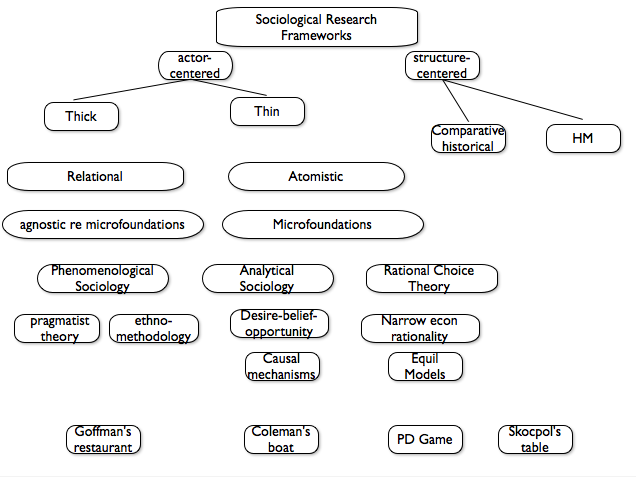
The second diagram provides an initial effort to identify the distinguishing features of the several approaches as a dichotomous tree structure. AS and RCT share the microfoundations characteristic, whereas the phenomenological approach does not. The phenomenological approach emphasizes the need for a "thick" theory of the actor, whereas AS and RCT favor a thin theory. AS distinguishes the DBO assumption from the even more restrictive assumption of narrow economic rationality. And AS is more interested in identifying causal mechanisms than either alternative, whereas the phenomenological approach favors narratives and the RCT approach favors the creation of equilibrium models. The final row of this diagram provides instances of explanatory paradigms for the various approaches -- Goffman's account of the social behaviors in a restaurant, Coleman's boat, the formal analysis of the prisoner's dilemma, and Skocpol's table of revolutionary outcomes.

Here is another possible approach, which might be described as the "ecological" view of methodologies. In a recent post I argued that we might think of a research framework as consisting of a small set of “genes” (methodological and ontological assumptions), which then give rise to the “phenotype” of research products in the hands of groups of researchers (link).

On this way of thinking, AS and RCT share a number of genes in common, and they are open to borrowing additional elements in the future through research collaboration (inter-species contact). Each shares some of the core commitments of actor-centered sociology, even as they postulate theoretical and explanatory strategies fairly distant from the key practitioners of ACS. The two “species” of research frameworks are closely related, and show promise of becoming more so in the future. But likewise, AS can become a more robust genotype for sociological research by sharing genetic components with its ecological partner, actor-based sociology. Finally, by this measure all three of these actor-based approaches are some distance from other main research approaches within sociology: survey science, quantitative research, comparative research, and organizational studies.

I would like to argue that analytical sociology has the intellectual breadth to encompass the core insights and methods of RCT and ACS as distinct theories of the actor, and that ABM is a formal methodology that is well suited to one component of the AS model of explanation, the aggregative component (the rising strut of Coleman’s boat). ABM is not limited to economic models of the actor and can incorporate as much detail about the actor as the modeler chooses; so ACS and pragmatist findings can be incorporated into ABM models at the possible cost of a loss of determinacy of outcome.

It appears to me that agent-based models represent something different from the three frameworks considered here. ABM approaches do not inherently privilege any specific model of the actor. Most current models make use of actors who are economically rational; but it would be equally consistent to assign formal interpretations to the premises of pragmatist theories of the actor and then embody those premises within an ABM model. So ABM is a formal technique for aggregating assumptions about the actions and interactions of actors, not a substantive theory of what makes the actor tick. This observation is recorded in the Venn diagram above, with the circle representing ABM approaches overlapping will all three substantive frameworks.

Saturday, March 2, 2013

New thinking about social systems


There is a great deal of important international work underway today within the philosophy of social science on the general topic of social ontology. How do social structures relate to the actions of socially situated actors? How does causation work in the social realm? Can we say anything rigorous about the nature of "levels" of the social world -- micro, meso, and macro? And is there such a thing as an "emergent" social property or entity?

Sociologists and philosophers in Germany, Scandinavia, the UK, Belgium, France, Italy, and North America have undertaken serious work on these topics, and they constitute a dynamic network of thinking and debating. Some of the longstanding dualities in philosophy and sociology are questioned: individualism versus holism, micro versus macro, analytic versus continental, structure versus agent. Sociologists whose dispositions incline towards the importance of social structures are convening with rational choice theorists and game theorists; analytic sociologists are debating ontology with emergentists; and the field is displaying an energetic and productive degree of ferment.

The people whose work I am thinking of here are a motley group: Peter Hedstrom, Hans Joas, Petri Ylikoski, Bert Leuridan, Margaret Archer, Gianluca Manzo, Philippo Barbera, Pierre Demeulenaere, Julian Reiss, Rainer Greshoff, Dave Elder-Vass, Jeroen Van Bouwel, Mohamed Cherkaoui, ... And it is roughly as challenging to keep clearly in mind the manifold debates that are unfolding as it is to watch the Indianapolis 500 as the cars rocket by at 200 miles an hour. Some of these contributors are long-established scholars with huge reputations; others are young scholars with wickedly sharp minds and awesome work habits. And frankly, I'm at least as impressed with the younger generation as the elder.

One recent book that stands out as a key contribution that permits a degree of geolocation within these tangled debates is Poe Wan's Reframing the Social: Emergentist Systemism and Social Theory. Wan seems to have read every word of the debates, and he is ready to help interested parties take stock of the various theoretical perspectives.

The key axis in Wan's work -- here and elsewhere -- is that defined by Niklas Luhmann and Mario Bunge on the topic of emergent social systems. Wan is persuaded that social properties are "emergent" in some important sense, and he also seems to believe that the ideas of system and complexity are important components of our vocabulary for social ontology. But how should we understand these ideas? Luhmann's theory tends towards the position of holism, whereas Bunge's position allows that there is an intelligible connection between upper-level properties and micro-level facts and he focuses his theory of explanation on finding underlying mechanisms of various social outcomes. Wan refers to Bunge's approach as "rational emergentism" (68). Wan is respectful towards each of these theories, but he clearly favors that put forward by Bunge. Like Bunge, Wan too favors the focus on mechanisms; he admires Bunge's insistence on paying attention to the details of existing research in the natural and social sciences; and most importantly, he endorses Bunge's view that our theories of "emergent" social phenomena must be grounded in a theory of the actor.

Here is how Wan characterizes Bunge's systems theory and its relationship to a theory of the actor:
Bunge's emergentist systemism is best construed as a version of action-systems theory ..., because Bunge states explicitly that "the features of a social system depend upon the nature, strength, and variability of social relations, which in turn are reducible to social actions." (6)
And Wan believes that Bunge's approach provides a robust way of conceptualizing the nature of the social realm:
In Chapter 5 I argue for a systems approach that is ontologically sound (that is to say, transcending both holism [macro-reductionism] and individualism [micro-reductionism]), with due consideration given to the role of human factors and their actions in designing, maintaining, improving, repairing or dismantling social systems. (10)
Wan also believes that Bunge's CESM model is a helpful one for thinking about social ontology and explanation.  This model incorporates composition, environment, structure, and mechanisms. For a given social entity we want to know what it is composed of; what are the features of the environment within which it functions; how is it arranged internally; and how does it work (55).

Another important part of Wan's approach is his affinity with the social theories of the critical realists -- Bhaskar, Archer, Elder-Vass. Fundamentally this comes down to the view that social structures have real causal powers, along the lines of Rom Harre's meaning of this term (110, 119, 121).

Reframing the Social is an important contribution to current debates about the nature of the social. And I agree with him that the question of social ontology is a fundamental one; perhaps more so than the issues of the epistemology of the social sciences that have generally played first violin. Further, Wan does a good job of showing how these debates are relevant to the emerging framework of analytical sociology -- sometimes in ways that cast doubt on some of the guiding presuppositions of that field. In particular, the aggregative strategy of explanation that is favored by AS is questionable once we give credence to the idea that social structures possess autonomous causal powers. Along with Dave Elder-Vass's The Causal Power of Social Structures: Emergence, Structure and Agency, this book stands as an important alternative to Hedstrom's Dissecting the Social: On the Principles of Analytical Sociology.

Here is a nice passage from the preface to the second edition of Durkheim’s Rules of Sociological Method that Wan quotes on the subject of emergence:

Whenever elements of any kind combine, by virtue of this combination they give rise to new phenomena. One is therefore forced to conceive of these phenomena as residing, not in the elements, but in the entity formed by the union of these elements. The living cell contains nothing save chemical particles, just as society is made up of nothing except individuals. Yet it is very clearly impossible for the characteristic phenomena of Iife to reside in atoms of hydrogen, oxygen, carbon and nitrogen. For how could living movements arise from amidst non-living elements? Furthermore, how would biological properties be allocated amongst these elements? They could not be found equally in them all, since they are not of the same nature: carbon is not nitrogen and thus cannot possess the same properties or play the same part. It is no less unacceptable for every facet of life, for each of its main characteristics, to be incorporated in a distinct group of atoms. Life cannot be split up in this fashion. It is one, and consequently cannot be located save in the living substance in its entirety. It is in the whole and not in the parts. It is not the non-living particles of the cell which feed themselves and reproduce – in a word, which live; it is the cell itself and it alone. And what we maintain regarding life could be reaffirmed for every possible kind of synthesis. The hardness of bronze lies neither in the copper, nor in the tin, nor in the lead which have been used to form it, which are all soft or malleable bodies. The hardness arises from the mixing of them. The liquidity of water, its sustaining and other properties, are not in the two gases of which it is composed, but in the complex substance which they form by coming together. 

Let us apply this principle to sociology. If, as is granted to us, this synthesis sui generis, which constitutes every society, gives rise to new phenomena, different from those which occur in conscious­nesses in isolation, one is forced to admit that these specific facts reside in the society itself that produces them and not in its parts — namely its members. In this sense therefore they lie outside the consciousness of individuals as such, in the same way as the distinctive features of life lie outside the chemical substances that make up a living organism. They cannot be reabsorbed into the elements without contradiction, since by definition they presume something other than what those elements contain. Thus yet another reason justifies the distinction we have established later between psychology proper — the science of the individual mind ­ and sociology. Social facts differ not only in quality from psychical facts; they have a different substratum, they do not evolve in the same environment or depend on the same conditions. (Rules of Sociological Method (S. Lukes, ed.) 1982:39-40)

(It is noteworthy that the passage raises many difficult questions, including the vitalism that Durkheim presupposes.)

Sunday, January 6, 2013

Simon on complexity

Herbert Simon's The Sciences of the Artificial - 3rd Edition provided an alternative model for thinking about society. We can think of social institutions as partially designed and selected for their organizational properties; so they are different from proteins and planetary systems.  Simon is also an important contributor to the study of complexity. So his new chapter in the 1996 edition of the book, "Alternative Views of Complexity," is worth reading carefully. Here is how he motivates this new chapter in SA:
The preceding chapters of this book have discussed several kinds of artificial systems. The examples we have examined -- in particular, economic systems, the business firm, the human mind, sophisticated engineering designs, and social plans -- range from the moderately to the exceedingly complex (not necessarily in the order in which I have just listed them). These final two chapters address the topic of complexity more generally, to see what light it casts on the structure and operation of these and other large systems that are prominent in our world today. (169)
It turns out that there isn't much new in the 1996 chapter, however. In fact, most of its content is taken from his pathbreaking 1962 article, "The Architecture of Complexity" (link). The new chapter 7 and renumbered chapter 8 largely incorporate the content and sometimes the language of the 1962 article. And this is interesting, because it implies that Simon's primary ideas about reduction, composition, and inter-level interactions were largely already formed in 1962.

There are a few ideas and themes that are new to the 1996 version. One is a more specific periodization of thinking about complexity theory in the twentieth century.  The 1996 version identifies three phases of theorizing about complexity and "whole systems".
  1. Biological emergence theory (post World War I)
  2. Cybernetics and systems theory (post World War II)
  3. Contemporary complexity theory (post 1960s)
Simon is skeptical about the tendency towards irreducible holism that was associated with the earlier two phases of thinking in both versions; in the 1996 chapter he favors a "weak" interpretation of emergence: a commitment to ...
... reductionism in principle even though it is not easy (often not even computationally feasible) to infer rigorously the properties of the whole from knowledge of the properties of the parts. In this pragmatic way, we can build nearly independent theories for each successive level of complexity, but at the same time, build bridging theories that show how each higher level can be accounted for in terms of the elements and relations of the next level down. (172)
This "pragmatic holism" is already contained in the 1962 version (link). So this doesn't represent new ground in 1996. But Simon's use of this idea to criticize several false starts in the field of complexity research is valuable.

Simon finds some of the central concepts of the third phase to be more promising for the study of social phenomena. The mathematics and physics of chaotic behavior (where simple low-level processes can aggregate to wildly variant higher-level outcomes), simulations of evolution through computational models (genetic algorithms), and the exploration of cellular autonoma (the game of life) all come in for favorable comments. (The Lorenz attractor illustrated here is a common example of chaotic behavior.)


One idea that is not contained in the 1962 version is that of causal non-linearity. Non-linearity is a problem for the "near decomposability" view that Simon wanted to take of complexity in the 1962 version, because it casts doubt on the ability to disentangle causal influences deriving from inter-connected subsystems. Small differences in initial conditions can lead to large differences in outcome. This is a key aspect of chaos theory and the varieties of turbulent phenomena that provide the best examples of chaotic systems. And this casts some doubt on one of the central conclusions of the 1962 paper:
The fact, then, that many complex systems have a nearly decomposable, hierarchic structure is a major facilitating factor enabling us to understand, to describe, and event to "see" such systems and their parts. Or perhaps the proposition should be put the other way round. If there are important systems in the world that are complex without being hierarchic, they may to a considerable extent escape our observation and our understanding. (477)
This is a decidedly pre-chaos understanding of the nature of complex systems. I have the impression that many contemporary complexity theorists would reject the idea that social processes are commonly the result of "nearly decomposable, hierarchic structures". So it is a genuine change for the mathematics of chaos theory to be included in the 1996 version. Complexity research has moved forward since 1962, and Simon recognizes this in the 1996 chapter.

What we don't find here is any discussion of whether actual social processes and systems display chaotic behavior in this well defined sense. And we don't see Simon shifting his position on "nearly decomposable" systems.

Are there examples of social processes and phenomena that display chaotic characteristics over time? Take the occurrence of massive street demonstrations as an example; are there aspects of chaos in the technical sense involved in the outbreak of street mobilization? Do small, apparently random events have large effects on the eventual outcome?

It would appear that this is the case when we look at the cases of uprising and passivity in different cities during the Arab Spring of 2011. Some social scientists have tried to understand the likelihood of uprising as an increasing function of economic crisis, regime weakness, and regime brutality. This implies a linear assumption about the causal role of these three forces. But it seems plausible to speculate that random events like a broken phone chain, an Internet outage, or the defection of a key leader could push the process of mobilization into a different direction. Moreover, it seems that contemporary research on social complexity pays a lot of attention to non-linearity, path-dependency, and sequential processes of social mobilization -- leaving a lot of room for the kinds of turbulent effects that are observed in traffic flow, storm generation, and water dripping from a leaking tap. This is the kind of work that is described in Scott Page and John Miller, Complex Adaptive Systems: An Introduction to Computational Models of Social Life.

So oddly enough, it seems that one could fairly say that Simon's views of social complexity -- as expressed in the 1996 third edition of  The Sciences of the Artificial as well as in his groundbreaking "Architecture of Complexity" in 1962 -- are significantly incomplete, given the way that complexity theorists are now thinking about social processes. Simon did not incorporate the guiding assumptions of "complex adaptive systems theory" into his own thinking, and remained convinced of the adequacy of the ideas of hierarchical systems and nearly decomposable systems as late at 1996.  His own approach to social complexity remains a phase two approach, not a phase three approach.

(The graph at the top of this post is offered as an interpretation of a highly path-dependent social process. The reader is asked to consider each path as a hypothetical development from a common origin, with small stochastic variations in the situation occurring over time. Imagine the starting position is "large city, economic hardship, weak state, lots of repression", time is the x axis, and the y axis measures civil unrest. Some of those variations push the path towards a high outcome (blue), and some towards a low outcome (magenta). The great majority of outcomes fall within a short distance of the starting position. So the most likely outcome is "not much change", but there are unlikely but diametrically different outcomes possible as well.)

Sunday, December 9, 2012

Simulating social mechanisms


A key premise of complexity theory is that a population of units has "emergent" properties that result from the interactions of units with dynamic characteristics. Call these units "agents".  The "agent" part of the description refers to the fact that the elements (persons) are self-directed units.  Social ensembles are referred to as "complex adaptive systems" -- systems in which outcomes are the result of complex interactions among the units AND in which the units themselves modify their behavior as a result of prior history.

Scott Page's Complex Adaptive Systems: An Introduction to Computational Models of Social Life provides an excellent introduction. Here is how Page describes an adaptive social system:
Adaptive social systems are composed of interacting, thoughtful (but perhaps not brilliant) agents. It would be difficult to date the exact moment that such systems first arose on our planet -- perhaps it was when early single-celled organisms began to compete with one another for resources.... What it takes to move from an adaptive system to a complex adaptive system is an open question and one that can engender endless debate. At the most basic level, the field of complex systems challenges the notion that by perfectly understanding the behavior of each component part of a system we will then understand the system as a whole. (kl 151)
Herbert Simon added a new chapter on complexity to the third edition of The Sciences of the Artificial - 3rd Edition in 1996.
By adopting this weak interpretation of emergence, we can adhere (and I will adhere) to reductionism in principle even though it is not easy (often not even computationally feasible) to infer rigorously the properties of the whole from knowledge of the properties of the parts. In this pragmatic way, we can build nearly independent theories for each successive level of complexity, but at the same time, build bridging theories that show how each higher level can be accounted for in terms of the elements and relations of the next level down. (172).
This formulation amounts to the claim of what I referred earlier to as "relative explanatory autonomy"; link. It is a further articulation of Simon's view of "pragmatic holism" first expressed in 1962 (link).

So how would agent-based models (ABM) be applied to mechanical systems? Mechanisms are not intentional units. They are not "thoughtful", in Page's terms. In the most abstract version, a mechanism is an input-output relation, perhaps with governing conditions and with probabilistic outcomes -- perhaps something like this:


In this diagram A, B, and D are jointly sufficient for the working of the mechanism, and C is a "blocking condition" for the mechanism. When A,B,C,D are configured as represented the mechanism then does its work, leading with probability PROB to R and the rest of the time to S.

So how do we get complexity, emergence, or unpredictability out of a mechanical system consisting of a group of separate mechanisms? If mechanisms are determinate and exact, then it would seem that a mechanical system should not display "complexity" in Simon's sense; we should be able to compute the state of the system in the future given the starting conditions.

There seem to be several key factors that create indeterminacy or emergence within complex systems. One is the fact of causal interdependency, where the state of one mechanism influences the state of another mechanism which is itself a precursor to the first mechanism.  This is the issue of feedback loops or "coupled" causal processes. Second is non-linearity: small differences in input conditions sometimes bring about large differences in outputs. Whenever an outcome is subject to a threshold effect, we will observe this feature; small changes short of the threshold make no change in the output, whereas small changes at the threshold bring about large changes. And third is the adaptability of the agent itself.  If the agent changes behavioral characteristics in response to earlier experience (through intention, evolution, or some other mechanism) then we can expect outcomes that surprise us, relative to similar earlier sequences. And in fact, mechanisms display features of each of these characteristics. They are generally probabilistic, they are often non-linear, they are sensitive to initial conditions, and at least sometimes they "evolve" over time.

So here is an interesting question: how do these considerations play into the topic of understanding social outcomes on the basis of an analysis of underlying social mechanisms? Assume we have a theory of organizations that involves a number of lesser institutional mechanisms that affect the behavior of the organization. Is it possible to develop an agent-based model of the organization in which the institutional mechanisms are the units? Are meso-level theories of organizations and institutions amenable to implementation within ABM simulation techniques?

Here is a Google Talk by Adrien Treuille on "Modeling and Control of Complex Dynamics".


The talk provides an interesting analysis of "crowd behavior" based on a new way of representing a crowd.

Tuesday, October 2, 2012

Domain of agent-based modeling methods

Agent-based modeling is an intriguing new set of tools for computational social science. The techniques permit us to project forward the system-level effects of a set of assumptions about agent behavior and a given environment. What kinds of real social phenomena are amenable to treatment by the techniques of agent-based modeling? David O'Sullivan and his co-authors offer an assessment of this question in their contribution to a valuable recent handbook, Heppenstall et al, Agent-Based Models of Geographical Systems. (Andrew Crooks and Alison Heppenstall provide a valuable and clear introduction to ABM methodology in their contribution to the volume.)

O'Sullivan and colleagues offer a basic taxonomy of different applications of ABM research.
  • simple abstract models where the focus is on exploring the collective implications of individual-level decision making. 
  • more detailed [accounts that] locate virtual model agents in a representation of the real world setting of interest. Typically, such models operate at a regional or landscape scale
  • some of the most ambitious models aim at detailed ... representations of both the geographical setting and the processes unfolding in that setting (111-112)
This taxonomy depends on the degree of abstraction and realism that the model aspires to.

Here are a handful of research projects that are amenable to these techniques, most of which are illustrated in the Heppenstall volume.
  • Land use patterns in peasant agriculture 
  • Residential patterns -- urban and rural
  • Patterns of burglaries
  • Occurrence of interpersonal violence in civil war
  • Traffic patterns -- pedestrian and vehicular
What do the clear examples have in common? They are situations where a number of independent individuals react to a social and natural environment with a set of goals; and they are usually situations where individuals influence each other through their actions. These are situations of dynamic interactive choices. O'Sullivan and colleagues put these points this way:
We consider the most fundamental characteristics of agents in spatial models to be goal-direction and autonomy.... However, more specific definitions of the concept may add any of flexibility, ‘intelligence', communication, learning, adaptation or a host of other features to these two. (115)
(Crooks and Heppenstall provide a similar list: autonomy, heterogeneity, and activity; 87.)

O'Sullivan et al also pose an important question about what the circumstances are where the features of agents makes a difference in the social outcome:
This argument focuses attention on three model features: heterogeneity of the decision-making context of agents, the importance of interaction effects , and the overall size and organization of the system. If agents are the same throughout the system, then, other things being equal, an aggregate approach is likely to capture the same signifi cant features of the system as an agent-based approach.
Essentially the point here is a simple one: if an aggregate outcome results from homogenous individuals making a decision about something on the same basis as everyone else, then we don't need an agent-based model. ABM techniques become valuable when heterogeneous agents interact with each other to bring about novel outcomes.

There are quite a few social situations that do not fit the terms of these models well. Some social processes are not simply the aggregate outcome of choices by a set of independent autonomous agents. For example, the flow of work through an architectural design studio is determined by the rules of the firm, not the independent choices of the employees, and the behavior of an army is largely determined by its general staff and command structure. O'Sullivan et al put the point this way:
A more important question may be, “what should the agents in an ABM of this system represent?” If the interactions among individual actors in the real world are substantially channelled via institutions or other social or spatial structures, perhaps it is those institutions or social or spatial structures that should be represented as agents in an ABM rather than the individuals of which they are formed. (120)
So a general question for ABM methodology is this: where do structural social factors come into ABM models? Here I am thinking of things like a system of regulation and law; a pattern of racialized behavior; the architecture of the transport system; a tax system; .... We might treat these as parameters in the environment of choice for the agents. They are beyond the control of the agents and are regarded as constraints and opportunities. (This is one place where the framework of "strategic interactive fields" disagrees, since the SIF approach looks at institutions themselves as part of the field of strategic interaction in that individuals strive to modify the rules to their own benefit.)

It seems reasonable to judge that ABM techniques are very useful when we are concerned with phenomena that are aggregates of strategic behavior by individual actors; but they are not pertinent to many of the questions sociologists pose. In particular, they do not seem useful for sociological inquiries that are primarily concerned with the dynamics and effects of large social structures where the behavior of individuals is routine, homogeneous, or largely determined exogenously. These are the circumstances where the premises of the ABM approach -- autonomy, heterogeneity, and activity -- are not satisfied.