Showing posts with label hate. Show all posts

Sunday, May 15, 2022

Incitement of violence by far-right media networks


The sickening tragedy of Buffalo yesterday -- the racist attack on a group of African-American shoppers and workers by an 18-year-old white supremacist man in body armor, carrying a military-style weapon -- is simply too much to absorb. This is indisputably an act of domestic terrorism; and yet our police and federal counter-terrorism agencies are still woefully behind in taking the threats of racist violence seriously. Where is Homeland Security when it comes to protecting African-Americans, Muslims, Asian-Americans, Latinos, and Jewish people against a rising tide of racist attacks? (Here is a Brookings report on the state of right-wing terrorism in America; link.) We are forced to ask ourselves, how many other "true believers" in the Great Replacement theory and other memes of white supremacy are out there, contemplating their own acts of racist violence?

But here is a question that must be confronted: how did violent white supremacy become mainstream in America? How did racist antagonism and fear-mongering become something more than shameful and marginal mutterings by fringe extremists? And more specifically, what role do Fox News and Tucker Carlson play in the shameful tragedy that took place in Buffalo this week?

The answer seems to be: a very extensive role. Carlson's advocacy of the supposed catastrophe of "the Great Replacement" has reverberated throughout this country and in other parts of the world. As the recent and rigorous New York Times study documents (link), Carlson's program is deliberate in its stoking of racial fear and hatred among its three million viewers. Here is part of the assessment offered in the Times series:

To channel their fear into ratings, Mr. Carlson has adopted the rhetorical tropes and exotic fixations of white nationalists, who have watched gleefully from the fringes of public life as he popularizes their ideas. Mr. Carlson sometimes refers to “legacy Americans,” a dog-whistle term that, before he began using it on his show last fall, appeared almost exclusively in white nationalist outlets like The Daily Stormer, The New York Times found. He takes up story lines otherwise relegated to far-right or nativist websites like VDare: “Tucker Carlson Tonight” has featured a string of segments about the gruesome murders of white farmers in South Africa, which Mr. Carlson suggested were part of a concerted campaign by that country’s Black-led government. Last April, Mr. Carlson set off yet another uproar, borrowing from a racist conspiracy theory known as “the great replacement” to argue that Democrats were deliberately importing “more obedient voters from the third world” to “replace” the current electorate and keep themselves in power. But a Times analysis of 1,150 episodes of his show found that it was far from the first time Mr. Carlson had done so. (link)

The alleged Buffalo assailant's manifesto seems to follow this script of "great replacement" and white supremacy very closely. The manifesto is explicit on these points (link). So the connection seems evident -- message disseminated, message received, violence committed.

Milan Obaidi, Jonas Kunst, Simon Ozer and Sasha Y. Kimel make a strong sociological argument for the connection between "great replacement" myths and racist violence in "The 'Great Replacement' conspiracy: How the perceived ousting of Whites can evoke violent extremism and Islamophobia" (link). These researchers document the role this meme has played in anti-immigrant and anti-Muslim populism in European states:

In recent years, the “Great Replacement” conspiracy has not only gained prominence among right-wing extremists but has also found a foot- hold among right-wing populist political parties in Europe. For example, while evoking anti-Muslim and anti-immigrant sentiment, such ideas have been espoused by the former leader of the Danish People’s Party Pia Kjærsgaard, the Prime Minister of Hungary Viktor Orbán, the Italian Interior Minister Matteo Salvini, and the leader of the far-right movement Rassemblement National Marine Le Pen (Alduy, 2017; Kingsley, 2019; Kjærsgaard, 2020). Various conservative intellectuals and far-right organizations have also utilized language that stokes fear about the decline of the “White race” and “White identity.” For instance, in an interview in the Wall Street Journal in 2006, Mark Steyn, a prominent proponent of “Eurabia” (i.e., a term coined to describe an alleged Islamization and Arabization of Europe), claimed that by the year 2025 “Europe will be 40 percent Muslim and much of what we loosely call the Western world will not survive this century” (Steyn quoted in Carr, 2006; see also Steyn, 2005). Meanwhile, anti-Muslim organizations such as the German PEGIDA movement and the European White-nativist movement Generation Identity (GI) have espoused similar views. For example, GI—one of Europe’s fastest growing far-right movements that advocates for an ethnically and culturally homogenous Europe—portrays immigrants as invaders while playing a prominent role in promoting, popularizing, and disseminating the “Great Replacement” conspiracy (Cox & Meisel, 2018; Feder & Maplestone, 2019). (link)

Based on their survey-based study, they find that there is a causal connection between perceived replacement and willingness to act violently against members of the other group.

Perceived replacement of the autochthonous population was positively correlated with willingness to violently persecute Muslims, violent intentions, Islamophobia, as well as symbolic and realistic threat perceptions (see Table 1). Moreover, both types of threats were related to Muslim persecution and Islamophobia. However, only symbolic threat was associated with violent intentions. (link)

Now--back to America. Tucker Carlson now finds it expedient to use the "Great Replacement" meme to crystallize the fears and antagonisms of his followers -- again, a finding well documented in the New York Times series cited above. It seems all too obvious that this is a potent causal factor in the rise of activist white supremacist individuals and organizations. And, coincidentally, our country is witnessing a horrifying rise in violent attacks on people of color.    

What are some of the means available to those who care about democracy and equality for combatting this resurgent white supremacy and the violence it so recklessly engenders? Electing politicians who demonstrate their commitment to our democratic values is one response, but not a very rapid or targeted cure.

Is there another possibility deriving from civil liability? Is it possible to make use of civil lawsuits against the purveyors of false and hateful theories that inspire other individuals to commit acts of violence? In the Lawfare blog Alexander Vindman raises the possibility of using civil lawsuits to prevent the harms purveyed by right-wing media and personalities, including defamation and (one might speculate) encouragement of violence (link). Consider the example of the lawsuit successfully undertaken by the Southern Poverty Law Center in 1981 against United Klans of America for the murder of Michael Donald by two klansmen. Success in this lawsuit led to bankruptcy and dissolution of this branch of the Ku Klux Klan (link).

Can the victims and their survivors of the Buffalo atrocity hold Tucker Carlson and Fox News at least partially responsible for the racist murders committed on May 14? Would $1 billion be an appropriate civil damage finding for the harm done by this reckless and immoral racism on a highly influential media channel? Would Fox News then find it prudent to eliminate the racist hatred it channels on its network if it were faced with such a judgment?

And what about the advertisers who continue to provide millions in ad revenue to Fox News? Can these companies at last be brought to recognize the shame of their support for racist hate mongering, and withdraw their support? If not, should not consumers look at these companies as complicit in the rising tide of racist violence in America? Here is a call for "defunding Fox News" (link) that identifies the top advertisers on Fox: GlaxoSmithKline, Liberty Mutual, General Motors, Procter & Gamble, Intuit, NortonLifeLock, Nestle, Kraft Heinz, Progressive, Charles Schwab, Toyota, and Subaru. GM, P&G, Subaru -- do you really want to align yourself with racism and anti-democratic lies and the rising tide of violence that accompanies these pathologies?

(Here is a New York Times article on the background of segregation in Buffalo; link.)


Saturday, April 2, 2022

Philosophies of the far right

image: Joseph de Maistre

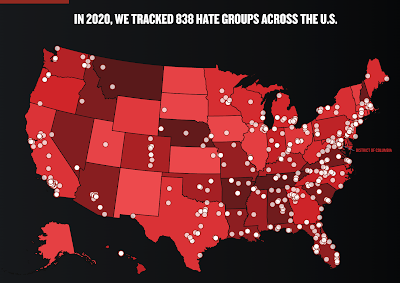
The ideologies of the far right have a particularly strong grip on a segment of democratic society in the current epoch. This is evident in the extremism of the current leadership of the GOP, and it is evident as well in the growth of hate-based groups in the United States (link). What are the ideas, values, and emotions that possess these anti-liberal, anti-democratic persons and parties?

There is a fairly simple set of answers that resonate with journalistic coverage of the far right in the US and other countries: nativism, anti-immigrant activism, white supremacy, anti-government activism, class resentment, and willingness to appeal to violence against one’s political or cultural “enemies”. These are the items mentioned in the hypothetical “far-right index” proposed in a recent post (link). Many of these attitudes and values can be bundled together into “right-wing populism” (link).

Do these attitudes amount to a political philosophy? Or are they more akin to a smorgasbord of separate attitudes of intolerance, mostly unified by hatred and mistrust of other groups, resentment of one’s own governing classes, and a crass willfulness that refuses any sense of collective democratic obligation? 

One way of thinking about this question is provided by Mark Sedgwick’s very interesting 2019 volume, Key Thinkers of the Radical Right: Behind the New Threat to Liberal Democracy. The contributors are drawn from a range of European and North American research institutes, and their essays reflect some of the diversity that exists across right-wing extremist thought in western democracies today.

In his informative introduction Sedgwick highlights a number of political ideas in these waves of far-right thinkers: from Spengler, a theme of “apocalypticism”; from Schmitt, a “suspicion of the global universal elite”, emphasis on “friend and enemy” in politics, and legitimation of authoritarian rule; from Evola, the elevation of tradition, hierarchy, and the transcendent; from de Benoist, a rejection of egalitarianism in favor of “ethnopluralism”; from Buchanan the “white European” roots of US history and heritage, as well as a deep suspicion of “global liberal elites” and antagonism towards Mexican immigration into the United States; from Taylor and Dugin a race-specific ideal of US culture; and from Bat Ye’or a fundamental antagonism towards Muslim states and immigration. There is a broad family resemblance across these conservative visions of civilization, but they by no means add up to a coherent philosophical system.

The volume also treats “emerging” thinkers on the far right: Mencius Moldbug, Greg Johnson, Richard Spencer, Jack Donovan, and Daniel Friberg. The political and cultural radicalism of this most recent group are the most extreme and alarming -- and the most influential on current hate-based organizations:

Moldbug and Johnson are both former libertarians. Moldbug draws on Gramsci’s analysis of hegemonic intellectual elites, and Johnson draws directly on the French New Right and on the idea of metapolitics (as well as on Heidegger and Traditionalism). Moldbug, like many other key thinkers, warns against progressive elites and their universalism, the egalitarian rhetoric that conceals their rule, and the “feedback loop” of which they are part, which he labels “the Cathedral.” He goes farther than most on the radical Right in directly and explicitly condemning democracy as a mask for the Cathedral, preferring hierarchy (like Evola) to democracy. Johnson, who runs the important website Counter-Currents, is perhaps the most radical of the contemporary thinkers of the radical Right, certainly in ethnic and racial terms. He is unusual in being distinctly anti-Semitic, a position held otherwise only by Schmitt, and then really only during the Third Reich. As well as subscribing to the Traditionalist narrative of inevitable decline, Johnson sees an apocalyptic risk of “demographic Armageddon,” and calls explicitly for forced population transfer and the nonlethal ethnic cleansing of both Jewish and black Americans to allow a white “ethnostate,” with blacks getting their own ethnostate in the American South, and Jews moving to Israel. It is Johnson who, alone among modern and contemporary key thinkers of the radical right, expresses sympathy for Nazism. In a typical month in 2017, his Counter-Currents website attracted two hundred thousand visitors who viewed 1.5 million pages of content. (kl 337)

Significantly, Sedgwick observes that the most politically potent of these far-right themes in the US are the themes of racial and cultural antagonism. “Race, Islam, and elites are especially important issues today because, more than the other themes common to the key thinkers of the radical Right, they have easy resonance at the street level, and in electoral politics” (introduction, kl 405).

The non-profit organization Counter Extremism Project monitors the activities of extremist and white-supremacist groups in numerous countries. Here is an extensive report on the current activities of white supremacist groups in the US; link. The report provides extensive evidence of the themes of racism, anti-semitism, anti-Muslim bigotry, and nativist political identities that are highlighted in the current wave of "Alt-Right" writers. Many of the groups documented in this report are neo-Nazi groups with explicit messages of anti-Semitism, racism, and violence.

So here is the hard question. Does the tradition of radical-right philosophy drive modern far-right extremism? Or are the philosophies expressed by this tradition just an epiphenomenon, with the real drivers of extremism coming from currents of racism, hatred, and antagonism that are present in segments of the populations of various countries of Europe and North America? Does a Patrick Buchanan or a Richard Spencer wield political influence because of his apocalyptic ideas, or rather simply because his ideas serve as a basis for potent mobilization speeches on Youtube and TikTok for individuals and groups already inclined towards hate and violence?

The answer seems evident. The extremist right as an activist movement is not driven by a coherent political philosophy. Rather, it is propelled by demagoguery, another ancient Greek invention; the use of simple tropes to win the emotions of masses of followers and energize them to action. And the tropes that have driven extremism in the US are painfully evident: white supremacy, nativism, resentment, and fear of the black helicopters.

Monday, January 24, 2022

Silence about the Holocaust after 1945

Image: Holocaust memorial at Camp Westerbork, The Netherlands

Each of the great evils of the twentieth century -- the Holocaust, the Holodomor, the Gulag -- was shrouded in silence and concealment for decades after information became available to the world. In the case of the Gulag, the Soviet government exercised great effort to keep the facts of the prison camp system quiet, and the Communist parties of Western Europe minimized or obfuscated the facts that were publicly available. (Anne Applebaum documents much of this shameful record of secrecy and obfuscation in Gulag: A History.) A similar story of secrecy and lies can be told about the Holodomor.

Most inexcusable is the silence that greeted the facts of the Final Solution after the end of hostilities in 1945. The evidence of mass killing was everywhere -- extermination camps, burial pits in Poland and Ukraine, first-person observations, the writings of contemporary observers like Vasily Grossman, and the Nuremberg trials. And yet there was little public recognition or discussion of the magnitude of the evil committed by the Nazi extermination plan, and their national collaborators, until the 1960s and 1970s.

Stimulated by discussions beginning in 1988 in Michigan at the first Holocaust Memorial Center in the United States, a group of scholars undertook to write a set of country studies on the reception of the Holocaust across Europe, North America, and Japan. The results are presented in a massive 1996 volume edited by David Wyman, The World Reacts to the Holocaust, which is highly relevant for our project of "confronting evil in history". Most of the countries surveyed in this volume did not confront history honestly; rather, they constructed more comfortable narratives that minimized the involvement of their own citizens in the Holocaust, and sometimes minimized and "normalized" the mass killings of Jews themselves. In his introduction David Wyman writes that during the 1950s "the most difficult and sensitive questions about the Holocaust had barely been raised. These issues included ... questions about the guilt of the German people, complicity and collaboration in the countries under German occupation, the failure of non-Jews to attempt to save their Jewish neighbors, and the very limited rescue efforts on the part of the outside world. Nor were these issues confronted during the 1950s; instead, in that decade the Holocaust all but disappeared from public consciousness in most of the world" (xix).

Here is the table of contents and list of countries studied:


The book demonstrates an important feature of Holocaust history -- the fact that much of the killing, and many of the documents, took place in Eastern Europe, in countries that came under Soviet control during and after the war. The Soviet government was slow to make available to the public records and documents that could provide a reasonably full understanding of the Holocaust in Ukraine, Belarus, Lithuania, Estonia, and Poland. Wyman writes, "Until the later 1980s these [Soviet bloc] countries all followed the Soviet Union's approach to the Holocaust: they universalized it and forced it into a Communist ideological mold. The destruction of the Jews was seen as merely a small part of racist fascism's murder of millions of Eastern European civilians" (xxi).

A number of the essays make the point that media events played an important role in Western European and North American countries in bringing awareness of the Holocaust to a broad audience. These include the US television series Holocaust (1978), Marcel Ophuls' two-part French documentary The Sorrow and the Pity (1969), and Claude Lanzmann's French documentary film Shoah (1985).

Here I will provide highlights from three of the country studies, to give a sense of the depth and detail of the essays. There is still much to be learned about the Holocaust and the way that various publics and governments have been willing to face the truth about their pasts honestly.

France, David Weinberg

David Weinberg's article on documents the French government's desire to "sanitize" the history of the Vichy years and the circumstances of the deportation of sixty to seventy thousand Jews from France to Nazi extermination camps. The issue of return of spoliated property -- homes, businesses, other forms of pre-war wealth -- was highly contentious in France in the postwar years. Further, thousands of Jewish children had been separated from their parents, and the task of reuniting families was both logistically and socially difficult. But most significant was the political interest that postwar governments had in concealing or distorting the collaboration that had occurred during the German occupation and the Vichy regime. "For much of the early postwar period the tragic events surrounding French involvement in the Final Solution were masked by governmental concerns with reconstruction and reconciliation.... The result was the gradual emergence of a national myth that viewed the overwhelming majority of Frenchmen during World War II as resisters to Nazism and portrayed the Vichy regime as an aberration whose traitorous deeds resulted from the venality and fanaticism of a crazed few" (18). One result was a resurgence of the far right in France: "Government amnesties brought many collaborators back to France after years in exile, and in the early fifties there was a noticeable increase in neo-fascist and neo-Nazi activity on the part of the extreme Right" (19). Weinberg also documents a resurgence of anti-Semitism in French society and politics in the 1950s. He describes the highly convoluted development of French political culture during the 1960s and 1970s, in which anti-colonialism converged to some degree with anti-Zionist, or anti-Israel, sentiment among activist youth. An important event in shifting French public awareness of the Holocaust and the Vichy years was the capture and trial in 1983 of Klaus Barbie, the chief of the Gestapo in Lyons and the prime mover in the deportation of French Jews. Barbie was also a notorious murderer of captured members of the Resistance (including Marc Bloch). Preparations for trial created a great deal of debate in France, and Barbie was eventually convicted and sentenced to life in prison, dying in prison in 1991. (Here is a detailed treatment of the Barbie trial; link.) Weinberg closes on a pessimistic note: French leaders as recently as Mitterrand preferred to remain silent about the crimes and collaborations of the Vichy years (35), and there has not yet been a clear and honest reckoning of the war years.

Poland, Michael Steinlauf

Poland's postwar history was determined by the imposition of a Soviet-style Communist regime. Returning Jews were unwelcome in Poland, in large part because of conflict over spoliated properties. Numerous pogroms took place in the first two years following the end of the war, including the shocking pogrom at Kielce that resulted in the murder of at least 42 people (112). (Steinlauf gives some credence to the possibility that the NKVD may have deliberately provoked the violence at Kielce.) Steinlauf describes 1956 as an important turning point in Polish political history, the "Polish road to socialism", resulting in an anti-Stalinist regime that was more pragmatic than its predecessors. But this change of regime also permitted a resurgence of anti-Semitic attitudes in society and within political elites. Largescale emigration from Poland to Israel and other countries took place, reflecting the conviction by the Jewish population that Poland would never be a welcoming home for them. The Communist government -- before and after the change of orientation in 1956 -- continued to ignore the Nazi extermination of Jews in favor of "Poles and citizens of other nationalities". "Under Communism, Auschwitz became a monument to internationalism that commemorated the 'resistance and martyrdom' of 'Poles and citizens of other nationalities,' In consultation with the International Auschwitz Committee, a group of survivors and relatives of victims dominated by veterans of the largely Communist Auschwitz underground, barracks in the original work cam were turned over to twenty countries for use as 'national pavilions.' One of these structures became a 'Jewish pavilion'" (117). Every part of this story represents denial: denial of the Jewish identities of the victims, erasure of the Nazi extermination goals of the camp, and inflation of the number of victims in order to suggest that comparable numbers of "Poles, Russian prisoners of war, and other non-Jews" were murdered at Auschwitz-Birkenau. "Auschwitz could thereby emerge as the central symbol of Polish martyrdom, but within an inclusive internationalist framework" (117). Even the monument at Treblinka, where only Jews were killed and which is specific about the Jewish identities of the victims there, was publicly described in Poland as "800,000 citizens of European nations" (119).

This pattern of Soviet obfuscation resulted in a national narrative "whose effect was to marginalize, or 'ghettoize,' its subject" (120). Poland's political history between 1956 and 1989 was complex and contentious, and anti-Semitism played a recurring role. 1968 manifested a student movement in Poland, state repression, and a serious official intensification of anti-Semitic actions and policies, in the form of an anti-Zionist campaign. (This is the period when Bauman and Kolakowski were force to leave Poland; link, link.) The period of the Solidarity movement, according to Steinlauf, produced greater honesty and openness about the tragedy of the extermination of the majority of Poland's Jewish population. Steinlauf quotes an especially interesting literary exchange between Czesław Miłosz and the literary critic Jan Błoński, concerning Miłosz's poem about the Warsaw ghetto "A Poor Christian Looks at the Ghetto"; (link): "Błoński explained that Poles had blocked the memory of this part of their history because 'when we consider the past, we want to derive moral advantage from it ... we want to be completely clean. We want to be also -- and only -- victims.' ... Błoński suggested that the only remedy was to see the past fully, without defensiveness, and then to 'acknowledge our own guilt, and ask for forgiveness'" (139).

Steinlauf depicts the period in Poland from 1989 to the mid-1990s as one in which the situation has improved. There is a greater willingness to speak openly about anti-Semitism in Poland -- past and present. Historical memorials have been corrected to more accurately reflect the overwhelming majority of Jews killed in Sobibor and Treblinka (144). And Steinlauf records the decision by the Polish government in 1990 to correct the inscriptions at Auschwitz, replacing reference to "four million people" murdered at Auschwitz with this passage:

Let this place remain for eternity as a cry of despair and a warning to humanity. About one and a half million men, women, children and infants, mainly Jews from different countries of Europe, were murdered here. The world was silent. Auschwitz-Birkenau, 1940-1945. (145)

Steinlauf concludes his article with these hopeful words (in 1996): "Half a century after witnessing the Holocaust, Poles are freely confronting the memory of the experience for the first time. It is far too soon, however, to speculate about the meaning of this confrontation. It will gradually assume a coherent form only in the decades to come" (145). The final qualification is prophetic, since in the past decade Poland has seen nationalist politicians and legislators seeking to -- once again -- silence honest acknowledgement of Polish responsibility during the time of the Holocaust.

Lithuania, Dov Levin

Dov Levin notes that the culpability of Lithuanians in the Final Solution is deep. Even before the German invasion began, murderous pogroms occurred in many communities in Lithuania. "Unlike the pogroms in Russia and Ukraine at the turn of the century, which had been organized mainly by the anti-Semitic and archconservative political vigilantes known as the Black Hundreds, in Lithuania, especially in the smaller towns, Jews were actually murdered by former neighbors, classmates, and customers" (333). Only days before the German invasion a massacre in Kaunas (Slobodka) of 1200 men, women, and children was undertaken by "armed Lithuanians who called themselves partisans". 2000 more Jews were murdered in the same place in the next few days (333). After the arrival of German forces and Einsatzgruppe A, "Lithuanians were soon accepted ... as auxiliaries attached to German units" (333). 90% of Lithuania's Jews perished by the end of the Holocaust in Lithuania, the majority before December 1941.

Following the retreat of the German forces from Lithuania following the battle of Stalingrad, the Soviet Union re-established control over Lithuania. It enforced its party line concerning the Holocaust, especially concerning the deaths of Jews, emphasizing "innocent Soviet citizens" rather than Jews as the primary victims. A quantity of documentary evidence was collected by the Jewish State Museum in Vilnius, but the museum was only permitted to operate for four years. Upon closure its valuable materials and documents were stored in a variety of places, including "book depositories of the Lithuanian SSR, where it was inaccessible to scholars and other interested persons" (338). Soviet authorities soon became unwilling to pursue complaints about stolen property, collaborators, and other crimes that had occurred during the German occupation (337). "Although many war criminals were eventually arrested and tried, the authorities generally avoided dwelling on the widespread nature of Lithuanian wartime collaboration with the enemy" (339). Levin observes that conditions for the surviving or returning Jewish community improved in the post-Stalin period, and there was an increase in publication of books and articles about the experience of the Nazi period in the 1960s and 1970s (340). However, diaspora Lithuanian communities began a campaign of obfuscation concerning Lithuanian responsibility for the killings of Jews (342). Within Lithuania the situation was different, according to Levin; "by the end of 1987 and early 1988, articles began to appear in the Lithuanian press ... severely criticizing past sins of both omission and commission in reference to the memory of the Holocaust" (343). After the collapse of Communist rule in Lithuania the Supreme Council of the Lithuanian Republic issued a statement in May 1990 signed by President Landsbergis, according to which the Supreme Council "unreservedly condemn[ed] the genocide committed against the Jewish people during the years of the Hitlerite occupation in Lithuania and state[d] with sorrow that among the henchmen who served the occupying power there were also citizens of Lithuania" (345). Levin notes the subsequent emergence of extreme anti-Semitic nationalists in Lithuania. He also highlights several important themes or myths that have taken hold in Lithuania that have the effect of misleading the current generation about the grim realities of the past: idealization of the past concerning Jewish-Lithuanian relations; symmetry between Jewish and Lithuanian behavior during World War II; tendentious exaggeration or distortion of proportions; reciprocity in punishment of war criminals; and euphoria about the present and utopian optimism for the future (347). 

Assessment

These are just three of the fascinating country cases included in The World Reacts to the Holocaust. Every essay contains material that will be surprising to the non-specialist. There are common themes, however. Both in the Soviet bloc and in Western Europe there is a residual level of anti-Semitism that expresses itself periodically. In all parts of Europe there have been political and nationalistic reasons for concealing or obfuscating the past -- for the sake of national unity, for the sake of economic progress, for a desire to move on. And yet each case makes it clear that no country can thrive if it is unwilling to honestly examine its past, to reckon with the inexcusable things that its citizens have done in prior decades, and to commit to a process of recognition, acknowledgement, and sorrow for the murders and atrocities committed in its name. Finally, it is important to recall that each of these narratives ends in the early 1990s. Much has happened in European politics that has given new force to right-wing nationalism, populism, and anti-Semitism that makes the overall cautious optimism of the volume quite uncertain. It would be highly interesting to see followup articles on these countries to see how things have developed in the twenty-six years since the volume was first published.

(A few examples of poetry relevant to the question of remembrance of the Holocaust are collected in a separate post; link. Powerful and evocative poems by Yevgeny Yevtushenko (Russia), Wim Ramaker (Netherlands), Czesław Miłosz (Poland), and Vasily Grossman (Ukraine) are provided there.) 

Saturday, December 18, 2021

Online mobilization strategies by right-wing extremists

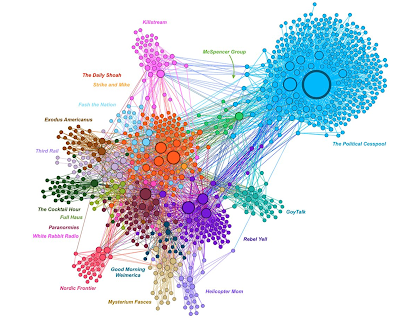
graphic: White supremacist podcast network (SPLC link)


The surge of right-wing extremism has been evident in the United States for the past five years, including the spread of white supremacist language and activism, armed demonstrations by right-wing militia organizations, violent threats against public officials in health and education agencies, and -- of course -- the violent insurrection that took place in the US Capitol Building January 6, 2021. But how does this work? What are the processes through which movements and groups that had been on the extremist fringe in the US are now coming into mass politics and are being embraced by Republican leaders from local to national? Is this just organic growth, or is it more deliberate and intentional than that?

The Souther Poverty Law Center has provided information -- increasingly alarming information -- about the growth of racist and extremist groups around the country for decades, and its research provides very important for all citizens who care about democracy to study. SPLC researchers have also highlighted the fact that hate-based groups and activists make extensive use of the internet to spread their ideas and values. Crucially, Megan Squire and Hannah Gais have documented a very rapid rise in mobilization and proselytization strategies through podcasts -- low-cost, readily disseminated productions that spew White Supremacist hate along with "shock radio" irony (link). They write that "the role of podcasts in the world of far-right extremism has been largely understudied." Producers of these hate-based podcasts can rely on dozens of podcast outlets provided by Apple, Google, and dozens of other internet mainstays, and the hate-based podcast can generate its audience at almost no cost. The article demonstrates graphically how these networks of extremist podcasts have grown in a very short time. They summarize the use of a wide network of hate-based podcasts for extremist purposes in these terms:

Podcasts have been exploited by far-right extremists in three distinct ways. They represent an important vehicle for radicalization to extremism and recruitment into extremist groups. Podcasts are also a bridge from online to on-the-ground organizing, specifically in the context of the deadly 2017 “Unite the Right” rally in Charlottesville, Virginia. Finally, extremists use podcasts to build contacts abroad and introduce their movements to leaders in other countries. (link)

Squire and Gais use a number of valuable analytical tools to describe the audiences of these podcasts and the important role that the podcast network has played in orchestrating events like Unite the Right. Through this research the SPLC report helps to capture the current structure of the White Supremacist movement today:

Both communities constituted two distinct poles within the white power movement, with Iron March representing its violent, terroristic ambitions and 504um typifying its efforts to build a white ethnostate through the existing political system. For a time, some users retained membership at both sites, while members of each site’s core leadership engaged in dialogue on their respective podcasts and occasionally republished one another’s work. However, after members of 8chan, a far-right image board popular with white supremacists and far-right conspiracy theorists, outed TRS leader Peinovich as married to a Jewish woman, the two communities fractured. “Slavros” and those groups, such as the Atomwaffen Division, that carried on the forum’s legacy of violence long after it disappeared from the web in fall 2017, expressed contempt for TRS and other factions of the alt-right. For “Slavros,” the alt-right represented “appeasement” to the current political order, as he argued in the September 2017 text “Zero Tolerance.”

Squire and Gais find a weird kind of narrative complexity in the stories of contemporary fascist beliefs that are represented in the various podcasts. This is important because it goes some way to explaining the virulence and appeal of these movements to some profiles of vulnerable individuals.

Another important angle that SPLC researchers have uncovered is the role played in hate organizations by cryptocurrencies (link). Michael Edison Hayden and Megan Squire show that cryptocurrency speculation has provided a very substantial source of funds in support of right-wing extremist mobilization. Here is a summary of their findings:

Hatewatch identified and compiled over 600 cryptocurrency addresses associated with white supremacists and other prominent far-right extremists for this essay and then probed their transaction histories through blockchain analysis software. What we found is striking: White supremacists such as Greg Johnson of Counter-Currents, race pseudoscience pundit Stefan Molyneux, Andrew “Weev” Auernheimer and Andrew Anglin of the Daily Stormer, and Don Black of the racist forum Stormfront, all bought into Bitcoin early in its history and turned a substantial profit from it. The estimated tens of millions of dollars’ worth of value extreme far-right figures generated represents a sum that would almost certainly be unavailable to them without cryptocurrency, and it gave them a chance to live comfortable lives while promoting hate and authoritarianism.

This research depends on the use of blockchain analysis software. Here is a definition of this kind of tool: "Blockchain analysis is the process of inspecting, identifying, clustering, modeling and visually representing data on a cryptographic distributed-ledger known as a blockchain. The goal of blockchain analysis is discovering useful information about the different actors transacting in cryptocurrency. Analysis of public blockchains such as the bitcoin and ethereum is often conducted by private companies. Bitcoin has long been associated with the trade of illegal goods on the dark web; this has been the case since bitcoin became the standard currency on the now closed " (link). Tools like these provide a window into the magnitude and disbursements made by some of these specific individuals. Speculation in Bitcoin and other currencies created a great deal of wealth for many of the leaders of far-right extremist organizations. And these cryptocurrency platforms provide relatively anonymous vehicles for transfer of funds from donors to organizations and their leaders.

Interesting and important as these analyses are, the job is still unfinished. We need a similarly detailed and technically sophisticated analysis of the use of Youtube, Facebook, Twitter, and other social media platforms by very intelligent right-wing extremists in pursuit of their goals of fundraising, mobilization, proselytization, and activism. What volume of videos on Youtube, and how many viewers, are connected to right-wing extremism and racist ideologies? How are Facebook groups used to transmit and amplify hate-based messages to followers? How is Twitter subverted with lies about immigration, covid, or government action? And what about online video game communities -- what role do these communities play in the amplification of hate-based values and beliefs? (Here is a New York Times piece about young teenagers being targeted in multi-player online games by neo-Nazi and white supremacist activists; link.)

When we consider the disproportionate role that false information, conspiracy theories, and outright lies about the coronavirus have played in the rapid incorporation of Covid into right-wing extremist grievances, the online networks described here are of great importance. These are some of the highways through which dangerous lies and mobilizing political narratives are conveyed by right-wing extremists. Hate-based extremists exist in real, concrete organizations and geographical locations; but they also exist in online communities. And the sophisticated data analysis provided by SPLC researchers is one of the tools we need if we are to fight effectively against the kinds of violent mobilization that occurred on January 6, 2021.

graphic: SPLC hate group map 2020 (link)


Sunday, November 21, 2021

Bauman on the Holocaust


There sometimes seems to be an important intertwining between personal biography and a person's sociological and historical imagination. Zygmunt Bauman (1925-2017) was a Jew of the generation in Poland who were destined to die -- most did in his generation of Polish Jews -- and he was exposed at various times to the murderous regime that conducted this campaign of death. And by the 1960s Bauman had become a sociologist of global importance. It would seem apparent Bauman's language and mental maps of the world were shaped by his experience in Poland, the Ukraine, and the Soviet Union during the searing decades of the 1930s and 1940s. Bauman had direct experience of the Nazi terror in Poland after 1939. As a Polish army officer in the Soviet Red Army he witnessed the Majdanek death camp and the horrors that it encompassed, and he witnessed the totality of the Nazi program of murder upon his return to Poland in 1945. And he served as a senior army intelligence and communications officer in the post-war Communist regime in Poland.

How did these life experiences influence Bauman's sociological imagination and his interpretation of the events of the 1930s and 1940s in Poland and elsewhere in central Europe? Bauman's personal life story involved direct experience of the Holocaust in Poland and the horrific tragedies, personally experienced, of German genocide and murderous warfare. Bauman himself witnessed and experienced some of the worst suffering of the Holocaust. And yet in his sociological writings in Poland through 1968 he never addressed the topics of genocide, totalitarianism, or the Nazi period. He turned to topics having to do with the fate of the Jews of Eastern Europe and the Holocaust only later in life -- in the 1980s, when he was over sixty. It appears that he was led to write Modernity and the Holocaust (1989) only after reading his wife Janina Bauman's powerful and moving account of her own experience in the Warsaw ghetto in Winter in the Morning: A Young Girl's Life in the Warsaw Ghetto and Beyond 1939-1945 (1986; link). And, when he does turn to the Holocaust, it is through the lens of his critique of modernity and the cult of rationality. The book is not a profound contribution to understanding the realities or historical horrors of the Holocaust; in fact, the results are banal and not especially insightful.

The Holocaust was born and executed in our modern rational society, at the high stage of our civilization and at  the peak of human cultural achievement, and for this reason it is a problem of that society, civilization and culture.... The implication that the perpetrators of the Holocaust were a wound or a malady of our civilization -- rather than its horrifying yet legitimate product -- results not only in the moral comfort of self-exculpation, but in the dire threat of moral and political disarmament.... Modern civilization was not the Holocaust's sufficient condition; it was, however, most certainly its necessary condition. Without it, the Holocaust would be unthinkable. It was the rational world of modern civilization that made the Holocaust thinkable. (x, xii, 13)

Here is Ali Rattansi's summary of Bauman's view of the Holocaust in Bauman and contemporary sociology: A critical analysis. Fundamentally Bauman sought to understand the Holocaust as an expression of modernity:

This truth could not, for Bauman, be denied by viewing the Holocaust as only a peculiarity of German history or Hitler’s evil personality and the cruelty, the moral decrepitude and sometimes the sheer indifference of those who in one way or another were implicated in such vile deeds. The effect of any such interpretation is to see the Holocaust as only something to do with Germany or Germanness, thereby absolving everyone else of responsibility, and, in particular, of shifting the blame away from the typical characteristics of modernity so widely taken for granted. For Bauman the factors involved were indeed ‘quite ordinary and common’; but they had come together in a historically unique encounter. The taken for granted civilisational framework which in fact harboured the seeds of the Holocaust consisted of the modern nation-state, the concentration and centralisation of the means of violence in its apparatuses and the adoption of a bold and sweeping project of social engineering by those in command of this immensely powerful state. The capacity of the leaders was enhanced by the dismantling of all sources of opposition and the possession of a particular modern apparatus of administration: a state bureaucracy. Science and modern technology had their own crucial role to play in the terrible sequence of events. It is in the combination of these common features of modern civilisation within a particular historical period that Bauman finds the basic causes of the Holocaust. (kl 753)

It is striking that Bauman's diagnosis of the Holocaust seems to have had more to do with his own in-depth experience of a totalitarian state as a functionary and eventually a victim in post-war Poland than with his childhood and adult experience of Nazi extermination: "the concentration and centralization of the means of violence", "a bold and sweeping project of social engineering", the "capacity of leaders [being] enhanced by the dismantling of all sources of opposition". This is a diagnosis that puts the responsibility for the Holocaust most fundamentally on the features of a totalitarian state.

Moreover, according to Bauman's diagnosis, genocide is a circumstance that emerges within the conditions of modernity:

I propose that the major lesson of the Holocaust is the necessity to treat the critique [of modernity] seriously and thus to expand the theoretical model of the civilizing process, so as to include the latter's tendency to demote, exprobate and delegitimize the ethical motivations of social action. We need to take stock of the evidence that the civilizing process is, among other things, a process of divesting the use and deployment of violence from moral calculus, and of emancipating the desiderata of rationality from interference of ethical norms or moral inhibitions. As the promotion of rationality to the exclusion of alternative criteria of action, and in particular the tendency to subordinate the use of violence to rational calculus, has been long ago acknowledged as a constitutive feature of modern civilization -- the Holocaust-style phenomena must be recognized as legitimate outcomes of civilizing tendency, and its constant potential. (Modernity and the Holocaust, 28)

Modernity would not have got where it has if it had relied on things as erratic, whimsical and thoroughly unmodern as human passions. Instead, it relied on the division of labour, on science, technology, scientific management and the power to make a rational calculation of costs and effects -- all thoroughly unemotional stuff. Stephen Trombley's remarkable study does for the 'execution industry' what the work of Gotz Aly and Susanne Heim did for the murderous enterprise of the Nazis: it shows beyond reasonable doubt that the setting which in modern society which makes mass production and unstoppable technological rationalization possible. Aly and Heim documented the crucial role played by the medics, psychologists and countless others -- in making mass extermination on a previously unheard-of scale feasible. (Modernity and the Holocaust, Afterword, 247)

But here is a crucial point to ponder: is the Holocaust a singular and evil event, or is it simply a manifestation of "modernity"? Bauman seems to be inclined down the road described by the second branch here; and that seems to be a mistake. To generalize the facts of the Holocaust to a few concepts characteristic of "modernity" rather than a particular period of suffering, evil-doing, and historical particulars seems to ultimately result in placing it beyond our reach. And yet, fundamentally, we want the generations prior to and following the Holocaust (including our own) to take responsibility for what occurred -- not dismiss it as the inevitable consequence of the modern world.

Here is one of the more personal passages in Modernity and the Holocaust on the intriguing idea about the moral importance of shame rather than rationalization from the final chapter:

The issue is that only the liberating feeling of shame may help to recover the moral significance of the awesome historical experience and thus help to exorcise the spectre of the Holocaust, which to this day haunts human conscience and makes us neglect vigilance at present for the sake of living in peace with the past. The choice is not between shame and pride. The choice is between the pride of morally purifying shame, and the shame of morally devastating pride. (205)

The inhuman world created by a homicidal tyranny dehumanized its victims and those who passively watched the victimization by pressing both to use the logic of self-preservation as absolution for moral insensitivity and inaction. No one can be proclaimed guilty for the sheer fact of breaking down under such pressure. Yet no one can be excused from moral self-deprecation for such surrender. And only when feeling ashamed for one's weakness can one finally shatter the mental prison which has outlived its builders and its guards. (205)

It is interesting to compare this abstract reflection with a passage from Janina Bauman's wartime diary from the Warsaw ghetto, which she quotes in Winter in the Morning.

'Don't you think the way we live is highly immoral?' I asked. 'We eat our breakfast, lunch and supper, we occupy our minds with the French Revolution or Polish poetry, or just which one of us L. fancies the most; then we go to bed with a good novel and peacefully fall asleep. At the same time they are starving and dying.' 'There's nothing we can do for them,' said Zula sadly, 'for the hundreds and thousands of them.' 'Of course not. But for some of them perhaps? Each of us for somebody?' 'Would you and your family be willing to take home these two begging boys?' asked Hanka very seriously. 'To share not only food but also beds with them, live with them for better or worse?' I had no ready answer to her question, and the more I think about it now, the clearer I see the answer is 'no'. (J Bauman, Winter in the Morning, 42)

Did Zygmunt Bauman himself have to face such choices -- in Poland, in the USSR, or in Poland once again as a political officer and informant? Is the experience of shame that he describes here one that was for him also a current human situational emotion? Izabela Wagner raises the question of culpability in Bauman's service as a political officer and informant in the Polish KBW (Internal Security Corps) during the imposition of Soviet-style dictatorship in Poland (Bauman: A Biography, 110-132); and she comes to a forgiving conclusion. Bauman did not inform meaningfully on others -- either his own circle or others. But what about the implications that Bauman himself may have drawn -- about an evil regime in whose service he was an active agent for several years? Did he experience this emancipating shame about his involvement in an authoritarian Communist regime in Poland?

Modernity and the Holocaust is an unsatisfying book, in that it fails to meaningfully address the historical and human specificity of the Holocaust. Bauman subordinates the Holocaust to a dimension of "Modernity" -- an abstraction, and lacking the deliberation and compassion demanded of the particular experiences of so many millions of people throughout east and central Europe. But these ideas have little of the sharp and penetrating insight of memoirs of survivors like Primo Levy or the contemporaneous writings of Vasily Grossman.

In 2009 Bauman wrote "Jews and other Europeans, old and new", where he reflects on the situation of European Jews in the twentieth century; link. This piece is more specific about the circumstances of European Jews than anything included in Modernity and the Holocaust. But it continues to link the war on the Jews to the failure of the modernization project in Europe. The emphasis is on nationalism and spurious assimilation.

In the late nineteenth century the great European project of nation-building was set in motion. It was meant to end in a Europe of unified nation-states, each of with its own language, history, traditions and a people undivided in its loyalty. The local or 'merely ethnic' communities would be effaced, subsumed into the homogeneous nation. Assimilation was the means whereby outsiders would become insiders, strangers would become citizens.

The Second World War, and the Holocaust, brought this project to its tragic and murderous end, laying bare the contradiction at its heart. Outsiders could not be assimilated since their loyalty was, by definition, always voluntary and therefore always seen as untrustworthy. As the historical epitome of the European outsider, Jews accordingly remained suspect despite all their ingenious efforts to assimilate. They experienced first-hand the ambivalence of the assimilatory drive, which was, from their point of view, to become like everyone else, and, from their hosts' point of view, to deepen belonging by emphasizing difference. (121)

But once again -- all theory, no compassion, and no real "micro-sociology" of the historical circumstances of the Jews of Poland, Ukraine, Lithuania, Estonia, Latvia, and the vibrant cultural and intellectual Jewish life that was part of the 1930s in central Europe. General sociological theory does not help to explain the Holocaust; instead, we need to trace the contingencies and pathways through which murder on a continent-wide scale came to be, and we need to reckon what we have lost. Grossman is more right than Bauman -- "Ukraine without Jews" is a horrendous, tragic, and irreplaceable loss to humanity, and it cannot be subsumed under the arch of the sociological theory of modernity.

And how about the question of intellectual formation with which we began above? Do Bauman's writings about the Holocaust reflect a worldview and sociological framework notably shaped through his lived experience? It seems clear that the answer is no. Bauman's intellectual framework is one of pure sociological theory, and this he gained through his graduate education and professional activities as a professor of sociology in Warsaw. There appears to be a very sharp line between Bauman's history as a Jewish teenager in Poland, a refugee in Molodechno, and an officer in the Red Army during the re-occupation of Ukraine and Poland, and his subsequent framing of the history he had lived through in Modernity and the Holocaust. (See this earlier post for more extensive discussion of Bauman's intellectual development.)

Friday, November 19, 2021

Jedwabne as memory and history


In July 1941 a terrible massacre of Jews took place in Jedwabne, a town in eastern Poland. The town consisted of some 3,000 residents, about half of whom were Jewish. On July 10, 1941, weeks after the German army took control of the town from the Soviet Red Army (according to the terms of the Molotov-Ribbentrop pact), a largescale action of mob violence against the Jews of Jedwabne took place, leading in the end to the murder of almost all of the Jewish population of the town. (Jan Gross estimates the death count to be about 1,600 men, women, and children.) Most horrifically, the largest number of these victims were herded into a barn which was set afire; everyone inside the barn was burned to death. Similar massacres occurred in nearby villages in the same week, in Wąsosz (July 5; link) and Radziłów (July 7; link).

Jan Gross's Neighbors: The Destruction of the Jewish Community in Jedwabne, Poland (2000) attempted to gather together the historical evidence available about the massacre and to provide a fact-based narrative of what happened on that awful day. His account, and the issues about Polish Catholic complicity in anti-Semitism and murder that it raises, have created a great deal of debate in Poland.

Several major questions have dominated the historical debate over what happened at Jedwabne:

  • Was the massacre ordered or instigated by the Germans?
  • Was ambient hatred of Jews among inter-war Poles responsible for this willingness to murder fellow human beings?
  • Was resentment against Jews for "collaboration with the Soviets" during the short period of Soviet occupation of Eastern Poland a primary factor in hostility to the Jews of Jedwabne by their neighbors?
  • Was Jedwabne typical of a common experience in rural Poland in 1941?

Journalist Anna Bikont undertook in 2000 to provide a fresh review of the events of Jedwabne, and the results are provided in The Crime and the Silence: Confronting the Massacre of Jews in Wartime Jedwabne (2004). Her book is a remarkable work of investigative journalism, involving careful review of existing archives and interviews with a surprising number of persons who were present in Jedwabne on that terrible day. In almost every large detail Bikont confirms Gross's key factual claims.

Bikont provides substantial documentation of the high level of anti-Semitism in eastern Poland (and the Łomża region in particular), promulgated by the extremist National Party and the Catholic Church. (The publication Catholic Cause was a frequent source of anti-Semitic exhortations.) These conclusions are based on her interviews, publications of the Church and the party, and investigative reports by the Interior Ministry. “In an Interior Ministry report of February 3, 1939, we read, 'Anti-Semitism is spreading uncontrollably.' In a climate where windows being smashed in Jewish homes, stalls being overturned, and Jews being beaten were daily occurrences, one case from Jedwabne that came to trial in 1939 concerned an accusation made against a Jewish woman” (51).

Bikont documents rampant anti-Semitism in the historical record. Here is a statement from her interview with Jan Skrodzki, who witnessed the brutality and murder in Jedwabne as a six-year-old child:

I often hear there’s no anti-Semitism in Poland now. I always say, ‘There are a lot of anti-Semites in my family, and of the people I know, every other one, or maybe every third, is anti-Semitic, and I could easily have been, too.’ And where did we get our anti-Semitism? The priest preached it from the pulpit, that fat Father Dołęgowski. And Poles in Radziłów lapped it up because they were uneducated or completely illiterate. Envious of Jews because they were better off. While Jews were working harder, organizing their work better, supporting each other. (235)

Bikont shares a few lines from her interview with Prosecutor Radoslaw Ignatiew in the Bialystok Institute of National Remembrance:

AB: You say, “The perpetrators of the crime, strictly speaking, were the Polish inhabitants of Jedwabne and its surroundings—a group of at least forty men … They actively participated in committing the crime, armed with sticks, crow bars, and other tools.” Let us try to trace how you came to the description you gave of the atrocity in your final findings. You read Gross’s book … (589)

Here is Prosecutor Ignatiew's summary conclusion:

I can state that the perpetrators of the atrocity were Polish residents of Jedwabne and its surroundings, at least forty men. There is no proof that the townspeople in general were the perpetrators. To claim that there was a company of Germans in Jedwabne is as implausible as maintaining the whole town went crazy. Most people behaved passively. I can’t judge where that passivity came from. Maybe some people felt compassion for the victims but were terrified by the brutality of the killers. Others, though they may have had anti-Semitic views, were not people quick to take an active part in actions of this kind. (600)

Prosecutor Ignatiew disagrees with Gross's account on two details. First, he believes the total number of murdered individuals was significantly fewer than the 1,600 reported in Neighbors. And second, based on his investigation he believes that the killings were instigated and encouraged by the Germans, though not commanded or organized by them. The evidence available to him supports the conclusion that the number of uniformed Germans was very small on the day of the killings. 

Antony Polonsky notes that Gross's book created great discord about Poland's history on its publication. Polonsky reviewed the debate about Jedwabne as it has unfolded in Poland in his important 2004 article, "Poles, Jews and the Problems of a Divided Memory" (link). Polonsky is a well-respected scholar of Jewish history, and especially of the history of the Jews in Poland, and his treatment of the facts and the historiography of Jedwabne is judicious and credible. The question of Polish culpability and collaboration is important; but in his view, the genocide was chiefly the work of Germany. "The primary responsibility for these crimes clearly lies with the Nazis" (128). But this conclusion is about the genocide of Poland's Jews throughout the period -- not specifically at Jedwabne.

Polonsky addresses the question of whether the murderous violence in Jedwabne occurred because Christian Poles believed that Jewish Poles had been disloyal under Soviet occupation. Polonsky takes a nuanced position on this question. He believes that this suspicion and resentment played a role in elevating anti-Semitism in 1940, and he notes that it was natural for the Jewish community to suspect that Soviet rule would be less harmful to them than Nazi rule. But he does not appear to believe that this was a primary cause of the murderous actions of ordinary Polish people in July 1940.

In addition, Jewish collaboration with the new Soviet authorities aroused widespread Polish resentment. It is undeniable that a fair number of Jews (like the overwhelming majority of Belarusians, a considerable number of Ukrainians, and even some Poles) welcomed the establishment of Soviet rule. In the Jewish case, this welcome was natural: it is explained by a desire to see an end to the insecurity caused by the collapse of Polish rule in these areas and the belief that the Soviets were less hostile than the Nazis and the resentment of Polish anti-Jewish policies in the interwar period. There was, in addition, some support for the communist system, although this was very much a minority position within the Jewish community. While the Soviets did offer new opportunities to individual Jews, they acted to suppress organized Jewish life, both religious and political, dissolving kehillot, banning virtually all Jewish parties and arresting their leaders. Jews made up nearly a third of the over half a million people deported by the Soviets from these areas (which inadvertently saved many of them from annihilation at the hands of the Nazis). Under these conditions, the overwhelming majority of the Jewish population here very quickly lost whatever illusions they might have had about the Soviet system. (140)

Further, Polonsky and Michlic in their introduction to The Neighbors Respond: The Controversy over the Jedwabne Massacre in Poland (2009) suggest that the Łomża region was exceptional for the degree of right-wing extremism and anti-Semitism it exhibited in the years before Germany's invasion:

Such evidence as we have, both Polish and Jewish, suggests that the Łomża region in northeastern Poland where Jedwabne is located, an area that had long been a stronghold of the extreme right, was the only area in which collective massacres of Jews by civilian Poles took place in the summer of 1941—when the region, previously occupied by the Soviet Union, was reoccupied by Nazi Germany. (The Neighbors Respond, 45)

Polonsky and Michlic suggest that pogroms like these in the northeast were uncommon elsewhere in Poland, and that similar pogroms occurred in western Ukraine on a much broader scale. They quote research by Marco Carynnyk documenting largescale pogroms in 1941 in more than thirty places in western Ukraine, resulting in deaths estimated between 12,000 and 35,000. By that account, then, Łomża region atrocities (including Jedwabne, Wąsosz, and Radziłów) were not typical of the experience of Polish-Jewish communities in most of Poland, and were more similar to the localities of western Ukraine.

Another important resource on the active involvement of non-Jewish Poles in the murder of Poland's Jews is Jan Grabowski's "The Polish Police: Collaboration in the Holocaust" (link). Grabowski documents the substantial role that the "Blue Police" (Polish nationals in a reconstituted police force under Nazi command) played in implementation of Nazi Jewish regulations, including confinement in ghettos in Poland's major cities. This role included carrying out mass executions of Jews. Here is an example of Blue Police involvement in an aktion in Węgrówa small Polish city:

On the day of the Aktion in Węgrów, the German-Ukrainian Liquidierungskommando, with the assistance of the Blue Police, local firefighters, and so-called “bystanders,” murdered more than 1,000 Jews in the streets of the city. Another 8,000 Jews were marched to the Sokołów railway station, eight miles distant, and delivered to Treblinka. The Liquidierungskommando left Węgrów the following day. Their job, however, was far from complete: more than a thousand Jews remained hidden inside the ghetto. In the subsequent days and weeks the Polish Blue Police and the local firefighters conducted intense searches and found most of them. They either killed these Jews themselves, or delivered them to the German gendarmes for execution. (11)

Grabowski and Barbara Engelking were sued under Poland's recent libel and defamation laws, created by the Law and Justice Party government, for publication of their book Night without End on the basis of statements about Polish individuals who were responsible for crimes against Jews. Engelking and Grabowski were first found responsible for libel against a descendent of Edward Malinowski and ordered to publicly apologize. This verdict was profoundly chilling to historians conducting historical research on the Holocaust in Poland. An appellate court took note of the negative effect the lower court ruling had on academic freedom and reversed that finding in August 2021 (link). (Here is a review of the legal efforts in Poland to muzzle Holocaust historians by Mikhal Dekel (link). It was published in June 2021, before the appellate court ruling.) 

Polonsky makes a key point in both "Poles, Jews and the Problems of a Divided Memory" and the introduction to The Neighbors Respond, that parallels Tony Judt's arguments in "The Past is Another Country" (link) -- that confronting the ugly truths about the past is essential to moving forward to a democratic and peaceful future. Polish society has had difficulty in confronting the involvement of ordinary Polish people in the atrocities of the Holocaust and the political realities of Communist rule in Poland, and the current government is emphatic in its efforts to "sanitize" the telling of this history. In Judt's phrase, the current government prefers myth to truth. Gross, Grabowski, Engelking, Michlic, Polonsky, and a whole cohort of historians of Poland, both inside Poland and abroad, are working hard to discover the truth. 

Saturday, September 25, 2021

Fascist populism and the threat to democracy


What features of a political regime contribute to political loyalty and commitment on the part of its citizens? Can a fascist dictatorship inspire political loyalty and commitment from the mass of society? And what about liberal democracy; can a liberal democratic regime maintain mass support?

We have the makings of an answer to the first question. A fascist dictatorship like that of Mussolini can indeed maintain passionate support through a powerful (often mendacious) ideology and value scheme -- fatherland, church, family, scapegoating of "enemies of the people"; a social program that finds support (repression of immigrants and ethnic minorities); and a demonstration of competent governance ("the trains run on time"). This story identifies several factors -- ideology and values, scapegoating, implementation of popular policies of repression, and efficient adminstration of government (economic growth. jobs, stable prices, ...).

So what about liberal democracy: a maximal, extensive, and equal system of rights; and a legislative process implementing equal democratic rights to set law and policy. Does this system provide a basis for eliciting loyalty and commitment from all or most citizens? In particular, does it support a compelling value statement, a real principle of  tolerance, and the capacity for achieving “good government” (efficient management of the public good)? Can the values of equal worth, tolerance of difference, and majoritarian decision-making lead to loyalty and commitment? Can a Barack Obama, Bernie Sanders, or Hillary Clinton create an inspiring vision of the future that mobilizes most citizens in support?

The prospects don’t appear to be very good. Anti-liberal political opportunists can always create a counter-narrative that directly or tacitly rejects equality and tolerance and seeks to create a basis for minority rule. Right-wing populism has shown itself to be insidious and virulent — very capable of winning support from large groups of anti-liberal activists and followers. The politics of division and hate are indeed powerful. Fascist ideology, values, and programs have great strength in the space of contemporary mass politics. The currents of hate, fear, racism, xenophobia, and the political maneuver of “group supremacy” have shown themselves to be highly potent bases for political mobilization.

There seem to be two levels of support for a regime that are in question. First is “rational/reasonable consideration” of which regime best suits my longterm interests. The second is “emotional/passionate mobilization” around the call to action by a highly persuasive leader — a Tucker Carlson or Mussolini. The first is a deliberative “all things considered” choice of a regime; the other is political marketing and propaganda.

What then are the prospects for continuing stable support for liberal democracy? First, it is clear that this kind of support is not automatic. There are powerful and compelling anti-liberal voices in the space of liberal democracy. Liberal democrats must compete vigorously or they will lose. They must articulate the value of liberal democracy and the very real dangers of the rise of populist extremism.

Second, liberal democracy needs to make credible the belief that liberal democratic government can succeed in creating laws and policies that genuinely enhance justice, equality, and opportunity.

And third, defenders of liberal democracy need to ensure that the institutions of the state continue to guarantee the rights of all citizens. The willingness of the far-right to use violent threats and actions against our institutions must be rebutted. January 6 is a dangerous and sobering precedent; so are the kidnapping plot against Michigan Governor Whitmer, the brandishing of semi-automatic weapons in state houses around the country, and the intimidation of public health officials during the pandemic. Violence and intimidation are inherently toxic to liberal democracy.

It seems very clear: Citizens must actively assert themselves in support of our liberal democracy, or we will go the way of Hungary.

Wednesday, September 15, 2021

Probing atrocity in Miropol

photo: execution site at Babi Yar, Kiev, Ukraine, September 1941

It is challenging to form a mental picture of the significance and reality of the events and enormity of the Holocaust. Many of the summary facts that we "know" about the Nazi plan for extermination of the Jewish people are both inadequate to capture the human meaning of this period, and misleading or inaccurate, as Tim Snyder argues (Black Earth: The Holocaust as History and Warning). How can we gain a better and more personal understanding of these horrible events from the 1940s?

First-person accounts and oral histories represent one form of access to the realities of the mass killings that occurred across Europe, and especially in Eastern Europe. But an especially powerful recent book takes a somewhat different approach. This is Wendy Lower's The Ravine: A Family, a Photograph, a Holocaust Massacre Revealed, a book that proceeds from a single photograph of a single instant of brutality and murder, and helps the reader develop an extensive understanding of the human realities that led to this moment. The photograph is taken in the midst of a mass killing outside the town of Miropol in the Ukraine in October, 1941. The Jews of Miropol were forced to walk into the forest, were gathered at a previously prepared shooting pit, and were murdered by rifle fire. The photograph is unusual in that it is at close range and captures identifiable faces of both the murderers (two German soldiers and two Ukrainian militiamen) and the victim, a mother holding a child by the hand as she is shot. Lower wants to understand the photograph in detail, and to learn the identities of the individuals involved.

Lower combines the skills of an experienced historian, a resourceful crime investigator, and a compassionate observer of family tragedy in a time of mass killing. Her goal is ambitious: she would like to uncover the identity of the victims in the photograph, the killers, the photographer, and the possibility of holding the responsible persons to account in the present. And she accomplishes much of this set of goals. She gains a great deal of detailed knowledge about the Ukrainian and German personnel who were present. She forms an educated guess about the family identity of the victims in the photograph. And she learns a great deal about the photographer. Along the way she provides enough detail about the context of German military and Final Solution activity in 1941 to give the reader a fairly good idea about how this event relates to the larger orchestrated Aktions against the Jews of Eastern Europe from 1941 to 1944 -- the bulk of the killing during the Holocaust.

Miropol was a small town in occupied Ukraine in the fall of 1941. It is some 220 kilometers west of Kiev, the site of the massacre at Babi Yar in September 1941. In Miropol in October several hundred Jewish men, women, and children were exterminated by gunfire. This is the Aktion recorded in the photograph at the center of The Ravine. In Kiev only a few weeks earlier, the largest massacre of Jews in the Holocaust in the occupied Ukraine and Soviet territories occurred, involving the murder over a few days of over 34,000 human beings. In 1943 the Nazis made an effort to conceal the evidence of the massacre, and the Soviets concealed the fact that the victims were Jewish, preferring instead to refer to "Soviet civilians". No memorial was created for the Jewish dead at Babi Yar until 1991, fifty years after the massacre. There appears to be no memorial for the Jewish dead at Miropol; the handful of photographs by Škrovina alone serve as memorial. But The Ravine represents a different kind of memorial. The reader comes away with a sober and human recognition of these many hundreds of innocent victims of murder, and the lives that were stolen from them.

Lower begins with this particular photograph -- a photograph of several German soldiers and Ukrainian militia men in the act of shooting a Jewish mother holding a child at the edge of a burial pit. It is a haunting photograph. But Lower goes much beyond this particular photo, including archival evidence, more photographs, interviews with witnesses and participants, and records from both Nazi and Soviet sources. She is a resourceful, talented, and determined researcher, and her ability to unearth many of the details of this atrocity is continually surprising. She brings the skills and concentration of a forensic investigator to her work.

Especially interesting is Lower's treatment of the role of photographs in this kind of investigation. She is very clear that photography is purposive and intentional. It is not generally a "flat representation of what occurred"; instead, the photographer has a story he or she in interested in discovering and telling. So photography is creative and "subjective". And this proves to be true of the photographer of this particular image, a Slovak named Lubomir Škrovina, who had a narrative he was recording through a series of exposures. But at the same time, photographs prove to be a source of remarkable insight into the human realities of the moment captured in the negative -- details that were invisible to the photographer. And Škrovina himself turns out to be different from how he first appears. Initially Lower takes him to be an accomplice or collaborator, but eventually discovers that he was a dissident and a supporter of the Slovak resistance movement, and was interested in recording the atrocities he witnesses under German occupation for the outside world. Lower writes of Škrovina as a moral human being and his subsequent actions during and after the war:

But being there certainly shaped his subsequent choices and the risks he undertook, which affected him and his family. He refused to stay on the front, feigned illness, spent months in a nerve clinic, then resumed contact with Jews in his town, including sheltering some in the attic of his family home. He helped Dr. Gotthilf secure a place in the forest with his comrades in the Slovak National Resistance, although Škrovina ultimately could not save him or his wife and child. Škrovina was antifascist and anti-Soviet. He had felt no pride wearing any government-issued uniform. He hated the war. (91)

Several specific and important insights emerge from Lower's narrative. First is the importance of doing what we can to recognize and remember the individuals and families who were extinguished there. Lower's point about the killing of families is especially poignant: fathers, mothers, aunts, uncles, cousins, sons, and daughters, all destroyed. Second is the important reminder that Nazi violence was carried out by its allies in occupied countries -- Poland, Lithuania, Ukraine -- and that these armed groups and police units were merciless and remorseless towards their Jewish neighbors. What Lower uncovers at Miropol is a microcosm of Babi Yar.

Theodor Adorno once said that “To write poetry after Auschwitz is barbaric." But here is a good reason not to agree with Adorno. Consider the beautiful, sorrowful, and indicting poem written by Yevgeny Yevtushenko in 1961, Babi Yar. Yevtushenko helps us to mourn and recognize these children, women, and men who were murdered at Babi Yar. And he points a finger of accusation against the continuing anti-Semitism rampant in the Soviet Union in which he lived. Wendy Lower's book is not poetry, but it is just as eloquent in its evocation of the human realities of this tragic moment in Miropol, and in the great expanse of the bloodlands of Eastern Europe.

BABI YAR
Yevgeny Yevtushenko

No monument stands over Babi Yar.
A drop sheer as a crude gravestone.
I am afraid.
        Today I am as old in years
as all the Jewish people.
Now I seem to be
                a Jew.
Here I plod through ancient Egypt.
Here I perish crucified on the cross,
and to this day I bear the scars of nails.
I seem to be
                    Dreyfus.
The Philistine
                    is both informer and judge.
I am behind bars.
                    Beset on every side.
Hounded,
            spat on,
                    slandered.

Squealing, dainty ladies in flounced Brussels lace
stick their parasols into my face.
I seem to be then
                        a young boy in Byelostok.
Blood runs, spilling over the floors.
The barroom rabble-rousers
give off a stench of vodka and onion.
A boot kicks me aside, helpless.
In vain I plead with these pogrom bullies.
While they jeer and shout,
                            'Beat the Yids. Save Russia!'
Some grain-marketer beats up my mother.

O my Russian people!
                        I know
                                    you
are international to the core.
But those with unclean hands
have often made a jingle of your purest name.
I know the goodness of my land.
How vile these antisemites—
                                        without a qualm
they pompously called themselves
the Union of the Russian People!

I seem to be
                    Anne Frank
transparent
                   as a branch in April.
And I love.
                  And have no need of phrases.
My need
                  is that we gaze into each other.
How little we can see
                               or smell!
We are denied the leaves,
                               we are denied the sky.
Yet we can do so much—
                                tenderly
embrace each other in a darkened room.
They're coming here?
                                Be not afraid. Those are the booming
sounds of spring:
                                spring is coming here.
Come then to me.
                                Quick, give me your lips.
Are they smashing down the door?
                                No, it's the ice breaking . . .
The wild grasses rustle over Babi Yar.
The trees look ominous,
                        like judges.
Here all things scream silently,
                            and, baring my head,
slowly I feel myself
                            turning grey.
And I myself
                    am one massive, soundless scream
above the thousand thousand buried here.
I am
                each old man
                        here shot dead.
I am
                every child
                    here shot dead.
Nothing in me
                    shall ever forget!
The 'Internationale,' let it
                                thunder
when the last antisemite on earth
is buried for ever.
In my blood there is no Jewish blood.
In their callous rage, all antisemites
must hate me now as a Jew.
For that reason
                        I am a true Russian!