Showing posts with label CAT_organization. Show all posts

Sunday, July 9, 2023

The air traffic control system and ethno-cognition


Diane Vaughan's recent Dead Reckoning: Air Traffic Control, System Effects, and Risk is an important contribution to the literature on safety in complex socio-technical systems. The book is an ethnographic study of the workspaces and the men and women who manage the flow of aircraft throughout US airspace. Her ethnographic work for this study was extensive and detailed. She is interested in arriving at a representation of air traffic control arrangements as a system, and she pays ample attention to the legal and regulatory arrangements embodied in the Federal Aviation Administration as the administrator of this system. As an organizational sociologist, she understands full well that "institutions matter" -- the institutions and organizations that have been created and reformed over time have specific characteristics that influence the behavior of the actors who work within the system, and influence in turn the effectiveness and safety of the system. But her central finding is that it is the situated actors who do their work in control towers and flight centers who are critical to the resilience and safety of the system. And what is most important about their characteristics of work is the embodied social cognition that they have achieved through training and experience. She uses the term "ethno-cognition" to refer to the extended system of concrete and embodied knowledge that is distributed across the corps of controllers in air traffic control centers and towers across the country.

Vaughan emphasizes the importance of “situated action” in the workings of a complex socio-technological system: “the dynamic between the system’s institutional environment, the organization as a socio-technical system, and the controllers’ material practices, interpretive work, and the meanings the work has for them” (p. 11). She sees this intellectual frame as a bridge between the concrete activities in a control tower and the meso-level arrangements and material infrastructure within which the work proceeds. This is where "micro" meets macro and meso in the air traffic control system.

The key point here is that the skilled air traffic controller is not just the master of an explicit set of protocols and procedures. He or she has gained a set of cognitive skills that are “embodied” rather than formally represented as a system of formal rules and facts. “Collectively, controllers’ cultural system of knowledge is a set of embodied repertoires – cognitive, physical, emotional, and material practices – that are learned and drawn upon to craft action from moment to moment in response to changing conditions. In constructing the act, structure, culture, and agency combine” (p. 122). Vaughan's own process of learning through this extended immersion sounds a great deal like Michael Polanyi’s description in Personal Knowledge of the acquisition of “tacit knowledge” by a beginning radiologist; she learned to “see” the sky in the way that a trained controller saw it. The controllers have mastered a huge set of tacit repertoires that permit them to understand and control the rapidly changing air spaces around them.

A special strength of the book is the detailed attention Vaughan gives to the historicity and contingency of institutions and organizations. Vaughan’s approach is deliberately “multi-level”, including government agencies, institutions, organizations, and individuals in their workplaces. Vaughan takes full account of the fact that institutions change over time as a result of the actions of a variety of actors, and changes in the institutional settings have consequences for the workings of embedded technological systems. She points out, moreover, that these changes are almost always “patch-work” changes, involving incremental efforts to fit new technologies or team practices into existing organizational forms.  “Incrementally, problem-solving people and organizations inside the air traffic control system have developed strategies of resilience, reliability, and redundancy that provided perennial dynamic flexibility to the parts of the system structure, and they have improvised tools of repair to adjust innovations to local conditions, contributing to system persistence” (p. 9). Institutions and organizations change largely through processes of "social hacking" and adjustment, rather than wholesale redesign, and she finds that the small number of instances of efforts to fully redesign the system have failed.

Particularly valuable in Vaughan’s narrative is her fluid integration of processes and factors at the macro, meso, and micro levels. High-level features like economic pressures on airlines, budget constraints within the Federal government (e.g. delaying implementation of long-range radar in the air traffic control system; 83), and military imperatives on the movements of aircraft (83); meso-level features like the regulatory system for air traffic safety as it emerged and evolved; and micro-level features like the architecture of the workspaces of controllers over time and the practices and problem-solving abilities that were embodied in their work – all these levels are represented in almost every page of the book. And Vaughan points out that all of these processes have the potential of creating unanticipated system dysfunctions beyond their direct effects. Even the facts of the diffusion of high-speed commercial jets and the rise in military staffing demands during the Vietnam War had important and unanticipated system consequences for the air traffic control system.

Vaughan refers frequently to the causal role that “history” plays in complex technology systems like the air traffic control system. But she avoids the error of reification of “history” by carefully paraphrasing what this claim means to her: “History has a causal effect on the present only through the agency of multiple heterogeneous social actors and actions originating in different institutional and organizational locations and temporalities that intersect with a developing system and through its life course in unanticipated ways…. Causal explanations of historical events, institutions, and outcomes are best understood by storylike explanations that capture the sequential unfolding of events in and over time, revealing the interaction of structures and social actions that drive change” (p. 42). This clarification correctly disaggregates the causal powers of “history” into the actors, institutions, and processes whose influences over time have contributed to the current workings of the socio-technical system. Further, it provides a useful contribution to the literature on institutional change with its granular level of detail concerning the “career” of the air traffic control system over several decades. (Here she draws on the work of sociologists like Andrew Abbott on the role of temporality in social explanations.)

One illustration of Vaughan’s attention to historical details occurs in her account of the extended process of invention, design, test, and publicity undertaken by the Wright brothers. This narrative illustrates the multi-level influences that contributed to the establishment of a paradigm of heavier-than-air flight in the early decades of the twentieth century – individual innovation, networks of transmission of ideas, institutional context, and the authority and reputation of the magazine Scientific American (pp. 49-63). And, like Thomas Hughes' historical account of the development of electric power in the United States in Networks of Power, her account is fully attentive to the contingency and path-dependency of these processes. This material makes a genuine contribution to science and technology studies and to recent work in the history of technology. 

Vaughan sounds a cautionary note about the safety and resilience of the air traffic system, and its (usually) excellent record of preventing mid-air and on-ground collisions among aircraft. She has argued persuasively throughout the book that these features of safety and resilience depend crucially on the well-trained and experienced controllers who observe and control the airspace. But she notes as well the perennial desire of both private businesses and government agencies to squeeze costs and "waste" out of complex processes. In the context of the air traffic control system, this has meant trying to reduce the number of controllers through "streamlined" processes and more extensive technologies. Her reaction to these impulses is clearly a negative one: reducing staff in air traffic control towers is a very good way of making unlikely events like mid-air collisions incrementally more likely; and that fact translates into an increasing likelihood of loss of life (and the business and government losses associated with major disasters). We should not look at reasonable staffing levels in control towers as a "wasteful" organizational practice.

(Here is an earlier post on "Expert Knowledge" that is relevant to Vaughan's findings; link.)

Friday, May 12, 2023

Sources of technology failure


A recurring theme in Understanding Society is the topic of technology failure -- air disasters, chemical plant explosions, deep drilling accidents. This diagram is intended to capture several dimensions of failure causes that have been discussed. The categories identified here include organizational dysfunctions, behavioral shortcomings, system failures, and regulatory dysfunctions. Each of these broad categories has contributed to the occurrence of major technology disasters, and often most or all of them are involved.


System failures. 2005 Texas City refinery explosion. A complex technology system involves a dense set of sub-systems that have multiple failure modes and multiple ways of affecting other sub-systems. As Charles Perrow points out, often those system interactions are "tightly coupled", which means that there is very little time in which operators can attempt to diagnose the source of a failure before harmful effects have proliferated to other sub-systems. A pump fails in a cooling loop; an exhaust valve is stuck in the closed position; and nuclear fuel rods are left uncooled for less than a minute before they generate enough heat to boil away the coolant water. Similar to the issue of tight coupling is the feature of complex interactions: A influences B, C, D; B and D influence A; C's change of state further influences unexpected performance by D. The causal chains here are not linear, so once again -- operators and engineers are hard pressed to diagnose the source cause of an anomalous behavior in time to save the system from meltdown or catastrophic failure.

And then there are failures that originate in problems in the original design of the system and its instruments. Nancy Leveson identifies many such design failures in "The Role of Software in Spacecraft Accidents" (link). For example, the explosion at the Texas City refinery (link) occurred in part because the level transmitter instrument for the splitter high tower only measured column height up to the ten-foot maximum permissible height of the column of flammable liquid in the high splitter. Otherwise it only produced an alarm, which was routinely ignored. As a result the operators had no way of knowing that the column had gone up to 80 feet and then to the top of the column, leading to a release and subsequent fire and explosion (CSB Final Report Texas City BP) -- an overflow accident. And sometimes the overall system actually had no formal design process at all; as Andrew Hopkins observes,

Processing plants evolve and grow over time. A study of petroleum refineries in the US has shown that “the largest and most complex refineries in the sample are also the oldest … Their complexity emerged as a result of historical accretion. Processes were modified, added, linked, enhanced and replaced over a history that greatly exceeded the memories of those who worked in the refinery. (Lessons from Longford, 33)

This implies that the whole system is not fully understood by any of the participants -- executives, managers, engineers, or skilled operators.

Organizational dysfunctions. Deepwater Horizon. There is a very wide range of organizational dysfunctions that can be identified in case studies of technology disasters, from refineries to patient safety accidents. These include excessive cost reduction mandated by corporate decisions, inadequate safety culture embodied in leaders, operators, and day-to-day operations; poor inter-unit communications, where one unit concludes that a hazardous operation should be suspended but another unit doesn't get the message; poor training and supervision; and conflicting priorities within the organization. Top managers are subject to production pressures that lead them to resist decisions involving a shutdown of process while anomalies are sorted out; higher-level managers sometimes lack the technical knowledge needed to know when a given signal or alarm may be potentially catastrophic; failures of communications within large companies about known process risks; and inadequate oversight within a large firm of subcontractor performance and responsibilities. Two pervasive problems are identified in a great many case studies: relentless cost containment initiatives to increase efficiency and profitability; and a lack of commitment to (and understanding of) an enterprise-wide culture of safety. In particular, it is common for executives and governing boards of high-risk enterprises to declare that "safety is our number-one priority", where what they focus on is "days-lost" measures of injuries in the workplace. But this conception of safety fails completely to identify system risks. (Andrew Hopkins makes a very persuasive case for the use of "safety case" regulation and detailed HAZOP analysis for a complex operation as a whole; link.)

Behavioral shortcomings. Bhopal toxic gas release, Texas City refinery accident. No organization works like a Swiss watch. Rather, specific individuals occupy positions of work responsibility that may sometimes be only imperfectly performed. A control room supervisor is distracted at the end of his shift and fails to provide critical information for the supervisor on the incoming shift. Process inspectors sometimes take shortcuts and certify processes that in fact contain critical sources of failure; or inspectors yield to management pressure to overlook "minor" deviations from regulations. A maintenance crew deviates from training and protocol in order to complete tasks on time, resulting in a minor accident that leads to a cascade of more serious events. Directors of separate units within a process facility fail to inform each other of anomalies that may affect the safety of other sub-systems. Staff at each level have an incentive to conceal mistakes and "near-misses" that could otherwise be corrected.

Regulatory shortcomings. Longford gas plant, Davis-Besse nuclear plant incidents, East Palestine Norfolk Southern Railway accident. Risky industries plainly require regulation. But regulatory frameworks are often seriously flawed by known dysfunctions (link, link, link): industry capture (nuclear power industry); inadequate resources (NRC); inadequate enforcement tools (Chemical Safety Board); revolving door from industry to regulatory staff to industry; vulnerability to "anti-regulation" ideology expressed by industry and sympathetic legislators; and many of the dysfunctions already mentioned under the categories of organizational and behavioral shortcomings. The system of delegated regulation has been appealing to both industry and government officials. This is a system where central oversight is exercised by the regulatory agency, but the technical experts of the industry itself are called upon to assess critical safety features of the process being regulated. This approach makes government budget support for the regulatory agency much less costly. This system is used by the Federal Aviation Administration in its oversight of airframe safety. However, the experience of the Boeing 737 MAX failures has shown that the system of delegated regulation is vulnerable to distortion by the manufacturing companies that it oversees (link).

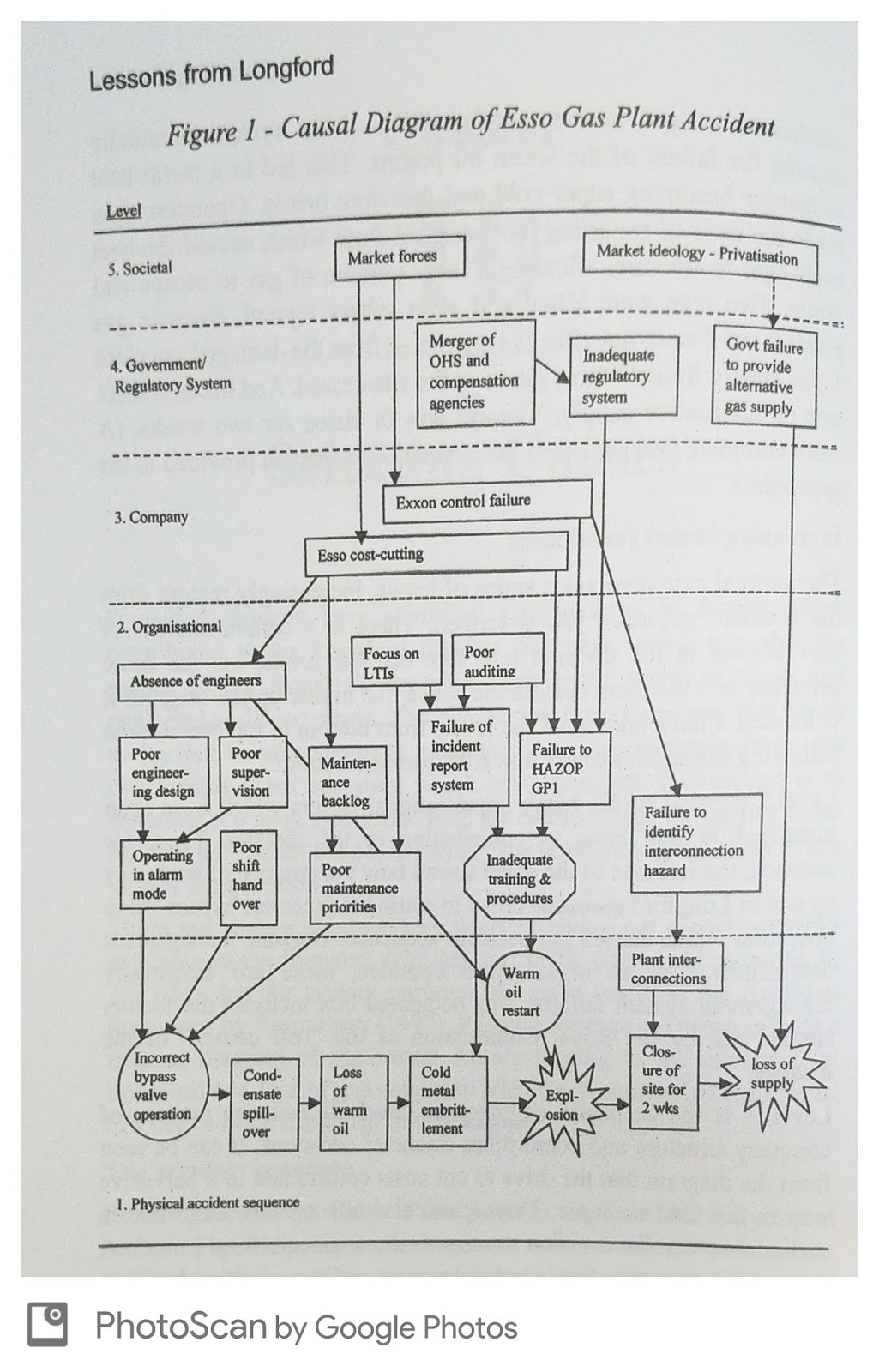
Here is Andrew Hopkin's multi-level analysis of the Longford Esso gas plant accident (link). This diagram illustrates each of the categories of failure mentioned here.


Consider this alternative universe. It is a world in which CEOs, executives, directors, and staff in risky enterprises have taken the time to read 4-6 detailed case studies of major technology accidents and have absorbed the complexity of the kinds of dysfunctions that can lead to serious disasters. Instructive case studies might include the Longford Esso gas plant explosion, the 2005 Texas City refinery explosion, the Columbia Space Shuttle disaster, the Boeing 737 MAX failure, the BP Deepwater Horizon disaster, and the Davis-Besse nuclear power plant incidents. These case studies would provide enterprise leaders and staff with a much more detailed understanding of the kinds of organizational and system failure that can be expected to occur in risky enterprises, and leaders and managers would be much better prepared to prevent failures like these in the future. It would be a safer world.

Thursday, February 2, 2023

New public administration 1968-2002

Image: org chart, Housing and Urban Development (9,500 staff)

Herbert Simon's important contribution to the study of administrative organizations appeared in 1947, with the title Administrative Behavior: A Study of Decision-Making Processes in Administrative Organizations. It is a remarkably sophisticated book in the social scientific study of bureaucracy and large organizations. (Here is an earlier discussion of some of the main lines of thought in the book (link).) Simon provides a treatment of four of what he takes to be the key mechanisms underlying the operations of large organizations: authority, communications, efficiency, and "organizational identification". These mechanisms contribute to the ability of leaders to coordinate the actions of subordinates in pursuit of goals and plans articulated on behalf of the organization and its division. The book is still worth reading carefully.

In the 1960s there was a flurry of discussion and debate within the field of public administration about how thinking in the field ought to be reconceived. Much of this thinking was summarized in a volume edited by Frank Marini with the title Toward a New Public Administration: The Minnowbrook Perspective. It is now worth asking whether that burst of disciplinary energy lead to new insights about the workings of public agencies. Unhappily, it appears that it did not.

H. George Frederickson's contribution to the Marini volume provided a substantive synthesis of the field at that time. Frederickson was a leader in the field of public administration, and he was a pivotal figure in reconvening the Minnowbrook Conference in 1988 to assess progress since the first Minnowbrook Conference in 1968. Frederickson summarizes the thrust of "New Public Administration" in these terms (included in Shafritz and Hyde, Classics of Public Administration (3rd ed.)).

New Public Administration adds social equity to the classic objectives and rationale. Conventional or classic Public Administration seeks to answer either of these questions: (1) How can we offer more or better services with available resources (efficiency)? or (2) how can we maintain our level of services while spending less money (economy)? New Public Administration adds this question: Does this service enhance social equity? (369)

He observes that specific emphasis on social equity is needed because ...

Pluralistic government systematically discriminates in favor of established stable bureaucracies and their established minority clientele (the Department of Agriculture and large farmers as an example) and against those minorities (farm laborers, both migrant and permanent, as an example) who lack political and economic resources.... Social equity, then, includes activities designed to enhance the political power and economic well-being of these minorities. 369

This realization within the profession of academic public administration represents a recognition of the fact that agencies work within an environment of private actors, and some of those actors have substantially greater power through which to influence agency choices. Agencies are to some extent "open systems". This is the feature of "industry capture" that arises in the case of regulatory agencies. And it is certainly a good thing that the field of academic public administration was encouraged to shift its focus towards equity, not just efficiency and cost-cutting.

What the New Public Administration literature seems not to have addressed is the need for a meso-level analysis of the internal workings of agencies (and firms). This is a virtue of Simon's book, but it seems not to have carried over as a central focus into the paradigms of the New Public Administration. The only meso-level analysis offered in Frederickson's summary of the field concerns the topic of hierarchy. And his observations about "hierarchy" within governmental organizations come into dialogue with Simon's views. Here are a few passages:

Authority hierarchies are the primary means by which the work of persons in publicly administered organizations is coordinated. The formal hierarchy is the most obvious and easiest-to-identify part of the permanent and on-going organization. Administrators are seen as persons taking roles in the hierarchy and performing tasks that are integrated through the hierarchies to constitute a cohesive goal-seeking whole. The public administrator has customarily been regarded as the one who builds and maintains the organization through the hierarchy. He attempts to understand formal-informal relationships, status, politics, and power in authority hierarchies. The hierarchy environment is at once an ideal design and a hospitable for the person who wishes to manage, control, or direct the work of large numbers of people.

The counterproductive characteristics of hierarchies are now well known. New Public Administration is probably best understood as advocating modified hierarchic systems. Several means both in theory and practice are utilized to modify traditional hierarchies. The first and perhaps the best known is the project or matrix technique. The project is, by definition, temporary. (374)

Frederickson considers several alternatives to the authority hierarchies described here.

The search for less structured, less formal, and less authoritative integrative techniques in publicly administered organizations is only beginning. The preference for these types of organizational modes implies first a relative tolerance for variation.... The second problem [with less formal methods] is in the inherent conflict between higher-and lower-level administrators in less formal, integrative systems.... (375)

This passage suggests the conflict of priorities emphasized by Fligstein and McAdam in their treatment of organizations as strategic action fields (link).

This short discussion of the role and effectiveness of hierarchy is the only example I can find of efforts within the program of new public administration to open up the black box of the workings of a public agency, and this is a blindspot for the discipline.

Decades later Frederickson and Todd R. LaPorte published an article of interest to readers of Understanding Society, "Airport Security, High Reliability, and the Problem of Rationality" (link). (LaPorte is a major contributor to the literature on high-reliability organizations (link).) The establishment of the Transportation Security Administration following the September 11 attacks is the central example. The article reflects some new thinking for public administration from the twenty-first century. The primary new contribution is incorporation of the emerging literature on high-reliability organizations, and the authors' treatment of air safety from that perspective. The authors also give a nod to normal-accident theory, without working out the implications of Perrow's theory in the case of air safety organizations.

And in fact, Frederickson and LaPorte offer enough information about the air safety system to make us very dubious that it constitutes a "high-reliability organization" at all. Consider this relatively detailed description of the air safety system:

With the passage of the Aviation Security Act, the formal governance of the air passenger and baggage security system becomes the responsibility of the TSA, an agency in the Department of Transportation. Under the direction of the secretary of transportation, the TSA has dotted-line responsibilities to other executive agencies such as the Office of Management and Budget and now the Office of Homeland Security. Just as important, however, are contemporary patterns of congressional comanagement and the dotted-line relationships of the TSA to the Senate and House Committees on Transportation and Infrastructure, and, of course, to the appropriations committees and sub- committees (Gilmour and Halley 1994). The complex horizontal, lateral, and vertical network of participants in the air travel security system is still in place, augmented now by the coordinating role of the Office of Homeland Security (Moynihan and Roberts 2002). While the establishment of the TSA concentrates air passenger and baggage responsibility directly in governmental hands and provides a system of finance that is independent of the air carriers, it does not reduce the system's overall fragmentation and complexity. Much of the contemporary debate over whether the Office of Homeland Security should have more than just coordinating responsibilities has to do with perceived disarticulation between the fragmented components of the air security system. (39)

This is exactly the kind of complexity and tight coupling that Charles Perrow identifies as a potent source of "normal" accidents. It is not at all hard to see how this "complex ... network of participants" can lead to miscommunication, conflicting priorities, principal-agent problems, and the other sources of organizational dysfunction that lead to disaster. "Fragmentation and complexity" are exactly the attributes that have led to major failures, from intelligence failures leading up to the September 11 attacks to the lack of coordination between principal and contractors in the Deepwater Horizon disaster (link).

It would appear, then, that the field of public administration has not made a lot of progress in incorporating and extending the insights of organizational sociology to permit a better understanding of success and failure in government agencies. More case studies are needed to allow us to better understand the workings (and failures) of government agencies, and a more focused attention to the findings of the sociology of organizational failure would be a very welcome infusion.


Thursday, January 19, 2023

Philosophy of public administration?


Philosophy has well-developed theories about the foundations of government — the moral principles that underlie the legitimacy of government; the nature of rights and duties of citizens; the limits of government authority; and so on for a large number of issues. These debates take place within social and political philosophy, a field whose lineage extends back to the ancient Greek philosophers, through Hobbes, Locke, Rousseau, Kant, Hegel, Marx, and Mill, and into the twentieth century in the writings of people like Rawls, Habermas, van Parijs, and Nozick.

What does not yet exist is a discipline that treats the workings of government itself as a philosophical subject. This field could be called “the philosophy of public administration.” This subject matter invites us to focus on the “social ontology” of government — the mechanisms of governments as concrete human institutions and the logic of interaction that these constituents produce. How do governments, as extended social entities, perform the functions we attribute to them — knowledge gathering, belief formation, policy and priority setting, legislation, regulation, and enforcement? Governments are not unified entities; they are extended networks of agencies, organizations, alliances, interests, and actors, and it is worth careful philosophical investigation to consider how this kind of entity can be purposive, intentional, and calculating. A philosophical reflection on these questions would focus on issues about mechanisms, order, and dysfunction within government, through attention to the actors, institutions, and organizations that constitute it.

The topics of dysfunction and imperfect functionality run throughout these discussions — not because government is an especially defective kind of social organization, but because all extended social collectivities confront the sources of dysfunction mentioned at many points in Understanding Society. Principal-agent problems, conflicts of interest within individuals and between groups of individuals, multiple understandings of the setting of organizational action and the means that are available, conflicting priorities across agencies and groups involved in coordinated activity — all of these features of social “friction” are to be found within government, as they are within all kinds of large social collectivities.

Moreover, the bureaucratic state has changed greatly in the past century, and plays a much larger role in everyday life than at any earlier point in history. In a sense the subject matter of public administration simply didn’t exist at all in the ancient world of Plato and Aristotle. There was no “public administration” in the polis. (The same cannot be said of the Roman Empire, where there were clear divisions of bureaucratic responsibility and accountability, but I am not aware of any philosophers who studied the functions and dysfunctions of Roman administration.) So the fact of a deeply ramified and bureaucratized state is a fairly modern phenomenon that it makes sense for philosophers to attempt to address.

Another important change that has occurred in the past fifty years is the emergence of a much better-defined area of sociological research aimed at achieving a better understanding the workings of organizations than has been possible in the past. Organizational sociology and organizational studies have progressed rapidly since the 1960s, and these new areas of social-science research provide new theories and questions on the basis of which to try to understand the workings of governments and their agencies.

We might think of this field in analogy with the philosophy of action. Philosophers in the philosophy of action ask questions about the rationality and purposiveness of the individual, the materiality of the acting individual, the connections that exist between mental reasoning and bodily skill and habit, and other intriguing questions about how humans and other organisms can be said to “act”. These questions are similar in form to the questions that can be raised about government: how does an ensemble of separate organizations of government come to function in some limited way as a “collective actor”? How are the individual actors within government brought into some degree of coordination and collaboration in pursuit of common purposes? What is the substrate underlying action in the two realms (neurophysiology and organizational functioning)?

A good start for thinking about the philosophy of public policy is to ask, how does government work? What are the constituent processes of government through which governments “think” and “act”? What kinds of dysfunctions and surprises are embedded in the processes that appear to constitute the workings of government? And what hidden assumptions do we make when we think about the workings of government?

Here is a preliminary list of interesting questions:

  • How is authority conveyed through the multiple levels and organizations of government?
  • How are principal-agent problems solved within governments?
  • How can governments handle problems of conflict of interest in its agents?
  • How can governments address the issues raised by conflicting assumptions and priorities driving the actions of a range of sub-units of government?
  • How are purposes and goals embodied in agencies and departments?
  • Do agencies serve “functions”?
  • How can governments achieve a degree of unity of purpose and action?

And we might add a final question: what makes these topics philosophical rather than sociological?

Sunday, December 4, 2022

Reforming policing


The persistent fact of racial disparities in the use of deadly force by police officers in US cities is an intolerable injustice. The Washington Post has maintained a database of police shootings since 2015 which includes shootings but not other causes of death; link. This database shows a glaring level of disparity between black, Hispanic, and white persons shot by police officers. The rates provided in the report indicate 42 deaths per million for the Black population, 30 deaths per million for Hispanics, and 17 deaths per million for Whites. And yet efforts at police reform have been largely disappointing. Why is that the case? 

One component of the problem appears to be organizational. Police departments are complex organizations, with articulated authority relations from the street police officer to the sergeant to the lieutenants and captains. And, as we have seen in other instances of organizational dysfunction (link, link), there is the omnipresent possibility of principal-agent problems arising in a police organization. But second, police departments exist within a broader system of political authority -- mayors, city managers, city councils, state regulatory agencies, and even the Federal Department of Justice. Here again, there is only imperfect ability for political authorities to enforce their policies within the workings of the sub-agency, the police department. 

Compounding this ramified problem of principal-agent deviance, there are two other organizational features that work against the possibility of effective reform: conflicting priorities about police functioning at various levels (mayor, city council, police chief, sergeant, patrol officer); and the likelihood of a pervasive "culture of policing" that runs against the grain of effective efforts at operational reform.

In order to map out the complexity of police reform processes, let's first examine the actors and levers of change that are involved in the process. The actors include at least these: the public, legislators, DOJ, mayor, chief, mid-rank supervisors, rank-and-file officers. And, crucially, none of these actors are robots; they all have their own priorities, values, assumptions, biases, and plans, and they constitute a loosely-connected system of interaction with major social consequences.

It is crucial to take account of the specifics of the culture of work that exists in a police department. It is well understood in organizational studies that "culture" is an important determinant of functioning (link). The daily workings of an organization depend on the activities and behavior of the people who make it up; workers have habits, expectations, ways of perceiving social situations, and behavioral dispositions in a range of stylized circumstances. So, for example, the specifics of the safety culture on an oil rig in the North Sea have a great deal of impact on the likelihood of disaster on the rig. This general fact is especially relevant in the context of policing. And many examples of organizational culture suggest that culture is more enduring than policy and regulation as a determinant of behavior within the organization.

The organizational tools that exist for influencing the behavior of police officers include training programs, supervision, policy enforcement mechanisms, and efforts to understand and change the culture of policing at the street level.

So a police commander or political leader who wants to reform the style of policing in his or her city is faced with a difficult problem: changing policing means changing behavior of individual police on the street, but the tools available to the commander to bring about these changes are very limited. So the habits of interaction with the public -- aggressivity, readiness to resort to force, racial bias --  persist in spite of orders, regulations, briefings, and seminars.

Within a traditional understanding of organizations, these conflicts between habits of behavior and the official expectations of the organization can be resolved through supervision: non-conformist behavior can be identified and penalized. Violent officers can be punished or dismissed; line workers who break the rules can be fined; call center workers can be disciplined when they deviate from their scripts. But this avenue poses at least two huge problems: first, the cost of close supervision is very high, and second, the cultural norms found at the street level may well obtain at the level of supervisors as well. 

The hard question is this: How is it possible to effect change in policing practices and behavior if various of the actors mentioned here do not sincerely want to initiate and sustain change? The possibility exists that officers have embodied practices, prejudices, routines, and attitudes that guide their activity, and that these practices and prejudices themselves are a crucial ingredient in the incidence of excessive force and racial disparities in the use of force. Journalists and policy experts have observed that biases and assumptions about people of color permeate ranks of police officers. Further, it is likely that there is often a pervasive lack of buy-in for reform by rank-and-file officers. Under these circumstances, it seems likely that reform efforts will lose effectiveness as soon as intensive scrutiny is lessened (for example, when DOJ oversight comes to an end in a particular city or department).

Several ongoing efforts at understanding the obstacles that impede police reform are currently available. The Brookings-AEI Working Group on Criminal Justice Reform has provided a series of careful and insightful working papers on the subject (link). Here is a summary of the working group's primary recommendations: 

Short-Term Reforms

  Reform Qualified Immunity

•  Create National Standards for Training and De-escalation

Medium-Term Reforms

  Restructure Civilian Payouts for Police Misconduct

•  Address Officer Wellness

Long-Term Reforms

•  Restructure Regulations for Fraternal Order of Police Contracts

•  Change Police Culture to Protect Civilians and Police

Another ongoing research and policy effort is the SPARQ working group at Stanford University (link). The SPARQ group has undertaken to assess the availability of results in the social sciences that can help better understand the challenge of ending racial bias in policing. Here are the topics that this group has considered: 

1. What do we have to offer in the current moment as social psychologists?

2. Why is it so hard to end racism?

3. What’s the connection between people having implicit biases and the racial disparities we see across society?

4. Why might the “bad apples” theory of police misconduct fall short?

5. What is the organizational structure of a municipal police department? Could restructuring a police department shift its culture?

6. What does it really mean when people call out the culture of policing?

7. What does policing look like in other places? How might we reimagine it?

8. Who sets standards for the police? How does law enforcement fit into the larger system of governance and where are possible levers for change? 9. Can’t we just train police officers to do better? What’s the evidence on implicit bias and use-of-force trainings?

10. Do police body-worn cameras help or hurt?

11. Are there successful strategies out there to help bridge police-community divides? 

12. What other groups or organizations are using social science to drive change?

These are crucial questions that must be addressed if the US is to successfully solve the large and messy problems of policing in our society (Here is a discussion of "messy" problems in the social sciences; link).

Sociologist Stephen Mastrofski has devoted a great deal of attention to organizational issues within policing. Mastrofski and Willis provide a survey of findings in this field in a useful article in Crime and Justice (39:1 2010; link).

Finally, Human Rights Watch produced a major report on this issue as well (link). This report gives less attention to the organizational challenges of police reform and more attention to the societal causes of systemic patterns of excessive use of force by US police.


Wednesday, September 14, 2022

Better-functioning organizations


A recurring topic here is the potential for large and costly failures created by the dysfunctions of complex organizations (link). This perspective on organizations follows from the work of sociologists like Charles Perrow, Diane Vaughan, and Andrew Hopkins. But we can also ask the symmetrical question: is it possible for a medium- or large-scale organization to function well and to consistently to achieve its organizational purposes? Or are large organizations doomed to erratic performance?

Consider an example -- say, a large industrial manufacturing company like John Deere. John Deere employs about 70,000 workers and managers in locations in thirty countries.

John Deere is a manufacturing company that produces farm equipment -- tractors, harvesters, forestry equipment, residential lawn equipment, etc. Its corporate headquarters are in Moline, Illinois, and the company did $48.4 billion in annual sales in FY2021. This is roughly comparable to the revenues of Caterpillar, one of its main competitors, and a little over one-third the revenues of auto manufacturer Ford Motor Company. John Deere's current market value is $113.8 billion.

John Deere is widely regarded as one of the better-managed and led companies on the American scene today. What are the corporate goals and priorities that John Deere's executive team and upper management seek to achieve? Do they succeed? Is JD a social machine for success? Here are several unranked priorities:
  • Maintain and increase shareholder value
  • Maintain company's stock price
  • Achieve a strong rate of profit
  • Extend market share domestically and internationally
  • Increase revenue year-to-year
  • Satisfy customers
More specific goals concern the organization and management of production, the design of new products, and ongoing assessment of "market trends" for the technology of earth-moving and farm equipment. These might include:
  • manage and improve manufacturing processes for efficiency and quality of product
  • anticipate technology changes that affect farm equipment and other JD products
  • maintain worker morale
  • maintain appropriate coordination across divisions of company
  • contain costs, including materials and labor
  • maintain safety standards in the workplace
  • conduct effective and focused research and development activities
The company has three main divisions, with further divisions within each: Agriculture and Turf, Construction and Forestry, and Finance. The organization chart indicates the internal structure of the company. (Click the image to see a more legible version.)

The org chart indicates ten members of the executive team, including the CEO as well as presidents of Agriculture and Turf Division, Agriculture and Turf Division (small agriculture and turf, international markets), Construction and Forestry, Aftermarket services, Financial, Technology, General Counsel, Human Resources, and Senior VP and CFO. Several of these officers have responsibilities extending across the whole corporation, while others are responsible for the main product divisions of the company.

Not visible from the org chart is the management of activities that extend across multiple divisions: for example, manufacturing, new product design, technology development, and logistics. Consider manufacturing. The company builds tractors, engines, and other heavy equipment in factories in the US, Brazil, Argentina, Finland, France, Germany (2), The Netherlands, India (4), and Mexico (2). These manufacturing facilities presumably "belong" to different divisions of the company; and each of them presumably has local chief managers and directors as well. How are coordination problems solved within this complex set of manufacturing activities and sites? Are there systems in place for transferring new technologies of advanced manufacturing from one site to another? Are there quality assurance and worker safety systems in place ensuring that top executives will quickly learn of locations where either product quality or plant safety are compromised? Does a factory in Brazil that makes combine harvesters have ways of learning from technology and process innovations that have been developed in a turf maintenance tractor factory in Finland? Or are the divisions and locations "siloed" so that each proceeds according to its own internal measurements, processes, and executive leadership?

One answer that the central JD executive team might give to this question about coordination is that it doesn't matter very much. Their central responsibility is simply to manage manufacturing and sales processes in such a way that each market and division remains profitable and growing -- and perhaps to shut down activities that show little promise of improvement over the medium term. How they achieve this result is a problem for local and regional management. But this isn't a very convincing answer. If JD-Finland has redesigned a manufacturing process in a way that removes 10% of the cost of production, that is a savings that ought to be quickly shared with other factories around the world. Likewise, if JD-France has an unusual number of in-plant accidents, or JD-Mexico has a significantly high rate of product defects, the central management ought to be in a position to observe and correct those deficiencies. So an observer might suppose that there ought to be a central tracking system for technological and process innovation, safety performance, and quality ratings that extends across all regions and divisions of the company. If such a system is lacking, then the company is objectively less efficient than it could otherwise be.

A more serious source of corporate dysfunction can be found in the office of Finance, where the wizards are paying very close attention to the company's stock price. These experts lobby the CEO to take steps to prop up revenues in the coming 24 months, so that Wall Street will look at JD stock with more favor. Canvassing the options for increasing net revenue, the CEO's advisors recommend two things: to impose an IT fee on the users of the JD tractors and farm equipment "to offset the cost of these high-tech systems"; and to find significant sources of cost savings in heavy manufacturing plants. It is estimated that these changes will add 4% to net revenues in the coming 24 months. But these plans work out badly. Users of JD tractors are angered by the new fees -- leading to a surge of interest in Mitsubishi equipment in the heartland. And factory managers achieve cost savings by reducing production-line staff and curtailing safety programs. As a result, unionized workers are motivated to support a costly strike in the next negotiation, and a surge of factory accidents takes place in a number of factories.

This example illustrates a common source of dysfunction within an organization: one division favors priority X, which interferes with achieving priorities Y and Z. Enhancing stock value was achieved in this scenario; but at the price of alienating both customers and workers. So who is most able to influence the CEO -- the finance team, the HR team, or the marketing team?

This may sound like an entirely hypothetical and unlikely scenario; but something very much like it seems to have been in play in the background of the Boeing 737 MAX debacle. Here is an excerpt from a story in Industry Week about the sources of failure in the 737 MAX software redesign process:

Engineers who worked on the Max, which Boeing began developing eight years ago to match a rival Airbus SE plane, have complained of pressure from managers to limit changes that might introduce extra time or cost.

“Boeing was doing all kinds of things, everything you can imagine, to reduce cost, including moving work from Puget Sound, because we’d become very expensive here,” said Rick Ludtke, a former Boeing flight controls engineer laid off in 2017. “All that’s very understandable if you think of it from a business perspective. Slowly over time it appears that’s eroded the ability for Puget Sound designers to design.” (link)


Two observations are relevant from the example of a somewhat fictionalized John Deere company. First, a degree of decentralization and specialization is inevitable in a complex organization. Different products and markets need to be managed by leaders and managers who focus their attention on those particular technical and market conditions. But second, an organization is always vulnerable to conflicts of priority and demand from the various divisions and voices within the company. The advocacy of the General Counsel may be at odds with the office responsible for product innovation; the finance team may be at odds with both labor relations and safety management executives. 

John Deere seems to be an especially successful corporation when it comes to accomplishing its business goals as well as its safety and quality goals. And it pays close attention to worker satisfaction within the company (link). The interesting question is this: how has this success been maintained over decades? Does it have to do with the recruitment and selection of employees and senior executives who do a particularly good job of balancing priorities? Is there a culture at John Deere that allows it to escape some of the potentially damaging dynamics of the mentality of "maximize revenues, maximize stock price" over all else? Does a medium-duration timeline for corporate decision-making help -- a situation in which executives are encouraged to offer plans and solutions that will best serve the company and its stakeholders (customers, workers, investors) over the longterm?

(Here is a relevant discussion of the dysfunctional decision-making that occurred in the US steel industry after World War II, leading to its permanent decline relative to international competitors; link.)


Saturday, June 4, 2022

Dysfunctions of Soviet economic ministries


In my book A New Social Ontology of Government (2020) I tried to provide an analytical inventory of the sources of "dysfunctions" in large organizations and government agencies. Why do agencies like FEMA or the NRC so often do such a poor job in carrying out their missions? The book proposed that we can better understand the failures of agencies and corporations based on a "social ontology" of actors and networks of actors within large organizations. The book discusses principal-agent problems, failures of communication across an organization, inconsistent priorities and agendas in sub-agencies within an organization, corruption, and "capture" of the organization's decision-making process by powerful outsiders (industry groups, interest groups, advocacy organizations).

It is very interesting to see a similar analysis by Paul Gregory and Andrei Markevich of the sources of dysfunction and organizational failure in the classic Soviet economic agencies in the 1930s-1950s. Their article "Creating Soviet Industry: The House That Stalin Built" (link) provides a good indication of the limitations of "command" even within a totalitarian dictatorship, and many of the conclusions converge with ideas presented in A New Social Ontology. Stalin's economic agencies and central planning apparatus showed many of the failures identified in other large organizations in the democratic capitalist West.

First, a little background. In the 1930s and 1940s there was an idealized conception of economic organization current in socialist thought (both communist and non-communist) according to which a socialist economy could be rationally and scientifically organized, without the "chaos" of a disorganized capitalist economy. The socialist economy would be vertically organized, with a "chief executive" (boss of bosses) presiding over ministries representing major sectors of the economy and giving commands concerning basic economic factors. The chief executive would set the targets for final outputs of capital goods and consumer goods to be produced. Each ministry would be responsible for production, investment, and labor use for the industries and firms in its sector. The input needs of the overall economy and all sectors and enterprises would be represented in the form of vast input-output tables that capture the interdependency of industries throughout the economy. The professional staff of the chief executive would set final needs for each commodity -- refrigerators, tanks, miles of railway tracks, ... Each industry has "input" requirements for primary goods (steel, coal, labor, metals, machines, ...), and an equilibrium economy requires that the right quantity of final goods and production goods should be calculated and produced to satisfy the needs of each industry as well as final demand. Wassily Leontief proposed a computational solution for this problem in the form of a large multi-sector input-output table -- an NxN model for representing the input-output relationships among N industries. Suppose there are 100 basic industries, and each industry requires some quantity of the inputs provided by every other industry. We can now compute the quantity of iron ore, coal, electricity, and labor needed to produce the desired end products in one time period. The results of the I-O model permit the development of plans and quotas for each industry: how much product they need to produce, and how much raw material and other inputs they will need to consume to complete their quota. Now there is the apparently simple problem of organization and management: bosses, managers, and supervisors are recruited for each industry to implement the sub-plan for the various industries and enterprises, and to ensure that the production process is efficiently organized, waste is minimized, and quotas are reached. Production by each enterprise is managed by plans originating with the central economic ministry. Orders and quotas begin with the central ministry; master plans are broken out into sub-plans for each industry; and each industry is monitored to ensure that it succeeds in assembling its resources into the specified quota of output. And the I-O methodology eliminates waste: it is possible to plan for the amount of steel needed for all producers and the number of refrigerators needed for all consumers, so there is no surplus (or deficit) of steel or refrigerators.

This is a vertical conception of economic organization based on a command theory of organization. It is dependent on determination of final output targets at the top and implementation at the bottom. And it is coordinated by the modeling permitted by Leontief tables or something similar. Resource constraints are incorporated into the system by inspection of the final output targets and the associated levels of raw material inputs: if the total plan including capital goods and consumer goods results in a need for ten times the amount of iron ore or coal available to the nation, then output targets must be reduced, new sources of iron ore and coal (mining) need to be developed, or international trade must make up the deficit. International trade presents a new problem, however: it requires that a surplus of goods be available (consumer goods, capital goods, or raw materials) that can generate currency reserves capable of funding purchases from other countries. This in turn requires readjustment of the overall system of plans.

This description is incomplete in several important aspects. First, this account focuses on quantity rather than quality by setting quotas in terms of total output rather than output at a given level of quality. This means that directors and managers have the option of producing more low-quality steel or bread rather than a smaller quantity of high-quality product. Much as a commercial bakery on Main Street in Fargo can reach market goals by adulterating the bread it produces, so the railway wagon enterprise in Chelyabinsk can substitute inferior inputs in order to achieve output quotas. (Here is a critical assessment of product quality in the late Soviet economy and the last-ditch efforts made by Mikhail Gorbachev to address the issue of quality control; link.) But the problem is systemic: managing to quota does not reward high standards of quality control, and there is no way for consumers to "punish" producers for low-quality products in the system described here because price and demand play no role in the process.

A second shortcoming of this concept of a planned economy is that it leaves out entirely the possibility of technological change and process improvement; implicitly this conception of production and investment assumes a static process of production. Technology change can be reflected in the planning process described here, because technology change shifts the quantities of inputs required for production of a unit of output, so technology change would be reflected in the I-O table for the industries that it affects. But the model itself does not have a mechanism for encouraging technology innovation.

However, there is a more fundamental problem with the vertical description provided here: it makes assumptions about the capacity to implement a command system in a vast network of organizations that is completely impossible to achieve. It is simply not the case that Stalin could decree "10 million toasters needed in 1935"; his ministry of "Small Electrical Appliances" could take this decree and convert it into sub-plans and commands for regional authorities; and plant bosses could convert their directives into working orders, smoothly implemented, by their 1,000 toaster assemblers. Instead, at each juncture we can expect to find conflicting interests, priorities, problems, and accommodations that diverge from the idealized sub-plan delivered by telegram from the Ministry of Small Electrical Appliances. We may find then that firms and sub-ministry offices fail to meet their quotas of toasters; or they lie about production figures; or they build one-slice toasters at lower cost; or they may deliver the correct number of completely useless and non-functional toasters; or they may deliver the toasters commanded, but at the cost of shifting production away from the electric borscht cookers and leave great numbers of Soviet consumers short of their favorite soup. And in fact, these sorts of opportunistic adjustments are exactly what Gregory and Markevich find in their analysis of Soviet archives. So let's turn now to the very interesting analysis these researchers provide of the organizational dysfunctions that can now be detected in Soviet archives.

Here is the approach taken by Gregory and Markevich:

The textbook stereotype has focused on the powerful State Planning Commission (Gosplan) as the allocator of resources, but most actual planning and resource management was carried out by the commissariats and more specifically by their branch administrations (glavk). This study considers the internal workings of the commissariats, rather their dealings with such organizations as Gosplan and the Commissariat of Finance. (789)

So, to start, Gregory and Markevich propose to disaggregate the Soviet organizational decision-making process, from the high-level planning agency to the commissariats and branch administrations -- the more proximate levels of economic organization. In other words, they implicitly adopt the perspective taken by current organizational theorists in western organizational studies: the idea that large organizations consist of networks of more or less loosely connected centers of decision-making (link, link, link, link).

In the three-tiered Soviet system, the industrial commissariats occupied the intermediate level between the "dictator" (assisted by functional agencies such as Gosplan or the Commissariat of Finance) at the top, and enterprises subordinated to the industrial commissariat (at the bottom). The "dictator" was an interlocking directorate of officials from the Politburo and the Council of People's Commissars (Sovnarkom). Notably, the most important industrial commissars, such as Ordzhonikidze and later Kaganovich, were also members of the interlocking directorate, allowing them to plead their cases both within the dictatorship and as part of the system's vertical hierarchy. (790)

The idealized view of the command economy emphasizes "vertical" relations of authority; whereas Gregory and Markevich pay much more attention to "horizontal" relations among managers, firms, and other economic actors. Horizontal agreements among managers within firms and across firms may act contrary to vertical commands; and because of the lack of accurate information, it may be impossible for higher-level bosses to punish those horizontal actors.

A perfectly informed dictator could impose vertical discipline, but the agent will always possess superior information (asymmetric information), and thus be left with the choice to obey or to engage in opportunistic behavior. Opportunism is promoted by the fact that the superior must hold the agent responsible, in this case, for production and delivery, and must mete out punishment for plan failure. The agent has an incentive to use its information advantage to obtain easy production and delivery plans and to provide inaccurate information in the case of plan failure. (792)

This feature of a command economy derives from "information asymmetry". Another situational feature involves the fact that "plans" in the Soviet economic system were rarely exact or specific, which meant that managers could evade their responsibilities (perhaps excepting the quotas imposed on their units). Further, central planning ministries and offices were generally very poorly staffed, and therefore had little capacity to genuinely oversee and manage the enterprises within their formal scope. Further, the strategy of using increasing levels of punishment and threat against managers who failed to reach quotas and targets had perverse consequences for the "vertical" command structure; punishment tactics had the effect of incentivizing local managers to make separate horizontal deals with other actors and to withhold the truth about production to their superiors (799). (It is worth recalling that China's Great Leap Forward Famine largely resulted from the fact that collective farm directors and regional economic authorities withheld information from Beijing about the terrible economic consequences of agricultural collectivization.)

As described earlier, in the nested Soviet dictatorship, the superior issues vertical orders to subordinates, which the subordinate either obeys or disobeys. In extreme cases, the subordinate might disobey the order outright; or the subordinate might disobey the order by engaging in a horizontal transaction while concealing this fact from the superior. In addition, the subordinate could lobby to influence the superior's vertical orders, to shape them to be more suitable. The archives provide a wealth of information on all these dealings between superiors and subordinates. (801)

Gregory and Markevich's analysis often turns on pervasive principal-agent problems within and across agencies and firms: "A persistent principal/agent conflict characterized the relationship between dictator and commissariat that followed from the commissariat's requirement to "fulfill the plan" and from the commissariat's information advantage" (813). But numerous other sources of "loose-connectedness" among agencies and firms appear in their analysis as well. And it is striking that there is a great deal in common across the organizational problems posed in running the Environmental Protection Agency (US), the GOSPLAN (USSR), and the General Motors Corporation.

Were reforms possible in the Communist economic systems?

In historical context, it is interesting to speculate whether some of the ideas associated with "market socialism" could have been incorporated into the Soviet economy in a way that enhanced quality, resource allocation, and technological and process innovation. Could the system of state-owned enterprises be reconciled with a system of market-determined prices? Could a state-owned economy become less centralized and more guided by "consumer preferences" and market conditions? Reforms along these lines would address some of the sources of systemic weakness in the Soviet economy -- imbalanced investment decisions, poor quality of both consumer and capital goods, and slow technological and process innovation. But this kind of reform would have a fatal flaw from the point of view of the Soviet dictatorship: it would substantially reduce the power of the party and the dictator over the economy, over the use of labor, and over the questions of what is produced and in what quantities.

During 1989-1991 I had the special opportunity to have several lengthy conversations with Hungarian socialist economist Janos Kornai at Harvard's Center for International Affairs, at the time of the collapse of communism in Hungary and the pending collapse of the USSR. It was highly interesting to hear this astute observer's observations about the economic failures of the command economy in the USSR and its satellites. From notes I took at the time, Kornai had in mind a package of reforms of socialism that might be referred to as "radical reform market socialism". (1) Price reforms should be undertaken in order to establish a system of market-clearing prices, reflecting relative scarcities and real opportunity costs. (2) Enterprises should be regulated by the principle of profit-maximization, and they should be subject to a hard budget constraint; unprofitable enterprises should be allowed to go bankrupt. (3) Barriers to competition should be eliminated in commodity markets, labor markets, and capital markets. (4) The skewed size distribution of enterprises in socialist economies should be redressed, with a larger proportion of middle- and small-scale enterprises. (5) International trade should be encouraged and exchange rates should be realistic. (6) The state should enact strong and credible legal protections of the new economic institutions: land-use arrangements should be formalized, private businesses should be protected, and the right to accumulate property should be assured. Kornai was also aware of the negative economic and political consequences that reforms like these could have for countries like Hungary, Poland, or the USSR. A hard budget constraint on enterprises would be likely to lead to waves of bankruptcies among inefficient enterprises, producing large numbers of unemployed workers. Price reforms would be likely to significantly alter the pattern of income distribution across sectors and regions, including a rebalancing of urban-rural incomes. And substantial price reform might lead to high rates of inflation in the medium term, again leading to unpredictable political consequences. These are consequences that might be politically unacceptable for socialist states. I don't recall that Kornai was favorable towards even deeper structural reforms of the socialist economies, including a transition to worker-owned cooperatives in place of state-owned enterprises.


Friday, October 15, 2021

Fire safety in urban China


A rapidly rising percentage of the Chinese population is living in high-rise apartment buildings in hundreds of cities around the country. There is concern, however, about the quality and effectiveness of fire-safety regulation and enforcement for these buildings (as well as factories, warehouses, ports, and other structures). This means that high-rise fires represent a growing risk in urban China. Here is a news commentary from CGTN (link) in 2010 describing a particularly tragic high-rise fire that engulfed a 28-story building in Shanghai, killing 58 people. This piece serves to identify the parameters of the problem of fire safety more generally.

It is of course true that high-rise fires have occurred in many cities around the world, including the notorious Grenfell Tower disaster in 2017. And many of those fires also reflect underlying problems of safety regulation in the jurisdictions in which they occurred. But the problems underlying infrastructure safety seem to converge with particular seriousness in urban China. And, crucially, major fire disasters in other countries are carefully scrutinized in public reports, providing accurate and detailed information about the causes of the disaster. This scrutiny creates the political incentive to improve building codes, inspection regimes, and enforcement mechanisms of safety regulations. This open and public scrutiny is not permitted in China today, leaving the public largely ignorant of the background causes of fires, railway crashes, and other large accidents.

It is axiomatic that modern buildings require effective and professionally grounded building codes and construction requirements, adequate fire safety system requirements, and rigorous inspection and enforcement regimes that ensure a high level of compliance with fire safety regulations. Regrettably, it appears that no part of this prescription for fire safety is well developed in China.

The CGTN article mentioned above refers to the "effective" high-level fire safety legislation that the central government adopted in 1998, the Fire Control Law of the People's Republic of China (link), and this legislation warrants close study. However, close examination suggests that this guiding legislation lacks crucial elements that are needed in order to ensure compliance with safety regulations -- especially when compliance is highly costly for the owners/managers of buildings and other facilities. Previous disasters in China suggest a pattern: poor inspection and enforcement prior to an accident or fire, followed by prosecution and punishment of individuals involved in the occurrence of the disaster in the aftermath. But this is not an effective mechanism for ensuring safety. Owners, managers, and officials are more than ready to run the small risk of future prosecution for the sake of gains in the costs of present operations of various facilities.

The systemic factors that act against fire safety in China include at least these pervasive social and political conditions: ineffective and corrupt inspection offices, powerful property managers who are able to ignore safety violations, pressure from the central government to avoid interfering with rapid economic growth, government secrecy about disasters when they occur, and lack of independent journalism capable of freely gathering and publishing information about disasters.

In particular, the fact that the news media (and now social media as well) are tightly controlled in China is a very serious obstacle to improving safety when it comes to accidents, explosions, train wrecks, and fires. The Chinese news media do not publish detailed accounts of disasters as they occur, and they usually are unable to carry out the investigative journalism needed to uncover background conditions that have created the circumstances in which these catastrophes arise (ineffective or corrupt inspection regimes; enforcement agencies that are hampered in their work by the political requirements of the state; corrupt practices by private owners/managers of high-rise properties, factories, and ports; and so on). It is only when the public can become aware of the deficiencies in government and business that have led to a disaster, that reforms can be designed and implemented that make those disasters less likely in the future. But the lack of independent journalism means leaving the public in the dark about these important details of their contemporary lives.

The story quoted above is from CGTN, a Chinese news agency, and this story is unusual for its honesty in addressing some of the deficiencies of safety management and regulation in Shanghai. CGTN is an English-language Chinese news service, owned and operated by Chinese state-owned media organization China Central Television (CCTV). As such it is under full editorial control by offices of the Chinese central government. And the government is rarely willing to have open and honest reporting of major disasters, and the organizational, governmental, and private dysfunctions that led to them. It is noteworthy, therefore, that the story is somewhat explicit about the dysfunctions and corruption that led to the Shanghai disaster. The article quotes an article in China Daily (owned by the publicity department of the CCP) that refers to poor enforcement and corruption:

However, a 2015 article by China Daily called for the Fire Control Law to be more strictly enforced, saying that the Chinese public now “gradually takes it for granted that when a big fire happens there must be a heavy loss of life.”

While saying “China has a good fire protection law,” the newspaper warned that it was frequently violated, with fire engine access blocked by private cars, escape routes often blocked and flammable materials still being “widely used in high buildings.”

The article also pointed at corruption within fire departments, saying inspections have “become a cash cow,” with businesses and construction companies paying bribes in return for lax safety standards being ignored.

So -- weak inspections, poor compliance with regulations, and corruption. Both the CCTV report and the China Daily story it quotes are reasonably explicit about unpalatable truths. But note -- the CGTN story was prepared for an English-speaking audience, and is not available to ordinary Chinese readers in China. And this appears to be the case for the China Daily article that was quoted as well. And most importantly -- the political climate surrounding the journalistic practices of China Daily has tightened very significantly since 2015.

Another major institutional obstacle to safety in China is the lack of genuinely independent regulatory safety agencies. The 1998 Fire Control Law of the People's Republic of China is indicative. The legislation refers to the responsibility of local authorities (provincial, municipal) to establish fire safety organizations; but it is silent about the nature, resources, and independence of inspection authorities. Here is the language of the first several articles of the Fire Control Law:

Article 2 Fire control work shall follow the policy of devoting major efforts into prevention and combining fire prevention with fire fighting, and shall adhere to the principle of combining the efforts of both specialized organizations and the masses and carry out responsibility system on fire prevention and safety.

Note that this article immediately creates a confusion of responsibility concerning the detailed tasks of establishing fire safety: "specialized organizations" and "the masses" carry out responsibility.

Article 3 The State Council shall lead and the people's governments at all levels be responsible for fire control work. The people's government at all levels shall bring fire control work in line with the national economy and social development plan, and ensure that fire control work fit in with the economic construction and social development.

Here too is a harmful diffusion of responsibility: "the people's governments at all levels [shall] be responsible ...". In addition a new priority is introduced: consistency with the "national economy and social development plan". This implies that fire safety regulations and agencies at the provincial and municipal level must balance economic needs with the needs of ensuring safety -- a potentially fatal division of priorities. If substituting a non-flammable cladding to an 80-story residential building will add one billion yuan to the total cost of the building -- does this requirement impede the "national economy and development plan"? Can the owner/managers resist the new regulation on the grounds that it is too costly?

Article 4 The public security department of the State Council shall monitor and administer the nationwide fire control work; the public security organs of local people's governments above county level shall monitor and administer the fire control work within their administrative region and the fire control institutions of public security organs of the people's government at the same level shall be responsible for the implementation. Fire control work for military facilities, underground parts of mines and nuclear power plant shall be monitored and administered by their competent units. For fire control work on forest and grassland, in case there are separate regulations, the separate regulations shall be followed.

Here we find specific institutional details about oversight of "nationwide fire control work": it is the public security organs that are tasked to "monitor and administer" fire control institutions. Plainly, the public security organs have no independence from the political authorities at provincial and national levels; so their conduct is suspect when it comes to the task of "independent, rigorous enforcement of safety regulations".

Article 5 Any unit and individual shall have the obligation of keeping fire control safety, protecting fire control facilities, preventing fire disaster and reporting fire alarm. Any unit and adult shall have the obligation to take part in organized fire fighting work.

Here we are back to the theme of diffusion of responsibility. "Any unit and individual shall have the obligation of keeping fire control safety" -- this statement implies that there should not be free-standing, independent, and well-resourced agencies dedicated to ensuring compliance with fire codes, conducting inspections, and enforcing compliance by reluctant owners.

It seems, then, that the 1998 Fire Control Law is largely lacking in what should have been its primary purpose: specification of the priority of fire safety, establishment of independent safety agencies at various levels of government with independent power of enforcement, and with adequate resources to carry out their fire safety missions, and a clear statement that there should be no interference with the proper inspection and enforcement activities of these agencies -- whether by other organs of government or by large owner/operators.

The 1998 Fire Control Law was extended in 2009, and a chapter was added entitled "Supervision and Inspection". Clauses in this chapter offer somewhat greater specificity about inspections and enforcement of fire-safety regulation. Departments of local and regional government are charged to "conduct targeted fire safety inspections" and "promptly urge the rectification of hidden fire hazards" (Article 52). (Notice that the verb "urge" is used rather than "require".) Article 53 specifies that the police station (public security) is responsible for "supervising and inspecting the compliance of fire protection laws and regulations". Article 54 addresses the issue of possible discovery of "hidden fire hazards" during fire inspection; this requires notification of the responsible unit of the necessity of eliminating the hazard. Article 55 specifies that if a fire safety agency discovers that fire protection facilities do not meet safety requirements, it must report to the emergency management department of higher-level government in writing. Article 56 provides specifications aimed at preventing corrupt collaboration between fire departments and units: "Fire rescue agencies ... shall not charge fees, shall not use their positions to seek benefits". And, finally, Article 57 specifies that "all units and individuals have the right to report and sue the illegal activities of the authorities" if necessary. Notice, however, that, first, all of this inspection and enforcement activity occurs within a network of offices and departments dependent ultimately on central government; and second, the legislation remains very unspecific about how this set of expectations about regulation, inspection, and enforcement is to be implemented at the local and provincial levels. There is nothing in this chapter that gives the observer confidence that effective regulations will be written; effective inspection processes will be carried out; and failed inspections will lead to prompt remediation of hazardous conditions.

The Tianjin port explosion in 2015 is a case in point (link, link). Poor regulations, inadequate and ineffective inspections, corruption, and bad behavior by large private and governmental actors culminated in a gigantic pair of explosions of 800 tons of ammonium nitrate. This was one of the worst industrial and environmental disasters in China's recent history, and resulted in the loss of 173 lives, including 104 poorly equipped fire fighters. Prosecutions ensued after the disaster, including the conviction and suspended death sentence of Ruihai International Logistics Chairman Yu Xuewei for bribery, and the conviction of 48 other individuals for a variety of crimes (link). But punishment after the fact is no substitute for effective, prompt inspection and enforcement of safety requirements.

It is not difficult to identify the organizational dysfunctions in China that make fire safety, railway safety, food safety, and perhaps nuclear safety difficult to attain. What is genuinely difficult is to see how these dysfunctions can be corrected in a single-party state. Censorship, subordination of all agencies to central control, the omnipresence of temptations to corrupt cooperation -- all of these factors seem to be systemic within a one-party state. The party state wants to control public opinion; therefore censorship. The party state wants to control all political units; therefore a lack of independence for safety agencies. And positions of decision-making that create lucrative "rent-seeking" opportunities for office holders -- therefore corruption, from small payments to local inspectors to massive gifts of wealth to senior officials. A pluralistic, liberal society embodying multiple centers of power and freedom of press and association is almost surely a safer society. Ironically, this was essentially Amartya Sen's argument in Poverty and Famines: An Essay on Entitlement and Deprivation, his classic analysis of famine and malnutrition: a society embodying a free press and reasonably free political institutions is much more likely to respond quickly to conditions of famine. His comparison was between India in the Bengal famine (1943) and China in the Great Leap Forward famine (1959-61).

Here is a Google translation of Chapter V of the 2009 revision of the Fire Protection Law of the People's Republic of China mentioned above.

Chapter V Supervision and Inspection

Article 52 Local people's governments at all levels shall implement a fire protection responsibility system and supervise and inspect the performance of fire safety duties by relevant departments of the people's government at the same level.

The relevant departments of the local people's government at or above the county level shall, based on the characteristics of the system, conduct targeted fire safety inspections, and promptly urge the rectification of hidden fire hazards.

Article 53 Fire and rescue agencies shall supervise and inspect the compliance of fire protection laws and regulations by agencies, organizations, enterprises, institutions and other entities in accordance with the law. The police station may be responsible for daily fire control supervision and inspection, and conduct fire protection publicity and education. The specific measures shall be formulated by the public security department of the State Council.

The staff of fire rescue agencies and public security police stations shall present their certificates when conducting fire supervision and inspection.

Article 54: Fire rescue agencies that discover hidden fire hazards during fire supervision and inspection shall notify relevant units or individuals to take immediate measures to eliminate the hidden hazards; if the hidden hazards are not eliminated in time and may seriously threaten public safety, the fire rescue agency shall deal with the dangerous parts in accordance with regulations. Or the place adopts temporary sealing measures.

Article 55: If the fire rescue agency discovers that the urban and rural fire safety layout and public fire protection facilities do not meet the fire safety requirements during the fire supervision and inspection, or finds that there is a major fire hazard affecting public safety in the area, it shall report to the emergency management department in writing. Level People’s Government.

The people's government that receives the report shall verify the situation in a timely manner, organize or instruct relevant departments and units to take measures to make corrections.

Article 56 The competent department of housing and urban-rural construction, fire rescue agencies and their staff shall conduct fire protection design review, fire protection acceptance, random inspections and fire safety inspections in accordance with statutory powers and procedures, so as to be fair, strict, civilized and efficient.

Housing and urban-rural construction authorities, fire rescue agencies and their staff shall conduct fire protection design review, fire inspection and acceptance, record and spot checks and fire safety inspections, etc., shall not charge fees, shall not use their positions to seek benefits; they shall not use their positions to designate or appoint users, construction units, or Disguisedly designate the brand, sales unit or fire-fighting technical service organization or construction unit of fire-fighting equipment for fire-fighting products.

Article 57 The competent housing and urban-rural construction departments, fire and rescue agencies and their staff perform their duties, should consciously accept the supervision of society and citizens.

All units and individuals have the right to report and sue the illegal activities of the housing and urban-rural construction authorities, fire and rescue agencies and their staff in law enforcement. The agency that receives the report or accusation shall investigate and deal with it in a timely manner in accordance with its duties.

*    *    *    *    *

(Here is a detailed technical fire code for China from 2014 (link).)