Showing posts with label CAT_evil. Show all posts

Monday, September 4, 2023

A horrendous massacre in Tamil Nadu, 1968


A recurring theme in Understanding Society for the past several years is the occurrence of unfathomable atrocity in the twentieth century. Many of the examples considered occurred in Europe. But atrocities have occurred in many countries and civilizations. A horrific example occurred in Tamil Nadu, India, in 1968. In the small rural village of Keezhvenmani, some 44 dalit people, mostly women and children, were gathered into a hut by the strongmen of local landlords, the hut was set afire, and all 44 innocent dalit people died a horrifying, torturous death. The exact number of victims is uncertain.    

The term "dalit" refers to the lowest caste of people in the Indian caste system, now officially designated as "Scheduled Caste and Scheduled Tribe", and the massacre at Keezhvenmani was only one of a number of mass murders of dalits in Tamil Nadu since independence. (Here is a detailed report by Human Rights Watch on violence against dalit women in India (link). A central finding of the report: "The lack of law enforcement leaves many Dalit women unable to approach the legal system to seek redress. Women are often also unaware of the laws; their ignorance is exploited by their opponents, by the police, and, as illustrated by the cases below, by the judiciary. Even when cases are registered, the lack of appropriate investigation, or the judge’s own caste and gender biases, can lead to acquittal, regardless of the availability of evidence or witnesses. The failure to successfully prosecute cases of rape also allows for crimes against women to continue unabated, and in the caste context, encourages the use of rape as a tool to punish and silence Dalit communities.")

The young scholar Nithila Kanagasabai (herself a resident of Tamil Nadu) attempted to provide an evidence-based reconstruction of the Keezhvenmani massacre in "The Din of Silence: Reconstructing the Keezhvenmani Dalit Massacre of 1968" (link). 

The background of the 1968 killings was the conflict between landlords who owned or controlled the rice paddy of the region (mirasdar) and the landless workers (often formerly bonded laborers) who were the primary workforce. These agricultural workers were dalits and they were extremely poor. When these workers and families began to support the mobilizing efforts of the increasingly active presence of several Communist parties in the region, the landlords began to use violence against these workers and families. A number of murders occurred in the months preceding the December 1968 massacre at Keezhvenmani. Here is Kanagasabai's description of the December 25 massacre:

According to eye witness accounts, on 25th December 1968, at around 10 p.m., the mirasdars and their henchmen came in police lorries and surrounded the cheri (hutments), cutting off all routes of escape. They shot at the labourers and their families who could only throw stones to protect themselves or flee from the spot. They also started burning the huts in the vicinity. Many of the women and children, and some old men, sought protection in a hut that was 8 ft x 9 ft. The hut was burnt down, and the people with it. Both the sessions court and the high court that later heard the case, held that those who committed the arson were not aware of the presence of people in that particular hut (Krishnakumar, 2005). But eye witness accounts by the survivors point to an altogether different truth. (111)

The accused perpetrators of this atrocity were charged, tried, and convicted, but their convictions were set aside by the Madras High Court. "The evidence did not enable Their Lordships to identify and punish the guilty” (114).

This event illustrates the workings of oppression involving both caste and class. The landless workers were predominantly dalit -- the lowest caste. And they were the poorest of the poor, with very little power to assert a fair share of the harvest. Land owners were in a position to resist increases in wages (the primary demand of the workers in this dispute), both through their structural advantage within the property system (land ownership) and their coercive power (through their ability to call upon armed thugs to carry out their violence against the dalit protests). A solution for the property disadvantage for the dalit workers is land reform, and during the years following the Keezhvenmani massacre there was a reasonably strong organization dedicated to land reform and dalit land ownership, the Land for Tillers Freedom (LAFTI). However, land reform based on NGO activism is likely to remain small-scale, in comparison to state-wide land reform programs.

Kanagasabai quotes V Geetha and Kalpana Karunakaran in the introduction to Mythily Sivaraman's Haunted by Fire (2013):

That episode and visit brought home to Mythily the starkness of life in this grain rich part of Tamil Nadu... She realised that the price for dignity, for daring to declare oneself a communist was very high in these parts – many had paid with their lives... Unsurprisingly, in her subsequent reflections, she refused to concede that the monstrous incident at Kilvenmani was only a wage dispute gone wrong, and argued passionately for it to be recognised for what it was: class struggle in the countryside. (Geetha & Karunakaran, 2013)

Class struggle in the countryside, indeed -- landlords exercising horrendous violence against landless workers.


Saturday, July 8, 2023

Life and memory in Lviv


The tragic death of Victoria Amelina in Kramatorsk, Ukraine on June 27 in a Russian missile attack against civilian targets makes me think of her writings about Ukraine. Here is a good example -- "Nothing Bad Has Ever Happened" (link), published in Arrowsmith. Amelina refers to Timothy Snyder's use of the phrase "bloodlands" to refer to both the geography and the history of atrocity, genocide, and murder that unfolded over two decades across Poland, Ukraine, Lithuania, Belarus, and the USSR, and that has now resumed in Ukraine. Here is a moving obituary in the Guardian (link).

Here are several sentences from "Nothing Bad Has Ever Happened" about Lviv:

My hometown is located right in the middle of the “bloodlands” — in western Ukraine. Lviv was founded in 1256 by Danylo, King of Ruthenia. However, the German-speaking world might remember it as Lemberg in the Austro-Hungarian empire. The Poles recall the same city as Lwów. During the too-long life of the Soviet Union, Lviv grew Russified: many of its new citizens called it L’vov.

My grandparents moved there in the 50s and 70s, leaving behind their own family stories about the deadly 30s and 40s in central and eastern Ukraine, which had been the epicenter of the genocidal famine. By the time they settled in Lviv, almost none of the city’s prewar inhabitants remained. Only a handful of natives might have offered a first-person account of what the city had been like before the war. In 1939, Lviv was home to about 110,000 Jews, comprising fully a third of its population. By 1945, fewer than a thousand survivors remained.

The Soviet system never commemorated the Holocaust. One reason for this is that once you define and identify one genocide, you can recognize other genocidal crimes. The Soviet empire didn’t want us to learn our history. Decades of Soviet education and censorship ensured that even after the USSR collapsed, many in Lviv failed to realize the striking proximity of the Holocaust.

It is piercingly sad to read these lines by such a talented young woman about her hometown in Lviv, and to know that she died in Kramatorsk, some 1,200 kilometers to the east, under atrocious missile attack by the Russian state. The tragedies of Ukraine seem never to end.

The city of Lviv exemplifies the turmoil of life in Poland and Ukraine over the course of the past century. Lviv, Lemberg, Lwów, L’vov -- each iteration represented a cultural and political shift of identities, and often a movement of families and peoples as well. And with the Holocaust, the killing of the vast majority of the Jews of Lviv changed the city from an important center of Jewish life into an emptiness. (Here is a historical overview of Jewish Lviv; link.)

Timothy Snyder's 2003 book, The Reconstruction of Nations: Poland, Ukraine, Lithuania, Belarus, 1569-1999 is important reading today. Here is a vignette of the many transformations of a single town in Galicia, Kolomya (Ukraine) -- roughly 200 kilometers from Lviv:

When the statue of Lenin in the Galician town of Kolomya was dismantled, its pedestal was seen to be constructed from Jewish tombstones. Kolomya, today, is a town in southwestern Ukraine. In 1939-41 and 1945-91 it was a town in southwestern Soviet Ukraine, between 1941 and 1944 a town in the Nazi Generalgouvernement, before the Second World War a town in Poland's Stanislawow slawow province, before the First World War a town in Austrian Galicia, before 1772 a town in the Polish Kingdom's Ruthenian province. Until the Final Solution of 1941-42, Kolomya was, whatever its rulers, a Jewish town. The absence of Jews, in Kolomya as throughout Eastern Europe, coincided for forty years with the presence of communist rule. (Kindle Locations 115-119)

The passage is significant for several reasons. The historical fact of the use by the Soviet regime of Jewish tombstones to provide the foundation for a statue of Lenin is entirely revealing about the persistent anti-semitism of the Soviet regime throughout its history. The demographic and cultural transformation of Kolomya following from the physical destruction of Kolomya's Jewish population was a permanent change in its history -- like the same circumstances in countless towns and cities in Poland, Ukraine, Lithuania, and Belarus. Kiev, Lviv, Berdichev, Miropol -- all fundamentally transformed by the murder of Ukraine's Jews. This is the fundamental tragedy captured in Vasily Grossman's 1943 essay "Ukraine without Jews" (link):

There is a long list of Ukrainian towns and villages where I found myself while working as a special correspondent for the paper Red Star. I was in Satrobel’sk, Svatov, Muntsisk, Tsapuika, Voroshilovgrad, Krasnodon, Ostro, Iasotin, Borispol, Baturin... I was in hundreds of villages, farms, settlements, and fishing outposts on the shores of the Desna and Dnieper, in steppe farms encircled by pastures, in solitary little tar houses existing in a constant shadow of huge pine forests, and in beautiful hamlets whose thatched roofs are hidden beneath canopies of fruit trees.

If one was to gather into a single place all of the stories and images that I witnessed during those days and months in Ukraine, it would amount to a horrifying book about colossal injustice: forced labour and secret beatings, children deported to Germany, burnt houses and looted warehouses, evictions onto squares and streets, pits where those suspected of having sympathy for or connections with partisans were shot, humiliations and mockery, vulgar cursing and bribes, drunken and erratic behaviour, and the bestial depravity of reckless, criminal people in whose hands rested the fate, life, integrity and property of many millions of Ukrainian people for two long years. There is no home in a single Ukrainian town or village where you will not hear bitter and evil words about the Germans, no home where tears have not flowed during these past two years; no home where people do not curse German fascism; no home without an orphan or widow. These tears and curses flow like streams to an immense river of collective grief and fury; day and night, its troubles and pain roar beneath a Ukrainian sky that has been darkened by the smoke of raging fires.

....

And it occurred to me that just as Kozary is silent, so too are the Jews in Ukraine silent. In Ukraine there are no Jews. Nowhere—not in Poltava, Kharkov, Kremenchug, Borispol, not in Iagotin. You will not see the black, tear-filled eyes of a little girl, you will not hear the sorrowful drawling voice of an old woman, you will not glimpse the swarthy face of a hungry child in a single city or a single one of hundreds of thousands of shtetls.

Stillness. Silence. A people has been murdered. ("Ukraine without Jews")

Victoria Amelina sought to document the tragedy and atrocity that have once again engulfed Ukraine. The atrocious and lawless war of aggression initiated by the Russian Federation and its tyrant, Vladimir Putin rivals the crimes of Stalin and Hitler against the people of Ukraine. Once again innocent Ukrainian men, women, and children are being murdered, their cities and lives destroyed, and a new chapters of crimes against humanity are being written.

Victoria Amelina, your life ended too soon, and your courage is inspiring.


Friday, June 2, 2023

Photographs from the Holocaust

image: Warsaw Ghetto Memorial 1948 (detail)

An earlier post analyzed Wendy Lower's stunningly original treatment of a single photograph of a 1941 mass killing in the town of Miropol, Ukraine (link). The photograph captures the murder of a Ukrainian Jewish mother and her child by German soldiers and Ukrainian militiamen. After extensive investigation Lower was able to determine the identities of the victim, several of the killers, and the photographer. Like many photos documenting the atrocities of the Holocaust, this photograph was taken by a member of the German armed forces, a Slovak named Lubomir Škrovina. Initially Lower takes him to be an accomplice or collaborator, but eventually discovers that he was a dissident and a supporter of the Slovak resistance movement. She finds that Škrovina was concerned to record for the outside world the atrocities he witnessed under German occupation. In fact, Škrovina was a resister, not a collaborator.

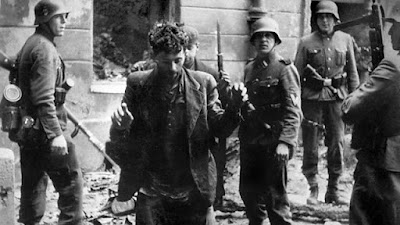
Now consider some of the best-known photographs from the Holocaust and their provenance. Some of these images come from the merciless destruction of the Warsaw Ghetto following the Warsaw Ghetto uprising. A largescale aktion was planned by the SS to put down the Warsaw Ghetto uprising in early 1943. The action was conducted by SS-Brigadeführer Jürgen Stroop, and it resulted in the deaths of 13,000 Jewish residents immediately. In the aftermath almost all of the 50,000 survivors were dispatched to the death camps of Majdanek and Treblinka.

We must ask a crucial question: how do we happen to have these photographs? Because the Nazi state was interested in documenting the success of its plans to exterminate the Jews of Poland and all of Europe. These photos were taken by a German military photographer at the orders of Stroop, to record the "efficiency" and completeness of the operation. Triumphal volumes of these photos were subsequently conveyed to Himmler and to the supreme commander of the SS, and eventually the collection of photos made their way into the Nuremberg trials. Originally titled "The Jewish Quarter of Warsaw Is No More!", the collection is now referred to as the "Stroop Report".

Perhaps the most powerful and widely known photograph of the Holocaust comes from the Stroop collection, the "Boy in the Warsaw Ghetto" image (reproduced below). It is an emotionally wrenching image of a group of adults and children with their hands raised being forced out of a Warsaw bunker by German soldiers. In the center of the image is a boy, apparently 8-10 years old, with his hands raised, and a German soldier in the background with a submachine gun aimed in his direction. The tragic inevitability of this group of innocent human beings at the power of ruthless armed men is a powerful emblem of the cruelty and remorselessness of the Holocaust. And what about the Nazi soldier? His identity is now known. His name was SS-Rottenführer Josef Blösche, and he was a notorious genocider who had joined the Nazi Party in 1938. This was no "ordinary man" along the lines of the policemen treated in Christopher Browning's study of Reserve Police Battalion 101 (link). (Blösche appears in several photos in the Stroop collection.) Blösche was convicted of war crimes, including murder of some 2,000 people, and was executed in Leipzig (GDR) in 1969. During his trial he was questioned about the moment captured in this photograph:

Judge: "You were with a submachine gun...against a small boy that you extracted from a building with his hands raised. How did those inhabitants react in those moments?"

Blösche: "They were in tremendous dread."

Judge: "This reflects well in that little boy. What did you think?"

Blösche: "We witnessed scenes like these daily. We could not even think." (Dan Porat, The Boy: A Holocaust Story (Hebrew). Dvir, 2013; quoted in Wikipedia (link))

Here are three especially powerful images from the Stroop file, including the "Boy in the Warsaw Ghetto". Blösche appears in the first and third images, and may also figure in the second image.


These are historically important images of a tragic moment in history. But they raise a difficult question: how should photographs like these be used? They are doubly charged with moral valence: they depict tragic and evil events in which pain and death are imposed on innocent people; they were produced by the perpetrators of that evil history; and they were produced for the purpose of glorifying the "successes" of the Nazi plan of extermination. All of the civilians in these photos are almost certainly doomed -- either immediately in the streets of Warsaw or in the death camps of Majdanek and Treblinka. So how can we treat these photos with the dignity that their human subjects deserve, while at the same time allowing the viewer to learn important aspects of the history of the Shoah that urgently need to be understood? (Recall the profound insights Wendy Lower reached in her analysis of an equally powerful and tragic image.)

Perhaps the question answers itself: treat images like these with the respect and dignity that the subjects deserve; and do so solely for purposes that lead to greater understanding of these terrible events -- not for entertainment, not for extraneous "marketing" purposes. For example, the World Wrestling Entertainment corporation recently used footage from Auschwitz to advertise an upcoming match. The Auschwitz-Birkenau Memorial and Museum released a compelling statement: “Exploiting the site that became a symbol of enormous human tragedy is shameless and insults the memory of all victims of Auschwitz”. WWE subsequently apologized (link).

We could say the same about careless and unthinking uses of these black-and-white photographs for purposes other than respectful understanding and remembrance.

(A full file of the Stroop Report photos is available here. Here are brief historical accounts of the Warsaw Ghetto uprising (link, link) and a video exhibition recording survivors' experiences from Yad Vashem (link).)


Sunday, April 23, 2023

Psychology of "comradeship" in Hitler's armies


What motivates violence, sacrifice, and atrocity among members of the military and other armed units in times of war and occupation? Christopher Browning asks this question for the members of Order Police Battalion 101 in Ordinary Men (link), and Thomas Kühne asks similar questions in The Rise and Fall of Comradeship: Hitler's Soldiers, Male Bonding and Mass Violence in the Twentieth Century. Kühne notes the parallels and contrasts between the two books in these terms:

Unaffected by military sociology, the Holocaust historian Christopher Browning, in his 1992 book on the German Police Battalion 101, nevertheless illuminated how group pressure, a basic feature of comradeship, enabled the perpetration of the Holocaust. While not explicitly addressed in Browning's book, comradeship again does not appear as the epitome of altruistic solidarity but as the engine of evil per se, deeply ingrained in the machinery of Nazi terror. Widely praised in Germany just as in America and other parts of the world, the book's argument thus yet raised concerns among readers who still appreciated comradeship as a core virtue of soldiers. An officer of the German Bundeswehr, for instance, warned about generalizing Browning's findings. The social psychology of Himmler's murder troops had nothing to do with the military virtue of comradeship, he clarified. Instead, he said, Himmler's men had “completely perverted this concept of dedicated commitment between soldiers.” (4)

Kühne's research depends on a very engaging combination of relevant sociological theory and careful analysis of letters and interviews of soldiers and veterans. He regards "comradeship" as both myth and sociological reality -- myth, in that its themes of heroic masculinity were romanticizations of the realities of a soldier's life, and reality, in that some core values of "comradeship" served both to motivate and to constrain the conduct of individual soldiers in the Wehrmacht. The value system of comradeship implied a strong degree of compliance with the group:

The benefits of comradeship were reserved for those who surrendered their Selves, their individual desires and their agency, to the group of comrades. The myth of comradeship leveled the ground for a conformist ethics that honored only what served group cohesion and denounced the concept of individual responsibility. (11)

And Kühne emphasizes the moral ambiguity of the concept of comradeship:

Once widely accepted as the epitome of altruistic solidarity and cooperation, of moral goodness, of humaneness per se, the concept came, by the end of the twentieth century, to be seen as a euphemism for criminal complicity and cover-ups – for collectively committed, clandestine evil. (12)

The hard question here is the question of motivation: to what extent did the meanings and values of "comradeship", solidarity with one's comrades, lead to both courage and atrocity? And to what extent was the value system of comradeship a coercive social order for soldiers in the Wehrmacht, creating a powerful set of pressures to conform even when the actions of the unit were atrocious?

Here is a passage that captures much of the psychology and mental state/identity that Kühne identifies with “comradeship” from the Wehrmacht.

A few weeks before the Third Reich collapsed, Kurt Kreisler, a thirty-three-year-old NCO fighting in the East against the Red Army, seemed to be in the best of moods. Most of his comrades had been killed in action, but there was something that made up for mass death all around him, he wrote in a letter to his parents in Baden. Social life trumped physical death. Only recently the shrunken battalion — merely 150 soldiers — had successfully defeated a Soviet detachment of 1,000 men. The mood of his outfit “couldn’t be better,” he wrote. Although assembled only shortly before, they got along splendidly. Immediately becoming “the best of friends” with men one had never known before induced a feeling of great community that became stronger the more devastating the nation’s future looked. Kreissler’s conclusion in February 1945 was: “We want to stick together, we want to fight together, or we want to get wounded together — that’s what we are longing for.” (107)

(Kühne notes a few pages later (114) that Kreisler was not typical or ordinary at all; he had been a salaried Hitler Youth leader, and had volunteered for the army at the advanced age of 28.)

Kühne links the thoughts expressed in Kreisler's letter to the work of Edward Shils and Morris Janowitz in their sociological explanation of small-group cohesion in combat units. They quote CH Cooley’s earlier ideas about small group identities: the theory that intimate face-to-face associations of primary groups enable “a certain fusion of individualities in a common whole so that one’s very self … is the common life and purpose of the group … a ‘we’ that is built on ‘sympathy,’ ‘mutual identification’ and ‘intimacy.’”. But, as Kühne notes, this theory paradoxically cleanses the typical Wehrmacht soldier of a Nazi or racist identity; it is loyalty to the small group rather than devotion to Nazi ideology that motivated the typical soldier, they imply. The Shils-Janowitz interpretation was challenged by Omer Bartov, who attributed soldierly solidarity to other factors: “the racist demonization of the enemy in the East; the harsh discipline; and ‘de-modernization of the front’ — the animal-like material conditions of the soldiers — which brutalized and barbarized them…. In Bartov’s view, the Wehrmacht was by no means an apolitical, ‘normal’ army but exactly the opposite: deeply Nazified, a crucial engine of the Nazis’ genocidal project” (109).

Kühne prefers an approach that includes both the psychological processes of “primary group solidarity” and the macro-institutional processes of military discipline, patriotic symbols, and virulent anti-semitism to explain the “fighting spirit” of Wehrmacht soldiers even after all hope of victory had vanished. And he suggests that the concept of “comradeship” encompassed both levels: “Comradeship as understood by many Germans in the interwar and Nazi period aligned and reconciled primary group bonding and secondary symbols of national unity” (111).

The Wehrmacht united 17 million German men of different, though mostly younger, ages; of urban and rural backgrounds, and of all social classes; of all political and ideological camps, from Nazis to conservatives, liberals, Social Democrats, and even communists; of all religious and non-religious creeds (including some Jews, who managed to hide in the Wehrmacht); and of course of enormously different personalities; men who had embraced the Hitler Youth or other sections of the German youth movement, and those who would have preferred to pursue their own careers and enjoy their private lives as husbands and fathers. To whom did comradeship matter, and in what ways? (113)

Kühne emphasizes the sociological observation that “communities” often depend on a clear definition of “others” to whom they are antagonistic — the role played by anti-Semitism and anti-Slav ideology within the Nazi ideological system.

Comradeship was a set of concentric circles, pulling men into face-to-face communities and into “secondary,” anonymous and imagined groups such as the entire army, the mystic community of fallen soldiers, and the Volksgemeinschaft. The military discourse on social relations and social cohesion in interwar Germany had supported this idea of comradeship. (134)

Comradeship in combat is one thing; but Kühne links the social motivations of comradeship to atrocity and genocide as well.

Without the Wehrmacht’s support, the Einsatzgruppen the SS and the police — often in conjunction with local collaborators, could not have killed more than a million Jews. Wehrmacht headquarters registered the Jews of a conquered region or city, forced them to wear visible identification, and concentrated them in ghettos. Wehrmacht units rounded them up and herded them to the execution sites, which the soldiers then shielded from public view, or they took bizarre pleasure in watching the spectacle. Individual soldiers or entire units joined in when the shootings started…. Some Wehrmacht soldiers took pleasure in murdering civilians, or at least they carried out the tasked they had volunteered for as cynically and cold-bloodedly as SS men, police officers, and local collaborators did. (142)

But Kühne suggests that Nazi ideology never achieved the total domination it sought of the inner lives of the millions of soldiers under arms:

Despite all indoctrination efforts by the regime, this ideological, political, and cultural diversity [across individual soldiers] still survived in Third Reich society, and subsequently also in the Wehrmacht, which reflected society. (142)

Nonetheless, he suggests that Nazi ideology held by officers was a decisive factor in determining whether a given Wehrmacht unit engaged in murder of Jews:

When it came to taking action against Jews or other civilians, it was often the ideological disposition of the commanding officers and the choices they made that decided whether or not a Wehrmacht unit collaborated in mass murder. (143)

Two opposing value systems directed the Wehrmacht soldiers’ choices: on the one hand, the universal virtues of human compassion and pity for the weak, enjoining mercy for the unarmed civilian and a defeated enemy; on the other hand, the harsh racist ideology that denounced the idea of universality and demanded, as Himmler put it, an “ethics” that complies “solely with the needs of our people. Good is what is useful for the people, evil is what damages our people.” (143)

He notes that some soldiers and officers acted on the basis of compassion. For example:

When the commanders of three parallel companies of Infantry Regiment 691 … were ordered by their superiors to kill the Jews in their respective districts, only one of them, Reserve Lieutenant Sibille, a forty-seven-year-old teacher, refused to carry out the order, explaining that he “could not expect decent German soldiers to soil their hands with such things” as the killing campaigns of the Einsatzgruppen. Asked by his superior when he would finally become “hard,” Sibille answered: “in such cases” — when it was to murder Jewish civilians including women and children — “never.” (142-143)

So far comradeship was joined with military success. But the Barbarosa campaign soon turned into a disaster for the German armies. How did comradeship survive during the collapse of the Wehrmacht?

In the last two years of the war, comradeship did not vanish but it was altered. Solidarity, humanity, and tenderness in the face of mass death gave way to a new, Nazified idea of collective identity. there may still have been a few efforts by soldiers to preserve humanity in the midst of the violence but this kind of comradeship was increasingly overshadowed by a new type of bond, one that was driven by cynicism rather than care and tenderness…. Comradeship denoted inclusion, belonging, solidarity, and togetherness, but its reality depended on its opposite, the Other, the foe — exclusion. The Other could be the overwhelming enemy soldier or the denigrated enemy civilian. (170-171)

Earlier posts have considered some of the themes that have been prominent within empirical psychology of morality. How do Kühne's findings relate to those themes? As noted above, there are suggestive parallels between Kühne's research and that of Christopher Browning in Ordinary Men. But there are a number of important convergences with the literature in moral psychology as well. Here are a few:

  • identity was important to soldiers' motivations -- identity as a man, as a Protestant, as a German, as a patriot
  • pre-war identities and value systems (political, religious, ethical) persisted in the private moral universes of many millions of Wehrmacht soldiers
  • the moral emotions stimulated by intense experiences within small groups created unusually strong motivations of solidarity, loyalty, affection, and sacrifice for fellow soldiers within the group
  • worldview (ideology) was an important factor in creating a willingness to kill the innocent
  • preserving a preferred self-conception was an important part of the space of judgment and action or inaction for many soldiers
  • for most soldiers, there was at least a degree of conflict between their human impulses of pity, compassion, and reluctance to harm the innocent, on the one hand, and the brutalized actions demanded by their Wehrmacht roles
  • Nazi ideology and dehumanization of Jews, Slavs, and other non-Aryan peoples played an important role in the willingness of some soldiers to commit mass murder

These observations can be tied back to the primary areas of research in moral psychology identified in Ellemers et al review of the field of moral psychology (link): moral reasoning; moral judgments; moral behavior; moral emotions; and moral self-views.

Finally, Kühne's research complements the work of Kristen Monroe in "Cracking the Code of Genocide: The Moral Psychology of Rescuers, Bystanders, and Nazis during the Holocaust" (link) in its detailed use of first-person documents created by Wehrmacht soldiers and veterans. These letters, diaries, and other personal writings give important insight into the mentalities of the diverse men who served in Hitler's armies -- from the former Hitler Youth leader Kurt Kreisler to the refusenik Reserve Lieutenant Sibille -- and who served in Hitler's genocidal wars. It is worth considering whether Monroe's theory of the mentalities of genocider, bystander, and rescuer finds support in Kühne's account.


Thursday, April 13, 2023

Social science study of the Holocaust

image: "Mapping the SS Concentration Camps," Geographies of the Holocaust (Anne Kelly Knowles, Tim Cole, and Alberto Giordano, eds.)

The complex realities of the Holocaust are now more than seventy-five years in the past. And yet the history, causes, and variations of this nightmare period have not yet been adequately understood (link). An excellent recent volume makes the case that social scientists -- political scientists, sociologists, demographers, economists -- potentially have much more to offer than they have done to date. In Politics, Violence, Memory: The New Social Science of the Holocaust, Jeffrey Kopstein, Jelena Subotić, and Susan Welch have assembled a rich collection of articles from current social-science research that illustrates the value that social science perspectives can bring to understanding the complex events that make up the Holocaust. (Here is an earlier post summarizing historians' silence about the Holocaust following the end of World War II; link.)

The editors' introduction provides an analysis of the incentives of the disciplines of the social sciences to account for the relative neglect of questions surrounding the Holocaust in political science, sociology, and demography in the 1960s through the 1980s and 1990s. The topic was likely to be considered an "area study", far from the methodological and theoretical orthodoxies of the established social science disciplines. It was a "special case" and not amenable to the large-scale generalizations preferred by social-science methodologies at the time.

Within political science in particular, perhaps nothing illustrates the delay in taking up the Holocaust as an object of study more poignantly than the fact that the first panel in the history of the annual meeting of the American Political Science Association devoted entirely to the subject appeared in the program only in 2011. (p. 19)

What can social scientists bring to contemporary Holocaust research? A key underling theme that runs across many of the essays is the idea that we should approach the Holocaust, not as a single unified event, but as a series of parallel and geographically and nationally separated events and processes. Here is a formulation of this idea by the editors in their introduction:

Charles King elaborates on his idea that the Holocaust is best seen by social scientists as a series of events, shaped in large part by local actors attuned to their own circumstances and institutions alongside the state strategies of the occupying power. He also highlights the Holocaust as a product of interstate collaboration and competition, the dynamics of which greatly affected outcomes in different nations. (p. 30)

Here is King's own formulation of the idea:

The macrohistorical phenomenon is so large and multilayered that a social science of it seems meaningless, or perhaps too meaningful. The Holocaust is thus best seen not as a single “case” but as a macrohistorical matrix of highly variable forms of mass killing, resistance, and survival. Recent work within Holocaust studies and an emerging literature offering social scientific insights on the Holocaust itself have revealed a vast field of variation—from the identity of perpetrators, to the possibility of resistance and survivorship, to the evolution of mass killing as state policy. (p. 43)

And Daniel Ziblatt summarizes this approach in his concluding essay in these terms:

Recently, historians have pushed back against this narrative with more fine-grained attention to local and decentered unfolding of events (Gross 2001; Bartov 2018). This volume represents a sustained effort of social scientists to join this conversation. This happens at a moment when not only social scientists but also historians have moved to the micro. At the core of this intellectual convergence is the proposition that the Holocaust is not simply to be thought of as a single “case” or “singular event” that occurred between 1933 and 1945, directed by the hierarchical German Nazi war machine. Instead, King (chapter 1) and the other authors suggest that the Holocaust should be conceived of as a process of (1) disparate events—mass killings, pogroms, forced migration, resistance, and survival; in which (2) multiple types of actors—perpetrators, victims, and bystanders— participated; all in (3) multiple locations—far from Berlin, and outside of German-directed concentration camps, and instead spread across the diverse landscape of both urban and rural communities in Central and Eastern Europe. (pp. 454-455)

The idea here is that it is valuable and insightful to examine the regimes of killing encompassed by the Holocaust at a range of levels -- macro, meso, micro; geographical; bureaucratic/military/organizational; gender; and other dimensions as well. And contributors argue that this strategy of disaggregation permits comparison across cases that sheds light on the behaviors, capacities, and outcomes that were present in different locations -- Lithuania, Hungary, or Denmark, for example.

This approach is similar to an important stream of research in historical sociology: comparative historical sociologists and new institutionalists who seek to understand the meso-level social arrangements that differentiate across apparently similar cases. This preference flows from an assessment of where the causal action is to be found: not at the grand level of macro-structures, but at the intermediate and contingent level of meso-level social processes and arrangements. It is a methodology that directs our attention to the social mechanisms through which outcomes of interest have arisen, and also account for the variations across episodes that we can observe. (McAdam, Tarrow, and Tilly make this point in Dynamics of Contention.)

The thrust of King's chapter, echoed in many other contributions, is that we can fruitfully seek out causes of mass killings in the borderlands (Ukraine, Belarus, Lithuania) by understanding the chronology, location, and population details of various episodes, and then engaging in careful comparison across cases to sort out what appear to be operative social influences (or what we might also call social mechanisms). How did mass killings by civilians vary across instances in ways that can be associated with factors like religious affiliation, existence of inter-group relationships, ideology, economic duress, and other factors?

This approach affirms that there were certainly macro-level causes at work -- German state policy and military decision-making -- but that these macro-level actions did not uniquely determine the outcomes. Both Eugene Finkel and Jeffrey Kopstein argue in their chapters for the importance of episode-specific factors in seeking to understand the ways that different locations displayed different patterns of resistance and mass murder. Kopstein's comparison of the occurrences of pogroms in 1941 in Lithuania and Ukraine illustrates the point. He asks:

What, then, was the meaning of the pogroms of summer 1941? Why engage in these exercises in public humiliation and brutality? Let us return to the simple statement made at the outset of this chapter: pogroms occurred in less than 10 percent of the localities in Western Ukraine where Jews resided. In other places, pogroms either were stopped, in many cases by local Ukrainian heroes, or never got off the ground in the first place. What distinguished these two very different kinds of localities? (p. 180)

Jan Burzlaff's contribution offers an historian's appreciation for the importance of finding a level of analysis that is neither too general nor too particular:

The second chief benefit for historians stems, I believe, from the close attention that social scientists pay to variations, paving the way for a middle ground between law-like regularities and historians’ attention to specificity. It is a truism that the Holocaust unfolded very differently across various countries, regions, even cities—hence the importance of understanding both Nazi policies and social processes on the ground (Bloxham 2009). The combination of different scales of analysis not only allows for a more careful understanding of how local and communal factors played a role in the Holocaust’s unfolding, but also dismisses one-size-fits-all approaches to the origins and variety of Nazi violence and—above all—the absence of neighbor-on-neighbor violence in specific communities (Bartov 2018). (p. 100)

In addressing the facts of the Shoah, it is crucial for historians and social scientists to fully recognize the depth of the human catastrophe that the Holocaust represented. This is one reason why there has been a continuing debate over the question of whether it is ever legitimate to compare the Holocaust to other horrific instances of genocide (link). King addresses the issue of comparability in an appropriate way:

It is fully possible to accept the uniqueness of the Holocaust as a world-historical event while also fruitfully comparing each of its myriad components with their cognates elsewhere: the relationship between ideology and purposeful killing, the origins of genocidal state policy, collaboration and denunciation, the politics of military occupation, rescue and resistance, the dehumanization of noncombatants, the political economy of violence, and survivorship and the politics of memory, among many others. (p. 57)

...

The problem with this view is that it too easily glides over the ethics of comparison, the morality of “modeling” human suffering, and the ultimate purposes for which scholars willingly delve into awfulness. After all, the comparison of discrete human experiences is never a cavalier exercise, especially in the realm of violence, loss, and death. The systematic and thorough nature of Nazi practice still places the Holocaust in a peculiar moral category. Its scale was gargantuan. It involved the purposeful killing of millions of individuals as well as the extinguishing of an entire civilization—the culture of the East European borderlands rooted in Jewish religiosity and the Yiddish language. It flowed from an ideology that was not just distasteful but fundamentally abhorrent, one that marshaled science and history to condemn an entire human population to elimination—in theory, anywhere its members happened to live on the entire planet. It produced social, political, cultural, and economic consequences that are still unparalleled. The Holocaust can still be a moral category of one even when specific episodes of violence, the tactics of perpetrators and heroism of resisters, and importantly the social scientific patterning within this world-historical event turn out not to be unique. The sum of every massacre, pogrom, shooting, and gassing within the Holocaust still does not quite equal the Holocaust. (pp. 79-80)

Politics, Violence, Memory provides a valuable demonstration of the importance of confronting various aspects of the Holocaust using methods and theories from the social sciences. One can only hope that it will help to bring studies of the Holocaust into the mainstream of the social sciences. It is a vast and tragic reality that we have not yet adequately understood or internalized.

(Here are two other interesting and innovative contributions to new social science research on the Holocaust: Geographies of the Holocaust, edited by Anne Kelly Knowles, Tim Cole, and Alberto Giordano, and Morality in the Making of Sense and Self. Stanley Milgram’s ‘Obedience’ Experiment and the New Science of Morality, edited by Matthew Hollander and Jason Turowetz (forthcoming).)


Thursday, March 9, 2023

Corporate ethics and corporate crimes


Several earlier posts focused on corporate responsibility for crimes against humanity during the period of the Holocaust (link, link, link). But we don't need to go to the period of World War II to find examples of crimes committed by corporations in support of their international business interests.

An especially egregious example was confirmed in 2018 when two former Ford Motor Company executives in Argentina were convicted of crimes against humanity for their cooperation with the military dictatorship in operations leading to the kidnapping and murder of twenty-four labor activists (link). The crimes occurred during the dictatorship of the 1970s, and the trial of executives and military officers culminated in 2018. Here is the summary of facts provided in the New York Times story:

A three-judge panel sentenced Pedro Müller, 87, then a manufacturing director at a Ford factory in Buenos Aires province, to 10 years, and Héctor Francisco Sibilla, 92, then the security manager at the plant, to 12 years for assisting in the kidnapping and torture of their colleagues.

The two executives “allowed a detention center to be set up inside the premises of that factory, in the recreational area, so that the abductees could be interrogated,” according to court papers.

These judicial findings establish the inexcusable behavior of Ford Motor Argentina. The question arises here, as it did in the case of Ford Werke during the Holocaust, the level of knowledge and control possessed by Ford Motor's parent corporation. This question is addressed in the New York Times article as well:

“It is clear that Ford Motor Company had control of the Argentinian subsidiary during the ’70s,” said Mr. Ojea Quintana. “Therefore, there is a direct responsibility of Ford Motor Company and that might give us the possibility to bring the case to the U.S. courts.”

Ford said in a statement the company was “aware of the verdict about the supposed participation of ex-employees of the firm in events related to human rights in the ’70s.” The company added that it “always had an open and collaborative attitude with judicial authorities supplying all the available information.”

It is evident that Ford's corporate position on its responsibility for these atrocities was ambivalent. The statement that the corporate headquarters is "aware of the verdict" is quite different from "FMC acknowledges and expresses remorse for these crimes that occurred in its Argentine subsidiary in the 1970s." 

Victoria Basualdo, Tomás Ojea Quintana, and Carolina Varsky address these issues of corporate responsibility in greater detail in "The Cases of Ford and Mercedes Benz", contained in The Economic Accomplices of the Argentine Dictatorship. In their very informative chapter they describe the background of the crimes committed at the Pacheco manufacturing plant in the 1970s:

Toward the mid-1970s, following a period of growth in the country’s automotive industry, workers at the Pacheco plant began mobilizing and organizing at the rank-and-file level, represented by some 200 factory delegates who not only stepped up their demands to management but also increasingly confronted their own national leadership at the Union of Automotive Transport Mechanics and Related Workers (Sindicato de Mecánicos y Afines del Transporte Automotor, SMATA). Pedro Troiani, a factory worker and delegate, and a member of the internal commission, was kidnapped and tortured inside the General Pacheco plant in April 1976. Later, when he testified in court, he talked about the implications and the impact of trade union activism on the way the company operated. In his testimony, he clearly explained that the internal commission received worker complaints that were not only about wages but also had to do with the working conditions and the pace at which they were forced to work, and that in 1975 the commission succeeded in signing an agreement that was highly beneficial to the workers. All of this, he said, had consolidated the commission’s position and the workers’ bargaining power in the company.

It was in that context that repressive policies were implemented, with increasing force after the March 24, 1976 military coup. Between March and May of that year, twenty-five workers in the plant were kidnapped, most of them members of the internal commission and the rest active unionists, who remained “disappeared” for thirty to sixty days. Some of them were kidnapped from their homes and taken to the Tigre police station, which operated as a clandestine detention center, while the rest were seized directly at the factory, where they were held for hours and then taken to the Tigre police station.

The relationship between company and armed forces in this process of repression of workers became apparent in different ways in the Ford case. First, the kidnapping victims have testified that they were picked up in F100 pickup trucks supplied by the company to the military. Second, there are numerous testimonies indicating that, as well as supporting the armed forces, the company asked the military to kidnap workers and trade union delegates. Arcelia Luján de Portillo, the wife of one of the victims, stated in her testimony that during a meeting she had with a military officer responsible for the kidnappings, whose last name was Molinari, the officer “opened a drawer and pulled out a list typed on a sheet of paper with the Ford logo, which he told me had ‘all the names that the company gave us of workers it wanted us to chupar,’” using the repression slang term for kidnapping and disappearing (literally, “suck up”). (159-160)

The authors make it clear that Ford's involvement was active and purposive, in support of business interests of the company:

Also, Ford personnel members participated in the interrogations of the kidnapped delegates, to extract information regarding trade union activities in the factory. One such interrogation was that of detainee Francisco Guillermo Perrotta, who was not a factory worker but one of the administrative employees, a category that until the mid-1970s had not been represented by a union. As an employee in the cost, material, and inventory analysis division, Perrotta had access to key information about the factory’s internal matters. He and another delegate from the financial area were tortured with an electric prod. During the torture session, in which his interrogators mentioned details and names that only very well-informed employees of the firm could know, Perrotta, who was wearing a hood, was able to identify the voice of the factory’s security chief, Héctor Francisco Sibilla, among the people present. Sibilla was a member of the armed forces and on July 26, 1978, after the kidnapping of workers, he was promoted to the rank of lieutenant colonel. After his time in the company, he was hired to work in security at the U.S. Embassy, a position he held until 2004. (162)

These sources make it plain that terrible crimes were committed in Argentina, not just by the military or a few rogue employees, but by the corporations themselves. Basualdo, Quintana, and Varsky quote the president of Ford Argentina in a speech given on May 13, 1980: 

As of March 1976 we were facing a challenge. In Argentina a process had begun, a change of system, a complete change in philosophy, which covered individual behaviors and the collective behavior of society as a whole. A change in mentality was necessary. In our case, we had to make a business decision and, with our actions and procedures, we showed what that decision was. Those representatives of destruction with no love of country and no God – whose eradication has cost the nation so much, and who still persist in small numbers – deserve only scorn from the decent men who work and study, day in and day out, to build this nation. (164)

This sounds very much like an unapologetic confession of a corporate decision to commit murder and other atrocities against "representatives of destruction" (labor organizers and activists).

What strategies exist to hold multinational corporations accountable for their subsidiary activities in many countries? One model that might be considered is a human rights analog to the Foreign Corrupt Practices Act. The FCPA was enacted in 1977 to create significant legal penalties against bribery and other corrupt practices in the conduct of international business (link), and the legislation has had significant effect on the practice of international business. Could we imagine an analogous set of laws and regulations that held corporate officers in multinational corporations legally responsible for crimes against humanity committed by agents of their international subsidiaries? And could such an enactment also provide for reasonably direct civil suits in US courts by foreign individuals in compensation for the damages they have suffered? A legal framework like this would present a new and behaviorally significant constraint on corporate crimes against humanity in other countries.

Ford Motor Company opened its archives in 1998 in order to demonstrate its lack of control of Ford Werke and its non-culpability for Ford Werke's use of forced labor. A similar level of transparency should have been demanded with regard to Ford's conduct during Argentina's military dictatorship.

(Here is a revealing article by Rut Diamint in The Conversation about the involvement of the US government in the dirty war in Argentina; link.)

Wednesday, December 28, 2022

Pinpointing responsibility for Russian atrocities in Bucha


In November I wrote a blog post asking the question, "What organization and what commanders have directed the campaign of atrocity, murder, rape, mutilation, torture, and abduction in Ukraine? Is there good investigative reporting on where orders for these unspeakable atrocities and crimes against humanity are coming from?" Now, thanks to some stupendous reporting by the New York Times, we know part of the answer. In Bucha, the Times has established "a mountain of evidence" based on painstaking analysis of digital and phone evidence that major atrocities and murder were committed by one elite Russian regiment, the 234th Regiment (link).

The Times identified the 234th Regiment, a paratrooper unit based in the city of Pskov in western Russia, as the main culprit in the Yablunska Street killings. Airborne units like this are considered among the best trained and equipped in the Russian military. Evidence of the 234th's involvement includes military equipment, uniform badges, radio chatter and packing slips on munitions crates. (New York Times, December 28, A6)

The reporting is remarkably detailed, providing names and photos of members of the 234th who used cell phones to call home to Russia that had been taken from murdered residents of Bucha. "We found the soldiers. One of them is Vladimir Vasilyev, posing here in a paratrooper uniform. He used the phones of two victims: Vitalii Karpenko; and Ivan Skyba, who survived."

Here are four incidents the Times was able to document.

March 4, 2022 When Russian forces arrived in Bucha on Yablunska Street, a group of Ukrainian men who had been guarding a checkpoint decided to hide inside a nearby home. But Russian soldiers carrying out a house-to-house clearing operation found them. Neighbors Tetiana and Serhii Chmut watched as Russian soldiers marched the guards, and the resident who housed them, to a Russian base and forced them onto their knees with their hands behind their heads. Russian soldiers executed seven of them. Another man was already lying there dead. Drone footage filmed the same day of the killings captures the men's bodies lying in the courtyard of the base.

March 5 When Iryna Filkina, a 52-year-old mother, rounded the corner onto Yablunska Street with her bike, the gunner in a Russian armored vehicle aimed his cannon at her and fired, killing her. A commanding officer was overseeing the operation just 75 yards away. Sheltering in an adjacent home were Iryna Abramova (above left), her father and her husband, Oleh. When Russian soldiers barded into their home, searching for men of military age, Iryna pleaded with them, explaining that Oleh was not in the military. They dragged him into the street and executed him. Oleh was among at least eight people killed by Russian soldiers in around three hours on March 5.

March 5 Russian soldiers moved farther down Yablunska Street, toward an intersection that was a pathway to Kyiv. Armored vehicles and machine gunners took up positions to protect the rest of the convoy. Anyone who crossed their path became a target. Drone footage of the scene shows Russian soldiers, and the bodies of their victims piling up on Yablunska Street. Meanwhile, Viktor Shatylo was documenting the killings from his nearby home. His videos and photographs reveal some of the victims killed by those Russian soldiers: 68-year-old Volodymyr Brovchenko and, in a van, Zhanna Kameneva, who was trying to escape Bucha with her neighbors Maria, Tamila, and 14-year-old Anna.

March 18 As they moved into homes along Yablunska Street, soldiers from the same Russian military unit continued to kill residents and neighbors weeks into the occupation of Bucha. Volodymyr Lisovskyi was living next door to Russian soldiers and filmed them as they executed at least three men on March 18. In his video, two of the men, Dmytro Shkirenkov and Oleksandr Chumak, can be seen on their knees, surrounded by Russian soldiers. The third victim, Maksym Kireev, is already lying dead on the ground. Drone footage captured three hours after Volodymyr filmed the scene shows the three men lying motionless on the ground in the same location.

This is a truly amazing effort of forensic journalism, and a huge contribution to the question of how to hold Russia responsible for its war crimes and atrocities in Ukraine.

The Times has produced a series of documentary videos based on this research that are available on Youtube (link). The video includes this horrific and honest assessment at 3:10:

These killings were not random acts of violence, but part of a methodical, planned, and lethal operation that may amount to crimes against humanity.

It is inescapable from the evidence provided in this investigation that these atrocities were indeed planned and ordered by commanding officers. The world needs to know: whose orders led to the methodical killings and other atrocities in Bucha? These are crimes of war, and the commanders must be called to account. That much is obvious. What the Times investigative report demonstrates is that there is a very broad range of evidence on the basis of which war crimes investigators can assess responsibility.

It is interesting to learn that the 234th Regiment is already subject to sanctions by the United States Department of State, based on this list of crimes.

The Department of State 28.06.2022 is designating three Russian Federation military units, the 76th Guards Air Assault Division and its subordinate 234th Guards Airborne Assault Regiment, as well as the 64th Separate Motorized Rifle Brigade, pursuant to E.O. 14024 Section 1(a)(i) because these entities operate or have operated in the defense and related materiel sector of the Russian Federation economy. Multiple, credible reports have documented summary executions and other unlawful killings of civilians, beatings of detained persons, and destruction of civilian property by Russia’s forces in Bucha, Ukraine this year. In March 2022, Russia’s 76th Guards Air Assault Division and its 234th Guards Airborne Assault Regiment encamped on Bucha, Ukraine’s Yablunska Street, which became an epicenter of violence against civilians and other human rights abuses in Bucha. According to credible reports, the 76th Guards Air Assault Division has been directly implicated in violence against unarmed civilians in Bucha, as well as beating detained persons. Credible reports also indicate that next to a wall of the 234th Guards Airborne Assault Regiment’s base on Yablunska Street in Bucha, Russia’s forces executed numerous detained Ukrainian citizens. According to credible reports, the 234th Guards Airborne Assault Regiment has also been directly implicated in the destruction of civilian property such as homes in Bucha. The 64th Separate Motorized Rifle Brigade also operated in the vicinity of Yablunska Street and other locations in Bucha. The 64th Separate Motorized Rifle Brigade has been described as the “butchers of Bucha.” According to credible reports, while operating in Bucha, this unit killed numerous civilians, detained civilians, beat detained civilians, seized and damaged civilian homes and property. (link)

Sunday, November 27, 2022

Koestler's observations of Soviet totalitarianism


In honor of the remembrance of the ninetieth anniversary of the Holodomor, it is worth recalling Arthur Koestler's first-hand observations of the devastation of 1932-33 in Ukraine.

In 1932 Koestler undertook a tour of the Soviet Union as a journalist, under the sponsorship of the Comintern. What he witnessed during these months of travel led to a lifetime rejection of Soviet Communism, and an honest recognition of the crimes committed by the Soviet state. Among the most horrific of those crimes was Stalin's war of starvation against the people of Ukraine, the Holodomor (link). Today is the day of remembrance marking the ninetieth anniversary of the Holodomor, so it is relevant to begin there in his recollections in his autobiography of the period, The Invisible Writing.

Here is how Koestler's travels begin:

My first destination was not Moscow but Kharkov, then capital of the Soviet Ukraine. I had friends living in that town, who had invited me to stay with them until I found my feet in the new world.... My idea of Russia had been formed entirely by Soviet propaganda. It was the image of a super-America, engaged in the most gigantic enterprise in history, buzzing with activity, efficiency, enthusiasm.... Only slowly does the newcomer learn to think in contradictions; to distinguish, underneath a chaotic surface, the shape of things to come; to realise that in Sovietland the present is a fiction, a quivering membrane stretched between the past and the future. . . . (Part Two, section IV)

Holodomor

Here is Koestler's first exposure to the Ukraine famine, the Holodomor:

The train puffed slowly across the Ukrainian steppe. It stopped frequently. At every station there was a crowd of peasants in rags, offering ikons and linen in exchange against a loaf of bread. The women were lifting up their infants to the compartment windows — infants pitiful and terrifying with limbs like sticks, puffed bellies, big cadaverous heads lolling on thin necks. I had arrived, unsuspecting, at the peak of the famine of 1932-33 which had depopulated entire districts and claimed several million victims. Its ravages are now officially admitted, but at the time they were kept secret from the world. The scenes at the railway-stations all along our journey gave me an inkling of the disaster, but no understanding of its causes and extent. My Russian travelling companions took pains to explain to me that these wretched crowds were kulaks -- rich peasants who had resisted the collectivisation of the land and whom it had therefore been necessary to evict from their farms.

Another incident was so slight that I only registered it half-consciously. As our train was approaching a river across which a bridge was being built, the conductor came walking down the corridor with an armful of square pieces of cardboard and blocked up all the windows. When I asked why this was done, my travelling companions explained with smiles that bridges were military objectives, and that this precaution was necessary to prevent anybody from photographing them. It was the first of a series of equally grotesque experiences which I put down as examples of revolutionary vigilance. (Part Two, section IV)

And the signs of famine and horrendous suffering were evident in the Kharkov bazaar:

The goods ranged from a handful of rusty nails to a tattered quilt, or a pot of sour milk sold by the spoon, flies included. You could see an old woman sitting for hours with one painted Easter egg or one small piece of dried-up goat’s cheese before her. Or an old man, his bare feet covered with sores, trying to barter his tom boots for a kilo of black bread and a packet of mahorka tobacco. Hemp slippers, and even soles and heels torn off from boots and replaced by a bandage of rags, were frequent items for barter. Some old men had nothing to sell; they sang Ukrainian ballads and were rewarded by an occasional kopeck. Some of the women had babies lying beside them on the pavement or in their laps, feeding; the fly-ridden infant’s lips were fastened to the leathery udder from which it seemed to suck bile instead of milk. A surprising number of men had something wrong with their eyes: a squint, or one pupil gone opaque and milky, or one entire eyeball missing. Most of them had swollen hands and feet; their faces, too, were puffed rather than emaciated, and of that peculiar colour which Tolstoy, talking of a prisoner, describes as ‘the hue of shoots sprouting from potatoes in a cellar’. ... Officially, these men and women were all kulaks who had been expropriated as a punitive measure. In reality, as I was gradually to find out, they were ordinary peasants who had been forced to abandon their villages in the famine-stricken regions. In last year’s harvest-collecting campaign the local Party officials, anxious to deliver their quota, had confiscated not only the harvest but also the seed reserves, and the newly established collective farms had nothing to sow with. ... Officially the famine did not exist. (Part Two, section IV)

Police state

Koestler was able to visit a number of friends in Kharkov and various other cities, and through them he gained a fairly direct perception of the conditions of repression under which Soviet citizens lived in the 1930s: bureaucracy, censorship, fear, arrest, and imprisonment.

When conditions become insupportable, men react according to their temperament in roughly three ways: -- by rebellion, apathy or self-deception. The Soviet citizen knows that rebellion against the largest and most perfect police machinery in history amounts to suicide. So the majority lives in a state of outward apathy and inner cynicism; while the minority lives by self-deception. (Part Two, section IV)

And he makes an important point about the role of the GPU, the omnipresent security police:

It is not the Terror, but the existence of this ubiquitous organisation without which nothing can be done, and which alone is capable of getting things done, that defines the structure of the totalitarian police state.

A Communist writer — a woman whom I greatly admired — once made an unguarded remark that has stuck in my memory. She was telling us, a small circle of Party members, about a clandestine meeting of her with a comrade in a forest in Austria. It had been spring, and despite the circumstances she greatly enjoyed her walk in the woods. When she met the other person, a Party official, he had launched at once into an ‘analysis of the difficulties confronting the movement and the means of overcoming them’. From that moment it had seemed to her that the birds had become silent, and the air had lost its fragrance. She was and is a devoted Communist, and this experience greatly disturbed her. ‘Why,’ she asked pathetically, ‘why is it that the leaves die wherever we go?’ (Part Two, section V)

Travels past the Caucasus

Koestler's account of his travels through the Caucasus and the Asian expanses of the Soviet Union are equally absorbing. He encounters Langston Hughes in a wretched GPU billet in Ashkhabad, Turkmenistan.

[Hughes] offered me some vodka and camel sausage (which, together with sweet Turkestan melon, was to replace in Asia my former staple diet of red caviar), and over these delicatessen he told me the tragi-comic story of how he had come to be stranded in Ashkhabad. He had arrived in the Soviet Union several months before, together with a troupe of some forty American Negro actors and singers. They had been invited by MESHRABPOM, the leading Soviet film trust, to make a film on the persecution of the Negroes. Hughes was to write the script. But by the time they arrived in Moscow a political rapprochement had begun between the U.S.S.R. and the U.S.A. which was eventually to lead to the official recognition of the Soviet regime by America in 1933. One of the American conditions for resuming normal diplomatic relations was that Russia should renounce its propaganda campaign among the American Negroes. Accordingly, MESHRABPOM overnight dropped the project of the film. ... Stranded in Ashkhabad, Hughes had kept sending wires to MESHRABPOM which were never answered. For the last three weeks he had lived as a kind of pensionnaire of the Ashkhabad G.P.U. in the dom sovietov getting what food was available in the G.P.U.’s canteen and co-operative stores on tick. He told me all this as a kind of shaggy-dog story— one of those funny things that inevitably happen in a country which has embarked on a great revolution. Later in the evening, more people arrived in Hughes’s room, and I discovered that we were not the only intellectuals in Ashkhabad. First to arrive was a timid little mouse of a man with a wizened Tartar face, who hardly ever spoke but listened to everything that was said with an immutably admiring smile. He was Shaarieh Kikiloff, the President of the Turkoman Writers’ Federation. What he wrote, neither Hughes nor I were ever able to find out, though we travelled together for about a fortnight. Nor did we ever discover whether he was married, where he lived and how he lived. (Part Two, section X)

Eventually Koestler and Hughes traveled on to Uzbekistan together. But while still in Ashkhabad Koestler witnessed a premonition of Stalinist terror to come, in the form of an extended political trial:

By a strange hazard I stumbled on the first great show trial in Central Asia — a foretaste of things to come.

The only sizeable building in Ashkhabad was the City Soviet, the equivalent of a Town Hall. I had walked past it several times with Kikiloff and wanted to have a look inside, but the smiling little man had each time side-tracked me with a vague ‘They are very busy there’ or It is not a good time’. Puzzled by his manner, I at last insisted and simply walked into the building with the anxious Kikiloff in tow. Inside, there was a courtyard from which a staircase led to the offices; and opposite the gate there was a large door, with red draperies over it, leading into the City Hall. People were drifting in and out of that hall; it looked as if a meeting were in progress there. I walked in and sat down in the last row, Kikiloff unhappily huddled beside me.

The charges were political -- sabotage and counter-revolutionary conspiracy -- and the trial went on for weeks.

Gradually, through Changildi’s testimony, and through the reports in the local newspaper during the following days, I got the hang of the affair. The trial had been on for several weeks. It was expected that it would last for another number of weeks. The City Hall was the only large public meeting place in Ashkhabad; whenever it was needed for a meeting or a theatre performance, the trial was adjourned. The twenty-nine defendants were accused of Sabotage and Counter-revolutionary Conspiracy.
Attakurdov had been the leading personality in the young Turkmen Soviet Republic. He had been chairman of the Ashkhabad Soviet; his brother-in-law, Ovez Kouhev, chairman of the District R.D.I.; another of his in-laws had been editor of the official Party paper. They were now all in the dock. It looked as if Attakurdov and his clan had been running the Republic, and were responsible for all the troubles that had befallen it.

Changildi’s testimony provided a revealing glimpse into the nature of these troubles. An entire kolkhoz had been disbanded because of a hundred and fifty melons. Moreover, private property of the collectivised land had been restored to its former owners, against the policy and law of the Government. Neither the Judge nor the Public Prosecutor had commented on this unheard-of event. When I asked Kikiloff about it, he shrugged and smiled: ‘There are difficulties’. But if such an event was possible, and accepted as a matter of course, the collectivisation programme in Turkmenistan must be in a state of chaos. I did not draw these conclusions; but I vaguely guessed them. I did not doubt that Attakurdov and his people were bad, guilty men; but the eerie unreality pervading the courtroom made me at the same time feel that they were being used as scapegoats. (Part Two, section X)

As a distinguished international visitor, Koestler was asked to sit with the officials on the stage, and Koestler drew an important conclusion from this experience:

The German Communist Party had a motto which used to appear every day on the top right corner of the official Party paper: 'Wo es Stdrkere gibt, immer auf der Seite der Schto decker en — ‘Where there is Power we are on the side of the Powerless’. On that platform I was obviously on the wrong side. It gave me the same guilty feeling that I had experienced towards the Ukrainian peasant girl in the sleeping-car to Erivan. And again, on a different level, towards Nadeshda. And again in my daily contacts with the common people who had no access to privileged co-operative stores, no priorities for food, housing, clothing and living. They were the powerless and I was on the side of the Power, and so it went on wherever I turned in Russia. A revolutionary can identify himself with Power, a rebel cannot; but I was a rebel, not a revolutionary. (Part Two, section X)

What is striking about Koestler's writings is his willingness to be honest about a political system to which he had been ideologically committed, and to describe in detail the social and political circumstances that he observed. Like his Spanish civil war prison memoir, Dialogue with Death, The Invisible Writing provides the reader with a very direct and vivid glimpse of the terrible events of the twentieth century that he witnessed.

Ninety years after Stalin's deliberate war of starvation against the Ukrainian people, another dictator is waging merciless war against Ukraine's civilian population. Putin's aggressive war against Ukraine, and the means of civilian terror he has turned to after the complete military failure of Russian conventional forces, are crimes against humanity, and they must end.


Friday, November 18, 2022

Who is ordering torture and execution in Ukraine?


With the retreat of Russian forces from Kherson this month, new evidence of gruesome atrocities against civilians has become visible (link). A very important question arises: What organization and what commanders have directed this campaign of atrocity, murder, rape, mutilation, torture, and abduction? Is there good investigative reporting on where orders for these unspeakable atrocities and crimes against humanity are coming from? 

Any list of possible suspects in ordering and committing systemic and horrific atrocities in Kherson and other Ukraine locations will certainly include these potential actors: rogue low-level occupation units, mid- to high-level military commanders, the Wagner Group and its presumed commander, Dmitri Utkin, forces commanded by Chechen militia leader Ramzan Kadyrov, and Putin's secret security serve, the FSB. It goes without saying that Vladimir Putin bears ultimate responsibility for these atrocities, since he knows full well that Russian forces are committing these horrendous acts, and we can therefore infer either explicit or implicit consent on his part. But we still need to know more about the organizations and commanders who are directing this campaign of deliberate atrocity against civilians in Ukraine.

A leading candidate is the Russian security service, the FSB, which is the successor to Stalin's NKVD and has been enormously empowered under Putin's rule. Andrei Soldatov and Irina Borogan provide a detailed and highly concerning analysis of Putin's FSB in their 2011 book, The New Nobility: The Restoration of Russia's Security State and the Enduring Legacy of the KGB. The book provides detailed information about the organization and functions of the FSB, as well as informed estimates of its overall size (more than 200,000; p. 2). The book also provides a detailed historical chronology of the evolution of the FSB since Gorbachev's dissolution of the KGB in 1991. 

Soldatov and Borogan document the wide extent of extra-judicial killing in the war in Chechnya and Dagestan by the security services.

Neighboring Dagestan has seen twenty-five kidnappings since February 2009 by Memorial’s count, twelve of which resulted in the murder of victims. A week after the press conference, Sirazhudin Umarov, 32, a construction worker, was kidnapped from Qala, a Derbent district of Dagestan. On September 9 he was called to a meeting by an acquaintance named Azer, a police officer. There Umarov was captured by unidentified masked men. The following day his badly mutilated body was discovered. The security forces confirmed that he had been killed by the authorities, though they claimed he had died during an antiterrorism operation. “His face was so badly smashed from beating that I had difficulty recognizing him,” said Gulbenis Badurova, 33, his wife. “His eye was missing, and both hands had been broken.” (184)

(Soldatov's account of his own interrogation at Lefortovo Prison is chilling, and expresses the nature of the Russian police state.) 

There is a direct lineage connecting Stalin's NKVD (the primary agent of Stalin's terror and repression) and the contemporary FSB, and Soldatov makes the case that the parallels are even more striking today than they were twenty years ago. The lineage from the NKVD to the FSB is important, because the NKVD carried out horrific atrocities and massacres throughout the Stalin period: in 1940 it carried out the Katyn Forest massacre of at least 20,000 Polish army officers (prisoners of war), and in 1941 it carried out a series of massacres of political prisoners in Kiev and other locations in Ukraine (link). (Here is some background on NKVD atrocities in Ukraine in1941; link.) There is no basis for doubting that the NKVD was the author of great atrocity and evil in the 1930s through 1950s and was the primary instrument of Stalin's will throughout those decades.

It is reasonable to ask, therefore, what role FSB directors and special forces agents have played in the atrocities of torture, rape, kidnapping, and murder that have become evident in multiple locations in Ukraine recovered from Russian occupation in recent months.

In a recent article in Foreign Affairs (link) Andrei Soldatov documents the increasing role of repression that has been assigned to the FSB during Putin's rule -- including in the occupation of territory seized from Ukraine since February 2022. The conclusion that Soldatov draws is stark: the FSB is moving closer and closer to the repressive omnipresent arm of a police state that the NKVD was for Stalin:

Since the war in began, Putin’s rapidly growing security state seems to be inching closer to its Stalinist predecessor. The militarization of the FSB, its new recruitment camps, its increasingly open and brutal tactics all suggest that Putin is looking more closely at the approach of the NKVD—an agency that was forged by a totalitarian state in wartime. And the long war is what the Kremlin is priming the country for.

Here is how Soldatov describes the new focus of the FSB, both in Russia and in its war aims in Ukraine:

As Russian President Vladimir Putin’s war in enters its sixth month, a dramatic shift has occurred in the Kremlin’s security bureaucracy, and it has centered on the agency closest to Putin himself: the Federal Security Service, or FSB. When the war began, the Kremlin planned to use the FSB mainly in Ukraine, as a special operations force that would consolidate a rapid Russian conquest. According to the plan, the Russian tanks rolling into Ukraine would trigger regime change in Kyiv, and a new pro-Moscow leadership, sponsored by FSB spymasters, would take control of the country. At the time, it was the FSB’s foreign intelligence branch—the Fifth Service—that was to carry out this task. It was the only major FSB department, out of a dozen, that was directly involved in preparing for the war.

As those plans, however, Putin crafted a different, far more comprehensive mission for the FSB: it would be at the forefront of Russia’s total war effort at home as well as its intelligence operations in Ukraine. And every branch of the service would now be involved. Running the new crackdowns in are the FSB’s counterterrorism unit, its counterintelligence service, and its investigative department. Meanwhile, FSB special forces and the military counterintelligence branch are running operations targeting Ukrainian service people in occupied territories and beyond, recruiting Ukrainian agents, and processing those whom the FSB hopes to see prosecuted in show trials.

Notice that Soldatov's description in the paragraphs quoted here specifically outlines a substantial role for the FSB in occupied Ukraine, according to Putin's pre-war planning. 

My question here is a simple one: how extensive is the involvement of the FSB in the widespread and horrific atrocities that have come to light in Kherson, Bucha, and many other locations in previously occupied Ukraine? These acts of rape, murder, and torture against innocent civilians are generally attributed to "troops" in news stories, which perhaps leads the reader to imagine "rogue low-level army units"; but this is implausible. The atrocities are too widespread to reflect a few sadistic killers among the Russian army of occupation. Therefore we need to know more about the command and control of this horrific way of waging a war of terror and atrocity against civilians in Ukraine. And the world must hold Russia and its bureaucrats of atrocity accountable for their actions during this war.

Friday, September 23, 2022

Confronting Evil in History


My short book Confronting Evil in History has just been published in Cambridge Elements in the Elements in Historical Theory and Practice series edited by Daniel Woolf. 

Here is the abstract:

Evil is sometimes thought to be incomprehensible and abnormal, falling outside of familiar historical and human processes. And yet the twentieth century was replete with instances of cruelty on a massive scale, including systematic torture, murder, and enslavement of ordinary, innocent human beings. These overwhelming atrocities included genocide, totalitarianism, the Holocaust, and the Holodomor. This Element underlines the importance of careful, truthful historical investigation of the complicated realities of dark periods in human history; the importance of understanding these events in terms that give attention to the human experience of the people who were subject to them and those who perpetrated them; the question of whether the idea of 'evil' helps us to confront these periods honestly; and the possibility of improving our civilization's resilience in the face of the impulses towards cruelty to other human beings that have so often emerged.

The book focuses on the question, how should philosophers and historians confront the massive evils of the twentieth century -- Holodomor, Holocaust, genocide, mass enslavement, totalitarianism? It argues that we have not yet adequately rethought our fundamental ideas about human nature, morality, institutions, and culture in light of those evils. The current atrocities committed by Russian forces against the innocent civilians of Ukraine underline the ongoing importance of these fundamental questions.

Cambridge University Press has the generous policy of making new publications in the Elements series available for free PDF download for two weeks from the date of publication. If you'd like a free digital copy, here is the URL. Look for the "Save PDF" tab. 

https://doi.org/10.1017/9781009104265

Feel free to share this link through social media with those who may be interested in the topic. Free access will continue for two weeks.