Showing posts sorted by date for query institutions. Sort by relevance Show all posts

Friday, September 18, 2026

Citizens demand impeachment


Every day that passes brings more bad news from Donald Trump’s unhinged behavior. His actions and dictatorial executive orders have caused immeasurable harm to our country, our citizens and residents, our friends and allies in the world community, and the standing of our country as a leader and a moral example.

Trump’s unprovoked war against Iran has caused thousands of deaths, erosion of the US military capability, and vast economic disruption to the world economy. His tariffs have increased the cost of living for Americans, and his government’s assault on Medicaid and government-assisted health insurance has forced millions of Americans into deep health insecurity. His completely unwarranted hostility and war of words and tariffs against Canada are examples of his reckless and impulsive behavior. His administration’s foolish and unscientific rejection of vaccinations, including measles vaccinations for children, has led to the largest measles outbreak the United States has seen in decades. Trump’s personal and brazen financial corruption and conflicts of interest have led to growth of his personal wealth of over $2 billion — perhaps as high as $4 billion — since his inauguration in 2025, and his family’s exploitation of their relationship to the White House is well-known as well. And Trump’s narcissistic insistence on remaking the face of our nation’s capital, his mismanagement and threats against the Kennedy Center, and his determination to proceed with a 250-foot-tall arch show a narcissistic and fundamental disregard for the traditions and values of our citizens.

Trump has failed to perform the duties of the presidency. He has sought to avoid or ignore legal orders by Federal courts. He has created a private army of violent thugs who have committed violence against innocent people in multiple cities. He has engaged in racist rants against Africans and people of African descent like the Somalis of Minneapolis and the Haitian refugees in Springfield, Ohio. He is morally unfit to be the leader of our country.

The Republican Congress has shown zero willingness to exercise its authority and to restrain the president’s actions. Fear of losing office in primary challenges appears to be more important to most incumbent Republicans than making a sober appraisal of this president’s usurpations of power, recklessness, and contempt for the institutions and norms of our democracy. And yet their most basic moral duty is to preserve our constitutional order.

Imagine an alternative political world in which we the people have taken the lead. Imagine a movement that begins with “letters of impeachment” signed by 50 million Americans, demanding impeachment and trial of Donald Trump. Imagine 50,000 people assembling every week in front of the Kennedy Center or the proposed site for Trump’s arch, peacefully resisting demolition and construction. Imagine pro-democracy demonstrations in our major cities, each involving 100,000 people in New York, Miami, St. Louis, Houston, Chicago, Seattle, Detroit, Boston, and occurring every week. Imagine every city standing up for its population against ICE in the way that Minneapolis did, forcing a retreat by Homeland Security.

And imagine an unprecedented turnout for the November election, leading to a majority in House and Senate for principled and courageous leaders like Jon Ossoff, Sherrod Brown, Joyce Beatty, and James Talarico. Majorities in Congress can provide some degree of braking capacity on Trump’s dictatorship in the final two years of his presidency.

Winning the midterms is crucial for our future as a democracy. But it is only a beginning. Reasserting the authority of Congress against a dictatorial president, finding new and unconventional ways of opposing Trump’s policies (like his assault on Canada or his threat to withdraw substantially from NATO or his determination to build a triumphal arch), and demanding accountability from cabinet officials (Blanche, Hegseth, Mullin, …) — these are the minimal steps that Democratic majorities must take. And facing the new crises that have arisen, and that Trump has waved aside (like the warnings about rogue AI technology) must be addressed. (Elizabeth Warren is ready to do this.)

And the rising economic disparities we have witnessed in our country since the 1970s must be addressed. Tax cuts for the super-rich that are paid for by reductions in Medicaid, food assistance, and other social programs are grotesque; the fact that our tech-oligarchs pay a tiny percentage of their income in taxes (3.4% according to ProPublica); the fact that corporations have many ways of avoiding revenue taxes altogether — all of these facts have contributed to the sudden transformation of the US distribution of wealth and income into an oligarch’s utopia.

A large majority of Americans now disapprove of Trump for his policies, and do not trust his promises or assurances about the future. The American public deserves better, and Trump has broken his Constitutional oath of office in numerous ways. Trump should be removed from office through impeachment, and successor administrations should learn the lesson: the Federal government exists to serve the interests of the American people within the strictures of the Constitution — not the private interests of the president and his loyal administration. And we are watching.


Friday, August 28, 2026

Ode to Canada


Lake Ontario, 1688

Even a short trip from Michigan to Canada refreshes the US visitor’s confidence that an inclusive multicultural democracy is not only possible, but that it is being happily experienced in North America already. That happy democratic experience is being lived in Canada — and most emphatically not in the United States.  Crossing the international border between Michigan and Ontario underlines that difference.

This fact puts Donald Trump’s ungrounded and impulsive hostility and bullying of Canada into even more shameful relief. His ludicrous and childish pretence of “renaming” Lake Ontario as Lake America is roughly similar to the mad emperor Caligula’s command to his troops to attack the waves of the incoming time. It is mad, and it is deeply shameful for all of us who respect the dignity, responsibility, and institutions of the United States in the year of its 250th anniversary. For shame, Donald Trump, for shame! You bring dishonor to our country.

So why is a short visit to a Canadian city so invigorating for a lifelong US citizen and resident? For many reasons. First, the streets, businesses, and destinations give an impression of a people who are secure in their freedoms and who trust their government and their fellow citizens. There is not the sense of foreboding which is so pervasive across America, in cities and towns. The police in Canada seem to live the slogan so often expressed but often not lived in the US, “to serve and protect”. Second, there is great racial, religious, and national diversity in most Canadian cities, and it is not a source of conflict and hate-based extremism. This seems apparent in the street behavior of ordinary men and women, families and children, reflecting that diversity. There is not the sense of wariness that pervades so many intergroup interactions in the US. Rather, the many racial and national communities appear to live in way and respectful harmony.

Other countries with powerful liberal traditions of equality and inclusion have succumbed to the vile forces of extremist right-wing populism. So far Canada has not shown itself vulnerable to that horrible disease. The dictatorial actions of the current US president, the affiliation of his movement with Christian nationalism and white supremacy, and his growing threats against the friends and allies of the United States in favor of the current strongmen and tyrants of our international environment suggest that the US has gone a long way down the road to fascist extremism. Having the humility to recognize that our country has misstepped and must take new resolve to strengthen our democracy suggests there is much we can learn from Canada’s experience. We must nurture our friendship with Canada, not destroy it.

And, as the map above reminds us, Lake Ontario has been Lake Ontario much longer than the United States has been a nation.

Saturday, July 4, 2026

On the Fourth of July


Selected materials removed from National Park sites at instructions from Trump administration (legal cases underway) (Gemini generated)

It is quite difficult to celebrate the 250th anniversary of our country under the current conditions. The occasion has been hijacked by a president and a political party that have no dignity, no respect for the basic values of our country, no allegiance to our Constitution and the rule of law, and no benevolence for our people, and no respect for the international system and other nations that have been loyal partners throughout times of crisis in the past and present.

Like many Americans, I am ashamed of the lies told every day by our president, the cruelty and lack of compassion he and his administration show to the people of the United States and in other countries, the crassness of his constant efforts at self-promotion in attacking the great monuments of our capital city, and the corruption and massive conflicts of interest shown by the $1.2-$1.5 billion he has gained since taking office through industries he has promoted as president. Even the day of national celebration itself has been hijacked by his party’s Freedom 250 organization, converting the July 4h celebrations into a rally on the president’s behalf.

And yet this sense of shame about our nation’s current leader and his administration does not extend to a sense of disillusionment about our nation itself. My thoughts go first to Abraham Lincoln and the words of his Gettysburg Address on November 19, 1863.

So many lines in this brief speech demonstrate a fundamental contrast to our current president. "The world will little note, nor long remember, what we say here" -- can we imagine the current occupant in the White House making such a humble remark? And just a moment later, Lincoln expresses a fundamental aspiration for the nation -- not for himself, not for his followers, not for his party, but for the nation: "That we here highly resolve that these dead shall not have died in vain; that this nation, under God, shall have a new birth of freedom, and that the government of the people, by the people, and for the people, shall not perish from the earth." Lincoln's thoughts in 1863 were for the people of the United States, for the institutions through which their freedom and equality is secured, and for our unity as a democratic people. Have we ever heard the current president make a sincere effort to speak to and on behalf of the whole of the people of the United States, not simply his "base"?

Recall as well the closing lines of Lincoln’s First Inaugural Address in 1861:

I am loath to close. We are not enemies, but friends. We must not be enemies. Though passion may have strained, it must not break our bonds of affection. The mystic chords of memory, stretching from every battlefield, and patriot grave, to every living heart and hearthstone, all over this broad land, will yet swell the chorus of the Union, when again touched, as surely they will be, by the better angels of our nature.


Or recall Dr. Martin Luther King, Jr.’s speech in the same place as the current “Great American State Fair” has been staged — to a crowd of some 250,000 men, women, and children from around the country on August 28, 1963. What a dignified and affirming set of aspirations were articulated on the steps of the Lincoln Memorial on that day, and what a stunning contrast to the scene on the same location today. Here are a few of MLK's words on that day:

I say to you today, my friends, though, even though we face the difficulties of today and tomorrow, I still have a dream. It is a dream deeply rooted in the American dream. I have a dream that one day this nation will rise up, live out the true meaning of its creed: “We hold these truths to be self-evident, that all men are created equal.”

I have a dream that one day on the red hills of Georgia sons of former slaves and the sons of former slave-owners will be able to sit down together at the table of brotherhood. I have a dream that one day even the state of Mississippi, a state sweltering with the heat of injustice, sweltering with the heat of oppression, will be transformed into an oasis of freedom and justice.

Or go back to Susan B. Anthony’s words in 1873 affirming women’s equality and demanding the right to vote for women after her own arrest for the crime of voting in the 1972 U.S. presidential election:

Friends and fellow citizens: I stand before you tonight under indictment for the alleged crime of having voted at the last presidential election, without having a lawful right to vote. It shall be my work this evening to prove to you that in thus voting, I not only committed no crime, but, instead, simply exercised my citizen's rights, guaranteed to me and all United States citizens by the National Constitution, beyond the power of any state to deny.

The preamble of the Federal Constitution says:

"We, the people of the United States, in order to form a more perfect union, establish justice, insure domestic tranquillity, provide for the common defense, promote the general welfare, and secure the blessings of liberty to ourselves and our posterity, do ordain and establish this Constitution for the United States of America."

It was we, the people; not we, the white male citizens; nor yet we, the male citizens; but we, the whole people, who formed the Union. And we formed it, not to give the blessings of liberty, but to secure them; not to the half of ourselves and the half of our posterity, but to the whole people - women as well as men. And it is a downright mockery to talk to women of their enjoyment of the blessings of liberty while they are denied the use of the only means of securing them provided by this democratic-republican government - the ballot.

Think finally of a fearless defender of freedom and the rule of law in the U.S. Senate, Senator Margaret Chase Smith of Maine. She spoke up against Senator Joseph McCarthy's unconscionable and cowardly attacks on the loyalty of other Americans in these words in June, 1950:

I speak as a Republican. I speak as a woman. I speak as a United States Senator. I speak as an American.

The United States Senate has long enjoyed worldwide respect as the greatest deliberative body in the world. But recently that deliberative character has too often been debased to the level of a forum of hate and character assassination sheltered by the shield of congressional immunity. ...

I think that it is high time that we remembered that we have sworn to uphold and defend the Constitution. I think that it is high time that we remembered that the Constitution, as amended, speaks not only of the freedom of speech but also of trial by jury instead of trial by accusation.

Whether it be a criminal prosecution in court or a character prosecution in the Senate, there is little practical distinction when the life of a person has been ruined.

Those of us who shout the loudest about Americanism in making character assassinations are all too frequently those who, by our own words and acts, ignore some of the basic principles of Americanism:

  • The right to criticize;
  • The right to hold unpopular beliefs;
  • The right to protest;
  • The right of independent thought.

The exercise of these rights should not cost one single American citizen his reputation or his right to a livelihood nor should he be in danger of losing his reputation or livelihood merely because he happens to know someone who holds unpopular beliefs. Who of us doesn’t? Otherwise none of us could call our souls our own. Otherwise thought control would have set in.

Abraham Lincoln, Susan B. Anthony, Martin Luther King, Jr., Margaret Chase Smith -- these were all Americans with a deep and enduring commitment to the values of equality, freedom, and the rule of law upon which our nation rests. And they all spoke in terms that recalled the language of the Declaration of Independence and the U.S. Constitution. They recognized very clearly the distance still to travel before those values are more adequately realized. In their various ways, they stood courageously in the face of threats, violence, and unsettled times. And they did not stand alone. Countless other leaders, citizens, officials, and ordinary citizens stood up in their own times and places to support equality, freedom, and dignity for all.

The values that we share as Americans are profound, their goals are incomplete, and they are under attack today. The rule of law, the responsibility of government to act justly and in support of the common good, and the political morality of mutual respect and dignity are all threatened by the current administration and its supporters in Congress and in the nation.

So, yes, let us celebrate the 250th anniversary of our nation on this Fourth of July, 2026. Let us embrace with renewed understanding the core values of equality and freedom, dignity and mutual respect, that are fundamental to a democracy that embraces all its citizens. And let us each take the actions that we can to help to ensure that our democracy survives these many challenges.


Saturday, June 27, 2026

Poland’s self-limiting revolution in 1980


Military coup, Poland, December 1981

Poland is an important example of the paths taken by the citizens of satellite states within the former Soviet Union. Soviet domination of the governments of Poland, Hungary, East Germany (GDR), Czechoslovakia, and other satellite states led to uprisings in several states, resulting in violent military interventions by the Soviet Union in East Germany (1953), Hungary (1956), and Czechoslovakia (1968), as well as threats of intervention and other forms of political pressure against others (Poland in 1956 and 1980-81).

The Polish pathway from Communist authoritarian rule to democracy included the rise of a large mass-based social movement, Solidarity. One telling of the story of the rise of the Solidarity movement is the pragmatic tactics and goals pursued by its leaders, including Lech Wałęsa. By carefully crafting goals and plans around labor union goals rather than an overtly “anti-communist” uprising, the Solidarity movement avoided a violent clash with the Polish military and General Jaruzelski. This is the line of interpretation offered by the Center for Nonviolent Conflict Research in its 2009 report on the movement (Maciej Bartkowski, link). According to Bartkowski, the movement illustrated an intelligent mobilization and marshaling of support from over ten million union members, and it avoided a violent showdown with the armed forces of the state. It was, in other words, a striking success for “people power” in the face of a vastly more powerful military and state apparatus. And it was an outcome worth celebrating by activists and organizations (like the CNCR) who advocate for the power of mass nonviolent action. Bartkowski writes:

With its self-limiting philosophy of nonviolent struggle and the support of the Catholic Church, Solidarity was in a position to consider the offer of negotiations and accept a pacted transition, even though that meant a preservation of the economic and social status of the ruling elites.

But this description uses a phrase that points to the limitations of the Solidarity movement as well, the idea of a “self-limiting” strategy of struggle. This phrase originated in the writings of the outstanding Polish sociologist Jadwiga Staniszkis, who was both an observer and a participant in the Solidarity movement and the political struggles it brought about. She was one of Poland’s leading academic sociologists in the 1970s and 1980s, and she was also asked to serve as a member of the Inter-Factory Strike Committee, a small group of advisers to the Solidarity union in GdaÅ„sk about strategies for negotiations with the government. Her book, Poland’s Self-Limiting Revolution, was written during and immediately following the rise of the workers’ movement and the imposition of martial law in 1981. It is notable for her objective and clear-eyed account of the movement. She does not romanticize the movement. She had brought an early draft of the book to the United States during an academic visit in 1980, and in 1981 it found a receptive reading at Princeton University Press. Jan Gross, another exceptional Polish sociologist who had emigrated to the U.S. in 1969, agreed to edit the manuscript and to add an historical section providing an account of the background events leading to the emergence of Solidarity, and the book was published by Princeton in 1984. In the editor’s preface to the book Jan Gross describes his reaction to the book as one of the initial readers for the press:

Staniszkis’s book is the best, most original, thought-provoking analysis of an East-Central European society and its politics that I have read in a long time. It goes beyond analyses derived from the totalitarian model approach and it is also more sophisticated than analyses using the interest group approach to study ‘socialist’ societies. The book is an attempt to describe and understand the authoritarian regime in Poland as a sort of corporatist society. As a sociologist of organizations the author succeeds in analyzing an intricate system of mechanisms that have been generated by a social system in order to compensate for irrationalities due to ideological restrictions placed upon it. She has been sensitive to the manifestations of symbolic manipulation in the process of social control and able to analyze such phenomena as simulation of interest group representation or ritualization of periodic crises of the regime. In these analyses she has demonstrated how the system succeeded in incorporating and, as it were, domesticating what would be seen by a less astute observer (or a traditionally thinking social scientist) as developments disrupting and threatening the system’s stability. (x)

Staniszkis describes the core concept of a “self-limiting revolution” in these terms:

Self-limiting revolution. The most striking characteristic of the initial period of the movement’s history was the painful process of cramming that radical wave of protest and class war into a ‘trade union” formula. Nearly all other features of the movement stemmed from this self-limitation of the Polish revolution. For instance, its symbolic politics (which took the form of attacks on local PUWP bosses and did not try to undermine the political institutions as such) provided a peculiar alibi for regional Solidarity leaders who had to pay with their own authority for the policy of moderating the movement, persuaded by its top authorities and experts from the intelligentsia. (17)

Staniszkis’s account differs substantially from that of Alain Touraine, discussed in earlier posts (link, link). Touraine emphasized (or perhaps over-emphasized) the substantial agency and purposiveness of the Solidarity movement, whereas Staniszkis emphasized the structural limitations to which its “pragmatic strategies” subjected it. There were clear limits to the scope of what could be demanded and achieved through the Solidarity social and political mobilization, according to Staniszkis, and this left the authoritarian capacity of the Polish state substantially unchanged. And Staniszkis’s view of the rank-and-file workers who made up the constituency of Solidarity is markedly different from Touraine’s. Touraine regarded Polish workers as having a high level of political consciousness and agency; whereas Staniszkis’s view is that workers were not especially ideological or militant in their support for the union. In her view, the interests motivating a substantial portion of the union members were primarily economic; and in fact, the union had very little concrete economic power (19 ff.). She writes: “Also almost all the victories won by Solidarity during this stage of the conflict were superficial, the ruling group made promises that it did not intend to keep, and hence Solidarity victories were pointless. The deadlock of the self-limiting revolution was also due to the narrow trade-union formula used to label the movement’s activity” (21).

Analysis of a social movement requires providing an account of the motivations and mental frameworks of the potential followers of the movement. Staniszkis considers the content and determinants of “working-class consciousness” in some detail:

Three thresholds must be mentioned when talking about the development of the consciousness of working class in Poland. The first is the barrier created by the limited semantic competence of the workers, which in the past has led to articulation of interests only in restricted, situation-specific, terms. In the first part of this chapter I will try to show how this limited semantic competence made the workers’ protest less efficient. This is a good example of a situation in which the structure of speech (rather than its content) plays an ideological role because it reinforces and stablizes the political system. However, this same limited competence sometimes served as an advantage by reducing the areas of possible communication during negotiations, as a result making the working class less vulnerable to manipulation and in a sense more radical. In this context, I will discuss radicalism as a problem of imagination as well as of attitude and the events of August 1980 as a type of cultural revolution. (113)

She refers also to the barrier of “reification” — the mental attitude according to which “power relations are perceived as painful but natural and without alternative” (113), and what she calls the “peculiar self-image of Solidarity activists” (113).

As suggested by the first barrier, Staniszkis takes a fairly negative view of the role of intellectuals and experts in the Solidarity struggle. She writes of the disconnect between the language and “semantic power” wielded by the intellectuals which rarely resonated with the political consciousness or goals of the rank-and-file union leaders and members. And she suggests that this semantic advantage sometimes worked to derail the more radical demands made by some activists and union leaders.

Most interesting in this chapter is her articulation of how she understands “ideological functions” in a social situation:

By ideological functions of forms of consciousness I mean:

  • 1) their participation in measures to stabilize present social relations;
  • 2) their influence on the opportunities of individuals, social groups, and classes in conflict situations;  
  • 3) their impact on the ability to defend against the tensions generated by the system;
  • 4) their role in the techniques of domination and manipulation applied by the ruling group. (115-116)

This is not a theory of the content of an ideology (as Marx attempts to do); rather, it is an effort at diagnosing the “functions” or “social effects” of a social ideology. So the book doesn’t give much attention to what Polish workers thought about the political structures within which they lived, and how they made sense of them. Instead, she places most of her attention on what she calls “semantic competence” — the concepts and vocabulary through which workers, leaders, unionists, farmers, and other members of Polish society expressed their thoughts about the political forces around them.

In fact, she seems to find the concept of “ideology” somewhat vacuous. Instead, she suggests the term “mentality” as a way of framing the “sense-making” thought processes of various segments of Polish society. (She cites Juan Linz’s use of these concepts in his analysis of authoritarianism.)

I use the term “mentality” as a synonym for a framework of cognitive forms actually operative in political life that is action-oriented and loaded with emotions. This term seems more useful in our case than the concept of ideology. (135)

In the end, Staniszkis’s assessment of the impact of the Solidarity movement in Polish political and social transformation is somewhat negative:

It may sound like heresy, but Polish political life and especially the flow of ideas after August 1980 and the creation of Solidarity has been impoverished as a result of the impact of the populist and solidarist perspective pressed upon society by Solidarity. This view contrasts with the segmented, often morally ambiguous but nevertheless less uniform and less aggregated course of society in the 1970s. (145)

And indeed, the military coup and martial law regime of December 1981 provided a striking parenthesis to the idea that Solidarity was a powerful social movement capable of transforming Polish society. She describes the final weeks in November and December leading up to the coup in these terms:

1) Solidarity leaders believed that the power vacuum (the ruling group’s inability to control the real processes in society and the economy) was synonymous with the ruling group’s inability to use repression. Interestingly, this assumption closely paralleled the position of the ruling group itself. Ironically, the latter has also mistaken the ability to repress for an ability to govern.
2) Leaders of Solidarity also assumed that, even if confrontation were to come, the ruling group would begin with mild and legal methods and that its options would be limited by the present form of the institutional regime, with its characteristic situation of stalemate. At worst a “state of emergency” would exist with the delegation of extraordinary powers to the government by Sejm, not a “state of war,” preceded by a military coup. (326)

These were grave mistakes. The Solidarity organization was outlawed and forced underground, its leaders were arrested and imprisoned, and the strategies of mass demonstration and protest were no longer feasible. So the repressive power of the state succeeded in blocking Solidarity as a political force for at least a few years. But Staniszkis argues that internal contradictions within the union itself presented another large obstacle to continued resistance:

Another mistake of Solidarity leaders was rooted in their underestimation of the problems within Solidarity itself. Recent surveys made by the sociological research center of Mazowsze Region” show among members of Solidarity not only a low willingness to strike (even if the right to strike were in danger), but also deep differences within the union, the ambiguous relationship between the rank-and-file members and their national leaders, and, above all, the increasing passivity of Solidarity members. The ruling group appears to have read this evidence much more carefully; especially the data showing the relatively high prestige of the army among Solidarity members as well as their ambivalence toward at least some proposals popular among Solidarity activists. (326-327).

The third mistake of the national leaders of Solidarity was in accelerating a “paper war’’ (an exchange of statements and resolutions) without any real preparation for the eventual consequences of such an escalation of claims. A feeling of strength based on its membership of nearly 10 million was one of the basic reasons for the ‘‘safe game” attitude of most of Solidarity’s leaders. They did not take into account how easily the union could be paralyzed by cutting off communications and arresting activists. (328)

For some reason Staniszkis’s account of this fairly short period of social conflict makes me think of Marx and Tocqueville in their treatment of the events leading up to the June Days in Paris, 1848. Here are Alexander Herzen’s recollections of the class warfare that occurred in the streets of Paris on those days:

I listened to the thunder and the tocsin and gazed avidly at this panorama of Paris; it was as though I was taking my leave of it. At that moment I loved Paris passionately. It was my last tribute to the great town; after the June days it grew hateful to me. On the other side of the river barricades were being raised in all the streets and alleys. I can still see the gloomy faces of the men dragging stones; women and children were helping them. A young student from the Polytechnic climbed up on to an apparently completed barricade, planted the banner and started singing the Marseillaise in a soft, sad, solemn voice; all the workers joined in and the chorus of this great song, resounding from behind the stones of the barricades, gripped one’s soul. . . . The tocsin was still tolling. Meanwhile, the artillery clattered across the bridge and General Bedeau standing there raised his field-glasses to inspect the enemy positions. . . . (From the Other Shore, After the Storm, 46)


Tuesday, March 31, 2026

How are an individual’s political values formed?


Human beings have attitudes, behaviors, habits, stereotypes, and values. And somehow these mental attributes are developed or acquired in the course of normal human social life. But how, when, and with what results does this process work? And how persistent are a set of attitudes and values once established in the individual?

The topic here is a deeply interesting question — what forms us as the adult human beings with values and a moral framework that we eventually become? For the past fifty years political scientists and social psychologists have discussed a theory of the formation of political attitudes and values that emphasizes the “impressionable years”. This theory holds that children are fairly fluid in their values and political affinities, and that young people are most open to new values and ideas in the years between 17 and 25 — essentially the years of a traditional university education. And there seems to be survey evidence supporting the idea that the formative events of that period in a given person’s life become bedrock to their political identities, with relatively little change in later years.

David Sears is one of the early founders of this approach. He presented some of his ideas as early as 1975, and in 1983 he describes the “impressionable years” hypothesis in these terms:

A third view could be termed the impressionable years viewpoint, which suggests that any dispositions are unusually vulnerable in late adolescence and early adulthood, given strong enough pressure to change. In other stages of life, people are resistant to change, and of course, even in the most vulnerable life stage, they would not change in the absence of substantial pressure to change. At all ages, the content of the disposition is irrelevant. A specific and particularly interesting instance of the impressionable years hypothesis is the generational effect. This occurs when a sizable number of those in the supposedly impressionable life stage (late adolescence and earlly adulthood) are subjected to a common massive pressure to change on some particular issue, for example, when the nation is engaged in an unpopular war. It presumably yields interactions of birth cohort and dispositional content. The final viewpoint is persistence, which suggests that the residues of early (preadult) socialization are relatively immune to change in later years. This asserts a simple main effect of age, with dispositions acquired primarily in the preadult years. (“The Persistence of Early Political Predispositions: The Roles of Attitude Object and Life Stage”, Wheeler and Shaver, Review of Personality and Social Psychology, 1983: 81-82)

This theory suggests that the ambient political and cultural environment of one’s “impressionable years” (18-25) represents a powerful influence upon his or her lifetime political attitudes and values. The theory has been subjected to some rigorous quantitative efforts at empirical evaluation, with some evidence supporting its accuracy. Especially interesting is Krosnick and Alwin, “Aging and Susceptibility to Attitude Change” (Journal of Personality and Social Psychology [1989] 57: 3 : 416-425). They found a reasonable level of support for the impressionable-years hypothesis. Here is their abstract:

Two hypotheses about the relation between age and susceptibility to attitude change were tested. The impressionable years hypothesis proposes that individuals are highly susceptible to attitude change during late adolescence and early adulthood and that susceptibility drops precipitously immediately thereafter and remains low throughout the rest of the life cycle. The increasing persistence hypothesis proposes that people become gradually more resistant to change throughout their lives. Structural equation models were applied to data from the 1956-1960,1972-1976, and 1980 National Election Panel Studies in order to estimate the stability of political attitudes and unreliability in measures of them. The results support the impressionable years hypothesis and disconfirm the increasing persistence hypothesis. A decrease in the over-time consistency of attitude reports among 66- to 83-year-olds was found to be due to increased random measurement error in their reports, not to increased attitude change.

For the Boomer generation (or the middle part of it anyway), the impressionable years were 1966-1974 or thereabouts. Major events during the period? Martin Luther King, Jr. was assassinated in 1968. Major unrest along racial lines occurred in dozens of cities in the US, including Chicago, Newark, and Los Angeles. The Kerner Commission report on urban unrest was released in 1968. The war in Vietnam became more and more divisive for American young people. The Civil Rights Act and the Voting Rights Act had been enacted in 1964 and 1965. Large demonstrations took place in Chicago in 1968 during the Democratic Convention. The first Moon landing took place in 1969. The feminist movement became a powerful national voice for equality in 1970 or so. The Watergate scandal and President Nixon’s resignation took place in 1972 and 1974. Tumult, large social protest movements, corrupt politicians, a seemingly “no-exit” war in Vietnam — the impressionable years for men and women born around 1950 were very different from those of people born fifteen years earlier or fifteen years later. With only one or two exceptions, these events helped to create habits of mind that counseled resistance, the power of public opposition to injustice, and the particular evils of American racism.

How does the impressionable-years theory contribute to the question of the rise of far-right attitudes and values (racism, xenophobia, receptivity to an authoritarian leader, male supremacy) among some young American and European men in the 2010s and forward? Were there features of life for young men and preadults in the period of roughly 1995-2010 that would explain the eruption of racist and authoritarian attitudes in the cohort coming of age during those years?

Two large factors are often mentioned. First is the prominence of racist and extremist social media influencers who have captured sizable audience of young men to subscribe to their hateful conspiracy theories. Nick Fuentes is just one example. But this isn’t entirely helpful; aren’t these right-wing entrepreneurs responding to the demand for hate created by an emerging generation rather than creating it? And second is the drumbeat of “anti-woke” impulses, trolling and “owning the libs”, and deliberately flouting norms like “don’t admire the Nazis”, “don’t deny the Holocaust”, or “don’t use the language of vile racism” in political discourse. (This is reflected in the recent scandals of encrypted chats by young GOP activists revealed in fall 2025.) Some of this extends back to the reckless language of conservative activists like Pat Buchanan and the John Birch Society (link), whose ranting took place before many of these young men were born. These “anti-woke” thrusts seen to resonate with this segment of young conservative men. Offending people is the goal, not the unfortunate side effect. And the “manosphere” is where it percolates in social media posts, game chats, Youtube videos, and encrypted Telegram chat rooms. But here again — did the John Birch Society and the Tea Party lay the ground for the radical far-right attitudes of one segment of Gen Z, or do we need to look for other causes that more directly impacted the lives of these young people?

The rise of the political attitudes of far-right extremism among young people is quite dangerous for our democracy, and dangerous for the groups who wind up being the objects of the vitriol. The language and demonstration of racist and neo-nazi social-political attitudes reflected in the “Unite the Right” riots in Charlottesville in 2017 speaks for itself: this is a movement based on white supremacy, Christian nationalism, and nostalgia for “strong leaders” who can fight for these values. And Trump, his closest allies, and his MAGA movement seem to encourage this hate-based ideological world. Stephen Miller is a true believer and Donald Trump has a long history of racist statements and ridicule. 

There is another complication as well: the far-right extremist faction of this age group is virulent and uninhibited; but it is a minority of its own generation. There are other “political attitude groups” in the same generation whose values are quite different — egalitarian, anti-racist, and affirmative of the value of an inclusive multicultural democracy. And, of course, there is the large group of young people who are disaffected from existing political institutions in the United Staes, frustrated by diminished opportunities for themselves and others, but inclined to turn away from any kind of political activism at all. They are “disaffected and disinvolved”. So the “impressionable years” hypothesis has a bit of a problem here as well: how is it that the experience world of the United States for young people in the period 1995-2010 gave rise to such different families of political attitudes among its young people? Part of the answer probably lies with the fact that the experiences of daily life differ widely across social and economic classes in the United States, across regions of the country, and across racial lines. So we might hypothesize that young men in Hamtramck, Michigan whose childhood reflected persistent deprivation; who did not find opportunities in high school that led either to better-paying job opportunities or to higher education; and who developed a rising level of resentment when they visited Somerset Mall in Oakland County for the standard of living that would never be theirs might develop political attitudes that highlighted resentment, disassociation from political loyalties, and an openness to antagonism to other ethnic and racial groups.

This topic relates to the questions raised by Desante and Smith in Racial Stasis (link), who focus on whether there has been substantial generational change on the topic of racial attitudes and prejudice since the 1960s.


Thursday, February 26, 2026

New thinking about generational change about race


The United States has a long history of racism against African-Americans, at multiple levels. At the level of individuals, we have a history of negative attitudes, stereotypes, fears, and antagonisms that are built into the social consciousness of white men and women about African-Americans. Racist attitudes about “genetic inferiority”, crime, and other negative stereotypes have persisted since the slave period. At the level of behavior, institutions and individuals in “majority society” discriminate against African-American men, women, and children. The code of inter-racial behavior embodied in the Jim Crow epoch has continuing relevance to contemporary society, and discrimination in employment and other socially important opportunities persists. And then there is “structural racism” or “institutional racism” — the persistence of patterns of disparity and disadvantage for African-American individuals and families that seem to result from the workings of the institutions themselves. Residential segregation and its consequences provide a clear illustration of structural racism, and the persistence of health and longevity disparities by race illustrates the deadly seriousness of these patterns of unequal treatment. (Here is an earlier post on racial disparities.)

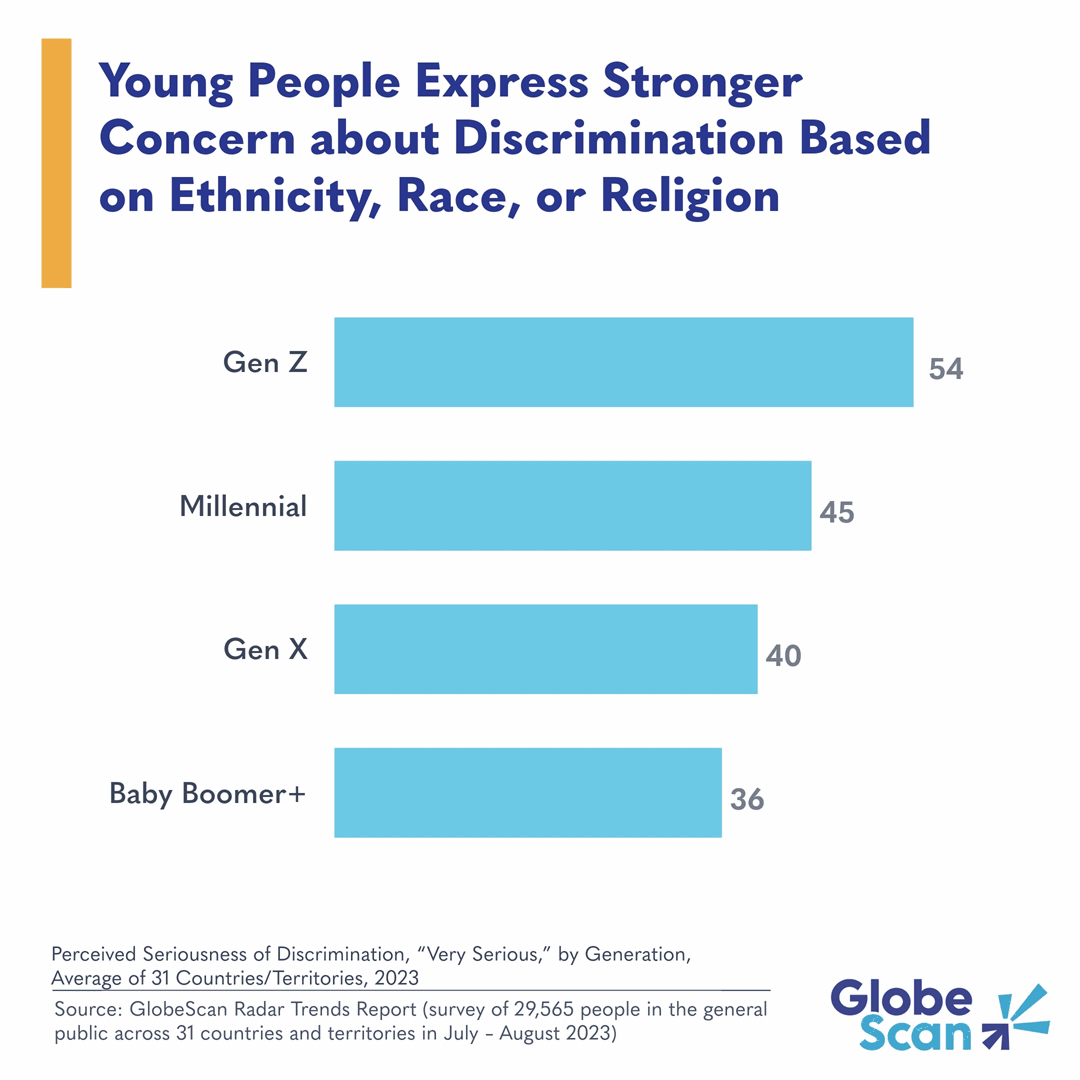
Observers have recognized for decades that American society needs to change in order to eliminate these facts of racism and substantive disparity of outcomes. But what kinds of change are called for? There is a comforting theory of change that seems to have some empirical basis. It is the idea that each cohort of Americans has become less racist and more tolerant of diversity than its predecessor cohort. On this account, the “silent generation” (1928-1945) had more explicitly racist attitudes than the baby boomers (1946-1964), Gen X (1965-1980), and Gen Z (1996-?). Each successive cohort was more accepting of racial diversity than its predecessor. This narrative suggests that racism and its legacy will die out as the more tolerant generations replace their less tolerant predecessors. GlobeScan, a global public opinion research organization, published the results of a brief survey on this topic in 2023 (link):

This report offers an empirical snapshot of the change across generations that is evident in some public opinion surveys: that concern about racial discrimination has steadily increased across recent generations of people. This is a comforting storyline for anyone who cares about an inclusive multicultural democracy. But Christopher DeSante and Candis Watts Smith argue in Racial Stasis: The Millennial Generation and the Stagnation of Racial Attitudes in American Politics (2020) that the storyline is fundamentally incorrect.

DeSante and Smith do not dispute that the generations since the 1940s have indeed experienced a shift in racial attitudes away from overt and explicit “biological racism”. Generations since the baby boom of the 1950s have internalized more “race-neutral” ways of describing current realities. And they have expressed rising discomfort with the fact of continuing racial discrimination. But these generations — GenX, Millennials, and GenZ in particular — appear not to have moved forward to the logical conclusion — the need for supporting the policy changes that would be effective in addressing the continuing realities of racial discrimination. This is the “stagnation and stasis” to which DeSante and Smith refer in the title of the book: progress on ending racism appears to have stalled.

The heart of their argument involves the question of how to measure “racist attitudes” among individuals. For several decades the primary tool of social-psychological measurement of racial attitudes has been based on the concept of “racial resentment” or symbolic racism. Survey questions were designed to elicit the subject’s level of resentment, fear, or antagonism towards members of another race. DeSante and Smith argue that this approach is no longer satisfactory as a measurement tool. They maintain that racism is inherently multidimensional, involving emotions and cognitive assumptions and frameworks, and a satisfactory measure needs to permit observation of several of these dimensions in the subjects of a survey. Instead they offer a four-dimensional framework that they call FIRE (Fear, Institutionalist Racism, and Empathy), and they use a set of survey questions that allow measurement of each dimension. These questions are designed to capture the emotional and cognitive components of “attitudes about race” among individuals in a racially mixed society.

Their measurement tool elaborates on these four questions:

-- I am fearful of people of other races.
-- White people in the US have certain advantages because of the color of their skin.
-- Racial problems in the US are rare, isolated situations.
-- I am angry that racism exists. (DeSantes and Smith 2020: 227)

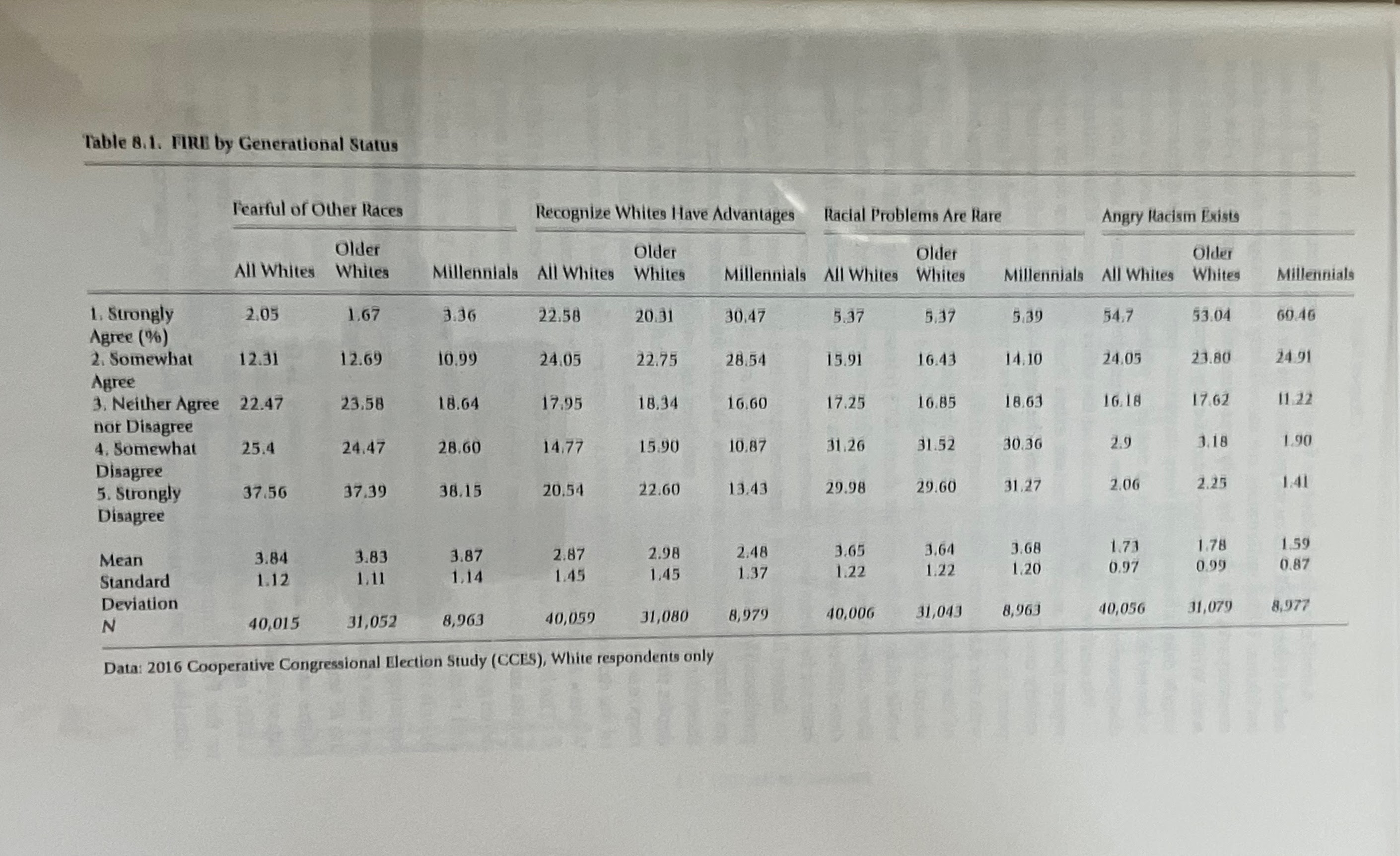
The questions are borrowed from several other survey instruments and are validated using statistical tools of consistency and predictive value. Here are the results of using these questions on the 2016 Cooperative Congressional Election Study (White respondents only).

The results are striking. Millennials are no less “racist” on average than the population of older whites on each of these measures. Here are the mean values for each question:

  • -- “Fearful of other races” 3.83 vs. 3.87
  • -- “Recognize whites have advantages” 2.98 vs. 2.48
  • -- “Racial problems are rare” 3.64 vs. 3.68
  • -- “Angry racism exists” 1.78 vs. 1.59

On average, Millennials demonstrate the same level of racist attitudes as older whites. The pattern is somewhat different when we compare “strongly agree” and “somewhat agree” responses to the four questions.

  • -- “Fearful of other races” 14.36 vs. 14.35
  • --  “Recognize whites have advantages” 43.06 vs. 59.01
  • -- “Racial problems are rare” 21.28 vs. 19.59
  • -- “Angry racism exists” 76.84 vs. 85.37

There are two significant differences in these “agree” responses. Millennials are more likely to agree that “whites have advantages” and agree more frequently that they are “angry racism exists”. Millennials are more likely to disagree or strongly disagree that they are “fearful of other races”. But overall, DeSantes and Smith argue that these differences are small, indicating that little change has occurred between the generations born before 1981 and the Millennials. Millennials have abandoned “old-fashioned racism” but have not advanced much further. Here is their summary statement:

Generally speaking, our results in this chapter also highlight the issue of racial stasis, as signs of the countervailing forces remain visible. For instance, White millennials do present more progressive attitudes. Compared to their predecessors, they are more likely to express anger about racism and more likely to acknowledge their privilege. But we also found that nearly one in five White millennials (20 percent) simultaneously feels angry that racism exists and does not believe Whites have advantages because of the color of their skin…. Ultimately we have a large number of walking contradictions in American society that are helping to produce and perpetuate ongoing racial inequities through their political stances and policy preferences. (244)

So if DeSantes and Smith are correct, then the hope that America’s conflicts over race and racism will disappear as a result of generational replacement is not likely to materialize. Instead, positive and purposeful steps will be needed in the realm of public and semi-public policy in order to address the effects of discrimination and prejudice. And since the burdens of discrimination are cumulative, it is not enough to ensure that opportunities are available on the basis of merit and achievement to solve the problem. If residential segregation makes it less likely that black children will receive equal educational opportunities, then all of their opportunities in later life will be stunted as well. If elementary schools or high schools are racially oriented so that black children on average receive lower quality educations, then “equal opportunity” at the university level is insufficient.

DeSante and Smith do not have much to say about what a “non-racist” mentality and culture would look like, but we can extend their thinking by emphasizing the importance of “education for an inclusive multicultural democracy”. This is a view of “civic education” for all of us based on respect across our various lines of division. A major part of such an education is a clear and honest knowledge of some of the sources of racist oppression and violence that have burdened our society in the past. Another is a deliberate and creative effort by educators, leaders, and students themselves to find our way to some of the ideals articulated by MLK and the beloved community. Without some idea of how young people can be genuinely transformed in their underlying attitudes about race, it is hard to see how the “stagnation of racial attitudes” called out by DeSante and Smith can be disrupted and reimagined. (Here is a more extensive discussion of what is needed for an inclusive multicultural democracy to become a reality; link.)


Saturday, January 31, 2026

Maintaining social resilience


What is needed for a community of diverse people and groups to maintain its resilience in the face of hateful language, incidents, and provocations?

This question is particularly important for universities, which commonly seek to create a climate of welcome and respect for the various groups of students who make them up, and which are sometimes subjected to anonymous hateful attacks through graffiti, email, posters, social media, or other means. University communities have periodically been thrown into tense situations of fear, mistrust, and anxiety by hateful attacks — even when no physical threats of violence have emerged (NYT).

Hateful and racist propaganda campaigns like these are deeply destructive to the cohesiveness of a community for several reasons. They undermine trust across groups — “do those other people think this way about me?”. They harden the separations that sometimes begin to emerge across groups. They may lead to a cycle of “tit for tat” hostilities, which have the inherent possibility of escalation. And possibly they reinforce and amplify the latent hateful assumptions of some people to a more virulent and expressive form.

So how can a diverse and multicultural community best prepare itself for attacks like these? How can students, faculty, and staff “take on hate” in a university community?

One avenue is to devote the effort necessary throughout the community to establish strong forms of affiliation and trust across groups, so that members of different groups have a substantial basis for sustaining confidence in the motivations and allegiances of members of other groups. This means creating avenues of interaction and communication across groups in routine times, not just the occasions of crisis when threats to cohesion arise.

Another is for leaders to be explicit and passionate about the values of inclusion that hold the community together.

Third, an important source of social resiliency results from affirmative organizations that advocate for the values of mutual respect and inclusion and that have established strong networks of relationships throughout the community, both within and across groups. Student organizations can play the lead in creating and supporting such groups.

Another important source of resiliency is realistic communication about the continuing possibility of individual anonymous expressions of hate and intolerance. It is a fact that hateful expressions are possible in every social setting, and in fact we seem to be in a period where such expressions are becoming more common. So a community that is mentally prepared for such assaults is probably better able to resist their pernicious effects than the world that Mary Poppins lives in.

It also makes sense that a community will be stronger and more resilient if its institutions establish confidence in protection of all members of the community against violence and intimidation. Fear is a toxic emotion in a multicultural community. If a community can ensure that racist actions will be appropriately addressed, and that no one needs to fear racist or hateful violence, then the anxieties created by anonymous hateful messages should have less effect on the cohesiveness of the community. This means that effective and predictable policing and law enforcement is an important source of community resilience.

So we might say that a resilient multicultural community is one in which --

  • there are lasting inter-group ties through organizations and person-to-person relationships;
  • leaders from civil society and from important organizations publicly espouse the values of inclusion and respect;
  • there is a broad understanding of the dynamics of hate and the possibility of occasional hateful occurrences; and
  • there is deep confidence in the ability of the community to provide safety for all its members through effective law enforcement.

These circumstances are likely to build the ongoing trust and commitment to positive intergroup loyalties that will make the community resilient to the efforts of hateful outsiders (or insiders) to disrupt its harmonious fabric of civil life.


Sunday, January 25, 2026

How democracies die


image: Senator Josh Hawley salutes January 6 insurrection

Steven Levitsky and Daniel Ziblatt have written with growing alarm about the threat to our democracy by right-wing extremism. How Democracies Die was sobering when it appeared in 2017, and the publication of Tyranny of the Minority: Why American Democracy Reached the Breaking Point (2023) reaches an even higher level of fear for our democratic institutions.

But just as this new democratic experiment was beginning to take root, America experienced an authoritarian backlash so fierce that it shook the foundations of the republic, leaving our allies across the world worried about whether the country had any democratic future at all. Meaningful steps toward democratic inclusion often trigger intense—even authoritarian—reactions. But the assault on American democracy was worse than anything we anticipated in 2017, when we were writing our first book, How Democracies Die. (Tyranny of the Minority, 5)

Levitsky and Ziblatt have spent their careers studying authoritarian regimes and their dynamics, so their assessment of our current situation is eye-opening. And of course, the situation today is worse than what they surveyed in 2023 — much worse. The earlier book focused on the powerful streaks of authoritarianism present in MAGA nationalism — race-baiting, contempt for democratic norms and practices, treating political opponents as contemptible enemies, and barely concealed willingness to defy Federal courts when rulings run contrary to the MAGA agenda. In the current book their focus is on the features of the political institutions (and the elected representatives) which have permitted these authoritarian dreams to come to reality.

They begin by identify a familiar aspect of US politics — the fact that electoral and congressional processes empower “partisan minorities” in dangerous ways.

The U.S. Constitution allows partisan minorities to routinely thwart majorities, and sometimes even govern them. Institutions that empower partisan minorities can become instruments of minority rule. And they are especially dangerous when they are in the hands of extremist or antidemocratic partisan minorities. (Tyranny, 10)

They emphasize that the extremist themes of the MAGA movement — white supremacy, Christian nationalism, anti-immigrant hatred, and glorification of strongman rule — have never been majority views in the US electorate. But a party exploiting these themes has in fact succeeded in gaining control of Congress, the presidency, and the Supreme Court. And this party has been fully willing to use its power to enforce its agenda on the rest of us.

The authors devote a chapter to several historical episodes of attempted right-wing seizures of power in the twentieth century. The first is an episode in France in 1934 that few of us have heard of. In the 1930s political instability in France, along with economic crises and unemployment, nourished the emergence of a constituency of radical right-wing opposition to French political institutions. These included young men and demobilized soldiers from WWI.

On the afternoon of February 6, 1934, tens of thousands of angry young men, mostly members of veterans’ associations and right-wing militias (or “leagues”) with names like Young Patriots, French Action, and Croix de Feu (Cross of Fire) gathered in or near the prominent Place de la Concorde, across the river from France’s national parliament building. Although the groups diverged in their ideologies and goals, they were united in their hostility toward parliamentary democracy. (Tyranny, 34)

On this winter night a large group of these militants marched on parliament. Clashes with mounted police occurred, and some of the militants were able to enter the parliament. “Members of parliament had to sneak out the back door, frightened for their lives. One minister attempted to escape but was discovered by protesters, who dragged him to the river, changing ‘Throw him in the Seine!’ (He was saved by police officers who happened to be nearby.)” (36)

France’s democracy survived the February 6, 1934, assault. But it was badly weakened. Prime Minister Édouard Daladier immediately resigned. He was replaced by Gaston Doumergue, a right-wing politician who was considered acceptable to the leagues. The goal of some of the insurrectionists had been achieved: the center-left Daladier government had been brought down by street pressure. Right-wing extremists were emboldened and mobilized. (36)

And here is the crucial point: the political leaders of France at this moment of crisis did not stand together in denouncing the violent, anti-democratic assault on the parliament:

Yet France’s leading conservative party, the Republican Federation, took a remarkably tolerant stance toward these extremist groups. Founded in 1903, the Federation had been led for many years by Louis Marin, a man with solid democratic credentials. But in the early 1930s, the party drifted to the right, first flirting with, and then openly embracing, the Young Patriot activists in its midst. Long considered a party of the elite, the Federation grew dependent on the Young Patriots and other far-right leagues as a source of activism and energy. Because the same individuals appeared in both groups, the boundary between the official “party” and the violent activists of the leagues grew harder to discern. (37)

There is a disturbing parallel between the French uprising in 1934 and the January 6 Capitol Insurrection in 2021. It is remarkable and disturbing to see how the Republican Party and Donald Trump have rewritten the history of the January 6 insurrection at the US Capitol. And Trump’s mass pardon of almost 1,600 individuals who were charged or convicted of crimes on that day makes it clear: he condones (and even encouraged) the actions taken by his supporters on that day. He and his MAGA followers seem to agree with the words quoted by Levitsky and Ziblatt from a vice president of the Republican Federation: “martyrs who can never be sufficiently praised or honored, [they] have paid with their lives…. The blood poured out on February 6, 1934 will be a seed of a great national awakening” (38).

Here is the most important conclusion that Ziblatt and Levitsky draw: the most important bulwark of a democracy is a unified rejection across all political parties of violent and anti-constitutional actions, no matter who stands to gain from those actions. And this is precisely where the Republican Party has failed the American public: it has not reaffirmed our shared democratic principles and has entirely failed to denounce efforts to bypass or destroy our democratic institutions.

Democracies get into trouble when mainstream parties tolerate, condone, or protect authoritarian extremists—when they become authoritarian enablers. Indeed, throughout history, cooperation between authoritarians and seemingly respectable semi-loyal democrats has been a recipe for democratic breakdown. (41)

The phrase “semi-loyal democrats” is key to their analysis. This is the weak link in any democracy in which there is prolonged political conflict. These are politicians who officially affirm the constitution and the rule of law; but who look for gestures and language that will establish common ground with the extremist groups and individuals whose actions most threaten constitution and the rule of law. Democratic institutions are most in peril when “semi-loyal democrats” are most numerous.

To be a loyal democrat, Ziblatt and Levitsky argue that political figures must honor four principles:

  • expel antidemocratic extremists from their own ranks
  • sever all ties — public and private — with allied groups that engage in antidemocratic behavior
  • unambiguously condemn political violence and other antidemocratic behavior
  • join forces with rival pro-democratic parties to isolate and defeat antidemocratic extremists (41-43)

By these standards, there are very few “loyal democrats” among the elected Republican members of Congress today. John McCain would fall in this category; so would Liz Cheney. Mitch McConnell does not, and, judging from the photo above, neither does Josh Hawley. There are a few others who have shown this kind of principle and courage; but it is not the majority. And this is a great risk to the continuing vitality of our democracy.