Tuesday, August 6, 2013

Economic observations


Oskar Morgenstern was one of the founders of mathematical game theory, as co-author with John von Neumann in 1944 of Theory of Games and Economic Behavior. He was also the author in 1950 (revised in 1963) of a book that should be of substantial interest to philosophers of the social sciences. The book was called On Accuracy of Economic Observations, and it called into question the unreasonable level of confidence that economists had in economic statistics in the post-war period. Here is how Morgenstern described his goals in the first edition:
This study is the preliminary result of a prolonged concern with the properties of economic data. Most recently the problem of accuracy arose again in connection with an investigation into the structure of the American economy by means of input-output tables. These are arrangements of the sales and purchases of industries which show the interconnectedness of the entire economy. They are attempts to provide information Quesnay intended to give in the ancient "Tableau Economique"; they were first used by W. W. Leontief. (v)
He puts the central message of the book in these words in the preface to the second edition:
This book addresses itself to both the general reader and the professional economist. The former will see that decisions made in business and in public service are based on data that are known with much less certainty than generally assumed by the public or the government. The second will discover that even most widely accepted figures frequently have error components of unexpected magnitude, and consequently cast doubt on many currently accepted analyses in economics. (vii)
Morgenstern's analysis in this book is a very sober assessment of the challenges that confront the task of assembling national or regional economic statistics -- employment, production, prices, trade, and so on. In Part Two of the book he has separate chapters on trade, prices, mining, agriculture, employment, national income, and growth.

His perspective is a scientific one; he is fully supportive of the need to treat economic reality on the basis of empirical data. But he insists on the crucial importance of carefully reviewing the instruments through which our economic observations are made, and assessing the cumulative range of error that is created by those instruments. In other words, he constructs an applied epistemology to accompany economic observation: a detailed accounting of the scope and limits of accuracy in these observations.

Our problems begin, Morgenstern believes, with the fact that economic statistics are generally reported without any indication of error estimates. "Yet it ought to be clear a priori that most economic statistics should not be stated in the manner in which they are commonly reported, pretending an accuracy that may be completely out of reach and for the most part is not demanded.... It will be seen later that national income and consumers' spending power probably cannot be known now in part without an error of +/- 10 to 15 percent" (8).

Morgenstern specifically discusses ten major sources of error in the estimation of economic statistics:
  1. Lack of designed experiments
  2. Hiding of information, lies
  3. The training of observers
  4. Errors from questionnaires
  5. Mass observations
  6. Lack of definition and classification
  7. Errors of instruments
  8. The factor of time
  9. Observations of unique phenomena
  10. Interdependence and stability of errors
Morgenstern illustrates the effects of these kinds of factors on the degree of accuracy attainable in several areas of economic observation. Particularly interesting for contemporary concerns is his analysis of employment statistics (chapter XIII). Here he points out that there are conceptual issues that compound the effects of difficulties of measurement; for example, how do we define an "involuntary status of employment"? How do we handle "frictional" unemployment? But he notes as well that there are substantial political pressures on the unemployment numbers (216). Morgenstern then digs into the methodologies involved in the four major sources of employment statistics in the 1950s: Bureau of Labor Statistics, Bureau of the Census, Bureau of Employment Security, and the US Department of Agriculture. (It must be born in mind that this analysis describes the methods used in the 1950s, not contemporary methods.) Here is a description of the method used by the Census Bureau:
The data are based on a geographically stratified random sample of about 35,000 households. These households are randomly chosen from sampling cells which have themselves been chosen according to a multi-stage cluster sampling procedure involving the use of probabilities proportional to size, from over 300 geographical areas. The sample is taken in the middle of each month to maximize comparability with other monthly series. (219)
Each of the four bureaus mentioned here conduct their observations using somewhat different  methods; and each sometimes arrive at significantly different estimates. For example, for the year 1950 the Census estimate of non-agricultural employment was 52.3%; BLS found 45.2%; and BES found 34.3%. "The three counts of non-agricultural employment differ widely by four to eighteen million people [from 1946 to 1961]" (224). Each is a reasonable and justifiable estimate; but there are broad differences among them.

Here is an interesting hypothetical graph that Morgenstern introduces to demonstrate how sensitive some economic judgments are to variations within the error range of a given variable. The solid graph plots national income against time as observed by an official national data time series. The lightly shaded area represents the error range around this variable. And the dashed line represents a hypothetical graph of the movements of national income that is entirely consistent with the empirical information associated with the national estimate -- but leads to diametrically different conclusions about the timing of the business cycle.


None of this should be taken to imply that we shouldn't pay attention to economic statistics, or that there are not rigorous methods for attempting to measure these kinds of variables. Rather, Morgenstern's point is that all scientific observation involves complex instruments; and it is incumbent upon the researcher to carefully assess the sources and magnitude of possible errors in his or her observations. Further, economists and policy makers need to exercise appropriate humility in making use of economic statistics to support this policy reform or that; they need to recognize the possibility that the estimates and time series of statistical variables upon which they rely are significantly skewed and inaccurate.

I wonder whether contemporary econometricians would seriously disagree with Morgenstern's skepticism about claims of several decimal points of precision for variables like national income, growth, or employment. Is there a current-generation refutation of Morgenstern's concerns?

(G. William Skinner wrote a highly interesting article in 1987 about the problems inherent in population, tax, and production data for historical Sichuan; "Sichuan's Population in the Nineteenth Century: Lessons from Disaggregated Data" (link). His analysis includes some of the same sources of error and bias that Morgenstern identifies.)

(Ian Hacking's The Emergence of Probability: A Philosophical Study of Early Ideas about Probability, Induction and Statistical Inference is a very interesting treatment of the history of the development of the mathematics of social statistics.)

Sunday, August 4, 2013

Eurasian Population Project


In the historical demography hall of fame there is but a single bust -- that of Thomas Malthus. (I'm joking -- there is no historical demography hall of fame.) Malthus is the theorist with the most enduring theories and hypotheses about population behavior across the world. Most central among his theories is a causal hypothesis about population change: different cultures embody significantly different mechanisms for adjusting population size to available resources. Malthus believed that Europe and Asia differed in exactly this way: the family norms of Western Europe controlled fertility according to the level of available resources, whereas the family norms of Asia controlled population size through excess mortality when resources were short. These were the preventive and positive checks that Malthus described in An Essay on the Principle of Population.

The most basic importance of the Eurasian Population Project is precisely its refutation of Malthus's core theory. (The Coursera offering described earlier in a post on "A New History for a New China" provides a good introduction to the EPP; link.) EPP scholars have demonstrated that there is no fundamental difference in the population dynamics of Europe and Asia, at least along the lines postulated by Malthus. The first set of findings of this group are presented in Life under Pressure: Mortality and Living Standards in Europe and Asia, 1700-1900 [2004]. 
[Our study] is an international comparison of short-term mortality responses at the microlevel in past times…, designed to improve our understanding of the individual and family demographic responses to social and economic pressure. Its hallmarks are geographic breadth, temporal depth, and detailed longitudinal data. It examines not just one people, but a variety of micro-populations in West Europe and East Asia; not just one period, but a period of 80 to 150 years, largely from the nineteenth century; not just one community but one hundred communities with 2.5 million longitudinally linked individual-level records; and not just mortality, the subject of this book, but in later volumes of this series, the entire range of demographic behavior, including reproduction, nuptially, and migration. (4)
In particular, there is evidence from sites across Asia that demonstrate a mortality responsiveness to changing economic circumstances that is highly similar to that found in Western European sites. And specifically on Malthus' view of Asian demographic behavior:
Contrary to the Malthusian claim that the positive check was more important in the East than in the West, we demonstrate that mortality responses at least to short-term economic pressure were just as great, indeed often greater, in the West as in the East. Contrary to the neo-Malthusian characterization of mortality as a function of ecology and human biology, we demonstrate the importance of human agency not just in the East, but in the West as well. (5)
There is a crucial methodological assumption that distinguishes the EPP approach from traditional historical demography. This has to do with its focus on communities rather than national populations. 
Our focus on comparison of communities, not countries, represents a new approach to social science history. While we generalize about certain aspects of human behavior, we do so within the cultural, economic, and historical contexts of specific communities, not at the national level. In contrast with the dominant thrust in academic research, we ignore contemporary nation-state boundaries and standard historical chronologies. Thus while our results illuminate the behavior of specific Belgian, Chinese, Italian, Japanese, and Swedish populations identified in map 1.1 from the early eighteenth to the early twentieth century, we draw from them implications for the demography not of specific countries, but of social and economic systems. This strategy of comparing individual contexts rather than countries avoids the problem of representativeness normally inherent in community studies. (7)
The research programme that holds together the numerous local projects encompassed by the Eurasian Population Project is innovative and important. It frames a significantly new way of designing research into large-scale social processes extended over a long period of time.

At the same time, it seems fair to ask whether the data currently available through the EPP is broad enough to achieve the group's ambitious goals. The studies of each site are very data-rich; but there is of necessity only a very limited number of sites that will receive this kind of intensive data collection and analysis. Let's assume that the effort results eventually in two dozen careful local inquiries from Sweden to Japan. This is only a minuscule selection of sites from the universe of possibilities. So what makes us think that the patterns and processes that are identified in these studies are actually more general features of the totality of demographic behavior?

The answer we give to this question seems to depend quite a bit on our background assumptions about social variation. How much variability is there across Scandinavia, North China, or Japan when it comes to social and political arrangements, marriage institutions, and economic institutions? If we think that most of the institutional arrangements show a lot of variation, then it is hard to justify the idea that one or two careful local studies will be good indicators of the more regional patterns. If, on the other hand, we think that the relevant institutional arrangements are substantially more widespread and stable, then the local studies are more likely to be reliable as indicators of larger regional patterns.

James Lee, Cameron Campbell, and Wang Feng conclude their essay on comparative mortality patterns with this nuanced statement that highlights both variation and universality:
In spite of the popularity of convergence theory, human society remains divergent, a product of specific historical processes. This divergence transcends national boundaries between the northeast Asian and northwest European communities, respectively, but persists between continental boundaries. The irony, of course, is that while the Eurasian Project is an initial step to produce a non-national history based on individual data, not aggregate data, written at the community level, not the country level, our preliminary efforts to produce a social scientific history for the twenty-first century have to some extent also reconfirmed the meta-geography of the nineteenth century. (130)
I believe this approach to historical demography is one of the genuinely important innovations in the historical social sciences in quite a long time. It represents a very different way of trying to gain access to the kinds of processes and mechanisms that have led to important social outcomes in the past two centuries. And it provides a different kind of "microscope" through which to interrogate the past, one that depends on substantially larger and more collaborative research efforts by scholars throughout the world while working with a substantially more localistic conception of where the action is to be found.

Thursday, August 1, 2013

Nelson Goodman on psychology


Nelson Goodman is best known within philosophy as an iconoclast within the logical empiricist tradition. He published Fact, Fiction and Forecast in 1954, offering a "new riddle of induction." Goodman was deeply interested in the arts and he argued that artistic expression is on a par with other forms of assertion and representation -- for example, in Languages of Art (1968). And his 1978 book, Ways of Worldmaking, cast doubt on the empiricist project of extracting concepts directly from experience. So Goodman was an important voice within American analytic philosophy. But he had a significant influence on me during my graduate studies in the context of a very different set of problems -- the philosophy of psychology.

Goodman taught a course titled "Philosophical Problems in Psychology" at Harvard in 1971. The course contained material from the tradition of empiricist philosophy -- Locke and Berkeley -- as well as then-current research on cognition and representation by empirical psychologists. These included Jean Piaget, Jerome Bruner, T.G.R. Bower, Ray Birdwhistell, Paul Kolers, Michael Posner, and R. W. Sperry. Goodman was interested in how perception works -- according to the philosophers and according to the psychologists. The guiding concern was this: what is the nature and origin of the conceptual systems through which human beings make sense of the world around them? The course began with an examination of the theories of perception and representation offered by Locke and Berkeley, beginning with the empiricists' critique of innate ideas, and then proceeded to contemporary efforts to analyze the same processes in real human beings.

Some of the writings of Jean Piaget played a central role in the topics and discussions of this class, including The Construction Of Reality In The Child. Goodman was interested in Piaget's efforts to chronicle the development of the child's conceptual world -- the formations through which the child makes sense of sensorimotor experience at various ages.

Another noteworthy component of the course was an extensive discussion of Paul Kolers' work on motion perception eventually published in Aspects of Motion Perception (1972). (This research was published in 1971 as "Figural Change in Apparent Motion"; link.) The phenomenon that Kolers described was a flashing pair of images that oscillated between one geometrical figure and another. The images are stationary, but the visual impression is of a smoothly moving object that changes from one shape to the other. Goodman provided a detailed and perceptive analysis of the methods and assumptions that underlaid Kolers' treatment of the phenomenon.

One idea that is pervasive throughout many of Goodman's writings is the idea of conceptual relativism. This is the key contribution of Ways of Worldmaking. The idea comes up repeatedly in the 1971 course. Here is a paragraph taken from my notes from the course that captures a lot of Goodman's own views about conceptual schemes:
Experience is always organized in one way or another. Moreover, not all ways of organizing are equally good; some work much better than others, some may be ineffectual; others may lead to internal inconsistencies. When one proves unsatisfactory, this leads to a reorganization. But doesn't this require that there be a world out there to which our schemes conform? Yes and no; no because there is no unalterable way of looking at the world in which facts about the world are expressed; but yes, within any given system of organization there are true facts about the world to which other schemata must form. The important thing here is that there is no unique "structure of the world"…. Goodman calls his point of view "neutralism" or "conceptual pluralism". (11/9/1971)
What is most impressive about this course is the fact that Goodman paid close attention to current work in psychology and the cognitive sciences. Goodman followed a philosophical method in this course that I continue to admire -- the idea that philosophical reflections about an area of science can be valuable to the degree that they are closely connected to real research problems in that area of research. This approach leans against a primary focus on big issues -- is behaviorism correct? Are there mental entities? -- in favor of more specific questions within philosophical and psychological studies of perception.

What I now find most interesting about the design of this course is the underlying assumption that philosophers and empirical scientists can find common questions where their methodologies can fruitfully interact to shed greater light on the issues.  In this case, philosophers have a lot of questions about perception and conceptual schemes; and cognitive and developmental psychologists are doing experimental and theoretical work that sheds light on exactly these issues. Finding a common vocabulary is challenging for the two research traditions, but it seems clear that the collaboration can be highly fruitful.

(Here is an interesting collection that takes seriously some of Goodman's strictures on conceptual systems from the point of view of problems in the social sciences: Mary Douglas and David Hull, eds., How Classification Works: Nelson Goodman Among the Social Sciences.) Alessandro Giovannelli's article on Goodman in the Stanford Encyclopedia of Philosophy is excellent; link. Here is an extensive bibliography of Goodman's works; link.)

Wednesday, July 31, 2013

A new history of China


James Lee and Byong-Ho Lee have created a remarkable new course on Coursera titled "A New History for a New China, 1700-2000: New Data and New Methods, Part 1". This production is a genuinely important contribution to Chinese history. The course is not designed as an up-to-date summary of the history of early modern China, along the lines of Fairbank's China: A New History, Second Enlarged Edition. It is not a survey of Chinese history as traditionally treated.  Instead, it is a clear and logical presentation of a very different way of thinking about China's history: not as a chronology of events, dynasties, revolutions, rebellions, and notable individuals, but rather as an analytical study of the forces underlying pervasive social realities in China over this three-hundred year period. The key topics are privilege, wealth, power, and health, and the methodology is solidly quantitative. The analysis depends on a number of large data sets of sub-populations that James Lee and colleagues have assembled in the past thirty years. And Lee and Lee use advanced statistical and quantitative methods to probe the associations that exist within these datasets that would cast light on topics like political power, social mobility, and the workings of institutions. Most importantly, Lee and Lee are determined to probe the large sociological questions on the basis of demographic and social data about historical individuals.

The Lee-Campbell research group has created eight data sets with millions of unique individuals from specific places and periods in China over the past three centuries. These sets include population registers for over 500,000 distinct individuals. These datasets constitute the empirical core of the course.

The course is organized in three large segments:
  • Part I. Who Gets What? social structure, mobility, distribution
  • Part II. Who Survives? mortality, fertility, marriage
  • Part III. Who Cares? religion, gender, ethnicity, nationalism
Part I is underway now, and later parts will be produced in the near future.

Lee's organizing questions are sociological and demographic. In Part I the key questions are these:
  • Why do some people rise to the top while others do not?
  • Why is wealth more unequally distributed in some societies than in others?
The approach taken here, and pervasively throughout the research of the Lee-Campbell research group, is quantitative.
We present the results from a new scholarship of discovery based largely on the creation and analysis of big social science data from historical and contemporary China…. [This allows us] to construct a new sort of history from below that contributes to a more global understanding of human history and human behavior.
So what are the statistical foundations of their analysis? Here are the datasets that are used in the course:
  1. China Multi-Generational Panel Data-Liaoning (1.2M records for 260K individuals)
  2. China Multi-Generational Panel Data-Shuangcheng (1.5M records for 125K individuals and 19K land plots, 1870-1906)
  3. China Multi-Generational Panel Data-Imperial Lineage (250K individual life histories 1640-1935)
  4. dataset of 350K+ individuals with university academic records or civil service examination results
  5. dataset of 75K successful Imperial Examination Juren and Jinshi, 1371-1904
  6. dataset of 120K Chinese university graduates, 1902-1951
  7. dataset of 175K Peking and Suzhou university students, 1952-2004
  8. dataset from Chinese collectivization, 1947-48, Shuangcheng County
It is plain that there are a large number of individuals included in these datasets. These bodies of data permit a very precise and rigorous level of analysis by the researchers in probing various kinds of causal associations. But it is also plain that they offer very focused and specialized points of observation of the social processes taking place across China and across time. So there is a background premise that seems credible but also seems to require more explicit discussion:
  • there are identifiable and pervasive social processes at work in China, and detailed study of Liaoning or Shuangcheng can identify some of these processes. 
The discoveries about the causal factors involved in Chinese social mobility that can be drawn from dataset #3, for example, are most interesting if we can infer that the contours of causation that we discover here are roughly similar to social mobility processes in other parts of China in the Qing period. On the other hand, it might turn out that mobility in the Lower Yangzi region is based on factors having to do with commerce and wealth to a greater extent than was true in North China's Liaoning.

It is also interesting that Lee and his collaborators take a somewhat structural approach to social causation:
The driving factors of history are not just the ideas or actions of Great Men (or Women), but also from society as a whole, and that socio-economic forces including social stratification and wealth distribution together with politics are important factors that "push and pull" on actors and actions to create historical change.
This description singles out socio-economic forces as objects of study.

Another thing that strikes me is that the work presented here is "comparative historical sociology" rather than traditional historical research. (Lee sometimes refers to his discipline as "historical social science", and he emphasizes that the course is "explicitly comparative".) The approach seeks to evaluate hypotheses about how these large variables are influenced (wealth, power, longevity, health status, education). The opening comments James Lee makes in the introductory lecture about intuitive and anecdotal historical interpretation, and the comments about analytical rather than chronological organization, underline the point: this is not traditional history.
Our class eschews the standard chronological narrative arc for an analytic approach that focuses on specific discoveries and on how these new facts complicate our understanding of comparative societies, human behavior, and the construction of individual and group identities.
...
Unlike traditional history which focuses largely on the biographies and actions of specific historic figures, A New History for a New China seeks to write a history based on the experiences of all people, elites and non-elites.
This might imply that Lee and his colleagues mean to replace traditional historiography of China with the "big data" approach. But James Lee and others in this research group make it clear (outside this course) that these researchers are in fact pluralistic about historical research; they don't mean to say that historians who are more interested in the specific circumstances leading to change in a largely chronological structure are doing shabby history. There is a great deal of very exciting new historical research on China that has come forward in the past twenty years, and much of that research takes the form of organized narratives. (Peter Perdue's China Marches West: The Qing Conquest of Central Eurasia is a very good example.) These are good pieces of rigorous historical knowledge creation as well, though not based on large quantitative data sets. So this sociological, "big data" approach is one important new contribution, but not a replacement for all other historiographical approaches.

This course is well worth following. It does an excellent job of tying together the diverse and rigorous work that the Lee-Campbell research group has been doing for thirty years, and it provides a coherent framework and scheme of presentation for that work. In this sense I think it illustrates a virtue of the MOOC format that hasn't yet been discussed very much: as a platform for the presentation and dissemination of specialized ongoing research programs for a broader specialist public. The lectures are downloadable, and when completed they will represent a highly valuable "new media" presentation of some very interesting and challenging results in the historical sociology of China.

(James Lee and his colleagues have published quite a number of books relevant to this course. Particularly significant are One Quarter of Humanity: Malthusian Mythology and Chinese Realities, 1700-2000, Fate and Fortune in Rural China: Social Organization and Population Behavior in Liaoning 1774-1873, Life under Pressure: Mortality and Living Standards in Europe and Asia, 1700-1900 (Eurasian Population and Family History), each with co-authors.)

Monday, July 29, 2013

Quine's indeterminacies


W.V.O. Quine's writings were key to the development of American philosophy in the 1950s, 1960s, and 1970s. His landmark works ("Two Dogmas of Empiricism," "Ontological Relativity," and Word and Object, for example) provided a very appealing combination of plain speaking, seriousness, and import. Quine's voice certainly stands out among all American philosophers of his period.

Quine's insistence on naturalism as a view of philosophy's place in the world is one of his key contributions. Philosophy is not a separate kind of theorizing and reasoning about the world, according to Quine; it is continuous with the empirical sciences through which we study the natural world (of which humanity and the social world are part). Also fundamental is his coherence theory of the justification of beliefs, both theoretical and philosophical. This theory was the source of John Rawls's method of reasoning for a theory of justice based the idea of "reflective equilibrium." This approach depended on careful weighing of our "considered judgments" and the adjustments of ethical beliefs needed to create the most coherent overall system of ethical beliefs.

There is another feature of Quine's work that is particularly appealing: the fundamental desire that Quine had to make sense of obscure issues and to work through to plausible solutions. There is sometimes a premium on obscurity and elliptical thinking in some corners of the intellectual world. Quine was a strong antidote to this tendency. (John Searle makes similar points about the value of clarity in philosophical argument in his comments on Foucault here.)

Take "Ontological Relativity" (OR), the first of the Dewey Lectures in 1968 (link). The essay articulates some of Quine's core themes -- the behaviorist perspective on language and meaning, the crucial status of naturalism, and the indeterminacy of meaning and reference. But the essay also demonstrates a sensitive and careful reading of Dewey. Quine shows himself to be a philosopher who was able to give a respectful and insightful account of the ideas of other great philosophers.
Philosophically I am bound to Dewey by the naturalism that dominated his last three decades. With Dewey I hold that knowledge, mind, and meaning are part of the same world that they have to do with, and that they are to be studied in the same empirical spirit that animates natural science. There is no place for a prior philosophy. (185).
In OR Quine refers to a key metaphor in his own understanding of language and meaning, the "museum myth" theory of meaning. "Uncritical semantics is the myth of a museum in which the exhibits are meanings and the words are labels. To switch languages is to change the labels" (186). Against the museum myth, Quine argues here (as he does in Word and Object as well) for the indeterminacy of "meaning" and translation. The basic idea of indeterminacy of translation, as expressed in WO, comes down to this: there are generally alternative translation manuals that are possible between two languages (or within one's own) which are equally compatible with all observed verbal behavior, and yet which map expressions onto significantly different alternative sentences. Sentence A can be mapped onto B1 or B2; B1 and B2 are apparently not equivalent; and therefore Sentence A does not have a fixed and determinate meaning either in the language or in the heads of the speakers. As Quine observes in his commentary on his example from Japanese concerning the translation of "five oxen", "between the two accounts of Japanese classifiers there is no question of right and wrong" (193).
For naturalism the question whether two expressions are alike or unlike in meaning has no determinate answer, known or unknown, except insofar as the answer is settled in principle by people's speech dispositions, known or unknown. If by these standards there are indeterminate cases, so much the worse for the terminology of meaning and likeness of meaning. (187)
Returning to the extended example he develops of indeterminacy of translation around the word "gavagai" that he introduced in Word and Object, Quine notes that the practical linguist will equate gavagai with "rabbit", not "undetached rabbit part". But he insists that there is no objective basis for this choice.
The implicit maxim guiding his choice of 'rabbit', and similar choices for other native words, is that an enduring and relatively homogeneous object, moving as a whole against a constrasting background, is a likely reference for a short expression. If he were to become conscious of this maxim, he might celebrate it as one of the linguistic universals, or traits of all languages, and he would have no trouble pointing out its psychological plausibility. But he would be wrong; the maxim is his own imposition, toward settling what is objectively indeterminate. It is a very sensible imposition, and I would recommend no other. But I am making philosophical point. (191)
In "Ontological Relativity" Quine takes the argument of the indeterminacy of meaning an important step forward, to argue for the "inscrutability of reference." That is: there is no behavioral basis for concluding that a given language system involves reference to this set of fundamental entities rather than that set of fundamental entities. So not only can we not say that there are unique meanings associated with linguistic expressions; we cannot even say that expressions refer uniquely to a set of non-linguistic entities. This is what the title implies: there is no fixed ontology for a language or a scientific or mathematical theory.

These are radical and counter-intuitive conclusions -- in some ways as radical as the "incommensurability of paradigms" notion associated with Thomas Kuhn and the critique of objectivity associated with Richard Rorty. What is most striking, though, is the fact that Quine comes to these conclusions through reasoning that rests upon very simple and clear assumptions. Fundamentally, it is his view that the only kinds of evidence and the only constraints that are available to users and listeners of language are the evidences of observable behavior; and the full body of this system of observations is insufficient to uniquely identify a single semantic map and a single ontology.

(Peter Hylton's article in the Stanford Encyclopedia of Philosophy does a good job of capturing the logic of Quine's philosophy; link.)

Thursday, July 18, 2013

Marx and the physiocrats


An earlier post highlighted an interesting piece of Marx scholarship by Regina Roth, included in a Routledge collection of important articles on the history of political economy (link). Another article that is of special interest in the Routledge collection is "Karl Marx on physiocracy" by Christian Gehrke and Heinz Kurz (link). The illustrations reproduced above are taken from this article. The first is a diagram, in Marx's own hand, of the process of simple reproduction developed in detail in Capital. The second is Marx's pairing of this same diagram with Quesnay's Tableau economique, suggesting Marx's indebtedness to Quesnay and the physiocrats.

Gehrke and Kurz provide a highly detailed survey of the times and sources through which Marx studied the physiocrats, and the comments and questions that he raised in his working notebooks. They present the results of this analysis in two useful appendices to the article. In the primary text they focus on the most important question: to what extent, and in what specific ways, was Marx influenced by the physiocrats' system?

They find two crucial parallels between Marx and the physiocrats: first, both present a view of a capitalist economy that originates in a theory of surplus value; and second, each presents a view of the economy in terms of a flow of value through various sets of hands. The tableau represent this flow visually and arithmetically, and Marx's schemes of simple reproduction do so algebraically.
The foundation of modern political economy, whose business is the analysis of capitalist production, is the conception of the value of labour-power as something fixed, as a given magnitude -- as indeed it is in practice in each particular case. The minimum of wages therefore correctly forms the pivotal point of Physiocratic theory. They were able to establish this although they had not yet recognised the nature of value itself, because this value of labour-power is manifested in the price of the necessary means of subsistence, hence in a sum of definite use-values. (TSV 1:45)
And in fact, the authors think this is fundamental for Marx's advocacy for the labor theory of value:
To Marx the labour theory of value was not fundamental in the sense that it was considered 'true' independently of whether it served the purpose of providing a logically coherent foundation of the theory of income distribution. Marx endorsed the labour theory of value precisely because be was convinced that it would offer that foundation, that is, allow one to elaborate a logically unassailable theory of the general rate of profit. He held the physiocrats in high esteem also because it was another achievement of theirs which he thought had paved the way to the development of such a theory. The achievement under consideration is the Tableau economique. (62)
What defines the physiocrats for most of us -- their view that the land is the ultimate source of all value -- is for Marx just a minor error of analysis on their part, not a fundamental misconception. Gehrke and Kurz write in paraphrasing Marx:
Scrutinizing carefully the texts of Quesnay, Mirabeau and especially Turgot shows that any surplus product is finally to be traced back to agricultural surplus labour, that is, it has its origin not in the productivity of land, or nature, but in the 'productivity' of the agricultural labourer who produces more than he gets in the form of wages. (60)
Here is the thrust of the second point, the fundamental similarity of the tableau economique and Marx's schemes of reproduction:
Quesnay's Tableau economique shows in a few broad outlines how the annual result of the nation production, representing a definite value, is distributed by means of circulation in such a way that, other things being equal, simple reproduction, i.e., reproduction on the same scale, can take place' (C 11: 363). Marx credits Quesnay with developing the Tableau in terms of 'great functionally determined economic classes of society' and with striking upon 'the main thing, thanks to the limitation of his horizon, within which agriculture is the only sphere of investment of human labour producing surplus-value, hence the only really productive one from the capitalist point of view.' (63)
What isn't entirely clear is the authors' analysis of influence and lineage of ideas. Did Marx's own thinking about surplus value and reproduction derive in some way from the doctrines of the physiocrats? Or did he simply note a pleasing convergence between his own thinking and that of the earliest tradition of classical PE? The authors suggest that the former is the case:
We have seen how much Marx owed the physiocrats for the development of his own views on the laws of production, distribution and circulation governing a capitalist economy. This is the deeper reason why Marx spoke so respectfully of Dr Quesnay and the physiocrats. After all, les economistes were amongst the true forerunners of his own analysis which was in important respects but a metamorphosis and development of theirs. He appears to have been particularly fascinated by the fact that in the physiocratic system, as he saw it, the theory of quantities and growth and the theory of prices and distribution do have a common origin in the concepts of social surplus and production as a circular flow. Marx can indeed be said to have seen through the lens of the physiocratic writings the essence of the duality relationship between the two sets of variables emphasized by later theorists and particularly by John von Neumann . Hence it may be argued that there exists a direct lineage from physiocracy to modern formulations of the classical theory. (73)
But their own chronology suggests Marx had arrived at many of his key economic ideas before he carefully analyzed the physiocrats.

It is worth noting that the availability of digital versions of Marx's manuscripts makes research on questions like this one immensely more efficient than it was in the 1990s when Gehrke and Kurz did their work. The online Archive of Marx and Engels provides digital access to many of Marx's most important works (though not unpublished manuscripts), and it is possible for anyone interested in the role that a certain author or issue played in Marx's thought to trace it quickly using the search functions available. For example, a quick search shows that there are ten mentions of "physiocrat" or derivatives in the Economic and Philosophic Manuscripts (1844). And there are hundreds of such mentions in Theories of Surplus Value.

Monday, July 15, 2013

Adelman on Albert Hirschman


Jeremy Adelman's detailed and illuminating biography of Albert Hirschman in Worldly Philosopher: The Odyssey of Albert O. Hirschman is an excellent example of intellectual biography. Even more, it is a valuable contribution to our understanding of the development of social science theories and frameworks.

Born to a professional Jewish family in Berlin in 1915, Hirschman's life bracketed the most searing nightmares of the twentieth century. Hirschman was an anti-fascist activist as a teenager, leaving Berlin for France in 1933. He was an intellectual from the start, with curiosity and originality driving his quest for ideas and knowledge. But equally early he was an activist, with political convictions and allegiances that gave him the courage to resist fascism in every way he was able to. In France he pursued a doctorate in business (as the only French program he could enter), while continuing his anti-fascist activism.

One part of the interest of this biography is the engagement in war and revolution into which his historical situation and political sympathies led Hirschman. He fought as a volunteer in Barcelona during the Spanish Civil War in 1936. Returning to France he found himself as a volunteer in the French army, but was quickly demobilized following the defeat of France by Germany in 1940. He then had an intense half year of clandestine work in Marseille helping arrange escape from France for leftist intellectuals, refugees, and the occasional stranded American. He himself managed to emigrate to America in 1940 by landing a Rockefeller fellowship at Berkeley; but he then enlisted in the American army within weeks after the Japanese attack on Pearl Harbor. So in a brief few years Hirschman served in three armies fighting fascism. He spent months in Algiers as an enlisted man, was assigned duties as a translator behind the American lines in Italy, and wound up serving as translator in Rome for the German general who was the first to be charged for war crimes by the American army. (The general was found guilty of these crimes and sentenced to death.) And on Hirschman's return to America his career was mysteriously blocked at various points by suspicions and innuendos that came to play a role in his confidential security dossier in Washington.

While living in France (and later in fascist Italy as an American soldier) he became closely acquainted with some of the most interesting activists and political thinkers of Europe. Among the intellectuals who passed through the escape channels Hirschman helped to maintain included "Hannah Arendt, André Breton, Marc Chagall, Marcel Duchamp, Max Ernst, Siegfried Kracauer, Wifredo Lam, Jacques Lipchitz, Alma Mahler Gropius Werfel (the serial wife of composer Gustav Mahler, architect Walter Gropius, and novelist Franz Werfel), Heinrich Mann, Walter Mehring" (171).

So Hirschman's life is inherently interesting. Hirschman combined reflection and activism in ways that were much deeper than most intellectual figures were called upon to do.  (Arthur Koestler's life has quite a few parallels; link.)

But I find Adelman's biography interesting for another reason as well. Adelman does a remarkable job of explicating the originality and edginess of Hirschman's thought, from his service in the Federal Reserve Bank in Washington and efforts at European reconstruction, to his advising role in Columbia, to his mid-life success in gaining entree to elite American universities (Berkeley, Yale, Columbia, Princeton) and the emerging field of the theory of development. Adelman works through the combinations of personal, contextual, and intellectual influences that helped to shape Hirschman's imagination as a social scientist, and this makes for very interesting reading.

There are many insights in Hirschman's work. But particularly fundamental is a point that Adelman underlines again and again: Hirschman's inherent skepticism about the claims of grand theory in social science and public policy. It was a skepticism about the idea of a social science aspiring to the exactness of the natural sciences; about the idea of comprehensive predictive theories about complex social processes; and about the hope of having a unified social scientific theory that could drive policy towards an optimal solution. Against these hopes, Hirschman emphasized the importance of hands-on experience of the complex processes we care about (economic development, for example); he emphasized the value of small and partial theories for limited aspects of the social world; and he celebrated the value of examining the particular rather than seeking always for the generalizable. In Adelman's words,
This eye for particulars and their meanings imprinted itself on Hirschman, who was already questioning History's "laws" and searching for a spirit that was more epic because it was open to chance and to choice. (111)
Adelman traces this crucial intellectual disposition to a number of different influences: Hirschman's brother-in-law, the Italian physicist and activist Eugenio Colorni (murdered by fascist thugs in Rome in 1944); the writings of Hayek; and his own experience as an observer and practitioner of economic change in Colombia (in international trade and in economic development).
To Otto Albert, the conversations with Eugenio drew his attention “to what we call the small ideas, small pieces of knowledge. They do not stand in connection with any ideologies or worldviews, they do not claim to provide total knowledge of the world, they probably undermine the claims of all previous ideologies". (114)
The Big Idea, which Hirschman associated with the “claim to complete cognition of the world,” claimed “to explain multi-causal social processes from a single principle.” The alternative was “the attempt to come to an understanding of reality in portions, admitting that the angle may be subjective.” (116)
Here is Adelman on the influence of Hayek:
Hayek got at something Hirschman felt strongly: the need to acknowledge the basic limits to the “intelligibility” of our complex world. Leaders were wont to claim complete knowledge when they did not have it and thus to squash the individual’s ability to make adjustments “to changes whose cause and nature he cannot understand.” Hayek’s vision of spontaneous, unguided, and hidden forces at work presumed an inscrutability about life that Hirschman shared, in which its ironies, paradoxes, and the possibilities of unintended consequences provided the underlying engines of change. (238)
Perhaps most important, Hirschman was persuaded by the bad experience of the dogmatic, ideological theories of both right and left in the 1930s of the importance of modesty and open-mindedness in one's convictions about how the social world works. This becomes one of the key elements in Hirschman's main academic work, his critique of modernization theory and unified central planning as foundations for the policies of agencies like the World Bank and the IMF.

What comes out of this skepticism about the grand theories of the economists or political scientists is a more pragmatic and experimental approach to policy. Rather than building complex plans that presuppose a detailed knowledge of causation and inter-connection of causes, we should instead take pragmatic steps that seem to be pushing the system in the right direction. In the case of Colombia, this meant favoring the developments of entrepreneurs and businessmen in their individual efforts rather than supporting grand schemes of reconstruction and capital investment. He favored multiple strategies, "not a single road to change" (274).
Instead of a “propensity to plan,” Hirschman advocated a “propensity to experiment and to improvise”— a spirit missing from the council and whose absence deprived all sides from actually learning from experience precisely because the planners were so convinced that it was not they who had to be converted. After all, they were “experts.” (323)
The result, in contrast to expensive, expansive, intellectually seductive general plans and combined assaults, was a piecemeal approach targeting the scarcest of all variables. This was the premise of “unbalanced growth,” a term he eventually abandoned because he did not want his work positioned only as an alternative to a mainstream. (347)
Also interesting is the fine interpretation that Adelman offers of Hirschman's first two books, National Power and the Structure of Foreign Trade and The Strategy of Economic Development. The first was a great disappointment to Hirschman, since he had hoped that it would launch his academic career and reputation in the United States; while the second achieved exactly the kind of success he had hoped for with the first. But in hindsight, the first book seems to have as much importance as the second. It lays out a powerful and rigorous argument for the ways in which nationalist and fascist regimes were able to use the "soft power" of trade alliances to achieve their goals. The inequalities of bargaining position that exist between bilateral trading partners create the opportunities for highly coercive actions by the more powerful. This argument still seems relevant in the global trade environment in which we now live. It also propelled the argument towards a de-nationalization of world affairs -- a historical development that came to life to some extent in the establishment of the European Union.

Adelman, a professor of history at Princeton, has also edited a forthcoming collection of some of Hirschman's work, The Essential Hirschman. Both these works are truly valuable, and particularly so for social scientists who have realized that their disciplines need the kinds of independent and cross-sectional thinking that Hirschman was so good at.

(I have a happy memory of meeting Albert Hirschman at a conference on poverty and development at the Woodrow Wilson School in 1990. He was very generous with his ideas, his critical suggestions, and his encouragement.)

Friday, July 12, 2013

Life-course histories and methods

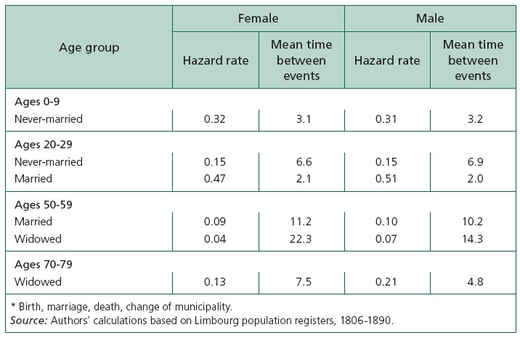
source: G. Alter, "Completing Life Histories with Imputed Exit Dates" (link)

I talked recently with George Alter, a leading historical demographer at the University of Michigan and author of Family and the Female Life Course: The Women of Verviers, Belgium, 1849-1880. (Here is George's presidential address to the Social Science History Association in 2010; link.) Alter has been a long-standing partner in the Eurasian Population and Family History Project, a genuinely innovative "large science" effort to bring together demographic studies of locations from Sweden to Japan.

George and I talked about something that is of interest to philosophers of the social sciences, but is rarely discussed -- the comings and goings of methodological innovations in some areas of the social sciences. There are a handful of "big picture" questions that define the philosophy of social science, and these don't change very rapidly over time and discipline. For example: What is a good explanation? What is the logic of causal inference? How do facts about individuals relate to facts about structures? These are questions that are broadly applicable across many social-science disciplines, and often the answers are fairly similar in different disciplines as well. But it turns out that specific disciplines are sometimes confronted with problems of data analysis and inference that require new methods and new analytical tools, and there may be moments in which significant methodological change occurs in a relatively short period of time.

George's field is historical demography -- the effort to reconstruct the population history of regions and countries through the registers and censuses that still exist for our study. This means examination of marriage behavior, fertility, mortality, emigration, and other key demographic trends. But it also means searching out the causes that can be traced of changes in these variables. So the field of historical demography is descriptive, but it is also analytical and causal; historical demographers are interested in identifying large social factors that influenced population behavior in centuries past.

The problem that Alter and some of his colleagues confronted in their research was a technical and logical one: how to extract the most useful information from population registers. And it turns out that answering this question requires developing radically new tools of analysis.
Most readers will find the methods used in some parts of this study unfamiliar. Some of these methods, like hazard models, have only recently become common in the social sciences, and there have been few previous applications in family history. The development of a new methodology, which is presented below in Chapter 2, was dictated by the characteristics of the Belgian population registers, from which data on nineteenth-century Verviers have been drawn. (13)
A population register differs from a census in a crucial respect: it provides an exhaustive chronological list of the births, deaths, entries, exits, and marital changes of the population present in the region over a specific period of time. This turns out to be a very tricky problem, and one that was not easily handled by traditional techniques of demographic analysis. Traditionally demographers made use of "snapshots" of a population at a time: the size of the population, the percent employed in a given industry, the percent married, etc. But demographic processes are temporal processes; so looking at snapshots frozen in time tends to lose an important dimension of the phenomena. And the method that will work well for population registers needs to be custom-designed to do a good job of representing temporality.

Alter describes the alternative methodology he and other demographers have developed to handle this particular set of problems in chapter two of Family and the Female Life Course. It is a complicated story, but fundamentally it comes down to a shift of perspective on demographic process -- a shift from persons and events to intervals of time. This means moving away from counting individuals to counting "person years". Alter characterizes this shift with the following tables:


And here is another take on the same data, this time arranged by age of the person rather than absolute date:


Each of these ways of looking at the data highlights different aspects of the demographic history of this small group.

The information contained in the population register can be transformed into a data set representing person-years and status during that interval. And it is then possible to use these data elements to compute age-specific rates of various demographically important states. Alter emphasizes that these methods permit a much more fine-grained use of the information presented by a population register.
There is much more information in the population registers than in the censuses and vital registers considered separately. The additional information comes from the linkage of information from the census to the demographic events and the linkage of events occurring in the life of each individual in the population register. (32) 
Alter then undertakes to adapt statistical methods to the problem of assessing the causal importance of various sets of factors for the occurrence of other factors; for example, the effect of "living with parents between 25 and 30" on "lifetime fertility". The tool that Alter turns to is the statistics of hazard models. Here is a brief description of hazards models from Wikipedia:
Proportional hazards models are a class of survival models in statistics. Survival models relate the time that passes before some event occurs to one or morecovariates that may be associated with that quantity of time. In a proportional hazards model, the unique effect of a unit increase in a covariate is multiplicative with respect to the hazard rate. For example, taking a drug may halve one's hazard rate for a stroke occurring, or, changing the material from which a manufactured component is constructed may double its hazard rate for failure. Other types of survival models such as accelerated failure time models do not exhibit proportional hazards. These models could describe a situation such as a drug that reduces a subject's immediate risk of having a stroke, but where there is no reduction in the hazard rate after one year for subjects who do not have a stroke in the first year of analysis. (link)
There is an unexpected difficulty that this method must confront -- the problem of what demographers call censoring. Essentially this comes down to the simple fact that a given population register leaves parts of an individual's life undocumented before and after the period covered by the register. So a woman who has not yet given birth at the age of 31 in 1835 (the end of the population register period) will be classified as childless; whereas she may well have a child in the next five years. But to add this woman into a raw count of women with and without children has the effect of under-estimating fertility. Alter shows how "life tables" can be used to address this problem. Essentially it is possible to use the data included in the population register itself to compute age-specific estimates of relevant variables (first marriage, first child, etc.) and then compute the average age of marriage from the life table. Here is an illustration:


This post doesn't suffice to explain the methodology that Alter develops. Interested readers will need to work through Alter's analysis with the same rigor they would apply to learning a new piece of physics. But this brief description does serve to highlight a key fact about research in the social sciences: social science methodology is not finished. Different fields of research encounter new problems with new sources of data; but they also sometimes raise issues about better ways of handling data that has long been available. This means that there will often be times of lively activity and change in the methods of a social science. It also means that it is very interesting to follow the details of the development of a discipline during these periods of change.

(It is interesting to re-read William Sewell's essay, "Three Temporalities: Towards an Eventful Sociology" (in Logics of History: Social Theory and Social Transformation) in light of Alter's remarks about the temporality associated with demographic change.)

Sunday, July 7, 2013

Graphing metadata


One element of the NSA revelations of the past month is the apparent fact that the NSA's PRISM program enables the agency to collect wholesale the transactions that occur on the Internet, including email header information. This follows the revelation that all metadata for phone calls made on the Verizon network (and presumably others) have been collected for a period of time -- perhaps as long as seven years. A story by John Naughton in the Guardian (7 July 2013) highlights the intrusiveness that wholesale exposure of communications metadata creates for each individual's privacy -- without ever looking into the contents of the communications.

An MIT research group has created a tool called Immersion to allow anyone to graph his or her own email communications network (link). This is a very powerful tool, and it is accessible to all of us. So it is an experiment well worth undertaking.

Here are the results for my own case. In the past three years I've transacted something like 60,000 email exchanges. The Immersion tool is able to analyze the metadata of this set of exchanges in a few minutes, and the resulting graphs are stunning. The vast and apparently disorderly library of messages turns out to have a very simple and revealing order. (I've removed the individual names from the graph, but these names are provided by the Immersion tool. An "analyst" would be able to focus in on any point of interest by name.) Here is the graph for the past three years of my communications:


It is important to understand the inputs to this analysis. Only the data from my own email library has been used. Lots of connections are represented in the graph between other people. But these connections all come from my own email cache -- as cc's on messages to or from me. Second, I am not represented on the graph. Rather, each circle is one of the 250 or so people with whom I have had email contact in the past three years. Each circle's diameter represents the volume of flow between that person and me; and the breadth of the links between individuals represents the volume of flow between them as registered in my email cache. (The program apparently has a smart way of excluding messages from organizations like newsletters.)

It is evident that the graph simplifies my social network substantially (as captured by my email traffic).  In fact, it is possible to dissect the graph into several key core groups: the local administrators at the campus where I work, the administrators at the system level of the university, a group of family members, a small group of researchers with whom I communicate and who communicate with each other, a journal editorial group, and a non-profit organization I'm involved in. (There are also students on the graph, but they are single dots, since my email does not provide evidence of email connections among them. Likewise, there are other single-point researchers with whom I communicate (the blue dots lower right), but my cache doesn't indicate communications among them.) So here is the same graph with labels for the distinct groups:


It is interesting to observe that there are lots of inter-group communications between members of the two administrative groups, but the two groups are clearly distinguished nonetheless on the graph. The intra-group communication for each is dense enough to pull the two systems apart. This algorithmic network analysis, based on a very limited set of data, accurately uncovers the organizational structure and hierarchy of the university and the campus administrative groups. Also of interest is the fact that the graph does a decent job of analyzing other people's relationships -- without any data from them!

In other words -- 60,000 messages boil down to a pretty simple and accurate picture of one person's activities over the past three years. 

Another facility that the Immersion tool provides is the ability to graph the recorded connections from any single person to everyone with whom he/she has communicated (out of my list of persons). The large purple circle in the first graph is the chief academic officer on my campus, who reports to me. This is the person with whom I communicate most frequently within the university. (By looking at the month-to-month frequency of communication, also provided by Immersion, it is also possible to single out the months where crises arose.) It is possible to blow up the circle of this individual's network as well, and see which individuals are most frequent connections (again, as recorded by cc's and forwards of messages from other people included in my own in-box). Here is the graph of the CAO's network:


Now think how much more informative these graphs would be if an agency also had access to the email caches of the two hundred or so people represented here. Communications between X and Y that are minor or non-existent on my graph, may turn out to have broad links when this larger set of data is incorporated. And this is exactly the capability that most observers are now attributing to the PRISM and telephone capture programs of the NSA.

What this implies to me is that the people who are most worried about the NSA's wholesale data collection programs are probably right. The data that is being collected -- phone and email metadata, perhaps auto license readers, credit card transactions, and electronic toll and transportation cards as well -- this fund of data suffices to map out our personal lives in much, much greater detail than we would ever have imagined possible in a democratic society. We no longer have the luxury of "privacy through anonymity" or "haystack privacy". Once there is full information recorded over time of our electronic transactions (including, remember, locational data from our phones), our lives can be played back in detail at any point. And the Immersion tool shows that the software exists to make sense of such vast databases, enabling agencies to produce customized and individually tailored "dossiers" for all of us.

The revelations about the FISA court in today's New York Times certainly support skepticism about the notion that these capabilities are carefully and properly controlled by the FISA process (link). Here is a particularly worrisome finding in the NYT article:
The officials said one central concept connects a number of the court’s opinions. The judges have concluded that the mere collection of enormous volumes of “metadata” — facts like the time of phone calls and the numbers dialed, but not the content of conversations — does not violate the Fourth Amendment, as long as the government establishes a valid reason under national security regulations before taking the next step of actually examining the contents of an American’s communications.
This legal theory specifically permits the kind of wholesale collection of metadata that can be used in the ways described here. And that is surely a profound threat to our privacy.


Friday, July 5, 2013

Marx's thinking about technology


It sometimes seems as though there isn't much new to say about Marx and his theories. But, like any rich and prolific thinker, that's not actually true. Two articles featured in the Routledge Great Economists series (link) are genuinely interesting. Both are deeply scholarly treatments of interesting aspects of the development of Marx's thinking, and each sheds new light on the influences and thought processes through which some of Marx's key ideas took shape. I will consider one of those articles here and leave the second, a consideration of Marx's relationship to the physiocrats, for a future post.

Regina Roth's "Marx on technical change in the critical edition" (link) is a tour-de-force in Marx scholarship. There are two aspects of this work that I found particularly worthwhile. The first is a detailed "map" of the work that has been done since the early twentieth century to curate and collate Marx's documents and notes. This was an especially important effort because Marx himself rarely brought his work to publishable form; he wrote thousands of pages of notes and documents in preparation for many related lines of thought, and not all of those problem areas have been developed in the published corpus of Marx's writings. Roth demonstrates a truly impressive grasp of the thousands of pages of materials included in the Marx-Engels Gesamtaushgabe (MEGA) and Marx-Engels Collected Works (MECW) collections, and she does an outstanding job of tracing several important lines of thought through published and unpublished materials. She notes that the MEGA collection is remarkably rich:
A second point I want to stress is that the MEGA offers more material than other editions, not only regarding the manuscripts mentioned above but also with other types of written material. If we look at the material gathered in the MEGA we find examples of several different levels of communication. We may think of manuscripts on a first level as witnessing the communication between the author with himself and with his potential readers. On a second level, his letters give us notice of what he talked about to the people around him. And, on a third level, there is the vast part of his legacy that documents Marx's discourse with authors of his time: his excerpts, the books he read and his collections of newspaper cuttings. (1231)
Here is a table in which Roth correlates several important economic manuscripts in the two collections.


Careful study of these thousands of pages of manuscripts and notes is crucial, Roth implies, if we are to have a nuanced view of the evolution and logic of Marx's thought.
They show, first of all, that Marx was never content with what he had written: he started five drafts of his first chapter, and added four fragments to the same subject, each of them with numerous changes within each text. (1228)
And study of these many versions, notes, and emendations shows something else as well: a very serious effort on Marx's part to get his thinking right. He was not searching out the most persuasive or the simplest versions of some of his critical thoughts about capitalism; instead, he was trying to piece together the economic logic of this social-economic system in a way that made sense given the analytical tools at his disposal. Marx was not the dogmatic figure that he is sometimes portrayed to be.

There are many surprises in Roth's study. The falling rate of profit? That's Engels' editorial summation rather than Marx's finished conclusion! By comparing Marx's original manuscripts with the posthumous published version of volume 3 of Capital, she finds that "Engels inserted the following sentence in the printed version [of Capital vol. 3]: 'But in reality [...] the rate of profit will fall in the long run' " (1233). In several important aspects she finds that Engels the editor was more definitive about the long-term tendencies of capitalism than Marx the author was willing to be. For example:
Therefore, Engels continued, this capitalist mode of production 'is becoming senile and has further and further outlived its epoch.' Marx did not give such a clear opinion with a view to the future of capitalism, at least not in Capital. (1233)
She notes also that Engels was anxious about Marx's unwillingness to bring his rewriting and reconsideration of key theses to a close:
Shortly before the publication of Volume I of Capital, Engels worried: 'I had really begun to suspect from one or two phrases in your last letter that you had again reached an unexpected turning-point which might prolong everything indefinitely.' (1247)
The other important aspect of this article -- the substantive goal of the piece -- is Roth's effort to reconstruct the development of Marx's thinking about technology and technology change, the ways that capitalism interacts with technology, and the effects that Marx expected to emerge out of this complicated set of processes. But this requires careful study of the full corpus, not simply the contents of the published works.
To understand Marx's views on technical change, his whole legacy, which is also comprised of numerous drafts, excerpts, letters, and so forth, must be considered. (1224)
In fact, the unpublished corpus has much more substantial commentary on technology and technical change than do the published works. "In Capital terms such as technical progress, technical change or simply technology turn up rarely" (1241).

Roth finds that Marx had a sustained interest in "the machinery question" -- essentially, the history of mechanical invention and the role that machines play in the economic system of capitalism. He studied and annotated the writings of Peter Gaskell, Andrew Ure, and Charles Babbage, as well as many other writers on the technical details of industrial and mining practices; Roth mentions Robert Willis and James Nasmyth in particular.

The economic importance of technical change for Marx's system is the fact that it presents the capitalist with the possibility of increasing "relative surplus value" by raising the productivity of labor (1241). But because technical innovation is generally capital-intensive (increasing the proportion of constant capital to variable capital, or labor), technical innovation tends to bring about a falling rate of profit (offset, as Roth demonstrates, by specific counteracting forces). So the capitalist is always under pressure to prop up the rate of profit, and more intensive exploitation of labor is one of the means available.
In the discussion in the General Council [of the IWMA], Marx argued that machines had effects that turned out to be the opposite of what was expected: they prolonged the working day instead of shortening it; the proportion of women and children working in mechanized industries increased; labourers suffered from a growing intensity of labour and became more dependent on capitalists because they did not own the means of production any more .... (1246)
So technology change and capitalism are deeply intertwined; and there is nothing emancipatory about technology change in itself.