Wednesday, March 23, 2022

An extremism index for elected officials


Senator Mike Braun (R-Indiana) made news in the past few days by questioning whether the Supreme Court was right to rule in 1967 that state bans on interracial marriage were unconstitutional. Here is the exchange (link):

"So you would be OK with the Supreme Court leaving the question of interracial marriage to the states?" a reporter asked.

"Yes," Braun answered. "I think that that’s something that if you’re not wanting the Supreme Court to weigh in on issues like that, you’re not going to be able to have your cake and eat it too. I think that’s hypocritical."

Braun now says that he misunderstood the question; but the video makes that hard to believe.

Braun's statement is just the most recent in a long series of appalling statements, screeds, and complaints by elected officials that place them in the range of what would have been called unacceptable right-wing extremism only a few decades ago. US senators and representatives have made statements with extremely ominous implications on a range of topics:

  • justifying or encouraging political violence
  • condoning racism and white supremacy
  • vilifying their political opponents
  • aligning themselves with openly insurrectionary organizations
  • expressing admiration for authoritarian leaders in other countries
  • calling for extreme voter suppression legislation in their home states
  • defending the January 6 rioters as "peaceful protesters"

Reading the newspapers everyday provides the interested reader with an impression that these kinds of statements are increasing in frequency and boldness, but that is just an impression. Would it be possible to attempt a more systematic study of the extent and depth of anti-democratic rhetoric among our elected officials based on their public speeches and comments?

This sounds like a big-data kind of project, in which the research team would collect speeches, interviews, and quotes through newspaper reports, press releases, social media items, and other sources. Then a systematic content analysis could be performed, identifying recurring themes and phrases for each politician. The work would need to be done according to clear criteria so that it would be possible to provide a profile of the themes advocated by each politician, and a measure of each politician's score with respect to a few large themes: white supremacy/racism; condoning of political violence; support for voter suppression; support for the rule of law; support for neutral and equal political institutions; affiliation with extremist groups; ....

An ongoing project like this could be conducted by a news organization like Talking Points Memo (link), the Atlantic Monthly, or the Guardian, or it could be conducted by a non-profit organization. Much as the Americans for Democratic Action (link) constructs a "liberalism index" for elected officials based on their voting records on a selected group of pieces of legislation, we might imagine a multi-dimensional index of elected officials measuring their affiliation with right-wing extremism through statements contained in their public utterances. 

It would be very interesting to see a list of current elected officials who have explicitly supported racist or white supremacist ideas; a list of officials who have endorsed or encouraged political violence; a list of officials who cast doubt on the validity of voting and electoral processes; and officials who have publicly associated themselves with hate-based groups. Presumably there would be a good degree of association among the lists, and as citizens we would be in a much better position to understand the depth and breadth of the threat to democracy that we currently face. And it is likely that many of us would be jolted and alarmed at how long those lists are.

The graphic for this kind of research project might look like a weird spike protein for each individual, with spikes for the handful of themes and values used to aggregate the content analysis of their speeches. A politician given to racist utterances, support for political violence, and support for voter suppression would show a preponderance of elongated spikes on these themes, and negligible spikes on the pro-democracy, pro-voting rights, anti-racism themes.

The research team might go further and consider constructing a "rightwing extremism" index, as a weighted combination of several of these factors.

It would be very interesting to see how many members of the Senate and the House would emerge with high scores on the "rightwing extremism" index. In the current environment it seems as though the number would be a large one. And it would also be very interesting to see how the distribution of ratings on this index changes over time. Will these politicians become even more extreme in the near future? Will they begin to moderate their words and actions? Will the impulse towards anti-democratic extremism abate in the United States, or will it continue to intensify? And most importantly, what do these trends suggest for the health and prospects for our democracy?

It is possible that there is research along these lines currently underway. If so, I'd like to hear about it.

Wednesday, March 16, 2022

Russia's aggression against Ukraine as a war crime


When Nazi Germany attacked Poland in 1939 it committed a war crime, codified by the standards established in preparation for the Nuremberg Trials in 1945. Here is a very useful summary of the Nuremberg process ("The Influence of the Nuremberg Trial on International Criminal Law", edited by Tove Rosen) at the Robert H. Jackson Center (link), and here is a summary of the Nuremberg Trial process provided by the US Holocaust Memorial Museum (link). Useful discussion and definitions are provided by the United Nations Office on Genocide Prevention and the Responsibility to Protect (link). The principles established for the Nuremberg Trials have served as the basis for subsequent war crimes prosecutions since World War II, including the International Criminal Tribunal for the Former Yugoslavia in response to crimes against humanity in Bosnia and the former Yugoslavia, and the International Criminal Tribunal for Rwanda following the genocide in Rwanda.

The key charges to be considered in the Nuremberg Trials included these:

Principle VI

The crimes hereinafter set out are punishable as crimes under international law:

1. Crimes Against Peace:

a. Planning, preparation, initiation or waging of a war of aggression or a war in violation of international treaties, agreements or assurances;

2. War Crimes:

Violations of the laws or customs of war which include, but are not limited to, murder, ill-treatment or deportation to slave- labor or for any other purpose of civilian population of or in occupied territory, murder or ill-treatment of prisoners of war, of persons on the seas, killing of hostages, plunder of public or private property, wanton destruction of cities, towns, or villages, or devastation not justified by military necessity.

3. Crimes Against Humanity:

Murder, extermination, enslavement, deportation and other inhuman acts done against any civilian population, or persecutions on political, racial or religious grounds, when such acts are done or such persecutions are carried on in execution of or in connection with any crime against peace or any war crime.

The first charge is "initiating or waging of a war of aggression". It is perfectly evident that this phrase describes Russia's fullscale invasion and assault on Ukraine perfectly. War crime #1, planning and waging a war of aggression, should be immediately pursued against the Russian state, its leaders, and its military commanders, by the appropriate international tribunal.

The category of misconduct referred to in clause 2 is more complex. But evidence from numerous cities in Ukraine supports application of this article to Russia's military conduct as well. The fact of "murder, ill-treatment, or deportation to slave labor ... of civilian population" appears to be occurring through the use of bombs, rockets, and artillery against city centers, targeting civilians, and the apparent deliberate killings of refugees and news reporters by Russian soldiers and aircraft appear to be documented as well. "Wanton destruction of cities, towns, or villages, or devastation not justified by military necessity" is clearly taking place as well. The videos currently available of apartment buildings ablaze after rocket, shell, and bomb attacks seem to provide prima facie evidence of "wanton destruction of cities" as mentioned in article 2. The kidnapping of mayors of several Ukraine cities possibly fall under this article as crimes as well.

Clause 3 involves "genocide" and mass crimes against human beings, when based on "political, racial or religious grounds". The fact that Russian attacks on almost all of Ukraine's largest cities have led to massive refugee movements (currently more than four million displaced persons and refugees) suggests "ethnic cleansing" -- an effort to push out of Ukraine's territory the segment of Ukraine's population that is most unwilling to accept Russia's hegemony and domination.

Two important principles were codified in 1950 to reflect the legal practice of the Nuremberg Trials: the principle of the legal responsibility of heads of state and the invalidity of the defense of "following orders".

Principle III

The fact that a person who committed an act which constitutes a crime under international law acted as Head of State or responsible Government official does not relieve him from responsibility under international law.

Principle IV

The fact that a person acted pursuant to order of his government or of a superior does not relieve him from responsibility under international law, provided a moral choice was in fact possible to him.

These principles imply that the individual leaders of the Russian war of aggression against Ukraine are personally vulnerable to charges of war crimes. Principle III explicitly declares that the head of state (Vladimir Putin) is appropriately subject to charges of war crimes under international law. Perhaps more importantly, Principle IV implies that military commanders themselves are liable to charges based on the crime of waging aggressive war. This strongly suggests that military commanders need to be considering their own liability for their actions in Ukraine.


Friday, March 11, 2022

Advancing high-energy physics in the United States


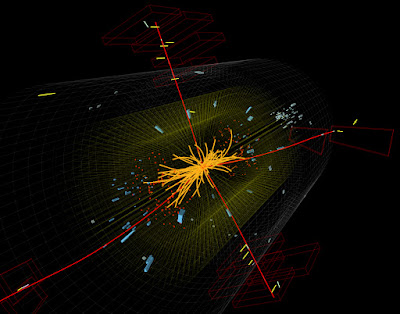
Here is an interesting and important scientific question: where is high-energy physics going? What future discoveries are possible in the field? And what strategies are most likely to bring these breakthroughs about? HEP is the field of physics that studies sub-atomic particles -- muons, quarks, neutrinos, bosons, as well as now-familiar larger particles like neutrons, protons, and electrons -- and their interactions. Research in this field involves producing collisions of sub-atomic particles at high energies (speeds) to create conditions permitting observation of new particles and properties. (The image above is a screenshot of the breakthrough results achieved at Europe's CERN particle accelerator documenting observation of the Higgs boson.) And the most striking feature of HEP is the fact that it requires multi-billion-dollar tools (particle accelerators) and scientific teams (armies of advanced experimental physicists) to have any hope of making progress in the state of the field. Progress in high-energy physics does not happen in a garage or a university laboratory; it requires massive public investments in research facilities and scientific teams, organized around specific research objectives. In the United States these are largely located in the national laboratories (link) and through collaboration with international research facilities (CERN).

The question I want to address here is this: Who should be interested in a serious way in the topic of where research in high-energy physics is going? It should be emphasized that in this context I mean "interest" in a specific way: "materially, politically, or professionally concerned about the choices that are made". Who are the actors who contribute to setting the agenda for future scientific work in high-energy physics? To what extent do the scientists themselves determine the future of their scientific field? Is this primarily an academic and scientific question, a question of public policy, a question of national prestige, or possibly a question of economic growth and development?

One answer to "who should be interested" is straightforward and obvious: the small network of world-class experimental and theoretical physicists in the country whose scientific careers are devoted to progress and discovery in the field of high-energy physics. Every physicist who teaches physics in a university in a sense has an interest in the future of the field, and a small number of highly trained physicists have strong scientific intuitions about where future advances are most likely to be found. Moreover, there is only a relatively small number of expert physicists whose own abilities and the capacities of their laboratories have a realistic opportunity to contribute to progress in the field. So the expert scientific community, including experimental and theoretical physicists, computational experts, and instrumentation specialists, have highly informed ideas about where meaningful progress in physics is possible.

An institution with definite interest in the question is the formal organization that represents the collective scientific practice of American physics -- the American Physical Society (APS) (link). The APS is a prestigious organization which contributes specialized advice to government and the public on a range of questions, from the feasibility of anti-missile defense to the level of risk associated with global climate change (link).

An important practice involved directly in surveying the horizon for future physics advances is the Snowmass conference (link) (or more formally, the Particle Physics Community Planning Exercise). Snowmass is organized and managed by APS, and it has formal independence from the Department of Energy. Here is a thumbnail description of Snowmass:

The Particle Physics Community Planning Exercise (a.k.a. “Snowmass”) is organized by the Division of Particles and Fields (DPF) of the American Physical Society. Snowmass is a scientific study. It provides an opportunity for the entire particle physics community to come together to identify and document a scientific vision for the future of particle physics in the U.S. and its international partners. Snowmass will define the most important questions for the field of particle physics and identify promising opportunities to address them. (Learn more about the history and spirit of Snowmass here "How to Snowmass" written by Chris Quigg). The P5, Particle Physics Project Prioritization Panel, will take the scientific input from Snowmass and develop a strategic plan for U.S. particle physics that can be executed over a 10 year timescale, in the context of a 20-year global vision for the field. (link)

As noted, Snowmass is an arm of APS, with close informal ties to the Department of Energy and its advisory committee HEPAC. For this reason we would like to infer that it is a reasonably independent process, developing its assessments and recommendations based on the best scientific expertise and judgment available. But we can also ask whether it succeeds in the task of formulating a clear set of visions and priorities for the future of high-energy physics research, or instead presents a grab-bag of the particular views of its participating scientists. If the latter, does the Snowmass process succeed in influencing or guiding the decision-making that others will follow in setting priorities and budgets for future investments in physics research? So there is an important question for policy-institution analysis even at this early stage of our consideration: how "rational" is the Snowmass process, and how effective is it at distilling a credible scientific consensus about the future direction of high energy physics research? This is a question for policy studies in organizational sociology, similar to many studies in the field of science, technology, and society (STS).

Snowmass in turn plays into a more formal part of DoE's decision-making process, the P5 process (Particle Physics Project Prioritization Panel), which prepares a decennial report and strategic vision for the future of high-energy physics for the coming decade. This report is then conveyed to the DoE advisory committee and to DoE's director. (Here is a summary of the 2007-08 P5 report (link), and here is a link to the 2014 P5 report (link). In 2020 HEPAC conducted a review of the recommendations of the 2014 report and progress made towards those priorities (link).) Here too we can ask the organizational question: how effective is the P5 process at defining the best possible scientific consensus on priorities for the field of high energy physics research?

The National Academy of Sciences, Engineering and Medicine (link) is another organization that has an interest and capability in developing specific assessments and recommendations about the future of high-energy physics, and the research investments most likely to lead to important advances and discoveries. Here is a "consensus report" prepared by a group of leading physicists and commissioned by the NASEM Committee on Elementary Particle Physics in the 21st Century in 2006 (link).

Scientists are actors in the process of priority setting for the future of physics research, then. But it is clear that scientists do not ultimately make these decisions. Given that programs of research in high energy physics require multi-billion dollar investments, the Federal government is a major decision-maker in priority-setting for the future of physics. There are several Federal agencies that have a primary interest in setting the direction of future research in high-energy physics. The Department of Energy is the largest source of funding -- and therefore priorities -- for future investments in research in high-energy physics, including the neutrino detector DUNE project centered in Chicago at Fermilab and the now-defunct plan for the Superconducting Super Collider (SSC) in Texas in the 1980s, terminated in 1993. The Office of High Energy Physics (link) is ultimately responsible for decisions about major capital investments in this field, with budget oversight from Congressional committees. The Office of National Laboratories has oversight over the national laboratories (Fermilab, Argonne, Ames, Brookhaven, and several others). The DoE process is inherently agency-driven, given that it is concerned with a small number of highly impactful investment decisions. One such decision was the plan to implement the Deep Underground Neutrino Experiment (DUNE) at Fermilab in metro Chicago in around 2010 for several billion dollars. So here again we have an organizational problem for research: how are decisions made within the Office of High Energy Physics? Are the director and staff simply a transparent transmission belt from the physics community to DoE priorities? Or do agency officials have agendas of their own?

The Office of High Energy Physics is supported by an advisory committee of senior scientists, the High Energy Physics Advisory Committee (HEPAP). This committee exists to provide expert scientific advice to OHEP about priorities, goals, and scientific strategies. It is unclear whether HEPAP is enabled to fulfill this role given its current functioning and administration. Do members of HEPAP have the opportunity for free and open discussion of priorities and projects, or is the agenda of the committee effectively driven by OHEP director and staff?

Congress is an important actor in the formulation of science policy in general, and policy in the field of high-energy physics in particular, through its control of the Federal budget. Some elected officials also have an interest in the question in the future of physics, for a different reason. They believe that there are national interests at stake in the future developments of physics; and they believe that world-class scientific discovery and progress are important components of global prestige. Perhaps the US will be thought to be less of a scientific superpower than Japan or Europe in twenty years because the major advances in particle physics have taken place at CERN and advanced research installations in Japan. To maintain the edge, the elected official may have an interest in supporting budget decisions that boost the strength and effectiveness of US science -- including high-energy physics. Small investments guarantee minimal progress, whereas large investments make the possibility of significant breakthroughs much greater than would otherwise be the case.

There are still two constituencies to be considered: citizens and businesses. Do ordinary citizens have an interest in the future of high-energy physics? Probably not. No one has made the case for HEP that has been made for the planetary space program -- that research dollars spent on planetary space vehicles and exploration will lead to currently unpredictable but valuable technology breakthroughs that will "change daily life as we know it". No "teflon story" is likely to emerge from the DUNE project. HEP, neutrinos, hadron particles, and their like, as well as the accelerators, detectors, and computational equipment needed to evaluate their behavior, have little likelihood of leading to practical spin-off technologies. As a first approximation, then, ordinary citizens have little interest -- in either the economist's sense or the psychologist's sense -- in what strategies are likely to be most fruitful for the progress of high-energy physics.

The business community is different from the citizen and consumer segment for a familiar reason. Like citizens and consumers, business leaders have no inherent interest in the progress or future of high-energy physics. But as manufacturers of high-performance cryogenic electromagnet systems or instrumentation systems, they have a very distinct interest in supporting (and lobbying for) the establishment of major new technology-intensive infrastructure projects. This is similar to the defense industry; it is not that aircraft manufacturers want military conflict, but they recognize that building military aircraft is a profitable business strategy. So more military spending on high-tech weapons is better than less, from the point of view of defense contractors. The large cryogenic electromagnet producer has a very specific business interest in seeing an investment in a largescale neutrino experiment, because it will lead to expenditures in the range of hundreds of millions of dollars on electromagnets once construction begins.

Now that we've surveyed the players, what should we expect when it comes to science policy and strategy? Should we expect a highly rational process in which "scientific aims and goals" are debated and finalized by the scientific experts solicited by the American Physical Society and Snowmass; a report is received from the P5 process by the quasi-public body HEPAP that advises DoE on its strategies, and evaluated in a clear and rational basis; recommendations are conveyed to DoE officials, who introduce a note of budget realism but strive to craft a set of strategic goals for the coming decade that largely incorporate the wisdom of the APS/Snowmass report; DoE executives are able to make a compelling case for the public good to key legislators; and budget commitments are made to accomplish the top 5 out of 8 recommendations of the Snowmass report? Do we get a reasonably coherent and scientifically defensible set of strategies and investments out of this process?

The answer is likely to be clear to any social scientist. The clean lines of "recommendation, collection of expert scientific opinion, rational assessment, disinterested selection of priorities" will quickly be blurred by facts having to do with very well known organizational and political dysfunctions: conflicts of interest and agenda within agencies; industry and agency capture of the big-science agenda; conflicting interests among stakeholders; confusion within policy debates between longterm and medium-term objectives; imperfect communication within and across organizational lines; and a powerful interest expressed by local stakeholders to gain part of the benefits of the project as private incomes. It is illogical that parochial business interests in Chicago or Japan would influence the decision whether to fund the International Linear Collider (link); but this appears in fact to be the case. In other words, the clean and rational decision-making process we would like to see is broken apart by conflicts of interest and priority from various powerful actors. And the result may bear only a faint resemblance to the best judgments about "good science" that were offered by the scientific advisors in early stages of the process. March and Simon's "garbage can model" of organizational decision-making seems relevant here (link); or, as Charles Perrow describes the process in Complex Organizations (2014):

Goals may thus emerge in a rather fortuitous fashion, as when the organization seems to back into a new line of activity or into an external alliance in a fit of absentmindedness. (135)

No coherent, stable goal guided the total process, but after the fact a coherent stable goal was presumed to have been present. It would be unsettling to see it otherwise. (135)


Saturday, March 5, 2022

Durkheim's social holism


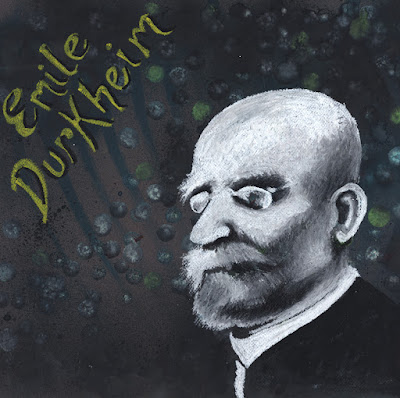
Emile Durkheim is celebrated for many achievements in the founding of the discipline of sociology, but most striking is his endorsement of the autonomy and irreducibility of the social realm to individual motivation, action, or psychology. "Social facts are things, irreducible to individual psychology." Durkheim was, we are often told, a social holist. This is a tantalizing and puzzling position. Here is a description of social facts offered by Durkheim in Rules of Sociological Method:

Yet social phenomena are things and should be treated as such. To demonstrate this proposition one does not need to philosophize about their nature or to discuss the analogies they present with phenomena of a lower order of existence. Suffice to say that they are the sole datum afforded the sociologist. A thing is in effect all that is given, all that is offered, or rather forces itself upon our observation. To treat phenomena as things is to treat them as data, and this constitutes the starting point for science. Social phe­nomena unquestionably display this characteristic. (Rules, 69)

Social phenomena must therefore be considered in themselves, detached from the conscious beings who form their own mental representations of them. They must be studied from the outside, as external things" because it is in this guise that they present themselves to us. If this quality of externality proves to be only apparent, the illusion will be dissipated as the science progresses and we will see, so to speak, the external merge with the internal. (70)

Here, then, is a category of facts which present very special characteristics: they consist of manners of acting, thinking and feeling external to the individual, which are invested with a coercive power by virtue of which they exercise control over him. Consequently, since they consist of representations and actions, they cannot be confused with organic phenomena, nor with psychical phenomena, which have no existence save in and through the individual consciousness. Thus they constitute a new species and to them must be exclusively assigned the term social. It is appropriate, since it is clear that, not having the individual as their substratum, they can have none other than society, either political society in its entirety or one of the partial groups that it includes -- religious denominations, political and literary schools, occupational corporations, etc. Moreover, it is for such as these alone that the term is fitting, for the word 'social' has the sole meaning of designating those phenomena which fall into none of the categories of facts already constituted and labelled. (52)

Durkheim seems to be quite committed, then, to the full and complete separation between social facts and individual facts. His reasons are unconvincing, however. 

Notice first that these points are entirely apriori. They derive from the idea -- almost Aristotelian in its dogmatism -- that each science must have a distinct and independent domain of things to study; and therefore sociology demands that social facts are distinct from the objects of study of another science -- psychology.

What are those supposed social facts? There are several that Durkheim refers to repeatedly: social conscience or morality; social habits and mores; laws and traditions; political arrangements; and social sentiments such as patriotism. In the simplistic understanding of Durkheim's ontology, these sets of norms, beliefs, values, and practices exist above individuals and constrain and direct their behavior. They cause events at the individual level, but they are not caused by individual-level events or conditions. This is an untenable holism, however. Further, there are important statements in Durkheim's writings that undercut this extravagant holism. For example, consider these comments from the second preface to the Rules:

Yet since society comprises only individuals it seems in accordance with common sense that social life can have no other substratum than the individual consciousness. Otherwise it would seem suspended in the air, floating in the void. (39)

Here he concedes the point that the social world consists only of individuals; but he wants to draw an analogy with the "emergence" of the physical properties of physical ensembles to support the idea that "social facts" are different in kind from individual facts:

The hardness of bronze lies neither in the copper, nor in the tin, nor in the lead which have been used to form it, which are all soft or malleable bodies. The hardness arises from the mixing of them. (39)

By analogy, he suggests that it is plausible to propose that social ensembles -- social facts -- possess properties different in kind from the properties of their parts -- the consciousness and representations of the individuals who make them up.

One is forced to admit that these specific facts reside in the society itself that produces them and not in its parts -- namely its members. In this sense therefore they lie outside the consciousness of individuals as such, in the same way as the distinctive features of life lie outside the chemical substances that make up a living organism. They cannot be reabsorbed into the elements without contradiction. since by definition they presume something other than what those elements contain. (39-40)

This line of thought is unconvincing, however. One giveaway is the phrase "by definition they presume something ...". We cannot learn something substantive about the nature of the world based on our definitions of "social facts" or our delineation of the "scope of sociology". Further, what are these qualitatively and ontologically new properties of the social realm? Social facts are said to be objective, independent, and coercive. They are objective because they persist over time. They are independent, perhaps, because they do not depend on any one individual's psychological content. And they are coercive because it is either impossible or inconvenient for individuals to reject them (for example, the conventions of money and debt). But these are peculiarly easy characteristics to explain in a microfoundational way -- more so even than the physical chemistry of the properties of a metal alloy. Once it is established that one should not spit into his dinner napkin at a formal meal -- a social fact -- the social fact is enforced through the fact that his dinner companions share the aversion, they express their disgust at his behavior, and they take him off future dinner guest lists. The microfoundations for this social norm are straightforward.

Consider another important point stemming from his view in Rules of the education of children:

Moreover, this definition of a social fact can be verified by examining an experience that is characteristic. It is sufficient to observe how children are brought up. If one views the facts as they are and indeed as they have always been, it is patently obvious that all education consists of a continual effort to impose upon the child ways of seeing, thinking and acting which he himself would not have arrived at spontaneously. (Rules, 53)

This passage refers to exactly the feature of social actors that I refer to as being "socially constituted" in my formulation of methodological localism (link). Children are brought to instantiate the beliefs, practices, behaviors, and values of the adults around them, and they in turn become the vehicles for the "social facts" represented by those beliefs and practices in the next turn of the wheel. It is straightforward, then, to provide the microfoundations of the idea that "the rules of polite French Catholic behavior" represent an objective social fact external to the particular beliefs of the individuals of society; once individuals have learned these rules, they become coercive for other individuals in the future. But -- contrary to Durkheim's rhetoric at various points -- there is no fundamental ontological separation between the "social fact of French politesse" and the psychological realities of French individuals. The individuals are shaped by their formative immersion in these rules as instantiated by their elders, and in turn go on to shape the behavior of others.

Durkheim is explicit in rejecting this microfoundational interpretation of social facts:

Thus it is not the fact that they are general which can serve to characterise sociological phenomena. Thoughts to be found in the consciousness of each individual and movements which are repe­ated by all individuals are not for this reason social facts. If some have been content with using this characteristic in order to define them it is because they have been confused, wrongly, with what might be termed their individual incarnations. What constitutes social facts are the beliefs, tendencies and practices of the group taken collectively. (54)

But this is a purely semantic point. Durkheim is insistent that French politesse is a social fact that is distinct from the psychological facts of French individuals because it is a feature of the ensemble taken collectively, not simply a conjunction of facts about individual psychology. It is what we might call a "category mistake" to confuse the two levels. 

We might say anachronistically that Durkheim would have emphatically rejected the picture of the social world involved in Coleman's boat (link), and would also have rejected the idea that social statements require microfoundations. He might possibly have accepted ontological individualism (as the passage from the second preface suggests), but would have endorsed some kind of emergentism. Social characteristics are different in kind from individual psychological characteristics. But, as we have seen elsewhere, emergentism can be formulated in a weak and a strong version (link); and the strong version is fundamentally mysterious. The weak version maintains that higher-level properties are different from lower-level properties but can in principle be explained by the lower-level properties; the strong version denies that the higher-level properties can be explained by the lower-level properties at all. And this sounds very much like a sociological version of vitalism. Durkheim is not forced to defend strong emergentism.

In his substantive and insightful introduction to Rules Steven Lukes summarizes his own assessment of these issues in terms that still seem correct to me:

But the [holistic] view makes little sense as a positive methodological principle. Every macro-theory presupposes, whether implicitly or explicitly, a micro-theory to back; up its explanations: in Durkheim's terms, social causes can only produce these, rather than those, social effects, if individuals act and react and interact in these ways rather than those. (17)

These arguments seem to lead to a pair of conclusions. First, Durkheim's strenuous and repeated privileging of the independence of "social facts" should not be understood as a demonstration of the complete causal independence of social facts from individual representations; rather, his emphasis on this point seems to derive from his polemical goal of establishing sociology as an entirely independent science. But this is not a valid reason for drawing conclusions about ontology. Second, it is entirely possible to offer an account of the relationship between social-level and individual-level descriptions that joins them. Whether he would acknowledge the point or not, Durkheim's social ontology does not provide any basis for believing that claims about causation at the social level cannot be instantiated through some account of the actions and representations of individual actors at a time and place. We can put the point more strongly: Durkheim's sociology no less than Weber's or Marx's requires a theory of the micro-macro connection. Further, Durkheim sometimes appears to acknowledge this point (for example, in his treatment of education of children). Therefore Durkheim does not provide a basis -- philosophical, theoretical, or empirical -- for defending social holism.


Friday, February 25, 2022

Vasily Grossman on good and evil


Vasily Grossman's novel Life and Fate was long delayed in its publication because of Soviet censorship but has come to be recognized as one of the greatest novels of the twentieth century. Grossman was a complex and appealing intellectual. Born in 1905, he was raised in a secular Jewish family in Berdichev, Ukraine. He was educated as a chemical engineer, but his vocation was writing and literature. When Hitler's armies invaded the Soviet Union in 1941 Grossman became a war correspondent in the Red Army, and quickly emerged as one of the most active and popular observers of the chaos and murder of the German invasion throughout the war. He was present through much of the battle of Stalingrad, he was the first journalist to observe and write about the Treblinka death camp, and he maintained extensive notebooks recording his experiences and observations throughout the war and genocide. Alexandra Popoff's biography Vasily Grossman and the Soviet Century offers a masterful account of his life and writings. Grossman began Life and Fate in the 1950s and completed it for publication in 1960. However, the manuscript and supporting materials were confiscated ("arrested") by the KGB and the novel was not published until 1980 (in Switzerland) -- sixteen years after Grossman's death.

The novel is riveting and complex. It represents an important piece of literary creation, a contribution to the history of the Holocaust and the German-Soviet war, and a prolonged critique of Stalinism. What is of special interest on this day in February, 2022 -- today, the first day of Russia's inexcusable and criminal aggressive war against Grossman's homeland, the Ukraine -- is Grossman's willingness to occasionally put the narrative aside and engage in philosophical-historical reflection. One such moment is in part 2, chapter 15, where Grossman presents a series of striking ideas about the nature of good and evil in history.

The theory is presented in a convoluted way. The old Bolshevik Mikhail Mostovskoy is a prisoner in a German concentration camp, and is brought for interrogation or conversation with Liss, a high Gestapo officer and student of Hegel. Liss has an unusual and surprising thesis to discuss with Mostovskoy: that both the Nazi officer and the loyal Bolshevik are involved in the same business -- service to an insane leader and a totalitarian ideology. Liss argues that the ideologies are remarkably similar. And secretly, Mostovskoy has come to see that the Soviet system is not so different from the Nazi system. He muses:

With all the strength of his soul, with all his revolutionary passion, he would have to hate the camps, the Lubyanka, bloodstained Yezhov, Yagoda, Beria! More than that ...! He would have to hate Stalin and his dictatorship! More than that! He would have to condemn Lenin ...! That was the edge of the abyss. (399)

The discussion of good and evil in this chapter is conveyed through the semi-coherent writings of another prisoner, the holy fool Ikonnikov. It is Ikonnikov whose shabby document on scraps of paper reflects on the history of good and evil. But the main lines of the view are Grossman's.

So what is the substance of this conception? To begin, the Ikonnikov manuscript rejects the idea that good and evil can be defined in general religious or philosophical terms. Religious doctrines in particular have given rise to great suffering, and Ikonnikov denies that religious figures or texts give humanity a true understanding of good and evil. He also denies that "good" is a universal concept, as perhaps a philosopher might hold:

People struggling for their particular good always attempt to dress it up as a universal good. They say: my good coincides with the universal good; my good is essential not only to me but to everyone; in achieving my good, I serve the universal good. (405)

Many books have been written about the nature of good and evil and the struggle between them ... There is a deep and undeniable sadness in all this: whenever we see the dawn of an eternal good that will never be overcome by evil -- an evil that is itself eternal but will never succeed in overcoming good -- whenever we see this dawn, the blood of old people and children is always shed. Not only men, but even God himself is powerless to lessen this evil. (406)

And most pertinent, Ikonnikov (and Grossman) link this critique of "universal theory of the good" to the evils of Soviet actions in the 1930s in Ukraine:

I have seen the unshakeable strength of the idea of social good that was born in my own country. I saw this struggle during the period of general collectivization and again in 1937. I saw people being annihilated in the name of an idea of good as fine and humane as the ideal of Christianity. I saw whole villages dying of hunger; I saw peasant children dying in the snows of Siberia; I saw trains bound for Siberia with hundreds and thousands of men and women from Moscow, Leningrad and every city in Russia -- men and women who had been declared enemies of a great and bright idea of social good. This idea was something fine and noble -- yet it killed some without mercy, crippled the lives of others, and separated wives from husbands and children from fathers. (406-407)

Here Ikonnikov refers to the Holodomor, the terror and purges, and the Gulag -- all created by the deliberate purposes of the Soviet state. It is the utopian ideas of Marxist communism, and the grim realities of the Holodomor, the Stalinist terror, and the Gulag that Grossman is bringing into focus through Ikonnikov. Utopian socialism led to the Holodomor, the NKVD, and the Gulag -- all in pursuit of "socialism in one country." (No wonder the book was "arrested" in 1962; it is surprising that Grossman himself was not shot on the grounds of this passage alone.)

Here, the critique -- whether of religion or of Communism or of Nazism -- is a thorough rejection of the notion of sacrificing human beings to an idea or a future utopia.

Where do we find "good", then, if not in universal principles of religion or philosophy or utopian doctrine? Ikonnikov is very clear about this question: good is found in the concrete actions of ordinary human beings. Ikonnikov's and Grossman's conception of the good is particular to human beings as they exist in specific times and places; it is not adherence to a set of principles, visions of the future, or prescriptions for the ultimate "good" of society. Good is found in concrete humanity in its particular historical circumstances.

Yes, as well as this terrible Good with a capital 'G', there is everyday human kindness. The kindness of an old woman carrying a piece of bread to a prisoner, the kindness of a soldier allowing a wounded enemy to drink from his water-flask, the kindness of youth towards age, the kindness of a peasant hiding an old Jew in his loft. The kindness of a prison guard who risks his own liberty to pass on letters written by a prisoner not to his ideological comrades, but to his wife and mother. (407-408)

And what is "kindness", the constant refrain of Grossman's optimism about the future? It is the simple human fact of compassion, the fact that human beings are often able to recognize the reality and the humanity of others around them, and to see that human reality as a concrete impulse to action. It is --

The private kindness of one individual towards another; a petty, thoughtless kindness; an unwitnessed kindness. Something we could call senseless kindness. A kindness outside any system of social or religious good. (408)

This kindness, this stupid kindness, is what is most truly human in a human being. It is what sets man apart, the highest achievement of his soul. No, it says, life is not evil! This kindness is both senseless and wordless. It is instinctive, blind. (409)

But Mostovskoy the disillusioned Bolshevik is not persuaded by Ikonnikov:

Yes, the man who had written this was unhinged. The ruin of a feeble spirit! The preacher declares that the heavens are empty ... He sees life as a war of everything against everything. And then at the end he starts tinkling the same old bells, praising the kindness of old women and hoping to extinguish a world-wide conflagration with an enema syringe. What trash! (410)

So whose view of good and evil is this -- the holy fool or Grossman himself? I believe it is Grossman's view, or at least an important part of his view. The theme of kindness is very deep in Grossman, and it is fundamental to his humanism and his faith in the future. Take this vignette from "The Old Teacher":

Then six-year-old Katya, the daughter of Weissman, the lieutenant who had been killed, came up to him in her torn dress, shuffling along in galoshes that were falling off her dirty, scratched little feet. Offering him a cold, sour pancake, she said, “Eat, teacher!”

He took the pancake and began to eat it, looking at the little girl’s thin face. As he ate, there was a sudden hush in the yard. Everyone—the old women, the big-breasted young women who could no longer remember their husbands, the one-legged lieutenant Voronenko lying on a mattress under a tree—was looking at the old man and the little girl. Rosenthal dropped his book and did not try to pick it up—he was looking at the little girl’s huge eyes, which were intently, even greedily, watching him as he ate. Once again he felt the urge to understand a wonder that never ceased to amaze him: human kindness. Perhaps the answer was there in the child’s eyes. But her eyes must have been too dark, or maybe what got in the way were his own tears—once again he saw nothing and understood nothing. (The Road: Stories, Journalism, and Essays)

And later, when the Jews of the village are being forced to the ravine to be slaughtered, the old teacher and the girl Katya are united again:

“How can I comfort her? How can I deceive her?” the old man wondered, gripped by a feeling of infinite sorrow. At this last minute too, there would be no one to support him, no one to say what he had longed all his life to hear— the words he had desired more than all the wisdom of books about the great thoughts and labors of man.

The little girl turned toward him. Her face was calm; it was the pale face of an adult, a face full of tolerant compassion. And in a sudden silence he heard her voice.

“Teacher,” she said, “don’t look that way, it will frighten you.” And, like a mother, she covered his eyes with the palms of her hands. (The Road)

A similar compassion and love for the particular human beings who died there is found in the closing lines of "The Hell of Treblinka":

Great is the power of true humanity. Humanity does not die until man dies. And when we see a brief but terrifying period of history, a period during which beasts triumph over human beings, the man being killed by the beast retains to his last breath his strength of spirit, clarity of thought, and passionate love. And the beast that triumphantly kills the man remains a beast. This immortality of spiritual strength is a somber martyrdom—the triumph of a dying man over a living beast. It was this, during the darkest days of 1942, that brought about the beginning of reason’s victory over bestial madness, the victory of good over evil, of light over darkness, of the forces of progress over the forces of reaction. A terrible dawn over a field of blood and tears, over an ocean of suffering—a dawn breaking amid the cries of dying mothers and infants, amid the death rattles of the aged.

The beasts and the beasts’ philosophy seemed to portend the sunset of Europe, the sunset of the world, but the red was not the red of a sunset, it was the red blood of humanity—a humanity that was dying yet achieving victory through its death. People remained people. They did not accept the morality and laws of Fascism. They fought it in all ways they could; they fought it by dying as human beings. (The Road)

It is Grossman, then, not simply the holy fool Ikonnikov, who finds enduring value chiefly in ordinary human compassion and kindness. This is the thrust of the closing lines of Ikonnikov's scraps of paper. And this is the heart of Grossman's concrete, intuitive humanism.

Human history is not the battle of good struggling to overcome evil. It is a battle fought by a great evil struggling to crush a small kernel of human kindness. But if what is human in human beings has not been destroyed even now, then evil will never conquer. (Life and Fate, 410)

Thursday, February 24, 2022

Atrocious and evil -- Russian aggressive war in Ukraine


The moment has come, after months of insistent, indignant jabber from Vladimir Putin that he has no intention of invading Ukraine: Russian forces have invaded Ukraine across a broad front.

This act by Vladimir Putin and his military is atrocious in precisely the way that Adolph Hitler's invasion of Poland in 1939 was atrocious. In fact, Putin's playbook is very similar to Hitler's playbook: spurious claims about ancestral rights to territory, phony claims about provocative attacks by Poland (1939) and Ukraine (2022), defiant histrionics to the world about Russia's right to the territory of Ukraine. This is an atrocity for a fundamental reason: it involves attack against a non-aggressor nation, it is unprovoked, it will undoubtedly lead to massive suffering, dislocation, and death of innocent Ukrainian citizens. Putin demonstrates that he -- and now the country for which he is unopposed dictator -- have complete disregard for international law, the rights and dignity of non-combatants, and the legal and moral importance of sovereignty.

The point deserves to be underlined: Putin is a dictator, and contemporary Russia is a dictatorship. Independent critics are imprisoned, persecuted, and assassinated; political organizations that dissent from Putin's rule are suppressed; and ordinary citizens are intimidated. Even oligarchs are treated harshly if they fail to support Putin's regime.

And what about Ukraine? Ukraine's history since 1920 is a story of vast suffering, much of it at the hands of Russians and the Soviet regime. The mass and deliberate starvation campaign conducted by Stalin in 1931-33, the Holodomor (link), led to the deaths of perhaps four million Ukrainian villagers during the famine years. Stalin's campaign of terror against his own people took a major toll on Ukrainians before and after World War II. The dictatorship of Soviet rule was harsh and unforgotten in Ukraine today. The devastation and death toll of fighting and Holocaust in 1941-43 in Ukraine against invading Nazi armies and Einsatzgruppen led to over a million deaths of Ukraine's Jewish population, and vast military and prisoner-of-war casualties. Kiev itself was the site of the largest single site of mass killings of the Ukrainian Jewish population, Babi Yar. To be aware that once again, artillery fire, air strikes, and missiles are in the skies of Ukraine is unbearably sad for the Ukrainian people and for everyone who cares about peace and human wellbeing.

The great Ukrainian writer Vasily Grossman, citizen of Berdichev, had greater wisdom, even as he witnessed the atrocities of Nazi extermination of the Jews of eastern Europe, the defense of Stalingrad, and the eventual defeat of the Nazi regime. In Life and Fate he wrote:

I have seen that it is not man who is impotent in the struggle against evil, but the power of evil that is impotent in the struggle against man. The powerlessness of kindness, of senseless kindness, is the secret of its immortality. It can never be conquered. The more stupid, the more senseless, the more helpless it may seem, the vaster it is. Evil is impotent before it. The prophets, religious teachers, reformers, social and political leaders are impotent before it. This dumb, blind love is man’s meaning. Human history is not the battle of good struggling to overcome evil. It is a battle fought by a great evil, struggling to crush a small kernel of human kindness. But if what is human in human beings has not been destroyed even now, then evil will never conquer. (Life and Fate, Part II, chapter 15)

Grossman never surrendered his belief in freedom, peace, and the dignity of the individual human being -- even as he witnessed the atrocities of the Gulag, the anti-Semitic campaigns of the 1950s, and the reckless and despotic behavior of the Soviet dictatorship.

Putin's decision is the act of an international outlaw and cannot be forgiven. Massive, enduring, and punishing sanctions must be the response of the rest of the world. And perhaps Ukrainians can take some hope from the anthem of their countryman: "evil will never conquer".

Wednesday, February 23, 2022

How to think about deliberate social change


What is involved in trying to create a better world? That is: what is involved in being an activist, a reformer, a radical, a revolutionary, or – for that matter – a reactionary? And how do the various forms of knowledge provided by areas of research in the social sciences play into this question? Is reforming the social world more like dreaming or more like building a cabinet?

This is an interesting set of questions for several reasons. One has to do with a very basic and crucial human feature – our capacity for rational-intentional manipulation of our various environments. Marx (and Hegel) put this feature of human capacity at the center of a rich conception of human “species being” – homo faber, the human tool-user, the creator through intelligent labor. The essence of “labor” is the use of one’s skills and knowledge to transform materials into objects that satisfy our needs, wants, and aesthetic values. And we would like to suppose that we can use our intelligence, our abilities to cooperate, and our practical skills at building social institutions, to construct a better world.

When we put this question in terms of transformation of the material world, we are talking about technology. We are led into a reflection on the knowledge provided by the natural sciences and the ways in which these forms of knowledge permit human beings to transform and build the natural environment; we are led to the disciplines of craftsmanship and technology. We are led to a consideration of practical intelligence and the artful transformation of nature. But what about purposive social change? How should we use knowledge and intelligence to bring about a better social world?

An important preliminary question is the scope of the possible: to what extent can we remake either the natural world or the social world? On the side of the natural world, the answer is fairly clear; humanity has thoroughly transformed the surface of the earth through its use of technology and scientific knowledge. (What is less clear is whether we have done so in ways that serve our collective interests, and whether unanticipated consequences have often derailed the benefits we sought.) An aircraft is the result of an integrated design process; a city is the result of a combination of plans, designs, accidents, and uncoordinated choices. So an aircraft is a much more intentional artifact than a city.

In the realm of the social world, the evidence is less clear when it comes to intentional transformation. There is ample evidence of social change, of course; but to what extent is that purposive or intentional social change? To what extent, perhaps, is largescale social change more like an ecological system than a building designed by an architect; more the result of many small and often unintended interventions rather than the result of a blueprint?

We can also ask the question: what sorts of things are we thinking to change, when we yearn for change? Here are several important possibilities: basic social structures; intermediate institutions; patterns of human behavior; mentalities and forms of social consciousness; social practices; and patterns of exploitation and domination.

So where do the social sciences come in when we consider the project of social reform? There are at least three locations within this story:

  • in the theory of the present (why does contemporary America embody racial inequalities? What are the current social mechanisms?);
  • in the theory of an ideal future (description of feasible institutions that produce equality); and
  • in the theory of a strategy of change (description of feasible actions that can be taken over time leading to the establishment of new social arrangements).

What this comes down to is three rather different applications of the empirical and theoretical findings of the social sciences. First, the social sciences can provide the basis for a causal-institutional analysis of the way that the current system works. Second, the social sciences can allow us to “test” the viability of an institutional change and a new set of institutions, to try to estimate the way that these new institutions will function. This is a bit like simulating the behavior of a new device under a set of test conditions. Third, the social sciences can provide an inventory of a large number of mechanisms and processes of change – protest, demonstrations, armed struggle, lobbying, public relations campaigns, … This application permits us to attempt to evaluate the credibility of a proposed strategy of change.

So how should we think about purposive social change – especially change in the direction of novelty, systemic change, and large change of behavior and mentality? Careful reflection on the nature of the social suggests that social arrangements and processes are always conditioned by contingency, heterogeneity, and plasticity; so there are no “iron laws of history,” no general theories that tell us how social processes work. Instead, good social science theories shed light on specific, mid-level social mechanisms and processes – very ably described by McAdam, Tarrow, and Tilly in Dynamics of Contention. So we can forget about the social sciences providing a general “physics” or “mechanics” that might provide a blueprint for social design – as our understanding of the natural sciences does in fact permit in the design of material technologies. Instead, we can derive from the various areas of the social sciences some pragmatic rules of thumb about how mid-level social processes work.

How does this help to answer our question? Because we can use the open-ended totality of the learning that research in the social sciences has made possible about how the social world actually works, to help guide our thinking as we think about social reform and social change. We can attempt to mentally model the way that new institutions would work. We can attempt to foresee some of the glitches that will arise as we undertake a process of extended social reform. We are forced to be humble: prediction is very limited, there are always confounding factors that we haven’t incorporated into our mental models, and contingency runs deep. But we can make a start at evaluating a change strategy – the likely features of functioning that a given institutional design will display; the failures that may arise as a process of communication or coordination is undertaken; and the forms of corruption, weakness of the will, freeriding, and gaming that we can expect in any large process of social change.

A good example worth considering is the inadequate efforts that were undertaken towards reform of the financial industry following the 2008 financial crisis. These efforts were not highly successful, for several identifiable reasons: industry capture of the process, inadequate understanding of complex interactions among rules and regulatory institutions, and failure to anticipate innovative strategies to circumvent the rules. But equally difficult questions arise every kind of social reform – the design of a new set of tenure procedures in a university, the design of a system of regulation to end disparate use of force by US police departments against racial minorities, or the design of single-payer health insurance system.

Several ideas seem to come to the top out of these reflections.

(1) Designing social change is difficult, in part, because it requires us to imagine and create social arrangements that don’t yet exist. So we have to exert our analytical and empirical intelligence to try to estimate the way these arrangements might work – and how ordinary people might live within them. Are they feasible? And do they produce the intended social effects?

(2) The social sciences set some loose limits on our reasoning as we think about both systems and pathways; but social science will never permit precise calculations about the future. There is a very broad range of possible outcomes for almost any social intervention.

(3) The kinds of atrociously bad outcomes that twentieth-century “modernizing projects” have led to have occurred as a result of aggressive and misplaced confidence in social theories and models. This is a deeply important lesson. There is a very wide gap between theory and reality. Marxism and neoliberal purism alike have created enormous human suffering in the past century.

(4) This being recognized, social innovators ought to be risk-aware: take small steps, evaluate, examine; and proceed further. Just as designers of nuclear power plants need to design for worst-case scenarios and soft landings, so social innovators should be cautious as they push forward their reforms.

(5) All these cautions properly acknowledged, we have no choice but to attempt to create a better social future for humanity. And this means respecting the constraints of democracy even as we struggle for substantively better social arrangements.

(Here are several earlier discussions relevant to this topic; link, link, link, link.)

Sunday, February 20, 2022

A topology of political theories?


We sometimes think of political philosophies as falling on a spectrum from left to right. Bernie Sanders is on the left and Greg Abbott is on the right. Our mental map might perhaps look something like this:


(Please note that the graphs are easier to see if the reader clicks the image and views the full-resolution image.)

However, a moment's reflection shows that this scheme doesn't really work. There isn't a single dimension along which these various political philosophies can be arranged. Anarchism isn't just further out on the same dimension as liberal constitutionalism; rather, it highlights a different set of moral concerns altogether. Communitarianism is a complex of values that appeals, in different ways, to both progressives and conservatives. Is communitarianism a left-leaning or a right-leaning philosophical position?

We might say as a form of shorthand that classical liberalism gives highest priority to the rights and freedoms of individual citizens; classical conservatism gives highest priority to the continuity of traditional social and political values and relationships; socialism gives priority to bringing about the end of economic domination of one group by another (equality); and fascism gives priority to ideological purity and state control of society. This shorthand gives a sense of the multi-polar nature of political philosophy. 

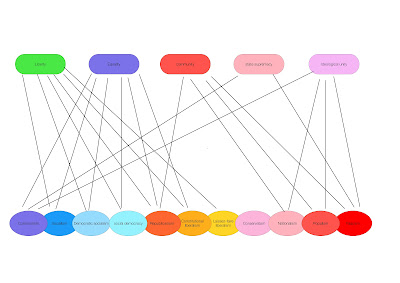
Consider a handful of fundamental values or themes that have motivated important schools of political philosophy -- for example, the values of liberty, equality, community, state supremacy, and ideological unity. How do the eleven political philosophies mentioned on the left-right spectrum above relate to those values? Here is an impressionistic graphic that perhaps sheds some light on the "space" of political philosophy. The core values of liberty and equality do a reasonably good job of differentiating between the "left" end of the spectrum from the right end. The values of ideological supremacy and state supremacy capture theories at both extremes: communism in the Stalinist mode and fascism. The value of community seems to be invoked in theories on both the left and right halves of the spectrum.

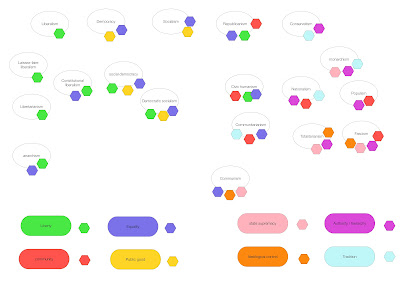
Can we do even better? We might consider placing political philosophies on a more notional graph that flags each political theory with a tag for the values it incorporates. This might look something like this:


This graph gives a greater sense of the nuances and divisions that distinguish the various political philosophies mentioned here; some are more similar to others because they share more of the "tags" that characterize them, and yet they differ in incommensurable ways. Here again, the left-right spectrum doesn't work well; rather, there is a multi-dimensional scattering of political philosophies across the values of equality, liberty, tradition, state domination, etc. Communism and fascism wind up looking like cousins, not extremes at opposite ends of the spectrum.

It should be possible to incorporate the relationships indicated in the preceding graph into a network graph among the eleven political theories mentioned here. The graph might look something like this:


This graph is still impressionistic, but it has a credible logic to it. It seems to capture real affinities among a range of political philosophies. And, most interestingly, it seems to give rise to a very different arrangement of views across conceptual space. The centrist views on this scheme are social democracy and civic humanism, whereas the extreme views are totalitarianism and populism, as well as libertarianism and anarchism.

Having spent several hours exploring different ways of "graphing" the space of political philosophies, I'm inclined to think that this is a useful tool for exploring the underlying commitments of various political theories. The multiple values and fundamental questions posed by Locke, Rousseau, Mill, Marx, Hayek, or Nietzsche do not reduce to a simple set of propositions. But by examining the cross-connections that exist among these various theories we can see both areas of consensus and difference among the theories. And we can see why the theories associated with totalitarianism, fascism, and communism, are so fundamentally unacceptable to a broad range of political thinkers. They are incompatible with the values of individual rights and liberties, the value of human equality, and the aspiration to human progress.

Thursday, February 10, 2022

Factions, insurrections, and the Federalist Papers


Sometimes political philosophers think of the The Federalist Papers as fairly minor contributions to the history of political theory -- time-bound, parochial, and written by colonial bumpkins who couldn't really hold a candle to Locke or Hobbes. When addressed at all, they are often used simply as evidence about the "original intent" of various constitutional provisions in the US Constitution (link). Now that I've included several of the papers in a course I'm currently teaching on modern political thought, however, I've come to a new appreciation of what Madison, Hamilton, and Jay were attempting to accomplish -- in contrast to Locke, Hobbes, and Rousseau. And I have gained a new appreciation of their sophistication as political philosophers and theorists. Most strikingly, I've seen today something that was invisible in the 1960s: how some of the work is enormously relevant on the assault to democracy we are currently experiencing from the far right in the United States.

The approach taken by the writers of the Federalist Papers is one of psychological realism. They want to design political institutions that work for citizens as they actually behave, not as we would wish them to behave. Here is a fine statement of their approach in FP 51, offered in their analysis of the institutional idea of "separation of powers" in government:

But the great security against a gradual concentration of the several powers in the same department, consists in giving to those who administer each department, the necessary constitutional means, and personal motives, to resist encroachments of the others. The provision for defence must in this, as in all other cases, be made commensurate to the danger of attack. Ambition must be made to counteract ambition. The interest of the man, must be connected with the constitutional rights of the place. It may be a reflection on human nature, that such devices should be necessary to control the abuses of government. But what is government itself, but the greatest of all reflections on human nature? If men were angels, no government would be necessary. If angels were to govern men, neither external nor internal controls on government would be necessary. In framing a government which is to be administered by men over men, the great difficulty lies in this: you must first enable the government to control the governed; and in the next place oblige it to control itself. A dependence on the people is, no doubt, the primary control on the government; but experience has taught mankind the necessity of auxiliary precautions. (FP 51: 268-269)

One of the key problems that Madison and Hamilton confront, in a very serious way, is that of "faction". We might think of this problem in a fairly trivial way: "I say potato, you say potahto". We're different. But what they have in mind is much more critical to the health and stability of a democracy than that. It has to do with groups that potentially endanger the survival of the republic itself, and the liberties of the citizens who make it up. Madison opens No. 10 with these words:

Among the numerous advantages promised by a well constructed union, none deserves to be more accurately developed, than its tendency to break and control the violence of faction. (FP 10: 42)

Madison and Hamilton hope that they and their colleagues in institution-building in 1787 will be able to design governance arrangements that reduce the dangers of "faction" to the viability of the emerging American democracy.

By a faction, I understand a number of citizens, whether amounting to a majority or minority of the whole, who are united and actuated by some common impulse of passion, or of interest, adverse to the rights of other citizens, or to the permanent and aggregate interests of the community. (FP 10: 43)

It is worth observing that a faction is not simply a group united by a shared set of preferences -- citizens who advocate for a new public park in a city, say -- but rather a group that advocates for actions that are "adverse to the rights of other citizens, or to the permanent and aggregate interests of the community". Ku Klux Klan activists in Alabama in the 1950s who sought to intimidate African-American men and women from exercising their rights to vote would be a faction; so would a group that seeks to undermine a community's ability to prevent the spread of polio among its children.

Why do factions and inter-group conflict arise? Madison (and Hamilton) approach the problem of politics realistically; and that means that they take human beings as they find them, not as we would wish them to be. Moreover, this is true both for citizens and leaders. Here is an extended passage:

The latent causes of faction are thus sown in the nature of man; and we see them every where brought into different degrees of activity, according to the different circumstances of civil society. A zeal for different opinions concerning religion, concerning government, and many other points, as well of speculation as of practice; an attachment to different leaders, ambitiously contending for pre-eminence and power; or to persons of other descriptions, whose fortunes have been interesting to the human passions, have, in turn, divided mankind into parties, inflamed them with mutual animosity, and rendered them much more disposed to vex and oppress each other, than to co-operate for their common good. So strong is this propensity of mankind, to fall into mutual animosities, that where no substantial occasion presents itself, the most frivolous and fanciful distinctions have been sufficient to kindle their unfriendly passions, and excite their most violent conflicts. (FP 10: 43)

Madison notes that it is impossible to prevent the occurrence of factions and the conflicts they create; individuals are not fully rational, just, or self-controlled.

If the impulse and the opportunity be suffered to coincide, we well know, that neither moral nor religious motives can be relied on as an adequate control. They are not found to be such on the injustice and violence of individuals, and lose their efficacy in proportion to the number combined together; that is, in proportion as their efficacy becomes needful.(FP 10: 46)

And likewise, rulers are not angels either:

It is in vain to say, that enlightened statesmen will be able to adjust these clashing interests, and render them all subservient to the public good. Enlightened statesmen will not always be at the helm: nor, in many cases, can such an adjustment be made at all, without taking into view indirect and remote considerations, which will rarely prevail over the immediate interest which one party may find in disregarding the rights of another, or the good of the whole. (FP 10: 45)

But Madison believes that appropriate institutional arrangements can minimize the bad effects of ordinary citizens exercising their passions and their interests. One such arrangement that serves as a buffer to the hazards of factions is representative government, or what he refers to as a republic. Political decisions no longer depend on the direct votes of citizens, but instead emerge from a decision-making process involving their elected representatives. He believes that the elected representatives will be more moderate than the factions of the public and "more consonant to the public good" (46). But, realist that he is, he also realizes that there may be a process of faction formation within the government itself:

Men of factious tempers, of local prejudices, or of sinister designs, may by intrigue, by corruption, or by other means, first obtain the suffrages, and then betray the interests of the people. (FP 10: 47)

We seem to have examples of both hazards to democracy in contemporary US politics: a substantial minority of citizens who come together with the goal of attacking legitimate public institutions (public health departments and school boards, for example) and legislators "of sinister design" who gain the votes of their districts and then act out of ideological and personal self-interest. Madison confirmed that this was a possibility in 1787, but he thought it unlikely as the electorate grew larger.

In the next place, as each representative will be chosen by a greater number of citizens in the large than in the small republic, it will be more difficult for unworthy candidates to practise with success the vicious arts, by which elections are too often carried; and the suffrages of the people being more free, will be more likely to centre in men who possess the most attractive merit, and the most diffusive and established characters. (FP 10: 47)

Finally, Madison believed that the plurality of states within the Federal republic would be a buffer against extremism in the legislature:

The influence of factious leaders may kindle a flame within their particular states, but will be unable to spread a general conflagration through the other states: a religious sect may degenerate into a political faction in a part of the confederacy; but the variety of sects dispersed over the entire face of it, must secure the national councils against any danger from that source: a rage for paper money, for an abolition of debts, for an equal division of property, or for any other improper or wicked project, will be less apt to pervade the whole body of the union, than a particular member of it; in the same proportion as such a malady is more likely to taint a particular county or district, than an entire state. (FP 10: 48)

Both of these replies suggests a confidence in something like the "wisdom of the crowd"; but both are refuted by the politics of the recent past. "Factious leaders" have gained national followings, with adherents in multiple states. And multitudes of voters and citizens have been swept up into populist fantasies leading them to support policies and candidates who advocate those fantasies. Right-wing populism, fueled by conspiracy theories and social media, seems to have swamped democratic republicanism.

Madison and Hamilton were asking the right questions: How can we design democratic political institutions that are resilient in the face of ordinary men and women, extremist factions, and unscrupulous leaders? Perhaps there are good answers to these questions that haven't yet been explored. But unhappily, Madison and Hamilton did not themselves arrive at a convincing solution.

Thursday, February 3, 2022

Alexander Herzen's radical liberalism

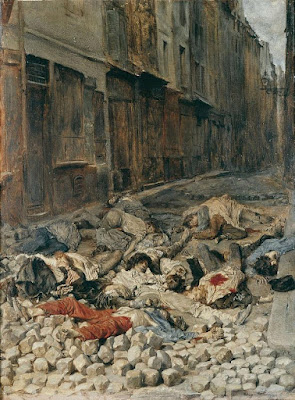
image: Meissonier, Massacre during June Days, 1848, Paris

Alexander Herzen's From the Other Shore (1850) is an exceptionally important example of an intelligent observer trying to make sense of the social, economic, and political changes of the nineteenth century. And Isaiah Berlin's introduction is profound. (Here is an online version of the book; link.)

Herzen's writings represented an almost unique combination of political perspectives. He was sympathetic to revolutionary activism by anarchists like Bakunin and Kropotkin, as well as revolutionary socialists in London and Paris and the radical workers of Paris in 1848. He was fervently opposed to the old oppressive order of Europe, whether the rule of the Czar and landed aristocracy in Russia or the dominant bourgeois order of wealth and poverty in France and Germany. And he was passionately committed to the principle of individual liberty. We might say that he was a revolutionary anti-Czarist liberal republican -- which sounds like a very contradictory bundle of political ideas. But the contradiction may be only apparent; it is the contradiction between revolution and liberty. As the revolutions of the nineteenth and twentieth centuries have unfolded, they have generally sacrificed liberty for the collectivist goals of revolution. But is a post-authoritarian, post-bourgeois regime in Europe necessarily indifferent to individual liberties? Or is it possible to imagine a genuinely egalitarian liberal social democracy, with strong constitutional protections of individual rights and liberties? If so, that seems to be the political idea that fits best with Herzen's political writings.

Here is Herzen's liberal principle:

The liberty of the individual is the greatest thing of all, it is on this and on this alone that the true will of the people can develop. Man must respect liberty in himself, and he must esteem it in himself no less than in his neighbour, than in the entire nation. (From the Other Shore, author's introduction, 12)

Here is his revolutionary anti-authoritarian commitment:

The state forms of France and other European countries are in their essence compatible with neither liberty, equality nor fraternity. If any of these ideas were realized, it would be the repudiation of contemporary European life; it would be its death. No constitution, no government is in a position to give feudal and monarchical countries true freedom and equality without annihilating everything feudal and monarchical in them. European life, Christian and aristocratic, has moulded our civilization, our notions, our ways of life. It cannot exist without a Christian and aristocratic environment. (From the Other Shore, Year LVII of the Republic, 62)

Here is a passage on the June days of Paris 1848 that captures his sympathy for the workers:

I listened to the thunder and the tocsin and gazed avidly at this panorama of Paris; it was as though I was taking my leave of it. At that moment I loved Paris passionately. It was my last tribute to the great town; after the June days it grew hateful to me. On the other side of the river barricades were being raised in all the streets and alleys. I can still see the gloomy faces of the men dragging stones; women and children were helping them. A young student from the Polytechnic climbed up on to an apparently completed barricade, planted the banner and started singing the Marseillaise in a soft, sad, solemn voice; all the workers joined in and the chorus of this great song, resounding from behind the stones of the barricades, gripped one's soul. . . . The tocsin was still tolling. Meanwhile, the artillery clattered across the bridge and General Bedeau standing there raised his field-glasses to inspect the enemy positions. . . . (From the Other Shore, After the Storm, 46)

And here is an alternative vision of work without wage labor -- cooperatives -- based on his understanding of the peasant commune in Russia:

There are a number of such artels—builders, carpenters and other sorts of artisans—each consisting of several hundred people drawn from different communes, who come together for a given period of time, for a year for instance, and so form a group. When the year is up, the workers share out the produce on the basis of the work they have done, in each case abiding by the general decision. The police have not so far had the satisfaction of being able to interfere in these arrangements. The association, I must emphasize, generally holds itself responsible for all the workers who comprise it. (From the Other Shore, The Russian People and Socialism, 184)

Finally, Herzen has a healthy distrust of "ideology", or purely philosophical theories of an ideal future for which all present human wellbeing must be sacrificed. Against Trotsky, Lenin, and Mao, Herzen mistrusted grand ideological goals and favored a process of social change that permitted ordinary human beings to exercise their freedoms as society changed. Berlin emphasizes this point in his introduction.

It is, in the main, a frontal attack upon the doctrine at that time preached by almost every left-wing orator in Europe (with the notable exception of Proudhon and a handful of anarchists to whom no one listened), about the sacred human duty of offering up oneself—or others—upon the altar of some great moral or political cause—some absolute principle or ‘collective noun’ capable of stirring strong emotion, like Nationality, or Democracy, or Equality, or Humanity, or Progress. For Herzen these are merely modern versions of ancient religions which demanded human sacrifice, faiths which spring from some irrational belief (rooted in theology or metaphysics) in the existence of vast and menacing powers, once the objects of blind religious worship, then, with the decay of primitive faith, degraded to becoming terms of political rhetoric. The dogmas of such religions declare that mere invocation of certain formulae, certain symbols, render what would normally be regarded as crimes or lunacies—murder, torture, the humiliation of defenceless human bodies—not only permissible, but often laudable. (From the Other Shore, Berlin introduction, xv)

Here is Herzen on "progress" in "Before the Storm":

‘You are quite right when you speak of nature, but it seems to me that you have forgotten that throughout all the changes and confusions of history there runs a single red thread binding it into one aim. This thread—is progress, or perhaps you do not acknowledge progress?’

‘Progress is the inalienable quality of uninterrupted conscious development: it consists in a retentive memory and the physiological perfection of man through social life.’

‘Is it possible that in all this you do not see a goal?’

‘Quite the opposite, I see here only a consequence. If progress is the end, for whom are we working? Who is this Moloch who, as the toilers approach him, instead of rewarding them, only recedes, and as a consolation to the exhausted, doomed multitudes crying “morituri te salutant”, can give back only the mocking answer that after their death all will be beautiful on earth. Do you truly wish to condemn all human beings alive to-day to the sad role of caryatids supporting a floor for others some day to dance on. . . or of wretched galley slaves, up to their knees in mud, dragging a barge filled with some mysterious treasure and with the humble words “progress in the future” inscribed on its bows? Those who are exhausted fall in their tracks; others, with fresh forces take up the ropes; but there remains, as you said yourself, as much ahead as there was at the beginning, because progress is infinite. This alone should serve as a warning to people: an end that is infinitely remote is not an end, but, if you like, a trap; an end must be nearer—it ought to be, at the very least, the labourer's wage, or pleasure in the work done. (From the Other Shore, Before the Storm, 36-37)

The new society, if it is to conform to these disparate values, must accomplish several different social goods:

  • respect liberty and equal dignity of all individuals;
  • secure the human needs of everyone -- workers, engineers, poets, and owners of property;
  • be democratic, not autocratic.
Was there any place on the planet in 1850 that satisfied these different structural features? There certainly was not -- not Britain, not Switzerland, not the United States. Is there a society on the planet today that satisfies them? Perhaps there is; it is called Finland.